Legal
Structural Safety Certificate for PGs: Rules & Process

Written by
Ishika Pannu
Read Time
13 min read
Posted on
November 3, 2026
Overview
Overview
Structural Safety Certificate for PGs: Rules & Process
A PG can look completely fine from the outside and still have structural issues that are not obvious to residents or operators. That is why structural safety cannot be judged by a quick visual check or the condition of a room.
The issue has become especially important in Delhi after the Satya Niketan PG building collapse, which claimed seven lives. Following the incident, the MCD began inspecting PG properties across the city and asking owners to obtain structural safety assessments from authorised engineers. You can read our detailed coverage of the incident in Satya Niketan Building Collapse: What Happened in Detail?
The latest exercise shows how seriously authorities are now looking at PG building safety. MCD surveyed 2,457 PG accommodations across 12 zones, but had received structural safety certificates from only around 250 of them by November 3. Owners who fail to comply may receive reminders and formal notices, with further action possible in continued cases.
So, what exactly is a structural safety certificate, who issues it, how do PG owners obtain one, and how does it fit into Delhi’s changing PG regulations?
What is a structural safety certificate?
A structural safety certificate is a professional assessment stating whether a building is structurally safe based on an inspection and technical evaluation.
It is not simply a document that an owner can fill out and submit. A qualified structural engineer examines the property and considers its structural condition, construction details, alterations, deterioration and other relevant factors before giving a professional opinion.
For PGs, this matters because buildings often experience changes over time. Rooms may be added, layouts may be modified, additional equipment may be installed and the number of occupants may be much higher than when the building was originally designed.
A certificate therefore provides documented evidence that the building has been assessed by the appropriate professional.
Why does a PG need structural safety certification?
For a PG operator, structural safety is about much more than meeting a documentation requirement.
Dozens of people may be living in one building every day. Students and working professionals depend on the property not only for accommodation, but also for basic safety while sleeping, studying and using shared spaces.
A structural problem that goes unnoticed can become significantly more serious over time. Cracks, water-related deterioration, unauthorised alterations or changes in how the building is being used may all require professional attention.
There is also a compliance angle.
The MCD’s recent PG inspections have brought building plans, structural certificates and other property documents into sharper focus. Earlier findings reported during the inspection drive showed significant gaps in the availability of approved building plans and structural stability certificates.
This is why structural safety should not be treated as a document to search for only after receiving a notice.
It should form part of the property’s overall compliance record
Who can issue a structural safety certificate?
A structural safety certificate should come from a qualified structural engineer who is authorised or empanelled by the relevant authority where such a requirement applies.
In the current Delhi exercise, the MCD has specifically asked PG owners to obtain fresh structural safety audits through engineers empanelled with the MCD. The corporation has also stated that it does not have an in-house mechanism for carrying out these technical structural assessments and has therefore required owners to engage authorised private structural engineers.
This distinction is important. A property manager, landlord, contractor or architect may be involved in the broader building process, but that does not automatically mean they can issue the structural safety certificate required for a particular compliance exercise.
Before appointing an engineer, PG operators should therefore check:
- Whether the engineer is qualified to conduct the required structural assessment.
- Whether the engineer appears on the relevant MCD-authorised or empanelled list, where MCD certification is required.
- Whether the engineer has been given access to the necessary building documents and areas of the property.
- What exactly will be covered in the inspection and certificate.
- Whether any additional testing, drawings or technical documents are required for the property.
The objective should be to obtain a genuine technical assessment, not simply a certificate to complete a checklist.
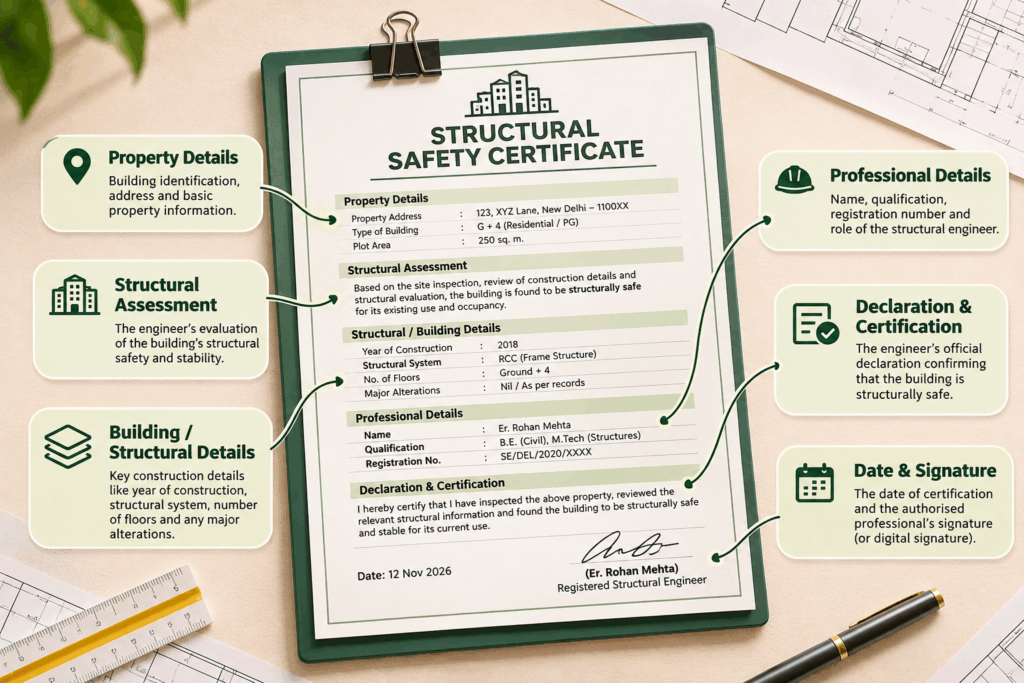
What does a structural safety certificate contain?
There is no single format that should automatically be assumed to apply to every PG in every situation. The required format can depend on the authority, building and purpose of the assessment.
Generally, the documentation should identify the property and connect the engineer’s professional assessment to that specific building.
Depending on the applicable process, it may include details such as:
- Property address and building identification.
- Relevant structural and construction details.
- Observations from the inspection.
- Structural assessment findings.
- Engineer’s name, qualifications and registration details.
- Signature, declaration and date of assessment.
- Any relevant supporting report or technical documentation.
MCD construction-related procedures also refer to prescribed formats for structure stability and structural safety certification. This is why owners should always confirm the format required for their particular notice or application instead of using an unrelated template found online.
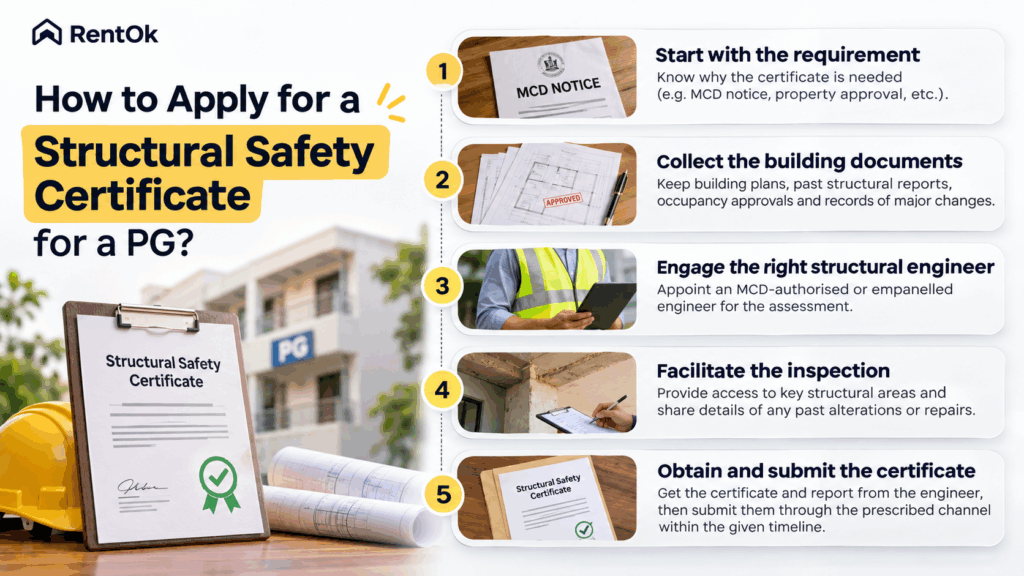
How do you apply for a structural safety certificate for a PG?
The process is easier when treated as a documentation and inspection exercise rather than something that starts with the certificate itself.
1. Start with the requirement
First understand why the certificate is being requested. Is it part of an MCD notice, a property approval process, a court-directed compliance exercise or another regulatory requirement?
The exact requirement matters because it determines who needs to inspect the property, what documentation may be required and where the final certificate has to be submitted.
2. Collect the building documents
Before the engineer visits, keep available whatever documents you have relating to the building. These may include sanctioned building plans, previous structural reports, construction-related documents, occupancy approvals and records of significant structural modifications.
This step is particularly important in Delhi because building-plan availability has itself emerged as a major issue during the current PG safety exercise. MCD officials have said that approved plans were unavailable for many surveyed properties, which is one reason structural assessments have been sought.
3. Engage the appropriate structural engineer
For the current MCD exercise, the engineer should be from the relevant MCD-authorised or empanelled list. Do not treat this appointment as a formality. The engineer needs to assess the actual property and its structural condition.
4. Facilitate the inspection
The engineer may need access to different parts of the property, including structural elements that are not visible during a normal room inspection. Any records relating to alterations or previous repairs should also be shared where relevant.
A visual walkthrough alone should not be confused with a complete structural assessment. MCD officials have specifically distinguished between identifying an apparently dangerous building through visual inspection and determining structural integrity through a detailed technical assessment.
5. Obtain the certificate and submit it correctly
Once the assessment is completed, obtain the certificate and supporting report from the engineer. The final step is to submit the documentation through the channel and within the timeline specified by the relevant authority.
Keep a copy of everything submitted, including the certificate, inspection report, engineer details, acknowledgement and correspondence.
For PG owners currently dealing with an MCD requirement, RentOk’s MCD Structural Safety Certificate for PGs: 15-Day Guide can also help break the process into a more practical compliance timeline.
Structural safety certificate vs Fire NOC: Are they the same?
No. This is one of the most important distinctions PG operators need to understand.
A structural safety certificate deals primarily with the stability and structural condition of the building. A fire safety certificate or Fire NOC relates to compliance with prescribed fire-safety requirements for the building and its occupancy.
They address different risks and are therefore not interchangeable.
The distinction became particularly visible during the MCD’s post-collapse survey. Earlier findings reported that only 31 of 2,453 surveyed PG buildings had a Delhi Fire Service NOC, while only eight had structural stability certificates at that stage.
This means an operator should not assume that having one automatically satisfies the other. Structural safety, fire safety, building-plan compliance and occupancy-related approvals should be tracked as separate compliance areas.
For a broader understanding of the fire-safety side, RentOk’s guide on What Fire Safety Rules Must PG Owners Follow in India? covers the subject separately.
What if the building does not have an old structural certificate?
This is an important situation because many existing PG buildings were not originally managed with today’s level of documentation.
The absence of an old certificate does not by itself tell you that a building is unsafe. At the same time, it should not be treated as a reason to ignore the requirement. The appropriate response is to understand what the current authority is asking for and arrange the required professional assessment.
In Delhi’s present exercise, MCD has specifically asked PG owners to obtain fresh structural safety audits through authorised engineers, particularly in circumstances where approved building plans are unavailable.
This is also where property records become extremely valuable. If an owner has old drawings, repair records, previous inspection reports or documentation relating to modifications, keeping those records organised can make future assessments considerably easier.
Delhi’s proposed PG rules could make safety documentation more important
Structural safety is also becoming part of a much larger discussion around how PGs should be regulated in Delhi.
Following the Satya Niketan incident, the Delhi government began working on a proposed framework covering PG registration, licensing, safety clearances, tenant-related processes and other operational requirements.
Reported proposals include structural and fire-safety clearances, police verification, a unique registration number and a proposed GovPG portal. Other provisions discussed include CCTV, security arrangements and wardens for certain larger PGs.
But there is an important distinction here:
These are proposed provisions, not all confirmed requirements already applicable to every PG.
The final framework, implementation process and exact requirements depend on the government’s final decisions and notifications.
Our Delhi PG Bill Explained: Licence, Deposit Cap, Rent Bands and the GovPG Portal breaks down the wider proposal and what owners may need to prepare for.
For now, PG operators should focus on something more practical: keeping their property documents, tenant records, safety records and operational information organised so they are not starting from scratch when a requirement is introduced
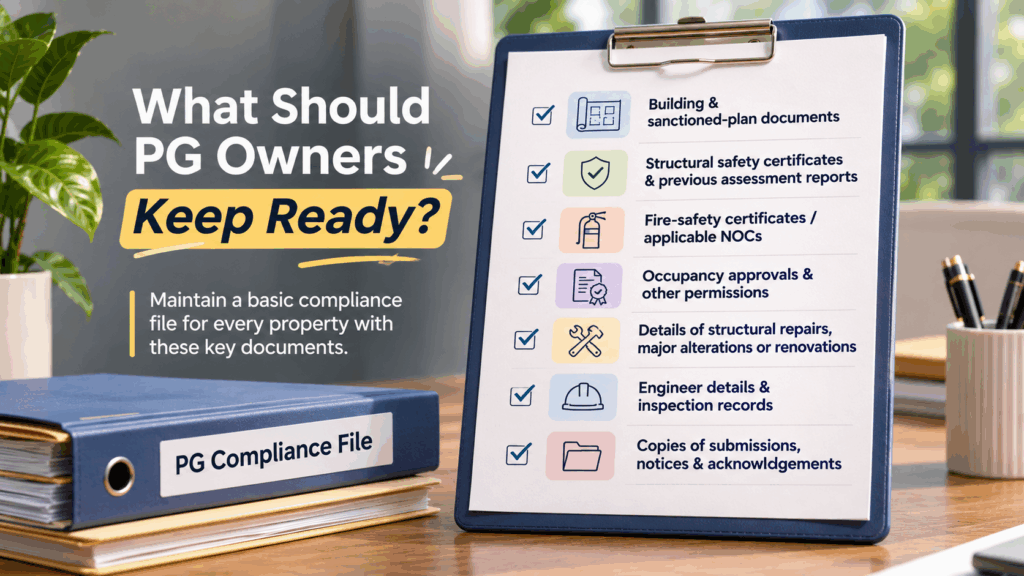
What should PG owners keep ready?
Structural certification is easier to manage when the underlying property records are already organised. Instead of searching for documents only after receiving a notice, operators should maintain a basic compliance file for every property.
At a minimum, the file should make it easy to locate:
- Building and sanctioned-plan documents available for the property.
- Structural safety or stability certificates and previous assessment reports.
- Fire-safety certificates or applicable NOCs.
- Occupancy-related approvals and other applicable permissions.
- Details of structural repairs, major alterations or renovations.
- Engineer details and inspection records.
- Copies of submissions, notices and acknowledgements received from authorities.
This becomes even more important for operators managing multiple PGs. A document sitting in one owner’s WhatsApp chat, another manager’s laptop and a third property’s physical file is not really a compliance system.
The goal should be to know which property has which certificate, when it was issued, what it covers and when the next action is required.
How RentOk Helps PG Operators Stay Organised
RentOk does not replace structural engineers, municipal authorities or statutory approvals. Structural safety assessments still need to be carried out by the appropriate professionals.
Where RentOk can help is in organising the operational side of running a PG.
As properties grow, owners are managing much more than rent collection. They are dealing with tenants, rooms, payments, complaints, maintenance, staff and multiple properties at the same time.
RentOk brings these day-to-day workflows into one platform, helping operators improve visibility across their properties and reduce dependence on scattered spreadsheets, registers and conversations.
For example, operators can manage:
- Tenant information and KYC: Keep resident information organised and easier to access when required.
- Occupancy: Track rooms and beds across properties instead of relying on manual registers.
- Complaints: Record and follow up on maintenance and tenant issues.
- Payments and dues: Maintain better visibility into collections and outstanding amounts.
- Property operations: Give teams a clearer view of what is happening across different properties.
The software does not determine whether a building is structurally safe. The engineer does that.
What technology can do is make the operational environment around the property more organised, so important information and follow-ups are less likely to disappear in day-to-day chaos.
Conclusion
The structural safety certificate has become an important part of the PG compliance conversation in Delhi, particularly after the Satya Niketan collapse and the MCD’s subsequent inspection drive.
For PG owners, the right approach is not to wait for a notice and then start searching for documents. Understand the requirement, appoint the right professional, arrange the inspection and maintain proper records of the assessment and submission.
More importantly, treat the certificate as one part of a larger safety system.
A well-managed PG is not simply one that stays occupied and collects rent on time. It is one where the property is maintained responsibly, problems are acted on, documents are organised and the people living there are treated as the responsibility they actually are.
If you want to bring your tenant management, payments, complaints, occupancy and property operations into one organised system, start your free RentOk trial and manage your PG business with better visibility.
Frequently Asked Questions
Find answers to common questions about this topic
About the Author
Ishika Pannu
Ishika Pannu brings you the latest insights and easy-to-apply strategies in property management—helping you simplify renting and grow with RentOk.