Legal
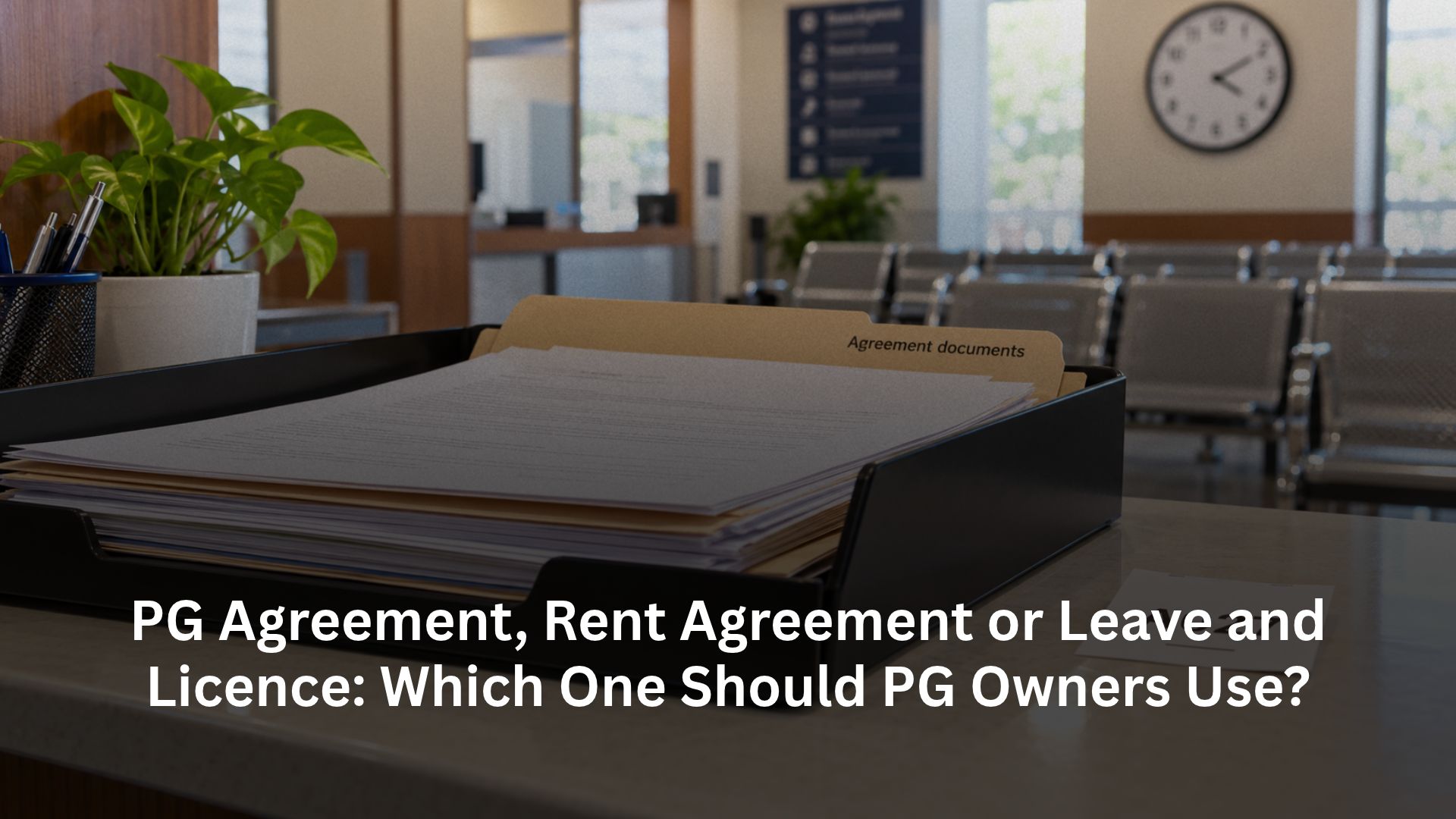
PG Agreement, Rent Agreement or Leave and Licence: Which One Should PG Owners Use?

Written by
Ishika Pannu
Read Time
10 min read
Posted on
November 2, 2026
Overview
Overview
PG Agreement, Rent Agreement or Leave and License: Which One Should PG Owners Use?
A PG owner may offer a bed, meals, housekeeping and managed access, while another hands over an independent flat with very little involvement. Both may call their paperwork a “PG agreement”, but that label does not make the two arrangements legally identical. The agreement needs to describe the rights you actually grant and the way you operate the property.
For a genuinely managed, shared-accommodation business, a licence-based PG agreement may fit better than a conventional lease. However, no single PG agreement format guarantees that result across India. Courts examine the substance of the arrangement, and state laws can change registration requirements and possession remedies. This guide explains the differences, the limits of “easier eviction”, the formalities to check and the clauses that make daily PG operations clearer.
Tenant or licensee: the distinction behind the paperwork
A lease transfers a right to enjoy immovable property for an agreed period and consideration. Section 105 of the Transfer of Property Act, 1882 provides the central definition. Applicable state tenancy laws may add protections, exclusions and procedures.
A licence gives permission to use property without creating an interest in it. Section 52 of the Indian Easements Act, 1882 supplies that distinction, subject to its territorial application and relevant local law. The owner retains legal possession, while the occupant receives the agreed permission to use the accommodation.
Shared beds, genuine housekeeping arrangements, common facilities and continuing management control can support a licence-based structure. A resident’s cupboard, allocated bed or room key does not settle the classification by itself. Equally, keeping a spare key or inserting an inspection clause cannot automatically turn a lease into a licence.
The Supreme Court reiterated the distinction in Samarpan Varishtha Jan Parisar v. Rajendra Prasad Agarwal, decided on 6 May 2022. The judgment discusses the parties’ intention, conduct and surrounding circumstances; exclusive possession matters, but does not conclusively answer every case. It concerned an old-age home, not a blanket exemption for PG businesses.
Three agreement names, different legal consequences
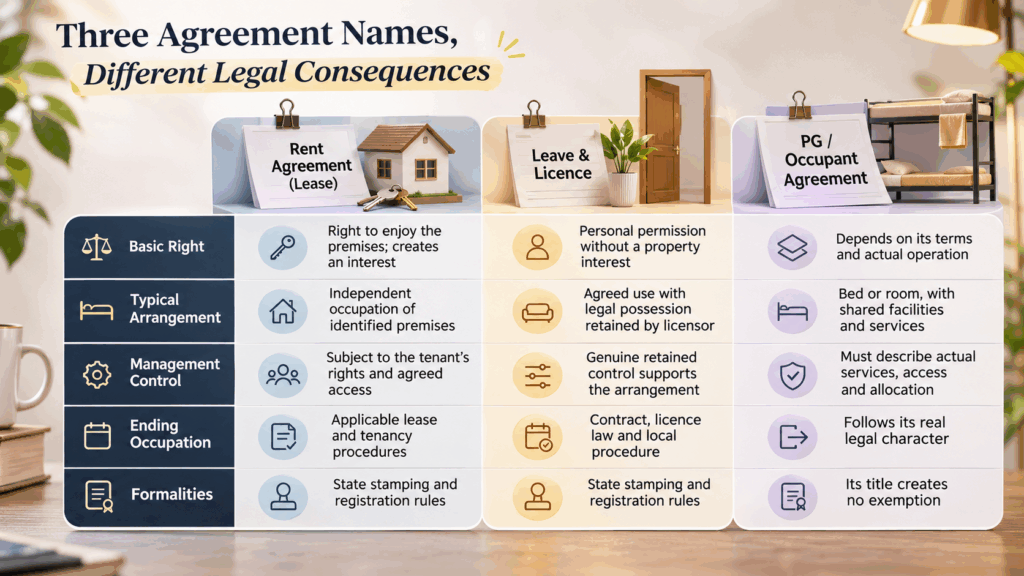
“Rent agreement” commonly describes a lease, while “PG agreement” describes the accommodation model. A PG agreement is not a separate nationwide statutory category that automatically overrides property or tenancy law.
| Point | Rent agreement / lease | Leave and licence | PG / occupant agreement |
|---|---|---|---|
| Basic right | Right to enjoy the premises; creates an interest | Personal permission without a property interest | Depends on its terms and actual operation |
| Typical arrangement | Independent occupation of identified premises | Agreed use with legal possession retained by licensor | Bed or room, shared facilities and services |
| Management control | Subject to the tenant’s rights and agreed access | Genuine retained control supports the arrangement | Must describe actual services, access and allocation |
| Ending occupation | Applicable lease and tenancy procedures | Contract, licence law and local procedure | Follows its real legal character |
| Formalities | State stamping and registration rules | State stamping and registration rules | Its title creates no exemption |
For example, a managed three-bed room with shared meals presents different facts from an independent flat handed over to one household. Do not copy a whole-flat lease and merely replace “tenant” with “paying guest”. Review the rights first, then tailor the document.
Does a licence make eviction easier?
A genuine licence can offer a clearer basis for ending permission when its term expires or a valid termination ground arises. However, revocation and physical recovery of possession are different steps. A disputed exit may still require proceedings before the appropriate court or authority; no agreement guarantees a quick outcome.
Maharashtra illustrates why local definitions matter. Section 24 provides a Competent Authority route for qualifying residential licences after expiry. But Section 7(5) excludes a “paying guest” from its licensee definition; Section 7(7) defines that guest by reference to accommodation in premises where the licensor resides. Do not assume every PG qualifies for Section 24. Check the arrangement against the Maharashtra Rent Control Act.
Where applicable, Section 63 of the Easements Act gives a licensee reasonable time to leave and remove belongings after revocation. Section 60 also recognises circumstances in which a licence is not revocable. A clause saying “management may cancel at any time” cannot displace the law.
Record the breach, follow the applicable notice requirements and seek the correct remedy if the occupant refuses to leave. Avoid lockouts, removal of belongings or utility cuts as eviction shortcuts: Section 6 of the Specific Relief Act, 1963 addresses dispossession outside due course of law.
A lease does not automatically give a tenant ownership or permanent occupation rights. Choose a licence because it reflects the business model, rather than treating it as a device to erase occupants’ legal protections.
Stamp duty and registration follow the arrangement
Stamp duty, registration and notarisation serve different purposes. Buying stamp paper or obtaining a notary’s signature does not establish that you completed every required formality. Nor does a digital signature make an agreement automatically registered.
Under Section 17(1)(d) of the Registration Act, 1908, specified leases require registration, including year-to-year leases, terms exceeding one year and leases reserving yearly rent, subject to applicable provisions and amendments. A monthly payment schedule and the agreement’s total term are different questions.
Is an 11-month agreement enough?
Eleven months is not a universal exemption. Maharashtra’s Section 55 requires writing and registration for covered letting and leave-and-licence agreements, with responsibility on the landlord. Check applicability carefully for genuine paying guests and other excluded arrangements rather than assuming either automatic coverage or exemption.
For other states, establish the document’s legal character, the relevant state amendments and any additional tenancy requirements. RentOK’s registered-agreement guide explains why duration alone cannot settle the issue.
The duty depends on your state and document
There is no nationwide PG stamp-paper amount. State rules may calculate duty using the nature of the instrument, term, fee or rent, deposit and other consideration. Registration fees are separate; confirm the current calculation with the state registration department before execution.
Apply that check to all three document labels. A PG occupant agreement may attract the rules for its underlying licence or lease. RentOK’s notarisation-versus-registration explainer helps distinguish the processes without treating notarisation as a substitute.

Financial and exit clauses every PG agreement needs
A useful licence agreement for PG accommodation turns operational promises into terms both sides can understand. Start with the parties’ correct names, addresses and signing authority, then identify the property and the precise room or bed allocation.
- Space and services: State which bed, cupboard and common areas the occupant may use. List meals, Wi-Fi, cleaning and other inclusions, with schedules or service limits where relevant.
- Monthly charges: Specify the accommodation fee, due date, payment method and renewal or revision process. Explain separate utility charges and their calculation rather than writing “extra charges as decided by management”.
- Deposit and refunds: Record the amount, permitted deductions, evidence for damage claims, settlement procedure and refund timeline. Separate unpaid dues from ordinary wear and tear; avoid unexplained automatic forfeiture.
- Term, notice and lock-in: Identify start and end dates, renewal conditions and each party’s termination rights. A 30-day notice period is an example to consider, not a nationwide statutory rule. Explain any early-exit consequences, subject to applicable law.
- Breach and handover: Define relevant breaches, notice and any opportunity to remedy them. Record how the occupant returns keys, clears dues and participates in the final inventory check.
Use RentOK’s agreement-review guide to test whether the clauses match what staff promise during enquiries. Its deposit-refund guide also shows why itemised deductions and supporting records matter when accommodation ends.
Operational control must respect privacy and local rules
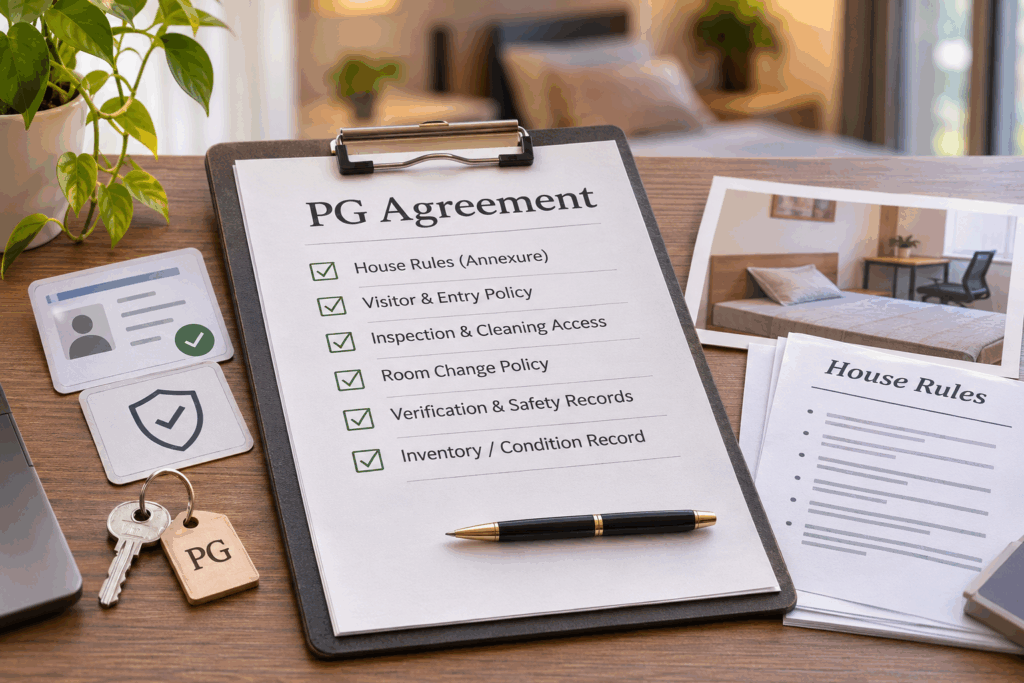
A PG agreement should explain how shared living works, rather than give management unlimited discretion. Attach the current house rules and make sure the occupant receives them before accepting the agreement.
Visitor and entry rules should cover permitted hours, overnight visitors, guest records, noise and common-area use. Explain late-arrival arrangements for work shifts where relevant. Avoid a vague power to invent new penalties or materially change the bargain without a defined process.
Inspection and cleaning access needs boundaries: purpose, reasonable advance notice, suitable timings and an emergency exception. Retaining keys does not justify unrestricted entry into a resident’s private space. If operational needs require bed or room changes, define the grounds, notice, equivalent facilities and a fair response when the change materially affects the agreed stay.
Verification and safety records should identify the required documents, who completes locally mandated police or tenant verification and how management handles the records. Follow the actual city or state procedure; a clause does not complete verification. RentOK’s PG owner’s background-verification guide distinguishes identity checks from other onboarding requirements.
Attach a dated inventory or condition record and give both sides the final agreement, including annexures. Keep changes documented rather than relying on a warden’s verbal instructions. The agreement also cannot replace municipal permissions, fire compliance, zoning approval or any required society clearance. If you operate leased premises, check that your own lease authorises the proposed PG activity.
How RentOK helps organise PG agreements
Once you choose the appropriate legal structure and terms, RentOK can help manage agreement preparation and signing alongside resident onboarding. Use a locally reviewed document suited to your property; software supports the workflow rather than deciding whether your arrangement is a lease or licence.
- Connect details with agreement preparation: RentOK’s onboarding workflow brings resident information into agreement review and signing. Check names, property details and agreed terms before approval so that an administrative error does not carry into the final document.
- Include the relevant parties: Its published multi-party workflow supports additional first parties and co-tenants, as well as parent details for under-18 occupants. Confirm the correct contracting roles; adding a parent does not, by itself, resolve every legal issue involving a minor.
- Track signing and retain the final copy: The documented Agreement Parties tab shows parties and signing status. After completion, the final PDF is available from the resident’s profile, giving staff a reference for renewals or questions about accepted terms.
RentOK’s September 2026 release notes describe Aadhaar e-Sign and note that multi-party agreements require enablement during the beta rollout. Confirm availability for your account. Its digital-agreement guide also explains why signing, stamping and registration need separate attention.
Conclusion
For a genuinely managed PG with shared facilities and continuing operational control, a carefully drafted licence-based agreement may be the right starting point. When you grant rights that amount to a lease, changing the heading to “PG agreement” will not remove that legal character. The sound choice follows the actual arrangement and the property’s state law.
Before onboarding your next resident, settle the classification, confirm stamping and registration, and document money, services, privacy and exit terms. Give the occupant the same clarity your staff need to manage the property consistently. Create a PG agreement on RentOK to organise preparation, signing and records, with the appropriate local legal review and formalities built into your process.
Frequently Asked Questions
Find answers to common questions about this topic
About the Author
Ishika Pannu
Ishika Pannu brings you the latest insights and easy-to-apply strategies in property management—helping you simplify renting and grow with RentOk.