Market Trends
Accounting Software for Property Management Companies

Written by
Ishika Pannu
Read Time
5 min read
Posted on
March 25, 2026
Overview
Overview
Accounting Software for Property Management Companies
Managing one property is manageable.
Managing multiple properties is where things start getting complicated.
At first, it feels like more of the same, more tenants, more rent, more expenses. But very quickly, the challenge shifts from handling operations to maintaining financial clarity across everything.
Different properties behave differently. Some have stable tenants, others see frequent turnover. Expenses fluctuate. Payment cycles don’t align.
And over time, this creates one core issue:
You have the numbers, but not a system that makes sense of them.
This is why choosing the right accounting software for property management companies is not just about tracking finances.
It’s about building a system that keeps everything connected, visible, and easy to manage as you scale.
Managing Multiple Properties Without Losing Control
As your portfolio grows, financial tracking stops being straightforward.
Instead of a single flow, you’re dealing with multiple moving parts at once:
- Rent coming in from different properties
- Expenses that vary across locations
- Maintenance costs that are unpredictable
- Tenant payments that are not always consistent
Individually, these are manageable.
But together, they create a situation where visibility starts breaking down.
For example, you may know your total monthly revenue. But:
- Do you know which property is actually performing best?
- Which one is eating into your margins?
- Where your expenses are quietly increasing?
Without structured tracking, these answers are not immediately clear.
That’s where a strong best accounting software property management setup becomes critical, it organizes your data in a way that helps you act on it, not just store it.
Trust Accounting Basics: Why Structure Matters
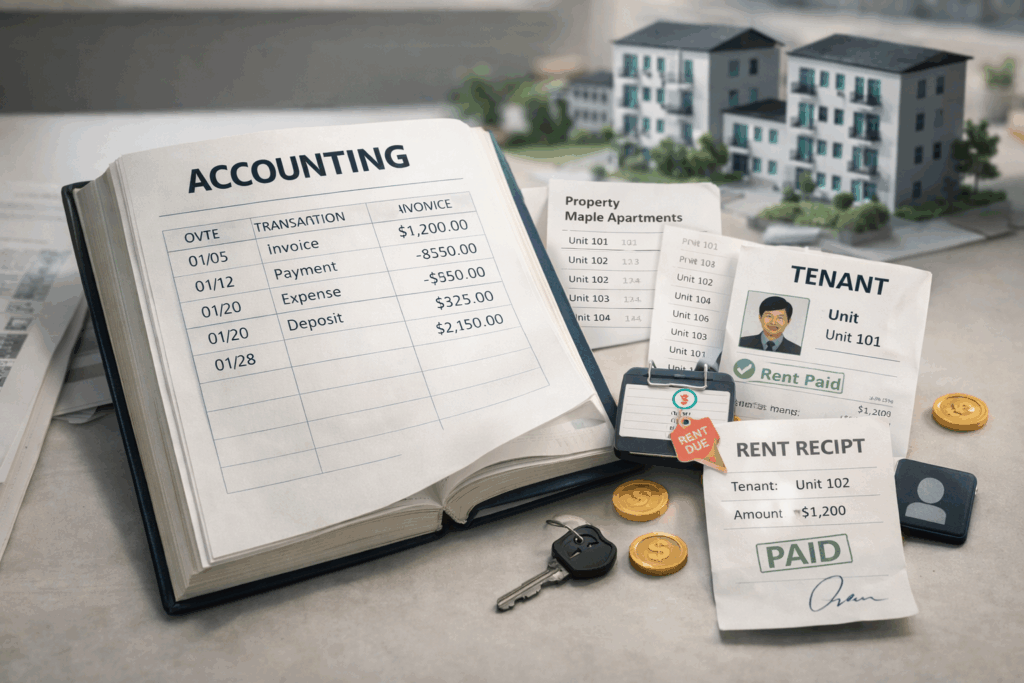
Property management companies don’t just handle their own money, they manage funds on behalf of others.
This includes:
- Tenant rent payments
- Security deposits
- Owner payouts
- Operational expenses
The challenge is not tracking these transactions.
It’s ensuring they remain separate, transparent, and traceable.
Without a proper system:
- Funds can get mixed unintentionally
- Records become harder to verify
- Reporting becomes inconsistent
Over time, even small gaps create confusion.
A structured accounting system ensures:
- Every transaction is clearly categorized
- Funds are not mixed across accounts
- Financial records are easy to audit and explain
This builds both operational clarity and trust.
The Real Problem With Generic Accounting Tools
Many property managers start with standard accounting software.
It seems like the obvious choice.
But property management has very specific workflows, and generic tools don’t fully support them.
You’ll often run into issues like:
- Transactions not tied to specific properties
- No tenant-level visibility of payments
- Difficulty tracking dues alongside accounting
- The need to maintain multiple parallel records
So instead of simplifying work, the system creates dependencies.
You might end up:
- Using spreadsheets alongside software
- Cross-checking data manually
- Spending more time reconciling than managing
The issue isn’t capability, it’s lack of alignment with real workflows.
What Good Property Management Accounting Software Should Actually Do
Instead of focusing on features, it’s better to focus on what the system should improve in your daily operations.
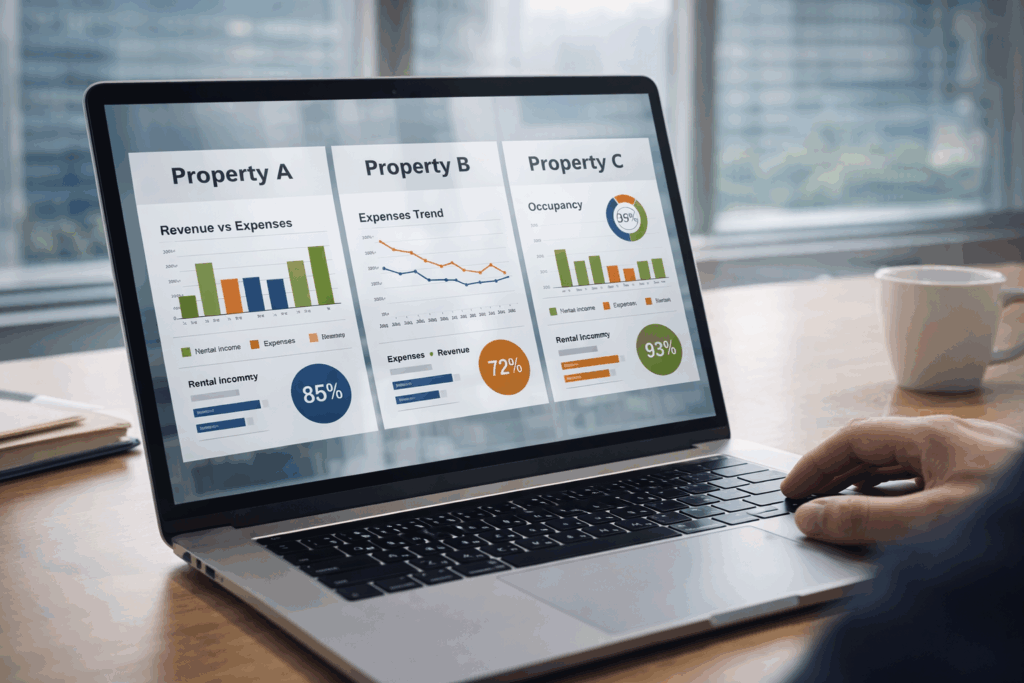
Property-Wise Financial Clarity
You should not have to dig through data to understand performance.
A good system lets you:
- Track income and expenses for each property
- Compare performance across locations
- Identify trends over time
This makes decision-making more precise.
Tenant and Payment Visibility
Accounting without tenant-level tracking is incomplete.
Your system should clearly show:
- Who has paid
- Who hasn’t
- What is still pending
This reduces dependency on manual follow-ups and constant checking.
A Centralized Financial View
While detailed tracking is important, you also need a clear overview.
At any point, you should be able to see:
- Total revenue across properties
- Total expenses
- Net earnings
- Outstanding dues
Not after calculations, instantly.
Automation That Supports Scale
As operations grow, manual processes become inefficient.
A good system should:
- Update records automatically
- Reduce repetitive data entry
- Maintain consistency across transactions
This ensures your workload doesn’t increase with scale.
Top Software Picks: What Should You Prioritize?
When evaluating the best accounting software property management, it’s easy to get distracted by tools that offer too much.
But in practice, simplicity and usability matter more.
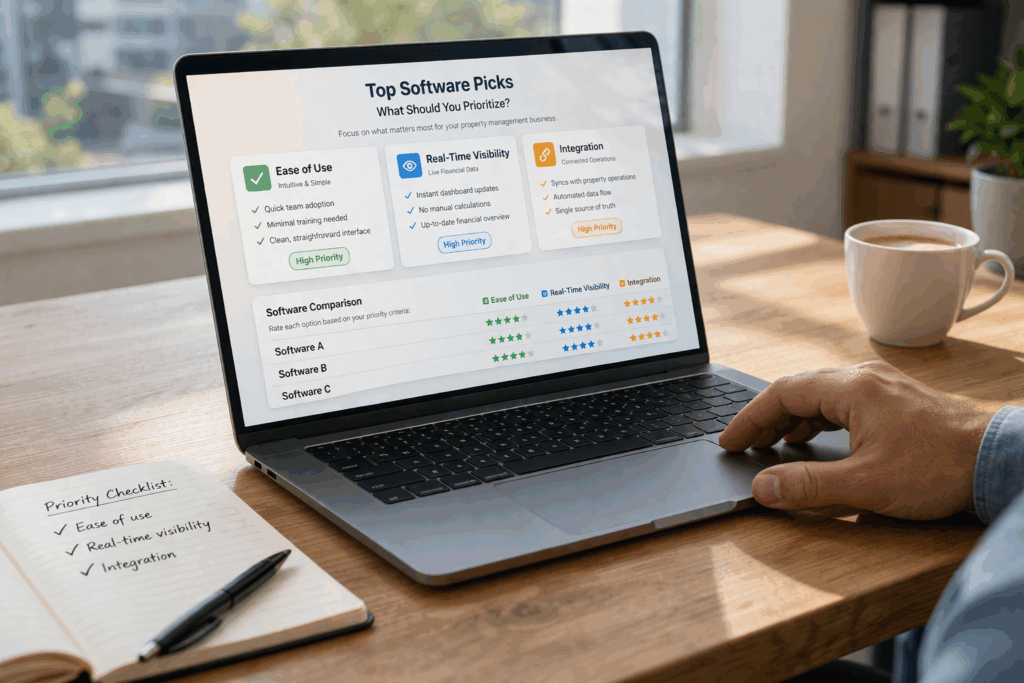
A practical approach is to prioritize:
Ease of use
If your team can’t use it easily, it slows everything down.
Real-time visibility
You shouldn’t have to wait or calculate to understand your finances.
Integration with operations
Your accounting should update as your business runs, not separately.
Because in property management, clarity is more valuable than complexity.
Integration With RentOk: Where Everything Connects
One of the biggest operational challenges in property management is fragmentation.
Rent tracking, expense management, and accounting often happen in separate systems.
This leads to:
- Delays in updates
- Inconsistent records
- Extra effort in reconciliation
RentOk removes this fragmentation by bringing everything into one connected system.
Instead of managing multiple tools, you manage one structured workflow.
With RentOk, you can:
- Track rent collection, dues, and payments in a unified system
- Record expenses and directly link them to specific properties
- Access financial insights through the Reports section
- Monitor overall performance from the Main dashboard
- Keep all financial data updated in real time
What makes this effective is how everything connects.
When rent is collected, it reflects instantly in your financial data.
When an expense is added, it’s already linked to the property it belongs to.
This eliminates:
- Duplicate entries
- Manual reconciliation
- Switching between tools
Instead, you get a system where your data stays accurate without extra effort.
Over time, this changes how you operate.
You’re no longer trying to understand your numbers, you’re using them to make better decisions.
The Cost of Not Having a Structured System
When your system is unstructured, the impact builds gradually.
You may not notice it immediately, but over time it shows up as:
- Delayed financial insights
- Increased manual workload
- Higher chances of errors
- Difficulty scaling operations
Even if your numbers are correct, the effort required to maintain them becomes inefficient.
And that directly affects how smoothly your business can grow.
A structured system removes these friction points and keeps your operations consistent.
Bringing Structure to Property Management Accounting
Property management becomes difficult only when financial tracking lacks structure.
Once your system connects income, expenses, tenants, and properties in one place, everything becomes easier to manage.
You stop reacting to problems and start operating with clarity.
And that shift is what allows you to scale confidently.
Because when your numbers are clear, your decisions become clearer too.
About the Author
Ishika Pannu
Ishika Pannu brings you the latest insights and easy-to-apply strategies in property management—helping you simplify renting and grow with RentOk.