Market Trends
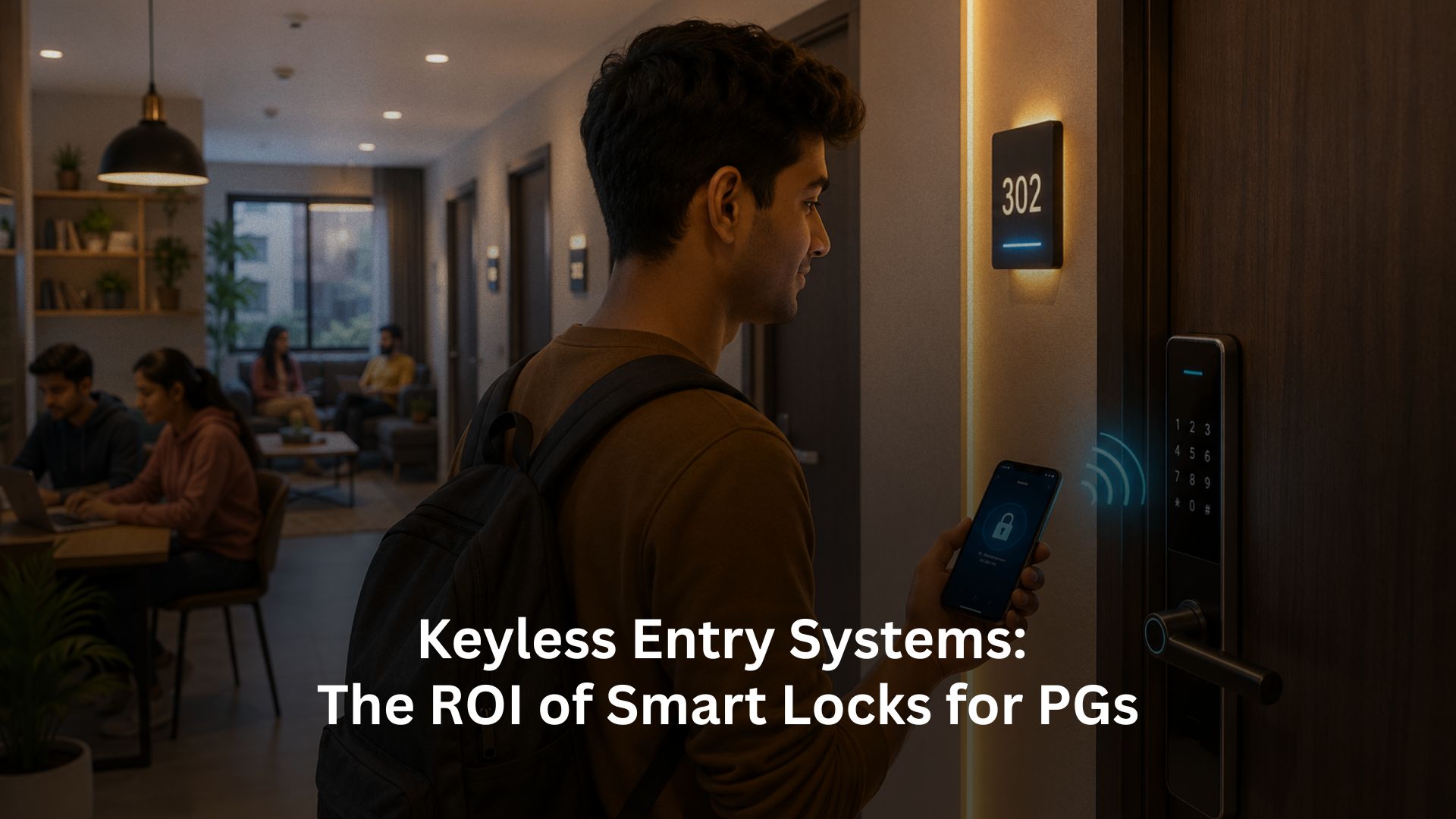
Keyless Entry Systems: The ROI of Smart Locks for PGs

Written by
Ishika Pannu
Read Time
9 min read
Posted on
May 12, 2026
Overview
Overview
Keyless Entry Systems: The ROI of Smart Locks for PGs
Managing a PG today is very different from managing one five years ago.
Tenant expectations have changed, operational complexity has increased, and the pressure to run properties more professionally is much higher than before. Residents now expect smoother onboarding, better security, faster issue resolution, and a living experience that feels organized rather than chaotic. At the same time, operators are handling larger occupancy numbers, faster turnover cycles, and multiple operational dependencies across staff, vendors, and tenants.
In the middle of all this, one operational area still remains surprisingly outdated in many PGs: access management.
Most properties still depend entirely on physical keys. A tenant moves in, duplicate keys are handed over, spare copies remain with caretakers, and the same process repeats every time somebody vacates. On the surface, this system feels manageable because it has existed for years. But operationally, it creates constant friction that landlords often underestimate until the property begins scaling.
The reality is that traditional lock systems create inefficiencies across:
- tenant onboarding and exits,
- room security and duplicate key tracking,
- staff coordination during maintenance access,
- and daily operational management inside the property.
This is exactly why smart locks and keyless entry systems are becoming increasingly important in modern PG and co-living businesses. They are no longer just “premium upgrades” designed for luxury spaces. They are gradually becoming operational infrastructure for landlords who want their properties to run more efficiently, securely, and professionally.
Why Traditional Key Systems Become an Operational Problem
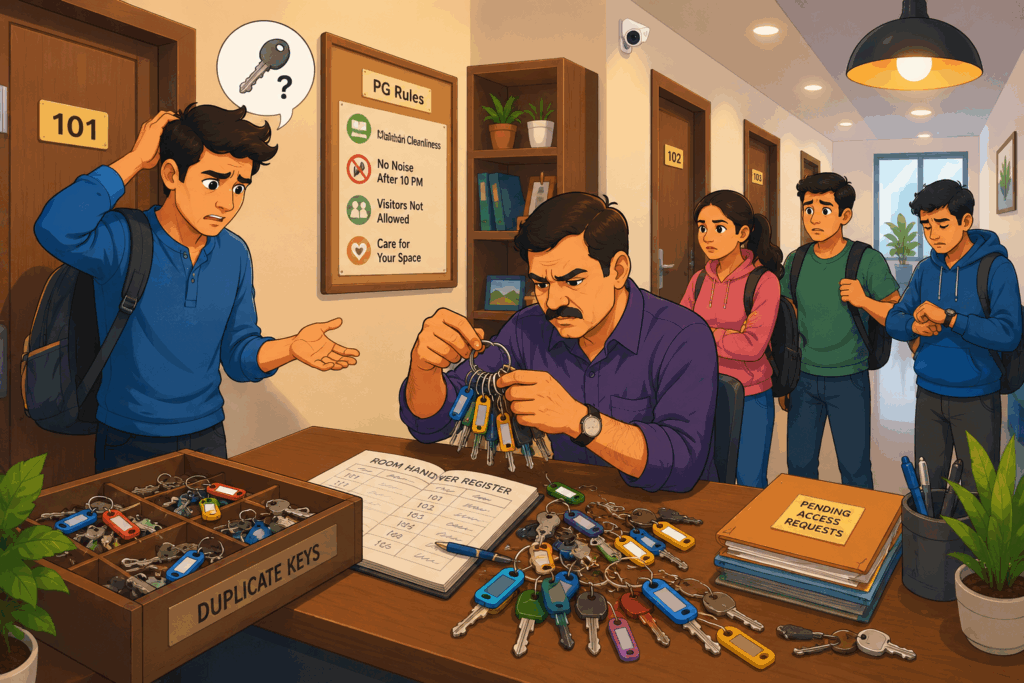
Most PG operators don’t notice the limitations of physical keys while managing a smaller property. The inefficiencies become visible only when occupancy grows and tenant movement becomes frequent.
At that stage, landlords start dealing with repetitive situations that consume operational time every single day:
- tenants forgetting or losing room keys repeatedly, forcing staff to coordinate emergency access requests and duplicate replacements far more often than expected,
- uncertainty around how many duplicate keys exist after a tenant vacates, especially in shared accommodations where copies may have circulated between roommates or staff,
- onboarding delays because incoming residents cannot access rooms immediately without physical handovers or caretaker coordination,
- maintenance and housekeeping staff depending entirely on manual key collection for room access, creating unnecessary interruptions across daily operations.
None of these problems individually appear major.
But collectively, they create operational drag that slowly affects:
- staff productivity,
- tenant experience,
- property security,
- and overall management efficiency.
The larger the property becomes, the more expensive this inefficiency becomes.
Smart Locks Change Access Management Completely
Most landlords think smart locks are simply digital versions of traditional locks.
Operationally, they change much more than that.
A keyless entry system transforms room access from a manually coordinated activity into a centralized operational workflow. Instead of depending on physical key handovers and caretaker availability, operators gain structured control over how access is assigned, monitored, and removed across the property.
This creates several practical advantages immediately:
- outgoing tenants can lose access instantly after move-out instead of requiring complete lock replacements,
- temporary digital permissions can be assigned to maintenance or housekeeping teams without distributing permanent physical keys,
- onboarding becomes faster because incoming residents receive digital access credentials immediately instead of waiting for manual coordination,
- and room access management becomes far more structured across multiple properties or larger occupancy setups.
The most important difference here is not convenience alone.
It is operational control.
Because once room access becomes system-driven instead of manually dependent, the property starts functioning more professionally at every level.
Security Benefits: The Biggest ROI Driver
Security is one of the most important aspects of shared living spaces, especially in PGs where multiple unrelated tenants occupy the same building.
Traditional lock systems create several visibility gaps because operators rarely know:
- who still has duplicate keys,
- whether old copies were returned properly,
- or how securely access is actually being controlled across rooms.
This creates silent uncertainty within the property.
Even if no incident occurs, tenants subconsciously evaluate whether the environment feels secure and professionally managed. And in modern rental housing, that perception matters significantly.
Smart locks improve security because access becomes controlled instead of assumed.
For example:
- room access can be revoked instantly when a tenant exits instead of replacing the entire lock setup,
- staff permissions can remain restricted to specific timings or operational zones instead of allowing unrestricted room access throughout the day,
- temporary access can be issued digitally to vendors or maintenance teams without circulating permanent keys inside the property.
This level of control creates a much stronger sense of safety, particularly for:
- female tenants,
- working professionals,
- long-stay residents,
- and premium co-living audiences.
The result is not only better security management but also stronger tenant trust.
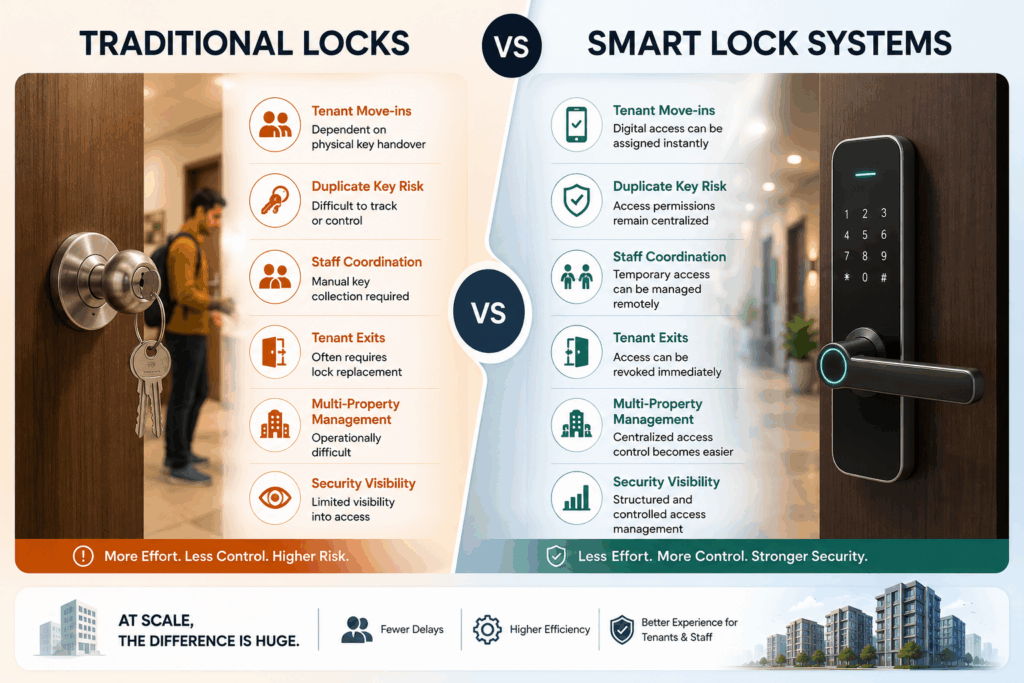
Comparing Traditional Locks vs Smart Lock Systems
| Area | Traditional Lock Systems | Smart Lock Systems |
|---|---|---|
| Tenant Move-ins | Dependent on physical key handover | Digital access can be assigned instantly |
| Duplicate Key Risk | Difficult to track or control | Access permissions remain centralized |
| Staff Coordination | Manual key collection required | Temporary access can be managed remotely |
| Tenant Exits | Often requires lock replacement | Access can be revoked immediately |
| Multi-Property Management | Operationally difficult | Centralized access control becomes easier |
| Security Visibility | Limited visibility into access | Structured and controlled access management |
The difference becomes even more visible once the property scales.
What feels like a “small operational issue” in one building becomes a major coordination challenge across multiple locations.
Faster Turnover Means Better Occupancy Efficiency
One of the most underrated operational advantages of smart locks is how much they improve tenant turnover management.
Move-ins and move-outs are some of the most repetitive activities inside a PG business. Traditional systems slow these transitions down because they involve:
- physical key handovers,
- caretaker coordination,
- duplicate key checks,
- and manual room access management.
These processes create delays that directly affect occupancy readiness.
Smart locks simplify this entire workflow.
Once a tenant vacates:
- room access can be disabled instantly,
- incoming residents can receive digital credentials immediately,
- and onboarding can happen without operational dependency on physical coordination.
This creates smoother room transitions and significantly reduces downtime between occupancies.
For high-turnover properties, this directly impacts:
- occupancy stability,
- onboarding efficiency,
- and monthly revenue consistency.
Because in rental businesses, faster room readiness always improves monetization efficiency.
Remote Access Management Makes Scaling Easier
One of the biggest operational limitations of traditional lock systems is physical dependency.
Someone always needs to be present for:
- maintenance access,
- emergency situations,
- late-night entries,
- and room coordination.
This becomes extremely difficult once operators begin managing multiple properties.
Smart locks reduce this dependency through centralized remote access management.
For example:
- maintenance staff can receive temporary room access digitally without physically collecting keys,
- operators can approve or remove room access remotely,
- late-night check-ins become smoother without disturbing caretakers repeatedly,
- and property owners gain better control across multiple locations without constant onsite coordination.
This operational flexibility becomes increasingly important as PG businesses expand.
Because scalability is not only about adding more rooms.
It is about reducing operational friction while managing those rooms efficiently.
Smart Locks Also Improve Tenant Experience
Modern tenants evaluate PGs very differently today compared to earlier years.
Previously, residents focused mainly on:
- affordability,
- location,
- and food quality.
Today, tenants also evaluate:
- convenience,
- operational smoothness,
- security standards,
- and how professionally the property functions daily.
This shift is especially visible among:
- corporate tenants,
- remote workers,
- and Gen Z residents.
These audiences are already accustomed to:
- digital payments,
- app-based services,
- instant communication,
- and convenience-first systems.
As a result, outdated operational processes feel much more noticeable than before.
Keyless entry systems improve tenant experience because they remove everyday friction points like:
- carrying physical keys constantly,
- depending on caretakers during lockouts,
- waiting for manual access coordination,
- and dealing with repetitive onboarding delays.
These operational improvements strongly influence how tenants perceive the overall quality of the property.
And in competitive rental markets, perception directly affects retention and referrals.
Common Mistakes Operators Make While Implementing Smart Locks
Interestingly, most smart lock failures happen not because of poor technology, but because operators install them without redesigning operational processes around them.
Some of the most common mistakes include:
- continuing manual onboarding systems even after introducing digital access infrastructure, which removes most efficiency benefits,
- giving unrestricted access permissions to multiple staff members without defining proper operational controls,
- failing to create backup systems during internet outages or power failures,
- and not training caretakers properly on how digital access workflows should function daily.
Technology alone never creates operational efficiency.
Structured systems do.
The technology simply makes those systems easier to execute consistently.
How RentOK Helps You Build Smarter PG Operations
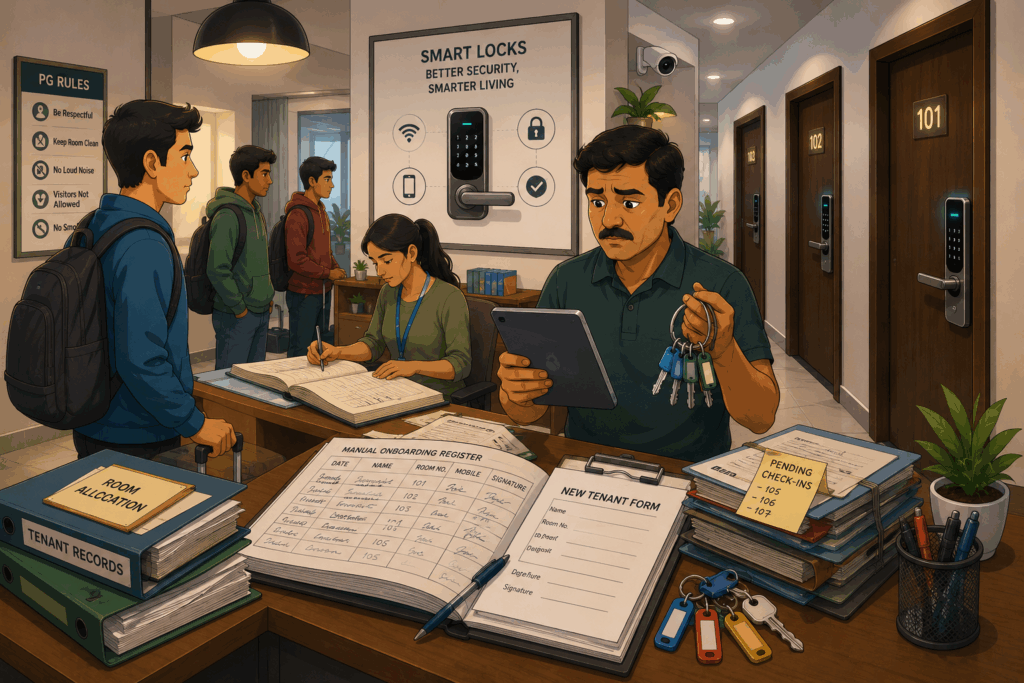
As operators introduce systems like smart locks, digital onboarding, and centralized access management, operational coordination becomes even more important. Smart infrastructure works effectively only when the overall property management system remains organized and connected.
This is where RentOK helps landlords build more structured and scalable PG operations.
With RentOK, operators can:
- maintain organized tenant records linked with occupancy and room movement tracking so onboarding and exits remain structured instead of manually coordinated across spreadsheets or scattered chats,
- track room allocation, tenant movement, and operational workflows from one centralized platform without depending heavily on caretaker memory or disconnected systems,
- streamline coordination between staff, management, and tenants so move-ins, exits, maintenance handling, and room transitions happen more smoothly,
- and build operational systems capable of supporting modern infrastructure upgrades like smart locks, digital KYC, centralized inventory tracking, and professional tenant management without increasing operational complexity.
The result is not just a technologically upgraded property.
It is a property that operates more professionally at every stage of the tenant experience.
Final Thoughts
The future of PG management is moving toward systems that reduce friction, improve security, and create better operational control.
Traditional lock-and-key systems were designed for a much simpler style of rental management. But modern PG and co-living businesses now require infrastructure capable of supporting:
- high tenant movement,
- faster onboarding,
- better security expectations,
- and scalable multi-property operations.
Smart locks solve these challenges not by making operations more complicated, but by eliminating inefficiencies that landlords have tolerated for years.
For modern rental businesses, keyless entry systems are no longer just premium add-ons.
They are becoming practical operational infrastructure.
If you’re looking to modernize your PG operations, improve tenant experience, and build a more scalable rental business, explore how RentOk helps landlords create smarter, more organized, and technology-driven property management systems for modern co-living operations.
About the Author
Ishika Pannu
Ishika Pannu brings you the latest insights and easy-to-apply strategies in property management—helping you simplify renting and grow with RentOk.