
Market Trends
Predictive Analytics in Property Management: Forecast Your Cash Flow

Written by
Ishika Pannu
Read Time
9 min read
Posted on
May 11, 2026
Overview
Overview
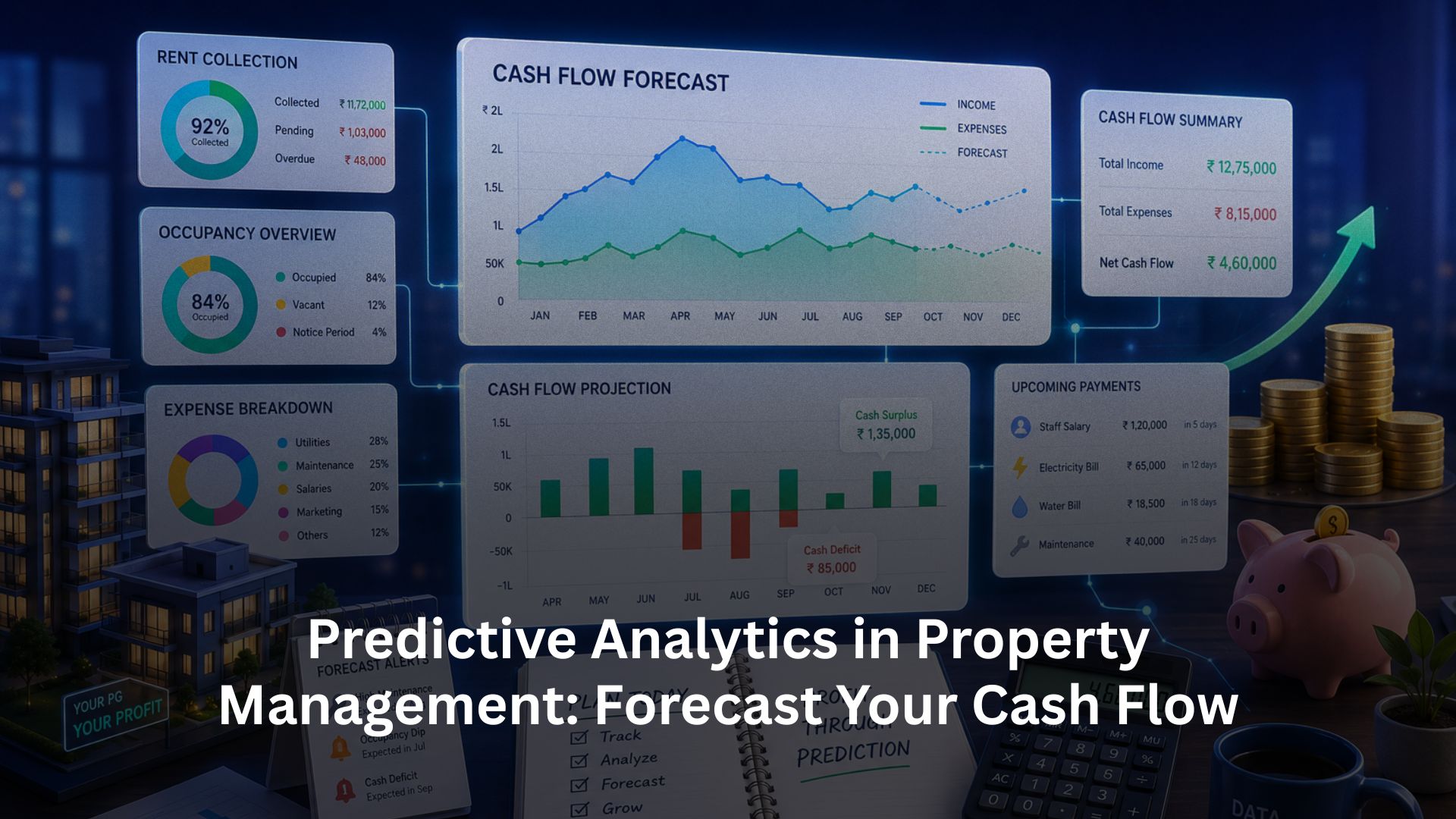
Predictive Analytics in Property Management: Forecast Your Cash Flow
Most PG operators believe they have a financial system in place because rent is coming in regularly and occupancy looks healthy. But operationally, most rental businesses are still being managed reactively. Expenses are handled only after they appear, vacancies are addressed after rooms become empty, and financial planning usually begins when cash flow already starts feeling tight.
That approach may work for a small setup running on instinct and manual coordination. But once a property starts scaling, reactive management becomes expensive very quickly. A few delayed payments, a sudden increase in maintenance costs, or even a short occupancy dip can create pressure across the entire operation.
This is exactly why predictive analytics is becoming one of the most important shifts in modern property management.
The strongest PG businesses today are not just tracking income. They are forecasting operational patterns before those patterns start affecting profitability. They know which months are likely to create occupancy pressure, which expenses are gradually increasing, and which operational inefficiencies are quietly reducing margins.
That level of visibility does not come from assumptions.
It comes from structured forecasting backed by data.
Why Most Cash Flow Problems Start Long Before Money Becomes the Issue
One of the biggest misconceptions in property management is that financial instability happens suddenly. In reality, cash flow problems usually begin operationally months before they become visible financially.
For example, most PGs already experience recurring issues like:
- Vacancy periods increasing gradually during specific months every year, but marketing and pricing strategies remaining unchanged until occupancy starts dropping noticeably.
- Maintenance costs rising steadily because repairs are being handled repeatedly instead of analyzing recurring infrastructure problems properly.
- Utility bills fluctuating unpredictably due to poor usage tracking across rooms, appliances, or tenant categories.
- Delayed rent collection becoming more common over time, especially in properties without structured follow-up systems.
Individually, these may not look alarming. But together, they slowly weaken the financial stability of the property.
This is why predictive property management matters so much. Instead of waiting for financial pressure to become visible in the bank account, operators start identifying patterns early enough to prepare operationally and financially before problems escalate.
That shift changes the entire way a property business functions.

Understanding Predictive Analytics in Property Management
Predictive analytics sounds technical, but operationally, the concept is very practical.
It simply means using historical operational data to forecast future business trends more accurately.
Every PG already generates useful business data daily:
- Occupancy movement and tenant turnover patterns
- Rent payment timelines and delayed dues
- Maintenance complaints and repair frequency
- Utility consumption trends
- Seasonal inquiry fluctuations
- Tenant retention behavior across room categories
The problem is not lack of information.
The problem is that most operators never structure or analyze this data properly. Operational records usually stay fragmented across:
- Spreadsheets
- WhatsApp chats
- Manual registers
- Bank statements
- Payment screenshots
- Memory-based tracking
As a result, decision-making remains reactive.
Once data becomes organized consistently, however, operational patterns start becoming visible naturally. Operators can begin identifying:
- Which room categories remain vacant longer than others
- Which tenant segments generate higher retention
- Which months historically experience slower lead flow
- Which maintenance issues repeat frequently across the property
This changes property management from instinct-driven operations into a much more structured business system.
Why Cash Flow Forecasting Matters More Than Revenue Tracking
Most landlords focus heavily on monthly revenue numbers.
But revenue alone does not determine whether the business is financially stable.
A PG can have:
- Good occupancy throughout the month
- Consistent rent collection on paper
- Strong inquiry volume from new leads
and still experience financial stress because future operational pressure has not been forecasted properly.
This is where cash flow forecasting becomes critical.
Revenue tracking tells you:
How much money came in this month.
Cash flow forecasting tells you:
How stable your financial position is likely to remain over the next few months.
That difference is extremely important because many operational expenses do not appear evenly.
A property may suddenly face:
- High maintenance expenditure during seasonal usage peaks
- Simultaneous tenant move-outs affecting occupancy
- Delayed payment cycles reducing liquidity
- Infrastructure replacement costs that were never budgeted earlier
Without forecasting, operators usually make decisions based only on current account balance instead of upcoming operational liabilities.
That creates unnecessary financial instability.
Using Historical Data to Forecast Occupancy Trends
Every rental market already follows patterns.
Student-heavy markets behave differently from corporate co-living hubs. Areas near universities experience admission cycles, while professional markets fluctuate based on hiring seasons, relocations, and internship periods.
Yet most PG operators still manage occupancy reactively.
The common cycle usually looks like this:
- Rooms become vacant.
- Lead flow slows down.
- Discounts start increasing.
- Marketing efforts become aggressive at the last minute.
This reactive strategy reduces profitability unnecessarily.
A predictive approach changes occupancy management completely because operators begin identifying trends before vacancy starts affecting revenue.
By analyzing historical occupancy data consistently, operators can forecast:
- Which months typically experience slower occupancy movement and require earlier marketing preparation.
- Which room configurations generate faster conversions and longer tenant retention.
- Which tenant categories create higher turnover cycles compared to others.
- Which pricing structures perform better during lower-demand periods.
This allows operators to prepare strategically instead of reacting emotionally.
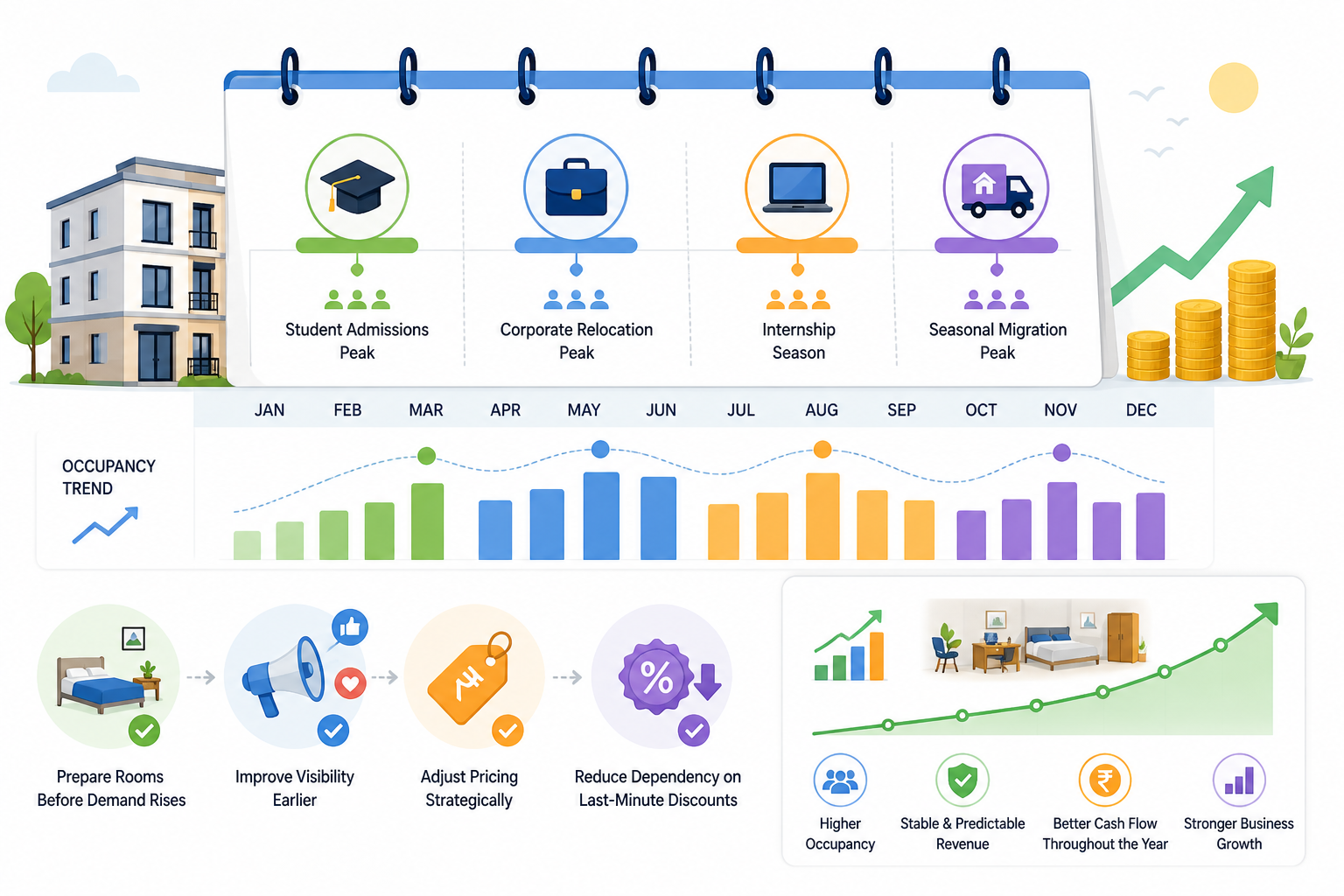
Predicting Peak Seasons Before Competitors React
One of the biggest advantages of predictive analytics is demand forecasting.
Most operators adjust pricing and marketing only after market demand becomes visible. By that point, competitors are already reacting similarly, and pricing pressure starts increasing rapidly.
Properties that track historical demand patterns gain a major operational advantage because they can identify:
- Admission-driven occupancy spikes in student-focused markets.
- Corporate relocation periods that increase demand for professional co-living.
- Internship seasons that create short-term occupancy movement.
- Seasonal migration trends affecting specific locations repeatedly every year.
This allows operators to:
- Prepare rooms before demand rises instead of rushing later.
- Improve property visibility earlier than competitors.
- Adjust pricing strategically during high-conversion periods.
- Reduce dependency on last-minute discounts to maintain occupancy.
The result is not just higher occupancy.
It is more stable and predictable revenue generation throughout the year.
Vacancy Forecasting: The Most Underrated Financial Tool
Most landlords underestimate the actual cost of vacancy because they calculate it too simply.
Vacancy is not just an empty bed.
It includes multiple layers of financial leakage that slowly affect profitability over time.
| Vacancy Factor | Business Impact |
|---|---|
| Delayed room filling | Reduces monthly cash flow stability |
| Last-minute discounting | Lowers overall revenue yield |
| Idle room maintenance | Creates operational expense without income |
| Weak lead pipeline planning | Extends vacancy duration unnecessarily |
Predictive vacancy forecasting allows operators to identify:
- Which rooms historically remain vacant longer than others.
- Which tenants are likely to move out within upcoming months.
- Which periods require stronger lead generation efforts.
- Which tenant categories create unstable retention patterns.
This creates a far more controlled occupancy strategy because vacancy stops feeling random. Instead, it becomes a measurable operational metric that can be planned for proactively.
Even reducing vacancy duration by a few days per room annually creates a noticeable impact on total profitability.
Budgeting for Repairs Before They Become Financial Emergencies
Most PG maintenance systems are still reactive.
Something breaks, money gets spent immediately, and the issue is resolved temporarily.
But over time, maintenance patterns become highly predictable if operators track operational data properly.
For example, most properties eventually notice recurring trends such as:
- Shared appliances deteriorating faster in high-density rooms due to heavier daily usage.
- Plumbing complaints increasing seasonally because of pressure fluctuations and overuse.
- Furniture replacement cycles shortening in rooms with higher tenant turnover.
- Air conditioning systems requiring servicing repeatedly during summer occupancy peaks.
Without maintenance tracking, these expenses continue feeling “unexpected.”
Predictive maintenance changes this approach completely because operators begin identifying recurring infrastructure pressure points before major breakdowns happen.
This creates several operational advantages:
- Maintenance budgets become easier to forecast instead of fluctuating unpredictably.
- Preventive servicing reduces emergency repair costs significantly.
- Asset lifespan improves because infrastructure receives attention earlier.
- Tenant experience improves because operational disruptions reduce noticeably.
For growing PG businesses, predictive maintenance is not just a cost-saving strategy anymore.
It becomes an operational stability strategy.
Why Visibility Is the Foundation of Predictive Property Management
Predictive analytics only works when operational visibility exists clearly.
And this is exactly where most PG businesses struggle today.
In many properties:
- Occupancy tracking still happens manually across scattered sheets.
- Payment records remain split across multiple systems and screenshots.
- Complaint history stays buried inside chats and calls.
- Maintenance expenses are not categorized consistently.
Without centralized visibility:
- Financial patterns remain hidden.
- Forecasting becomes unreliable.
- Decision-making stays reactive.
This is why predictive property management is not really about advanced technology first.
It is about building operational systems that make business patterns visible consistently.
Once visibility improves, forecasting becomes much more practical naturally.
How Predictive Analytics Improves Strategic Decision-Making
Most operators think forecasting only helps with monthly cash flow planning.
In reality, predictive analytics improves decision-making across the entire business.
When operational patterns become visible clearly, operators can make smarter decisions around:
- Expansion planning based on occupancy stability instead of assumptions.
- Vendor negotiations using actual maintenance and operational expense data.
- Staffing allocation during high-demand occupancy periods.
- Marketing investments during slower seasonal cycles.
- Pricing adjustments based on historical demand behavior.
This creates operational maturity.
Instead of constantly reacting to pressure, the business starts functioning strategically.
And that difference becomes extremely important while scaling across multiple properties

How RentOK Helps Build Financial Visibility Across Operations
Predictive analytics only works when operational and financial data stay structured properly.
This is where RentOK becomes valuable for growing PG businesses.
Most operators lose visibility because occupancy tracking, tenant records, payments, complaints, and maintenance updates remain fragmented across multiple systems. RentOK helps centralize these workflows so operators can monitor property performance more clearly and identify operational patterns earlier.
With RentOK, operators can:
- Track occupancy movement and vacancy trends systematically instead of relying on scattered manual records.
- Monitor rent collection, pending dues, and payment behavior more clearly to improve cash flow visibility.
- Maintain structured operational records that simplify maintenance tracking and expense monitoring.
- Improve financial planning by keeping tenant, operational, and occupancy information organized within one connected system.
The value is not just operational organization.
It is the ability to make stronger business decisions using visibility instead of assumptions.
Final Thoughts
The future of profitable property management will not depend only on occupancy.
It will depend on predictability.
The operators who scale successfully over the next few years will be the ones who understand operational patterns deeply enough to forecast financial pressure before it starts affecting the business. Predictive analytics transforms property management from a reactive operational cycle into a structured business system built on visibility, forecasting, and planning.
That shift creates:
- Better cash flow stability during seasonal fluctuations.
- Stronger control over occupancy and vacancy management.
- Smarter budgeting for maintenance and operational costs.
- More confidence in long-term business decisions and expansion planning.
Explore RentOk to build a more structured, financially visible, and operationally predictable property management system, because modern PG businesses no longer grow only through occupancy.
They grow through clarity, consistency, and smarter operational forecasting.
About the Author
Ishika Pannu
Ishika Pannu brings you the latest insights and easy-to-apply strategies in property management—helping you simplify renting and grow with RentOk.