Market Trends
How Much Should You Charge for a PG Room in 2026?

Written by
Ishika Pannu
Read Time
10 min read
Posted on
June 24, 2026
Overview
Overview
How Much Should You Charge for a PG Room in 2026?
Setting the right rent for a PG room has never been simple. Charge too much, and occupancy starts dropping as tenants explore more affordable alternatives nearby. Charge too little, and you may fill rooms quickly but leave significant revenue on the table. In 2026, this decision has become even more complex as tenant expectations, infrastructure development, local competition, and operating costs continue to evolve across Indian cities.
Many PG owners still determine rent by simply checking what nearby properties are charging and matching those numbers. While competitor pricing is important, relying solely on it often leads to poor pricing decisions. Two properties located on the same street can command very different rents depending on factors such as room quality, amenities, tenant experience, operational standards, and proximity to key locations.
The most successful PG operators no longer view pricing as a one-time decision. They treat it as an ongoing business strategy that balances occupancy, profitability, and market demand. Understanding how these factors interact is essential for building a sustainable and profitable rental business in 2026.
Why PG Pricing Matters More Than Ever
The Indian rental accommodation market has changed significantly over the past few years. Student migration continues to grow, more working professionals are relocating to major employment hubs, and co-living operators have raised the standard of what tenants expect from shared accommodation.
As a result, pricing is no longer determined solely by room size or location. Tenants today evaluate the overall value they receive for the amount they pay each month.
A tenant comparing two PGs is often assessing factors such as:
- Whether the property offers reliable Wi-Fi, housekeeping, security, and maintenance support rather than simply comparing room rent in isolation.
- How easily they can commute to colleges, offices, metro stations, and commercial hubs, as convenience often influences decision-making as much as affordability.
- Whether the management appears organized and responsive, because operational experience increasingly affects tenant satisfaction and retention.
This shift means that PG owners must think beyond square footage and competitor rates when deciding how much to charge.

The Biggest Factors That Influence PG Rent Pricing in India
There is no universal pricing formula that works across every city or property type. However, certain factors consistently have the greatest impact on rental performance.
Location Still Remains the Strongest Pricing Driver
Even in 2026, location remains the single biggest determinant of PG pricing.
A property located near a metro station, university campus, IT park, or business district can often charge significantly more than a similar property located several kilometers away. The reason is simple: tenants are willing to pay for convenience.
For students, proximity to educational institutions reduces travel time and transportation expenses. For working professionals, shorter commutes improve quality of life and save valuable time each day.
Properties located near:
- Major metro corridors often attract higher demand because tenants increasingly prioritize accessibility and connectivity.
- IT and corporate hubs generally command premium pricing due to the concentration of working professionals seeking nearby accommodation.
- Universities and coaching centers benefit from consistent demand cycles, particularly during admission seasons when occupancy levels rise sharply.
When evaluating pricing, operators should assess not only current demand but also upcoming infrastructure developments that may influence future rental potential.
Room Configuration and Occupancy Structure
Another major pricing factor is how the room itself is configured.
Single occupancy rooms naturally command the highest rent because they offer privacy and personal space. Double and triple sharing rooms typically generate higher overall revenue per room, even if the per-bed pricing is lower.
For example, a property owner may find that:
- A private room attracts premium-paying tenants who value privacy and convenience over affordability.
- Double-sharing arrangements appeal to tenants looking for a balance between cost savings and comfort.
- Triple-sharing setups often perform well in student markets where affordability plays a larger role in decision-making.
The ideal pricing strategy depends heavily on the target tenant profile and local market conditions.
Are Amenities Justifying Higher Rents in 2026?
Many operators assume that simply adding more amenities automatically allows them to increase rent. In reality, tenants evaluate whether those amenities genuinely improve their daily living experience.
Certain amenities have now become basic expectations rather than premium features.
For most tenants, the following are no longer optional:
- Reliable high-speed internet that supports online classes, remote work, streaming, and day-to-day digital usage.
- Regular housekeeping services that help maintain cleanliness without requiring residents to manage these tasks independently.
- Security measures such as CCTV surveillance, controlled access, and trained staff that create a safer living environment.
- Consistent maintenance support that ensures operational issues are addressed quickly and professionally.
Premium pricing becomes easier to justify when properties offer features that clearly differentiate them from competing options nearby.
Examples include dedicated study areas, coworking spaces, smart access systems, premium furnishings, fitness facilities, or community-driven experiences that improve tenant satisfaction.
The key is understanding which amenities your target audience actually values rather than investing in features that look impressive but have little impact on occupancy or retention.
How to Calculate the Right PG Rent for Your Property
One of the biggest mistakes PG owners make is treating pricing as a guess rather than a calculation. While no formula can predict demand perfectly, a structured pricing approach can significantly reduce the chances of underpricing or overpricing your rooms.
Instead of asking, “What is the PG next door charging?”, the better question is, “What value does my property deliver compared to other options available to the same tenant?”
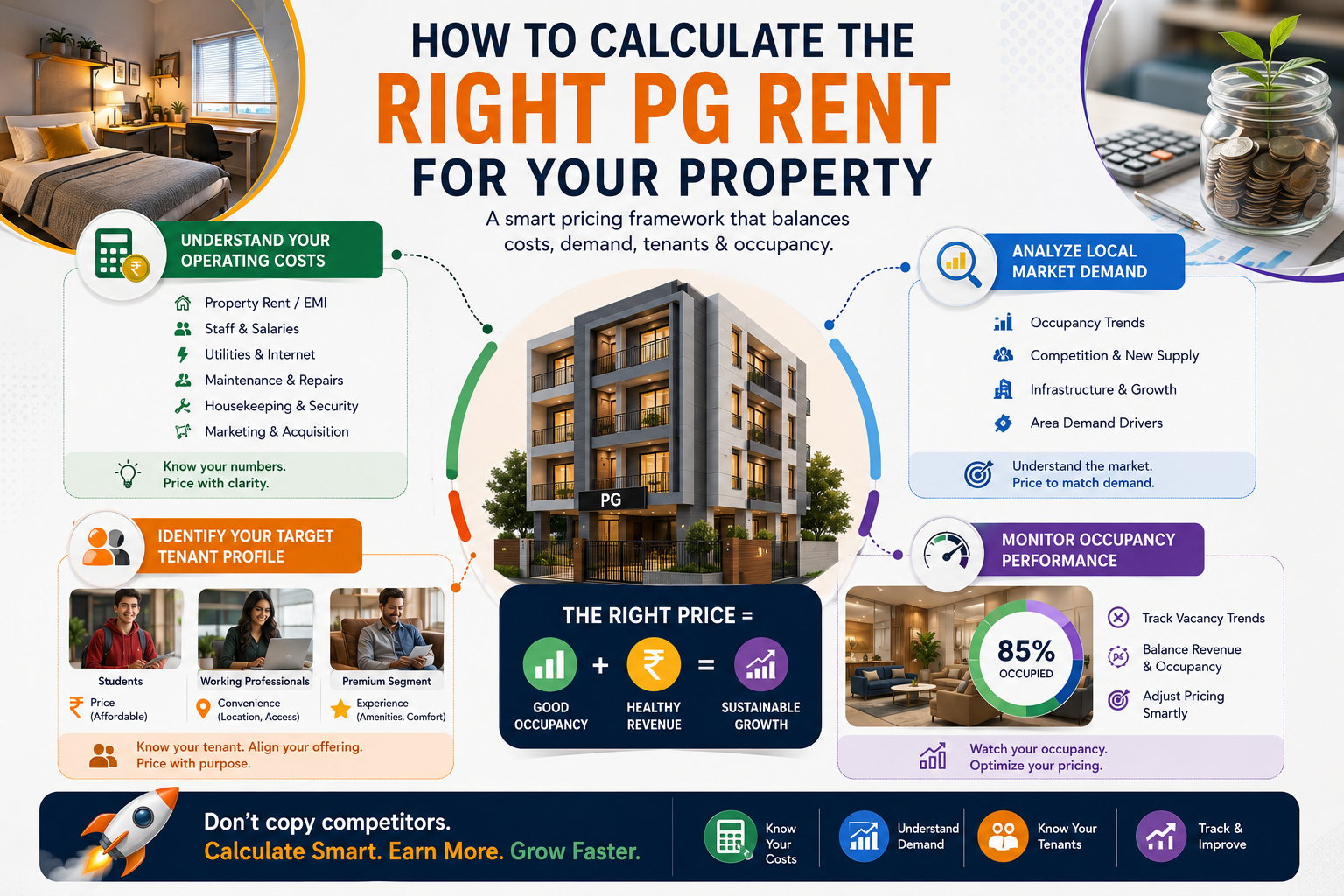
A practical pricing framework should consider four key areas:
1. Understand Your Operating Costs
Before deciding your rent, you need complete visibility into how much it actually costs to run the property.
These costs typically include:
- Property rent or EMI obligations, staff salaries, utility expenses, maintenance costs, internet charges, housekeeping, and security expenses that continue regardless of occupancy levels.
- Marketing and tenant acquisition expenses, which are often overlooked despite playing a significant role in maintaining occupancy.
- Periodic repair and replacement costs for furniture, appliances, mattresses, and other assets that experience wear and tear over time.
Without understanding these numbers, it becomes impossible to determine whether your pricing is generating healthy profits or simply covering expenses.
2. Analyze Local Market Demand
Pricing should reflect demand, not just costs.
A PG located near a rapidly growing business district may support significantly higher rents than a similar property in an area with limited employment opportunities. Similarly, admission seasons can temporarily increase demand around universities and coaching hubs.
Operators should regularly evaluate:
- Occupancy trends across nearby properties to understand whether demand is increasing, stabilizing, or declining within the local market.
- New PG developments entering the area, as additional supply can influence pricing flexibility and tenant expectations.
- Infrastructure improvements such as metro expansions, road projects, and commercial developments that may increase future rental demand.
3. Identify Your Target Tenant Profile
Different tenant segments value different things.
A student searching for accommodation may prioritize affordability, while a working professional may be willing to pay more for privacy, convenience, and premium amenities.
Understanding your audience helps determine whether your property should compete on:
- Price, by offering affordable accommodation that appeals to cost-conscious tenants and maximizes occupancy.
- Convenience, by emphasizing location advantages, accessibility, and operational efficiency.
- Experience, by delivering premium services and amenities that justify higher rents and attract higher-value tenants.
4. Monitor Occupancy Performance
Occupancy often provides the strongest indication of whether pricing is appropriate.
If a property consistently maintains near-full occupancy with minimal vacancies, there may be room for gradual rent increases. On the other hand, if rooms remain vacant for extended periods despite strong market demand, pricing may require adjustment.
The objective is not simply achieving maximum rent. The objective is finding the balance where occupancy and revenue work together.
Common PG Pricing Mistakes Owners Still Make
Even experienced operators occasionally make pricing decisions that hurt profitability or occupancy.
The most common mistake is copying competitor pricing without understanding the differences between properties.
Two PGs may appear similar from the outside, but factors such as maintenance quality, tenant experience, location advantages, room condition, and operational efficiency can justify significantly different pricing levels.
Another common mistake is refusing to review pricing regularly.
Many owners continue charging the same rent for years despite changes in:
- Local demand patterns, which may increase significantly as neighborhoods develop and attract more residents.
- Infrastructure growth that improves connectivity and increases the attractiveness of the surrounding area.
- Operating costs that gradually rise due to inflation, staffing requirements, and maintenance expenses.
Some operators make the opposite mistake and increase rents too aggressively.
While higher rents may improve revenue in the short term, excessive increases can damage occupancy, increase turnover, and make tenant acquisition more difficult. Sustainable pricing usually performs better than aggressive pricing.
Should You Charge More for Fully Furnished PG Rooms?
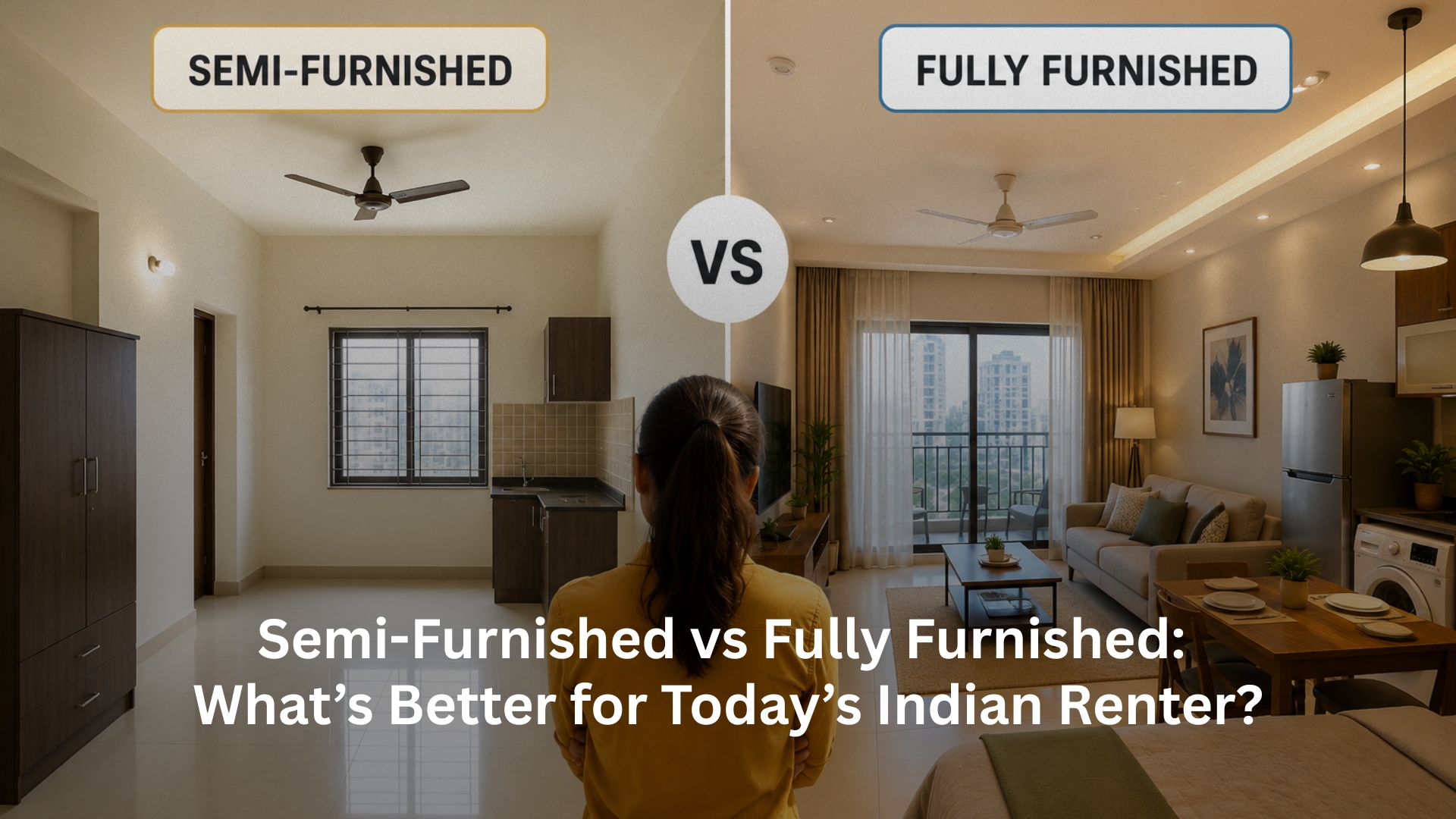
In most urban markets, fully furnished rooms continue to command a premium in 2026.
However, tenants are becoming increasingly selective about what they consider valuable.
A basic furnished room with an old mattress and minimal storage may not justify significantly higher rents. On the other hand, thoughtfully designed spaces that improve comfort and convenience often achieve better pricing outcomes.
Features that commonly support higher rents include:
- Comfortable beds, quality mattresses, wardrobes, and study tables that improve day-to-day living rather than simply filling the room with furniture.
- Air conditioning, smart locks, and modern appliances that provide clear functional benefits to tenants.
- Well-maintained common areas that create a more professional and organized living environment.
The lesson is simple: tenants pay for perceived value, not just furniture.
What Will Shape PG Rent Pricing Trends in 2026?
Several market trends are already influencing pricing decisions across India.
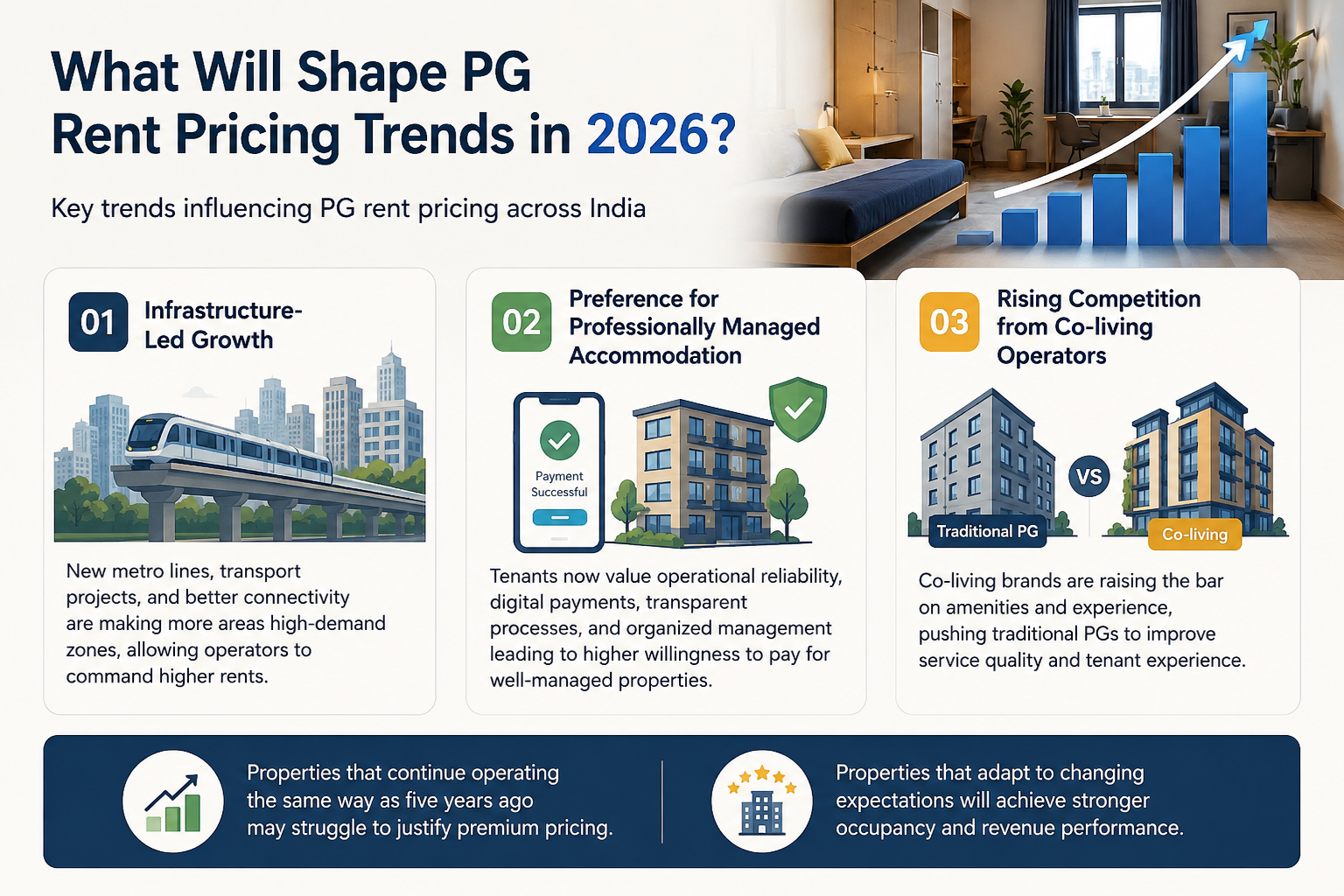
The first is infrastructure-led growth. Areas connected through new metro lines and transportation projects are experiencing stronger rental demand, allowing operators to command higher rents than before.
The second is the growing preference for professionally managed accommodation. Many tenants now prioritize operational reliability, digital payments, transparent processes, and organized management systems.
A third trend is increasing competition from co-living operators. This is pushing traditional PGs to improve both service quality and overall tenant experience.
Properties that continue operating exactly as they did five years ago may find it increasingly difficult to justify premium pricing.
Properties that adapt to changing expectations will likely achieve stronger occupancy and revenue performance.
How RentOk Helps PG Owners Make Better Pricing Decisions
Pricing decisions become much easier when operators have access to accurate occupancy, revenue, and tenant data.
Many PG owners still manage pricing through spreadsheets, manual records, and assumptions. This often makes it difficult to understand how pricing changes affect occupancy, collections, and overall profitability.
RentOk helps property owners centralize key operational data, including occupancy tracking, rent collection visibility, tenant management, and property performance reporting. With better visibility into how a property is performing, operators can make more informed pricing decisions rather than relying solely on market estimates or competitor rates.
As rental businesses grow, having access to structured operational data becomes increasingly important because pricing decisions influence everything from occupancy stability to long-term profitability.
Conclusion
There is no single answer to the question, “How much should you charge for a PG room in 2026?” The right price depends on a combination of location, tenant profile, room configuration, amenities, local demand, and operational quality.
The most successful PG operators understand that pricing is not just about matching competitors. It is about finding the point where occupancy, tenant satisfaction, and profitability align. Properties that regularly evaluate market conditions, track performance metrics, and adapt to changing tenant expectations are far more likely to maximize revenue without sacrificing occupancy.
If you’re looking for a smarter way to manage occupancy, track property performance, and make data-backed operational decisions, explore RentOk and see how modern property management software can help you build a more profitable rental business in 2026.
About the Author
Ishika Pannu
Ishika Pannu brings you the latest insights and easy-to-apply strategies in property management—helping you simplify renting and grow with RentOk.