Market Trends
My PG Got Sealed: What Happens to My Rent and Security Deposit?

Written by
Ishika Pannu
Read Time
12 min read
Posted on
November 13, 2026
Overview
Overview
My PG Got Sealed: What Happens to My Rent and Security Deposit?
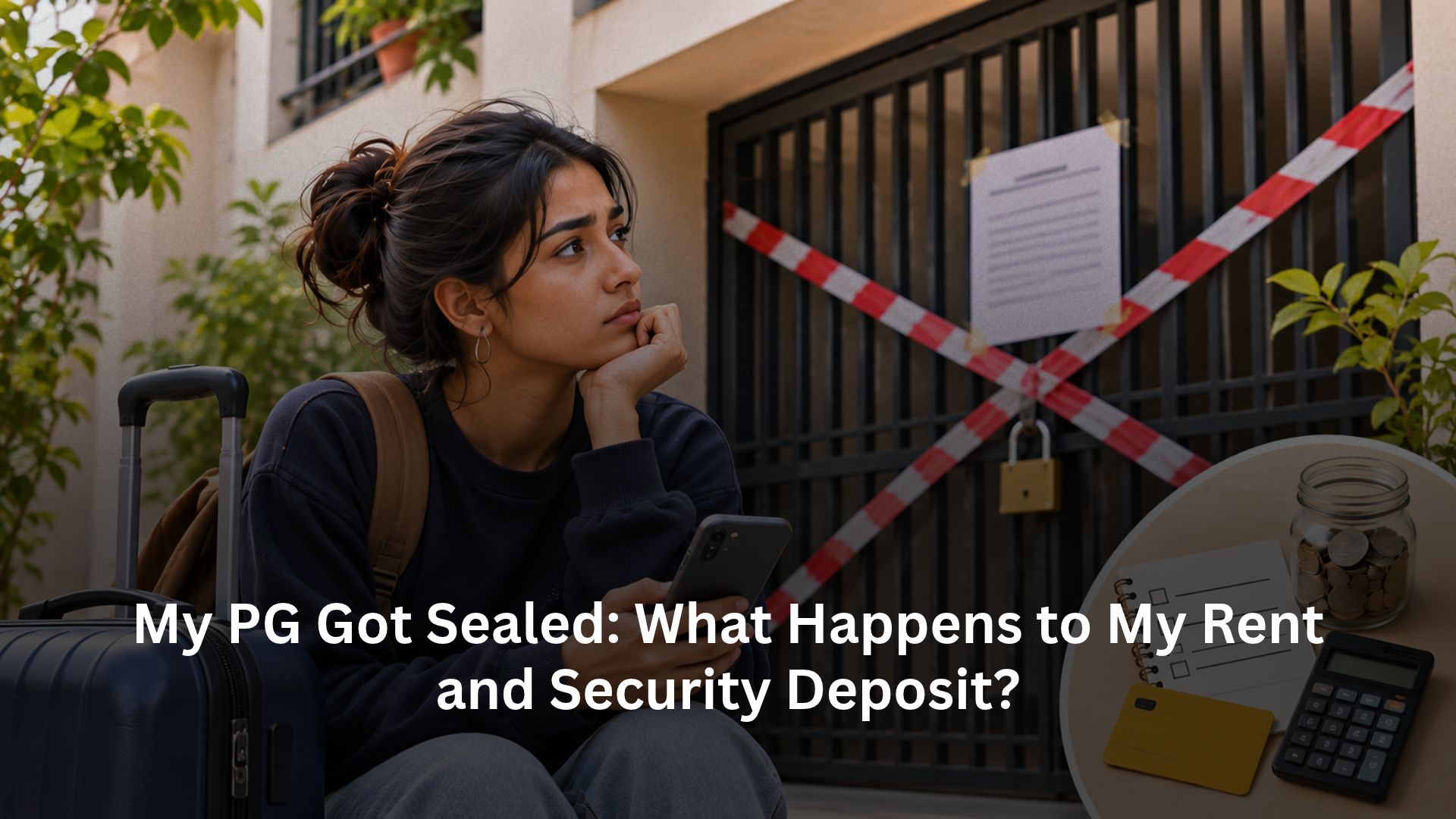
A sealed PG leaves you dealing with two problems at once: finding somewhere safe to stay and recovering money you paid for accommodation you can no longer use. Your security deposit, advance rent and belongings may all remain with the operator, while the closure notice tells you little about the refund process.
You can seek a settlement for unused advance rent and the refundable deposit balance, particularly when the operator’s compliance failure prevents the promised stay. However, a PG sealed refund does not follow one automatic nationwide formula. The closure order, your agreement, the nature of the arrangement and applicable local law affect the claim. Start by securing accommodation, preserving evidence and asking the operator for an itemised settlement in writing.
PG closures put safety and operating permissions under scrutiny
Authorities may close accommodation over unsafe construction, unauthorised building use, missing permissions or other violations. A municipal seal, a police restriction and an owner’s voluntary shutdown involve different powers and procedures. Read the actual notice before accepting anyone’s explanation of what happened.
Delhi’s recent scrutiny illustrates the concern. On 3 November 2026, reporting said MCD had received around 250 structural safety certificates from 2,457 surveyed PGs, following the September Satya Niketan collapse. Officials described reminders, formal notices and possible sealing for continued non-compliance. These figures describe certificate submissions, not the number of sealed buildings. Read the dated report on MCD’s PG safety checks.
If your PG is sealed by MCD, establish which building or floors the order covers, who issued it and whether anyone has authorised access. A manager’s promise that “everything will reopen tomorrow” cannot replace an official clarification. The same checks matter outside Delhi, although the relevant municipal authority and legal procedure differ.
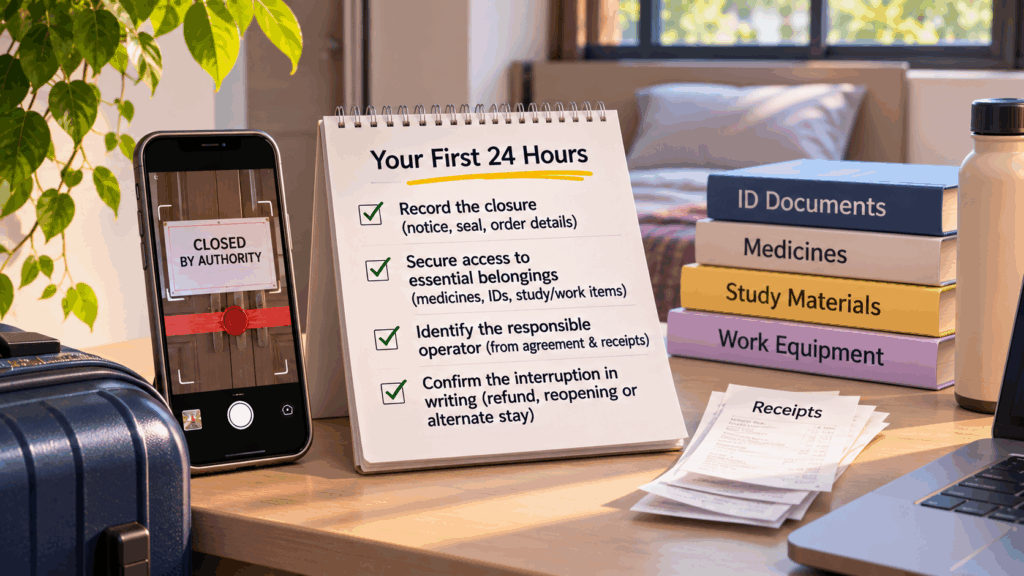
Your first 24 hours: safe accommodation and a written record
Arrange a safe place to stay before negotiating the final amount. Keep temporary accommodation and travel receipts; they may support a later claim for losses, although reimbursement depends on the facts and legal basis.
- Record the closure: Photograph the notice and seal from a safe, permitted location. Save the authority’s name, order number, date, property address and the time you lost access. Ask for a readable copy if necessary.
- Protect essential belongings: Tell the issuing authority if medicines, identification documents, study materials or work equipment remain inside. Ask about authorised retrieval and obtain instructions. Do not break the seal or enter solely on the manager’s permission.
- Identify the responsible operator: Check the agreement, receipts and payment account for the contracting individual or business. Send your request to that party and the manager; the building owner and PG operator may be different people.
- Confirm the interruption: Send a dated message recording that the closure has prevented your stay. Ask whether the operator proposes a refund, reopening or an alternative property, and request a written response.
Inspect any replacement PG before agreeing to move. Confirm the rent, deposit transfer, unused advance adjustment and remaining refund in writing. Accepting temporary help should not accidentally become an agreement to surrender the rest of your claim.
Does sealing mean you can stop paying rent immediately?
Do not assume that sealing automatically ends every payment obligation. An owner-operated PG offering accommodation and services may differ legally from a lease of a room or an entire property. Temporary restrictions, partial closure and an indefinite inability to provide accommodation can also produce different outcomes.
Where the operator cannot provide the stay because of its own default, demand an adjustment or refund for the unavailable period. Identify the exact dates, amount already paid and contractual basis. If the next instalment falls due during the dispute, communicate your position promptly and obtain advice before withholding money or treating the deposit as rent.
Check the termination, interruption, relocation and refund clauses. RentOK’s guide to the terms a rental agreement should record explains why the written arrangement matters; the label “PG agreement” alone does not settle its legal treatment.
Force majeure does not create an automatic refund
A force majeure clause deals with specified events under the contract. It does not automatically excuse an operator’s non-compliance. Nor does calling a closure “frustration” establish that every agreement has become void.
In Ramanand v Dr Girish Soni, the Delhi High Court explained that temporary non-use alone did not automatically suspend rent and distinguished leases from contracts governed by frustration principles. That case concerned a pandemic-related commercial tenancy, not PG sealing, but it cautions against assuming a universal rent waiver. Read the judgment.
If you paid before moving in, identify the booking token, advance rent and deposit separately. The distinction in advance booking and token refund policies helps frame a claim where the operator cannot deliver the confirmed accommodation.
Your deposit needs a settlement, not a closure penalty
A refundable security deposit secures legitimate liabilities under the arrangement; it does not become the operator’s earnings merely because the building closes. Ask for the deposit received, each proposed deduction, supporting evidence and the balance payable.
Valid deductions may include unpaid amounts that you actually owe, verified utility consumption and provable tenant-caused damage beyond ordinary wear. Challenge attempts to pass on the operator’s sealing fine, regularisation expense or business loss as “room damage.” Ask what legal or contractual basis makes you responsible for that charge.
RentOK’s security deposit recovery guide covers documentation and disputed deductions. In a closure case, add the official notice and the date access stopped to the usual payment and condition records.
Can the operator deduct a notice period or lock-in charge?
Challenge an automatic forfeiture if the operator’s default forced you out. Explain that you did not simply choose an early departure while suitable accommodation remained available, and ask the operator to justify the clause’s application to the closure.
The answer still depends on the agreement and circumstances; sealing does not automatically invalidate every clause. There is also no single national PG deposit-refund deadline. The Model Tenancy Act is a model framework, not a rule that applies uniformly to every PG across India.
An illustrative advance-and-deposit calculation
Assume a 30-day billing period, ₹18,000 paid in advance, 12 days of accommodation and 18 unavailable days. Both parties accept daily proration, a ₹25,000 refundable deposit and ₹1,200 in genuine outstanding utilities, with no other valid dues.
| Settlement item | Calculation | Amount |
|---|---|---|
| Daily rent | ₹18,000 ÷ 30 | ₹600 |
| Unused advance claimed | ₹600 × 18 | ₹10,800 |
| Deposit balance | ₹25,000 − ₹1,200 | ₹23,800 |
| Total settlement claim | ₹10,800 + ₹23,800 | ₹34,600 |
This is a claim illustration, not a guaranteed award or a compulsory 30-day formula. Use the actual billing period and applicable terms. Keep disputed deductions separate, and request the undisputed balance without giving up your remaining claim.

Evidence that connects the closure to your refund claim
A UPI screenshot proves a transfer more clearly than it proves what the payment covered. Build a short timeline that connects the promised accommodation, money paid, loss of access and refund request. This makes a deposit refund after PG closure easier to explain to the operator or an adviser.
Keep these records together:
- The agreement and promises: Save booking confirmations, rent inclusions, refund terms, advertisements and relevant messages, including any promise about permissions or a replacement room.
- The payment trail: Retain receipts, bank or UPI references and an explanation of which amount covered rent, deposit, food or a token. Include a parent’s payment if they paid on your behalf.
- The closure and room records: Preserve the notice, dated photographs, move-in condition evidence and any permitted final meter reading or handover acknowledgement.
- The response history: Save your demands, delivery acknowledgements, proposed deductions and refund promises. Record partial refunds and their transaction references separately.
Check the fields described in RentOK’s guide to rent receipts and payment records so each payment links to the resident, property and period. Keep a private backup; avoid circulating other residents’ identity documents in group chats.
A written demand you can adapt
Subject: Refund settlement following closure of [PG name and address]
I paid ₹[amount] as advance rent for [period] and ₹[amount] as a refundable security deposit. The closure dated [date/reference] prevented my stay from [date]. I request ₹[amount] for unused advance and ₹[amount] as the deposit balance, subject to justified, itemised dues.
Please provide the settlement calculation, evidence for any deduction and the proposed payment date by [date]. I attach the agreement, payment records and closure notice. Please also confirm the authorised process for retrieving my belongings. This request does not waive my claim to any disputed balance.
Choose a practical response date, such as seven days from delivery, rather than presenting it as a statutory deadline. If the operator offers instalments, record the amounts and dates. Read any “full and final settlement” wording before accepting it, especially if money remains disputed.
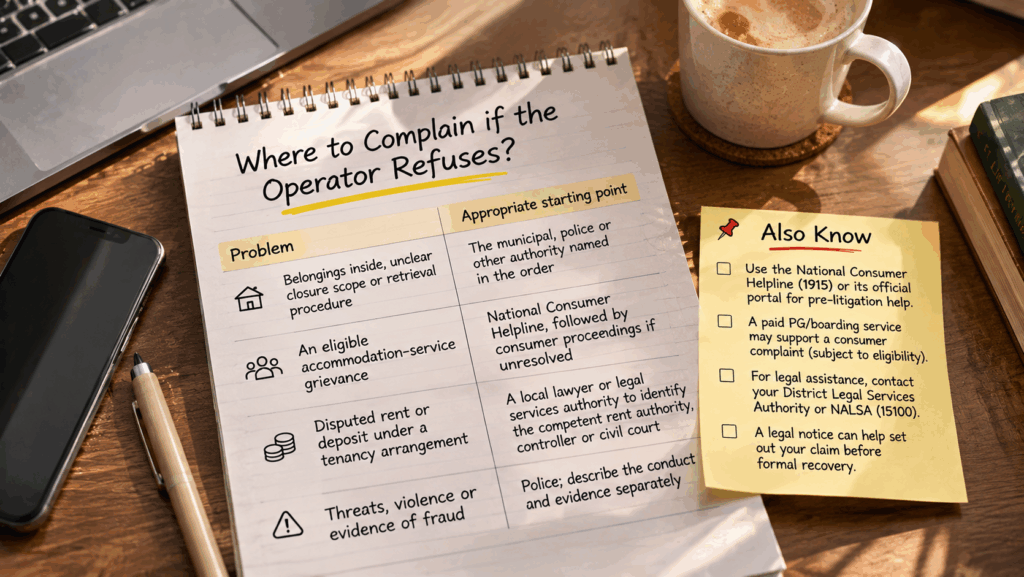
Where should you complain if the operator refuses?
The authority that sealed the building and the forum that can decide your money claim perform different roles. Ask the issuing authority about access and the order; pursue the operator through the appropriate refund or recovery route.
| Problem | Appropriate starting point |
|---|---|
| Belongings inside, unclear closure scope or retrieval procedure | The municipal, police or other authority named in the order |
| An eligible accommodation-service grievance | National Consumer Helpline, followed by advice on consumer proceedings if unresolved |
| Disputed rent or deposit under a tenancy arrangement | A local lawyer or legal services authority to identify the competent rent authority, controller or civil court |
| Threats, violence or evidence of fraud | Police; describe the conduct and evidence separately from the money dispute |
Consumer assistance and formal recovery
The National Consumer Helpline, available through 1915 and its official complaint portal, offers pre-litigation assistance. It does not issue a guaranteed refund order or replace a court. The Department of Consumer Affairs explains its role here.
A paid boarding or lodging service may support a consumer complaint, but an ordinary landlord–tenant dispute does not automatically belong before a Consumer Commission. An adviser can assess your arrangement and, where eligible, help you use e-Jagriti for consumer proceedings. A legal notice may help set out the claim before formal recovery action.
For guidance on legal assistance, contact your District Legal Services Authority or NALSA on 15100; free representation depends on eligibility. NALSA provides the official helpline information. An unpaid refund alone does not automatically establish a criminal offence, and a municipal complaint does not itself recover the deposit.
How RentOK helps keep rent and deposit records clear
A closure makes scattered payment screenshots and verbal promises difficult to reconcile. RentOK supports rental payment records and digital receipts, helping operators and residents establish what they paid or received before discussing an adjustment.
- Keep payment receipts accessible: Residents can download or save receipts through the supported payment interface. Retaining copies helps identify the amount, date and rental period when access to the property changes unexpectedly.
- Review recorded payments and dues: Operators can check the tenant’s payment history instead of reconstructing every transfer from messages. This supports a clearer discussion about paid rent and genuine outstanding charges.
- Separate deposits from rent: Maintain the deposit’s starting amount, adjustments and refund calculation clearly. The approach in tracking security deposits with a tenant ledger helps both sides follow the balance without confusing it with monthly income.
- Preserve supporting records: Keep receipt copies alongside the agreement, closure notice, written settlement and refund reference. The RentOK payment-page release notes explain the receipt download and save option; retain your own copies for follow-up.
These records support a claim and reconciliation. RentOK cannot remove an official seal, decide a disputed deduction or guarantee that an operator returns money.
Conclusion
After a PG closure, prioritise safe accommodation and authorised access to your belongings. Then separate unused advance rent, the security deposit and genuine outstanding dues in a written calculation. Challenge closure-related penalties or automatic forfeiture with the agreement and notice, and escalate through the forum suited to your arrangement if the operator refuses to settle.
Clear records make that process easier to follow. Keep digital rent receipts with RentOk, save an independent copy and retain the refund correspondence alongside them. A documented claim gives you a stronger starting point than a verbal promise that the money will arrive after the building reopens.
Frequently Asked Questions
Find answers to common questions about this topic
About the Author
Ishika Pannu
Ishika Pannu brings you the latest insights and easy-to-apply strategies in property management—helping you simplify renting and grow with RentOk.