Market Trends
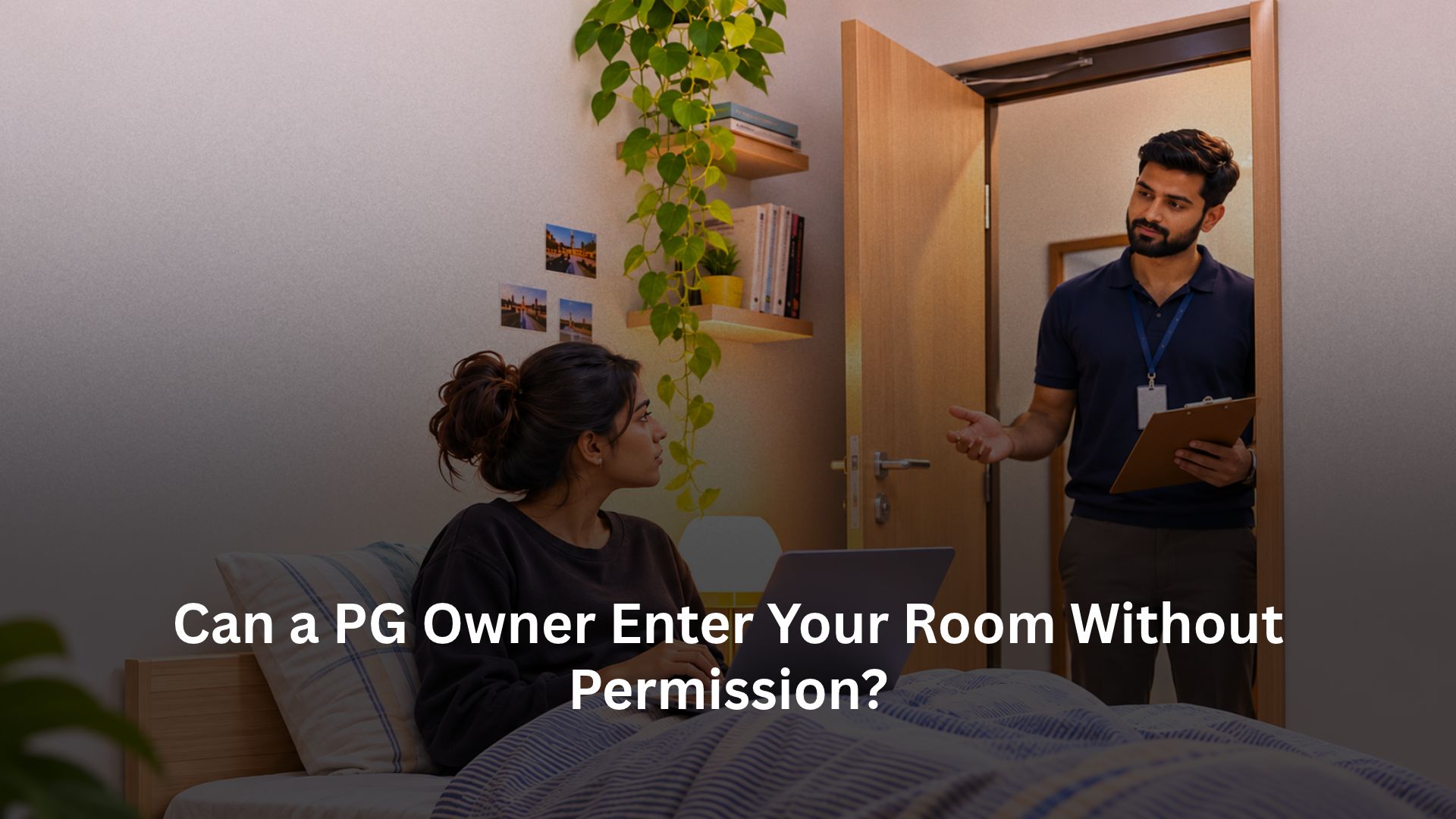
Can a PG Owner Enter Your Room Without Permission?

Written by
Ishika Pannu
Read Time
11 min read
Posted on
November 13, 2026
Overview
Overview
Can a PG Owner Enter Your Room Without Permission?
A spare key does not give a PG owner unrestricted access to your occupied room. Routine cleaning, repairs and inspections should follow the applicable law and a clear access arrangement. If you are asking “can PG owner enter my room?”, the answer depends on the purpose, timing, agreed permissions and any genuine urgency—not ownership alone.
Some lawful service visits can proceed under an agreed access arrangement without fresh permission each time. A PG may include scheduled housekeeping or shared-room services, while a flat tenancy can follow different rules. This guide explains tenant privacy rights in India, reasonable inspections, emergencies and the written boundaries that help residents and staff avoid intrusive surprises.
Entry and notice: what the law actually says
India does not have one nationwide PG-entry law specifying the same notice period for every property. Start with the state, the arrangement’s legal character and the agreement. Privacy is an important part of the analysis, but it does not remove legitimate maintenance and inspection rights.
For leases governed by the relevant provisions, Section 108(m) of the Transfer of Property Act addresses access for inspection at reasonable times, subject to the section’s contractual and local-usage qualifications. It does not establish a universal 24-hour notice requirement.
State provisions can be more specific. Section 28 of the Maharashtra Rent Control Act provides for inspection at a reasonable time after prior notice in covered arrangements. Section 17 of Uttarakhand’s tenancy law specifies at least 24 hours’ written or electronic notice for specified entry into covered rented premises.
Check coverage before applying either example to a PG. Definitions, exemptions and the actual occupation matter; Uttarakhand’s definition excludes hotel and lodging-house accommodation. Maharashtra’s definition of licensee excludes paying guests, with a specific definition involving accommodation in the licensor’s own residence. Neither example creates a rule for every Indian paying guest.
Does privacy mean the owner can never inspect?
No. Privacy and legitimate access can coexist. The Supreme Court’s privacy jurisprudence recognises privacy, dignity and individual autonomy. The remedy against a private operator still depends on the facts and applicable law; Article 21 alone does not supply one inspection timetable.
Why PG room access differs from a rented flat
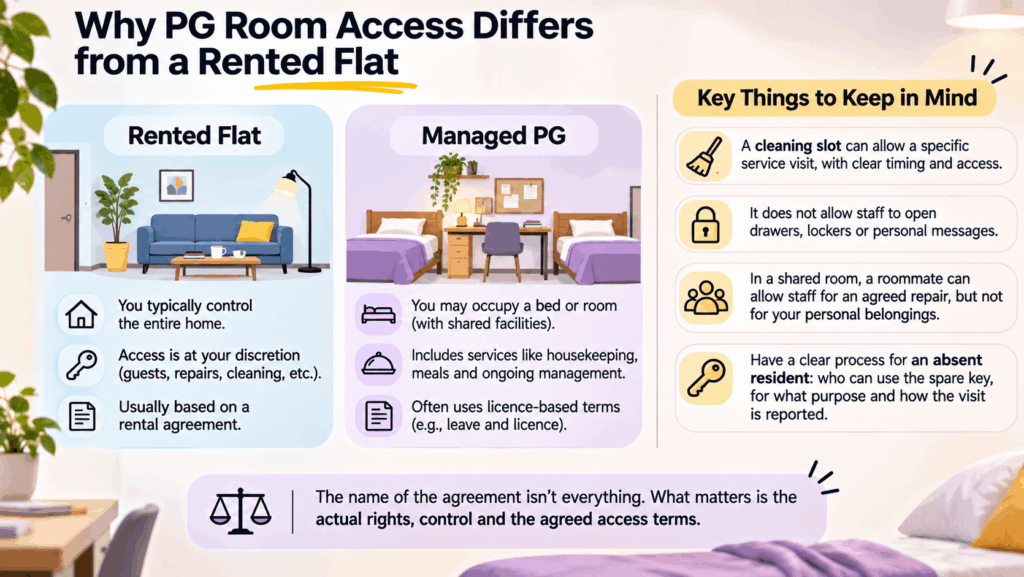
In a conventional flat letting, the tenant commonly controls the whole dwelling. In a managed PG, residents may occupy a bed or room alongside housekeeping, meals, shared facilities and continuing management access. Many such arrangements use licence-based terms, but the title alone does not settle their legal character.
RentOK’s PG agreement comparison explains why actual rights and control matter. Calling the document “leave and licence” does not give staff unlimited access or automatically remove every protection associated with occupation.
An agreed cleaning slot can authorise a specific service visit without a separate negotiation each morning. It should still identify timing, access arrangements and private areas. Permission to mop the floor does not become permission to open drawers or inspect personal messages.
What changes when you share the room?
A roommate can let authorised staff in for an agreed repair, but that does not give them authority over your locker, bag or documents. Ask management to coordinate with all affected occupants when work disrupts their sleeping or changing space.
Record the procedure for an absent resident too: who may use the spare key, for what purpose, and how management reports the visit. A shared bedroom remains a living and sleeping space, not a public common area. Keeping a key is a practical responsibility, not an unlimited permission slip.
A reasonable inspection has a purpose and limits
Good PG room inspection rules focus on a specific property concern: a leak, faulty wiring, pest problem, fixture damage or agreed safety requirement. The notice should identify the reason, proposed time and people attending. “Management inspection whenever necessary” offers little guidance to either residents or staff.
| Situation | A proportionate approach |
|---|---|
| Scheduled cleaning | Follow the disclosed slot and knock before entry; keep belongings outside the task |
| Non-urgent repair | Explain the work and arrange a suitable window with the affected residents |
| Condition inspection | Give applicable notice, identify what staff will check and limit the visit to that purpose |
| Showing a room to prospects | Check the access terms and coordinate separately; do not assume repair permission covers a viewing |
| Resident absent | Follow a lawful, agreed key-access process and provide a record of the visit |
An ordinary inspection should not turn into repeated late-night visits or a general search. Staff should identify themselves, announce their presence and allow a resident time to dress. Where possible, arrange a resident’s presence or an agreed representative; do not promise that every legal access right requires the resident to attend.
RentOK’s maintenance-request guide shows why recording the issue and assigning responsibility improves coordination. A repair ticket explains the task; it does not, by itself, establish permission to enter at any time.
When can an emergency justify immediate entry?
A credible, immediate risk may justify urgent access without the usual notice, depending on the circumstances and applicable law. Examples include smoke or fire, a major active water leak, or signs that someone inside needs urgent medical help. Staff should focus on protecting people and controlling the hazard.
A resident ignoring a payment reminder, leaving clothes untidy or failing to answer one routine call is not automatically an emergency. A welfare concern needs an objective basis: for example, a distress call or a credible report of collapse, rather than mere curiosity about someone’s movements.
Emergency access should remain limited
Management should try to contact the resident when feasible without delaying necessary help. Staff should involve appropriate emergency services, avoid unsafe action and restrict access to what the situation requires. A serious leak may require reaching a valve; it does not authorise searching a suitcase.
Afterward, management should promptly explain why entry occurred, who entered, when they left and what they did. Where practical, retain a factual incident record and secure the room. A genuine emergency should not become a standing excuse for future unannounced inspections.
If you face immediate danger, prioritise a safe location and emergency assistance. An internal complaint or app message should not delay urgent help. Agree on the PG’s emergency contact and response process before a crisis happens.
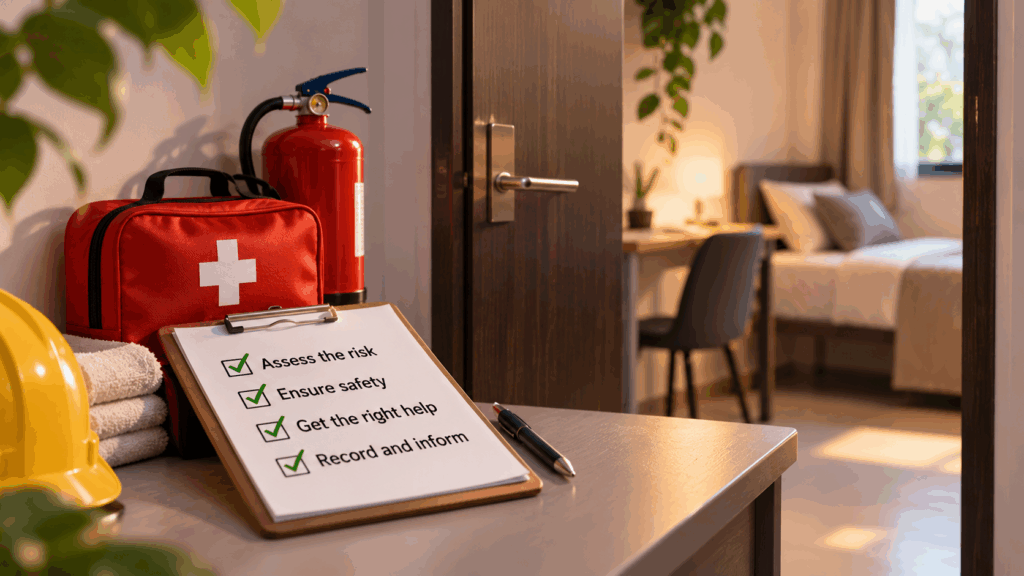
Access clauses to add to your PG agreement
Ask for a specific access policy before moving in. The document should distinguish routine service, inspection, absence and emergency entry, rather than bundle them into one broad sentence. RentOK’s agreement-reading checklist helps identify vague powers and missing conditions.
- Notice and scheduling: State the method, agreed notice period, reasonable visiting hours and rescheduling process. Preserve any stronger legal requirement; do not describe an example period as national law.
- Staff and spare keys: Identify authorised roles, supervision of outside technicians, key custody and how management records visits while residents are away.
- Scope and privacy: Restrict access to the stated task. Address bedroom and bathroom privacy, personal storage, photographs and arrangements for shared rooms.
- Housekeeping and emergencies: Set regular cleaning slots, explain how residents request changes, and define urgent entry and follow-up communication.
A starting clause to discuss
“Except where urgent circumstances lawfully justify immediate access, management will give [agreed notice, subject to applicable law] stating the purpose, proposed time and attending personnel. Visits will occur during [reasonable hours] under the agreed access process. Staff will knock, respect private belongings and limit work to the stated purpose. Management will document emergency or authorised absence-entry and notify affected residents promptly.”
Adapt that wording to the property and local law. RentOK’s tenant-handbook guide explains how a handbook can communicate daily procedures; a newly posted notice should not silently replace important agreed rights.
Unannounced entry: a practical response
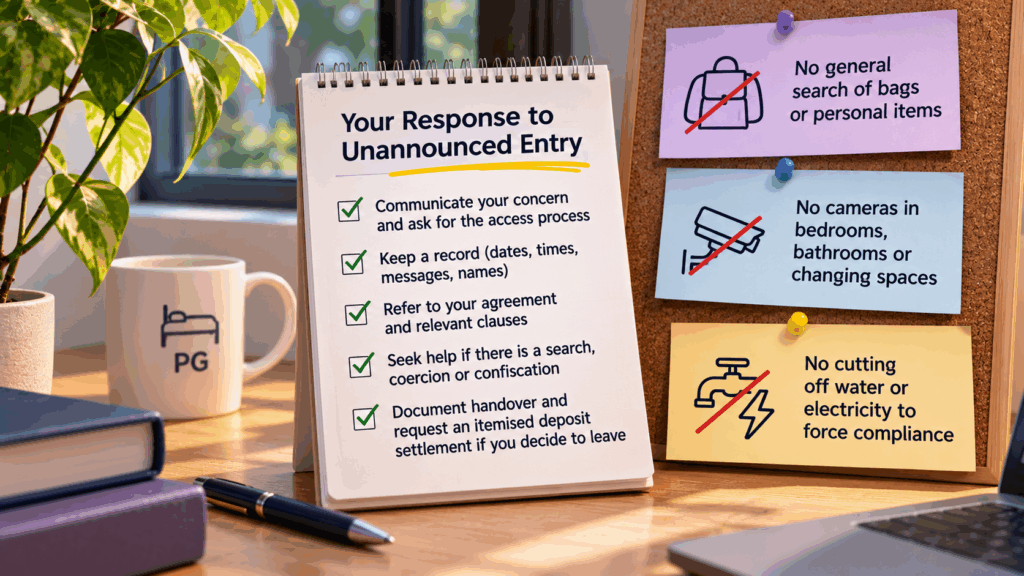
If you feel safe doing so, tell the owner or warden that unexpected visits make you uncomfortable. Ask for the applicable access clause and a written process. A useful message is: “Please confirm the reason and time for future non-emergency visits, and knock before entry. I can coordinate access during [availability].”
Keep dates, times, names, messages and a factual account of repeated incidents. Preserve relevant evidence without filming other residents’ private lives or circulating accusations publicly. Store your agreement and records somewhere you can access independently of the PG.
Searches, cameras and coercion need separate attention
A routine inspection does not give management a general right to search bags, read documents or confiscate belongings. Ask for the claimed legal basis and seek help if staff threaten you or take property. Police action under lawful authority is a different issue from an owner’s house rule.
Reject surveillance inside bedrooms, bathrooms or changing spaces. RentOK’s PG CCTV privacy guide explains the boundary; IT Act Section 66E addresses specified non-consensual images of private areas, not every form of room entry.
Cutting water or electricity to force compliance is not a legitimate substitute for resolving a dispute. Seek advice on applicable protections and urgent restoration. If you decide to leave, document handover and request an itemised deposit settlement; a complaint does not automatically cancel notice obligations or guarantee a full refund. The appropriate civil, tenancy, police or consumer route depends on the conduct, arrangement and jurisdiction.
How RentOK helps set clearer house rules
Room-access disputes often begin when a warden, cleaner and resident work from different instructions. RentOK supports agreement records, resident communication and complaint management, helping operators connect written expectations with daily work. Management must still draft lawful rules and train staff to follow them.
- Keep accepted terms accessible: Use the agreement workflow and resident records to maintain the relevant document. Include the agreed access policy and give residents their own copy rather than relying on a verbal explanation.
- Connect visits with a recorded issue: RentOK supports complaint logging and assignment to staff or vendors. Record the repair purpose and coordinate the visit separately; assigning a technician does not create an entry authorisation.
- Follow up on unresolved concerns: Supported complaint status and escalation workflows help teams identify pending requests. A resident’s privacy complaint needs an accountable response, even when no physical repair is necessary.
- Communicate consistent procedures: Use supported resident communication alongside the house rules to explain cleaning arrangements, access contacts and changes. Preserve a clear record of agreed changes instead of assuming that sending an announcement proves consent.
RentOK’s feature documentation describes complaint assignment and escalation capabilities. Confirm availability for the property. These tools support administration; they do not validate an intrusive clause, replace emergency services or guarantee that staff respect a boundary.
Conclusion
A PG owner’s access should follow a legitimate purpose, the applicable law and a clear arrangement with residents. Routine visits need reasonable coordination; genuine emergencies may require a faster response. Neither owning the building nor holding a spare key gives management unrestricted authority over an occupied room or personal belongings.
Before moving in, settle the notice process, housekeeping schedule, key controls and emergency procedure in writing. If boundaries repeatedly fail, document the incidents and choose help that matches the risk. For operators, set clear house rules on RentOK and connect those expectations with agreement records, resident communication and accountable complaint handling.
Frequently Asked Questions
Find answers to common questions about this topic
About the Author
Ishika Pannu
Ishika Pannu brings you the latest insights and easy-to-apply strategies in property management—helping you simplify renting and grow with RentOk.