Market Trends
No HRA From Your Employer? How to Claim Rent Deduction Under Section 80GG


Written by
Ishika Pannu
Read Time
12 min read
Posted on
November 14, 2026
Overview
Overview
No HRA From Your Employer? How to Claim Rent Deduction Under Section 80GG
Paying rent without a House Rent Allowance (HRA) component in your salary does not necessarily mean you lose every rent-related tax benefit. Section 80GG provides a deduction for eligible individuals who pay for their own residential accommodation without receiving HRA. Self-employed people can qualify too, provided they meet the ownership conditions and use the old tax regime.
The deduction has limits: ₹60,000 is the full-year ceiling, not an automatic entitlement or a tax refund. Your income and actual eligible rent determine the amount. There is also a filing-year distinction worth checking before you begin: the familiar Section 80GG and Form 10BA apply under the Income-tax Act, 1961, while the corresponding provisions for Tax Year 2026–27 use Section 134 and Form 31. This guide explains the calculation, PG rent records and declaration process.
Who can claim Section 80GG?
The deduction covers individuals, including eligible salaried and self-employed taxpayers. An HUF does not independently qualify simply because the ownership test mentions an HUF. For a salaried applicant, check the salary structure and Form 16; not submitting an HRA claim to payroll does not establish that you received no HRA. The Department’s deduction guidance identifies the eligible taxpayer category.
Check these conditions together:
- Residential rent: You must actually pay rent for furnished or unfurnished accommodation that you occupy as your own residence. Office rent belongs to a different tax analysis.
- No HRA: The provision excludes applicants with the relevant HRA income. If you changed jobs and received HRA during part of the year, obtain advice rather than assuming you can claim 80GG for the remaining months.
- Local ownership restriction: You, your spouse, minor child or HUF of which you are a member must not own residential accommodation at the place where you ordinarily live, work or carry on your business or profession.
- Property elsewhere: Owning a house in another city does not automatically qualify or disqualify you. The restriction also covers your own property elsewhere that falls within the specified self-occupied, nil-annual-value treatment. Merely leaving it empty does not resolve the test.
The Department’s detailed deductions note explains the ownership restrictions and declaration requirement. Review the actual tax treatment of any other home before signing the declaration.
Match the section and form to the income period
The Income-tax Act, 2025 took effect from 1 April 2026, but earlier income periods remain under the 1961 Act. Filing a return after that date does not, by itself, move an earlier year into the new Act.
| Income period | Relevant rent-deduction provision | Declaration |
|---|---|---|
| FY 2025–26, reported in AY 2026–27 | Section 80GG, Income-tax Act, 1961 | Form 10BA |
| Tax Year 2026–27, beginning 1 April 2026 | Section 134, Income-tax Act, 2025 | Form 31 |
The Department’s transition FAQs explain the period-based distinction, and its form guidance maps Form 10BA to Form 31. New Act and new tax regime mean different things: the Act changed, while the choice of tax regime still needs separate attention.
The 80GG calculation: compare all three limits
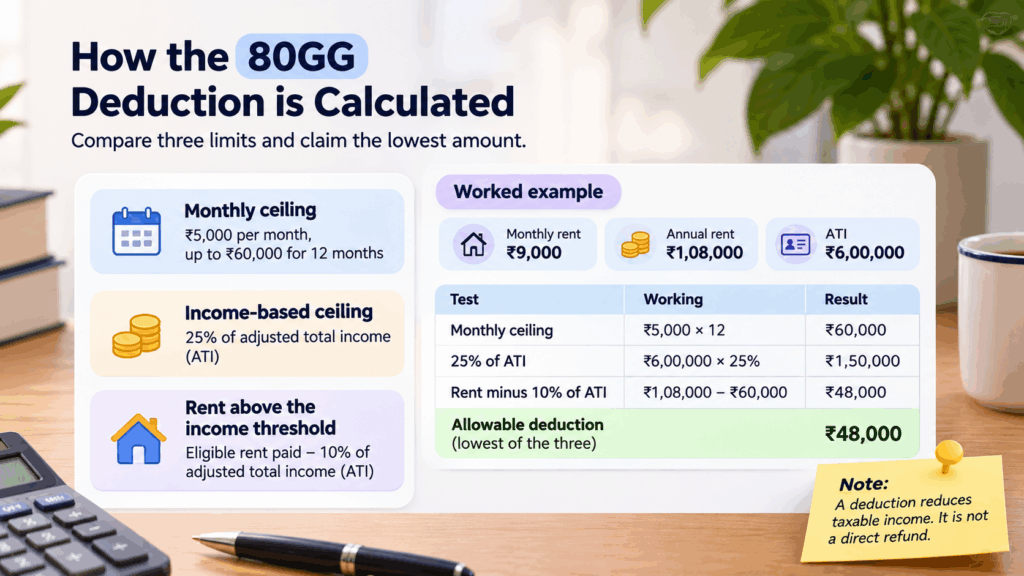
For a full year of eligible rent, claim the lowest of these amounts:
| Limit | Calculation |
|---|---|
| Monthly ceiling | ₹5,000 per month, up to ₹60,000 for 12 months |
| Income-based ceiling | 25% of adjusted total income |
| Rent above the income threshold | Eligible rent paid minus 10% of adjusted total income |
If rent does not exceed 10% of the relevant income, there is no positive deduction under this formula. A shorter eligible rental period also requires attention to the monthly ceiling; do not automatically enter ₹60,000.
Adjusted total income (ATI) is a useful shorthand for the income figure used in the calculation. Under the 1961 Act, start with gross total income, deduct eligible Chapter VI-A deductions other than 80GG, and apply the exclusions for long-term capital gains, Section 111A short-term gains and relevant special-rate income, such as income under Sections 115A or 115D where applicable. Do not use CTC or take-home salary as ATI. The Department’s AY 2026–27 taxpayer guidance sets out the limits and exclusions.
For Tax Year 2026–27, use the corresponding income computation under the 2025 Act rather than copying old section numbers into the return. Section 134 retains the three-part rent deduction structure.
A worked example where the deduction is below ₹60,000
Assume an eligible taxpayer pays ₹9,000 monthly rent for 12 months and has ₹6,00,000 ATI, after the relevant adjustments. Annual eligible rent comes to ₹1,08,000.
| Test | Working | Result |
|---|---|---|
| Monthly ceiling | ₹5,000 × 12 | ₹60,000 |
| 25% of ATI | ₹6,00,000 × 25% | ₹1,50,000 |
| Rent minus 10% of ATI | ₹1,08,000 − ₹60,000 | ₹48,000 |
| Allowable deduction | Lowest of the three | ₹48,000 |
The taxpayer reduces taxable income by ₹48,000. They do not receive ₹48,000 back from the government. Actual tax savings depend on the applicable rates, rebate and overall liability. This distinction matters when comparing regimes: a deduction’s face value does not equal its cash benefit.
Can you claim the deduction for PG rent?
PG accommodation can qualify where the payment genuinely represents rent for accommodation you occupy as your own residence and you meet the remaining conditions. The law covers furnished and unfurnished residential accommodation; it does not require you to rent an entire independent flat. This follows from the residential-accommodation wording of the provision, rather than a separate automatic exemption for PG residents.
The difficulty often lies in a bundled bill. A ₹14,000 PG package may include a bed, meals, electricity and other services. Do not assume the whole package qualifies as residential rent. Ask the operator to identify the accommodation component and explain the basis of the allocation. RentOK’s guide to what your rent includes and what costs extra explains why that breakdown should appear in the arrangement.
For example, a genuine invoice showing ₹9,000 accommodation rent, ₹3,000 meals and ₹2,000 separately charged utilities gives you a clearer starting point than a single unexplained amount. Treat the example as documentation guidance, not a prescribed tax allocation. Seek advice for inseparable packages or unusual service charges.
A refundable security deposit is not monthly rent merely because you paid both together. Keep deposit, token and rental payments separate, and claim only the eligible rent you actually paid. If you share a room, retain evidence of your own payment and agreed share instead of claiming the total room charge.
Rent records that support the amount you claim
Build the record during the year. An agreement establishes the accommodation and terms; a receipt acknowledges payment; a bank entry supports the transfer. Each document should tell the same story about who paid, who received the money and which rental period it covered.
Keep the following together:
- Rental agreement or PG occupancy agreement: Record the resident, operator or landlord, address, room or bed where relevant, rental period and accommodation charge. RentOK’s guide to creating a properly documented rental agreement explains the terms to record.
- Genuine rent receipts: Include names, property address, amount, payment date, rental period and the landlord’s acknowledgement. Obtain the landlord’s confirmation; a self-created PDF alone does not prove receipt of money.
- Payment evidence: Save UPI references, bank transfers or signed cash acknowledgements and reconcile them with the receipts. A pending transfer screenshot does not establish successful payment.
- A year-end summary: List the months, rent actually paid, separate non-rent charges and any refunds. Resolve duplicate or missing entries before calculating the deduction.
RentOk’s rent receipt generator guide distinguishes preparing a receipt from maintaining the payment evidence behind it. Keep your own copies even when the operator manages the records digitally.
Landlord PAN: avoid importing the wrong rule
The familiar ₹1 lakh annual-rent threshold comes from employer-side HRA documentation guidance. Do not treat it as a universal threshold that alone decides the landlord details required for an 80GG claim.
Follow the declaration and return requirements for your income period. The Department’s Form 31 guidance lists the landlord’s name, PAN and address. Obtain accurate details early and seek help if the recipient cannot provide them; never enter a fabricated PAN or assume a receipt overrides the form’s requirements.
RentOk’s explanation of landlord PAN and rent-receipt records provides related documentation context. Keep its HRA and payroll discussion separate from your own rent-deduction declaration.
Filing Form 10BA and entering the deduction in your return
For Section 80GG under the 1961 Act, submit Form 10BA before filing the ITR and enter its acknowledgement number in the relevant schedule. The Department’s ITR-2 FAQs explicitly require this sequence. A receipt does not replace the declaration.
Use this filing sequence:
- Confirm the year and regime: Choose the income period you are reporting, check that the deduction applies and calculate the eligible amount before completing the declaration.
- Find the appropriate form: In the official e-filing portal, use the Income Tax Forms filing area and select Form 10BA under the 1961 Act for the relevant assessment year. Follow the current portal prompts rather than relying on an old screenshot.
- Enter and verify the facts: Check your identity details, rented address, period of residence, rent paid, payment mode and landlord information. Read the ownership declaration carefully before submitting and verifying it.
- Save the acknowledgement: Retain the filed form and acknowledgement, then enter the calculated deduction and required reference in the ITR’s Section 80GG schedule. Review the return and complete its verification separately.
Select the ITR that fits your income and eligibility. A salaried applicant may qualify for ITR-1 or need ITR-2; business or professional income can require ITR-3 or, where permitted, ITR-4. An 80GG claim alone does not determine the return form.
Form 31 for Tax Year 2026–27
For rent falling under the 2025 Act, use Section 134 and Form 31, with the relevant tax-year return. The official Form 31 FAQs say to furnish the declaration along with the return and identify the return due date as its due date. Do not substitute Form 10BA merely because an older article uses that name.
Check the current filing utility and official instructions when that return is due. If you discover a missed declaration after filing an earlier return, obtain advice on the available correction route and deadlines; do not assume you can cure every omission by uploading a form later.
Old versus new regime: compare your final tax bill
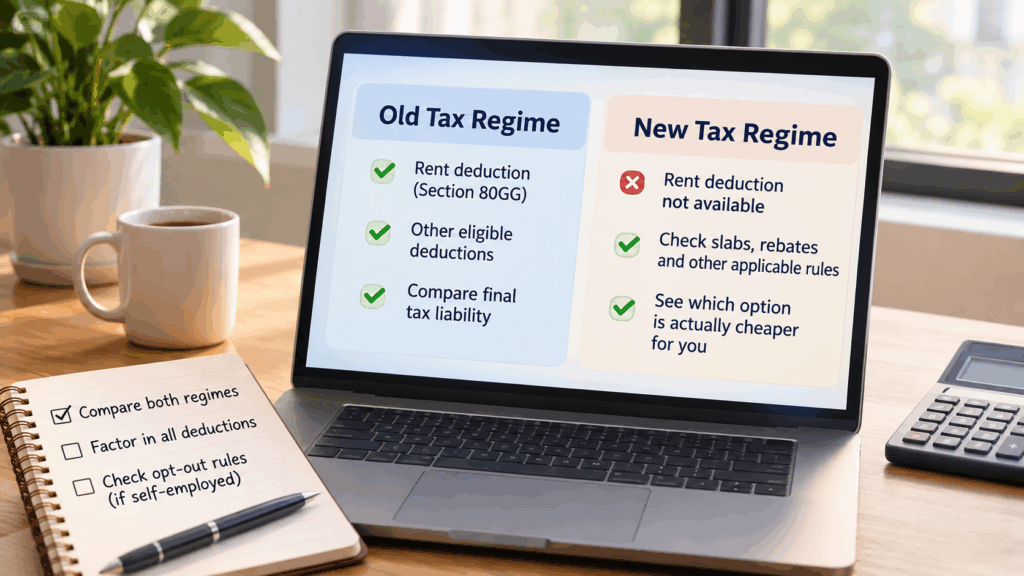
This rent deduction belongs to the old tax regime. Under the 1961 Act, Section 115BAC restricts the relevant Chapter VI-A deductions; under the 2025 Act, Section 202’s exclusions likewise keep Section 134 outside the new regime’s permitted deductions. Filing the rent declaration does not make the deduction available under the new regime.
However, having eligible rent does not automatically make the old regime cheaper. Compare the final liability under both options after accounting for the applicable slabs, standard deduction where available, rebates, other deductions and special-rate income. In some cases, a taxpayer saves little or no additional tax through the rent deduction.
Self-employed applicants should also check the rules and deadlines for opting out of the default regime. Business and professional taxpayers face different switching conditions from people without such income. The Department’s Form 10-IEA guidance explains the election for applicable 1961 Act years; use the corresponding requirements for a later tax year. Do not assume you can change regimes freely each year or choose the old regime through the rent form alone.
Digital payment methods can make the supporting trail easier to maintain. RentOk’s article on rent payment options and keeping receipts explains the record-keeping side. Your payment method supports evidence; it does not determine your tax eligibility.
How RentOK helps you keep rent receipts ready
An eligible claim needs accurate rent records, whether you use Form 10BA for an earlier income period or Form 31 under the newer framework. RentOK supports receipt preparation and rental payment records, helping residents and operators organise the amounts behind the claim.
- Prepare clear rent receipts: Use the supported receipt workflow to record the resident, property, rental period and actual amount received. Review the details and landlord acknowledgement before using the document as supporting evidence.
- Retrieve payment receipts: Residents can download or save receipts through the supported payment interface. Keep an independent copy so you can prepare the annual rental summary without searching old conversations.
- Check payment history: Operators can review recorded transactions and pending dues, helping resolve mismatches between a resident’s bank transfers and the receipts issued for particular months.
- Keep the claim amount explainable: Retain receipts alongside the agreement and a genuine accommodation-versus-services breakdown. Clearly separated records help you avoid including a refundable deposit or an unrelated service payment as residential rent.
The RentOk payment-page release notes describe the receipt download and save option. RentOK supports the documentation workflow; it does not file your tax declaration, choose your regime or guarantee that the deduction qualifies.
Conclusion
No HRA can leave room for a residential rent deduction, but the claim depends on more than a receipt. Check your ownership position, calculate the lowest of the three limits and compare your total tax under both regimes. For PG accommodation, establish the genuine residential rent component before applying the formula.
Match the filing documents to the income period: Section 80GG and Form 10BA for the applicable earlier years, or Section 134 and Form 31 for Tax Year 2026–27. Get rent receipts from RentOk, reconcile them with your payments and keep the supporting records ready before you file.
Frequently Asked Questions
Find answers to common questions about this topic
About the Author
Ishika Pannu
Ishika Pannu brings you the latest insights and easy-to-apply strategies in property management—helping you simplify renting and grow with RentOk.