Market Trends
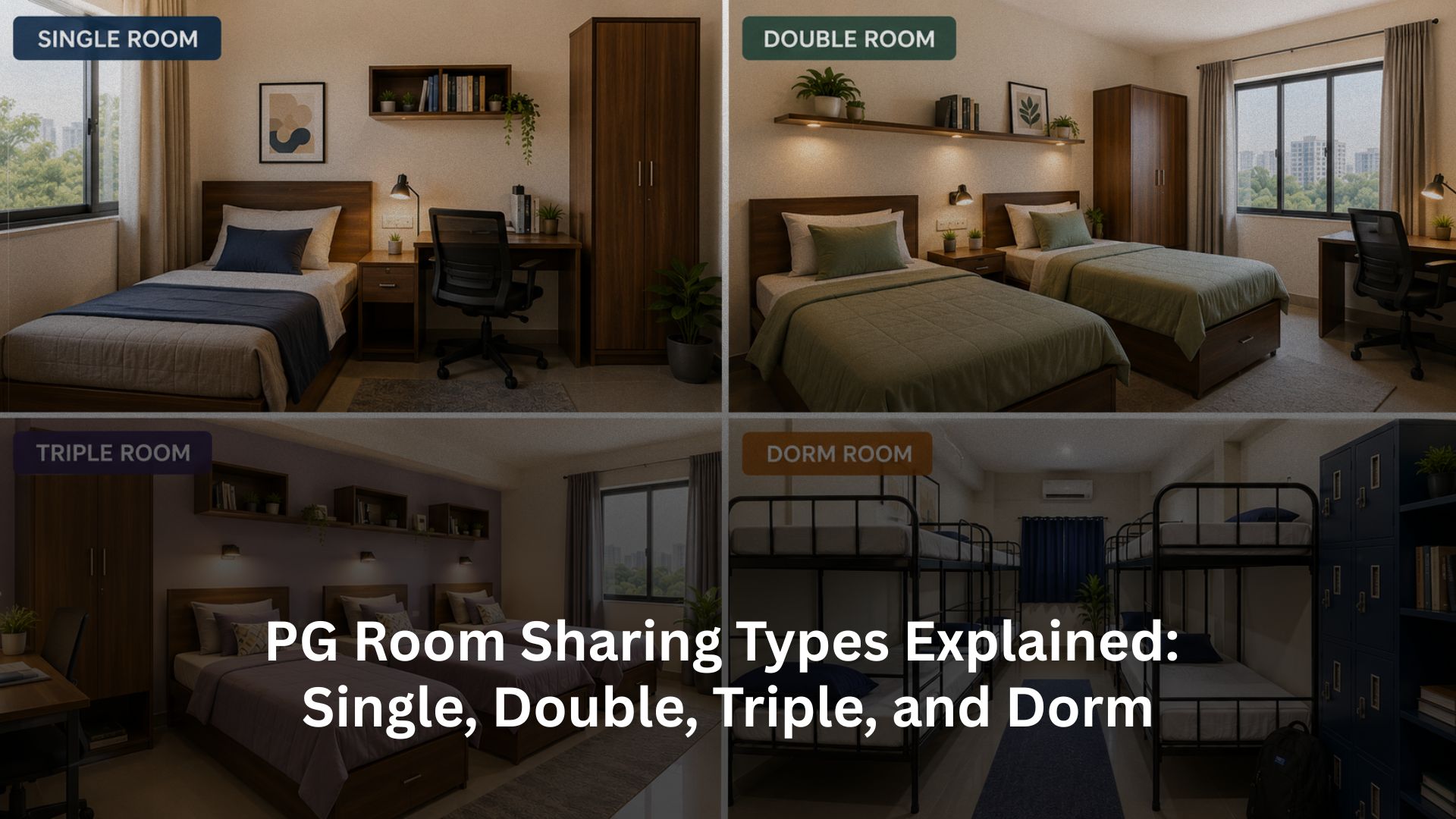
PG Room Sharing Types Explained: Single, Double, Triple, and Dorm

Written by
Ishika Pannu
Read Time
12 min read
Posted on
June 28, 2026
Overview
Overview
PG Room Sharing Types Explained: Single, Double, Triple, and Dorm
Choosing the right room-sharing model is one of the most important decisions a PG owner can make. It doesn’t just determine how many tenants your property can accommodate. It also influences occupancy, pricing, tenant satisfaction, operational efficiency, and long-term profitability.
Many new operators focus heavily on amenities, interiors, or marketing. While these factors certainly matter, the way you configure your rooms often has a greater impact on how your property performs over time.
After all, every tenant is looking for something different.
A working professional relocating for a new job may happily pay more for privacy. A college student, on the other hand, is usually searching for accommodation that keeps monthly expenses low. Interns, corporate trainees, and short-term residents often fall somewhere in between.
This is exactly why understanding different PG sharing types is essential before you decide your pricing strategy or start listing your property.
Today’s tenants also spend more time researching before making a decision. Whether they’re browsing NoBroker, MagicBricks, 99acres, Flat & Flatmates, or even Facebook Marketplace, they expect clear room categories, transparent pricing, and detailed property information before scheduling a visit.
The operators who understand this early are usually the ones who maintain better occupancy throughout the year.
Instead of treating every room the same, they build an inventory that appeals to different budgets, lifestyles, and tenant expectations.
In this guide, we’ll break down the four most common PG sharing types, single, double, triple, and dormitory accommodation. We’ll also look at where each room type performs best, who it’s designed for, and how it impacts your property’s profitability.
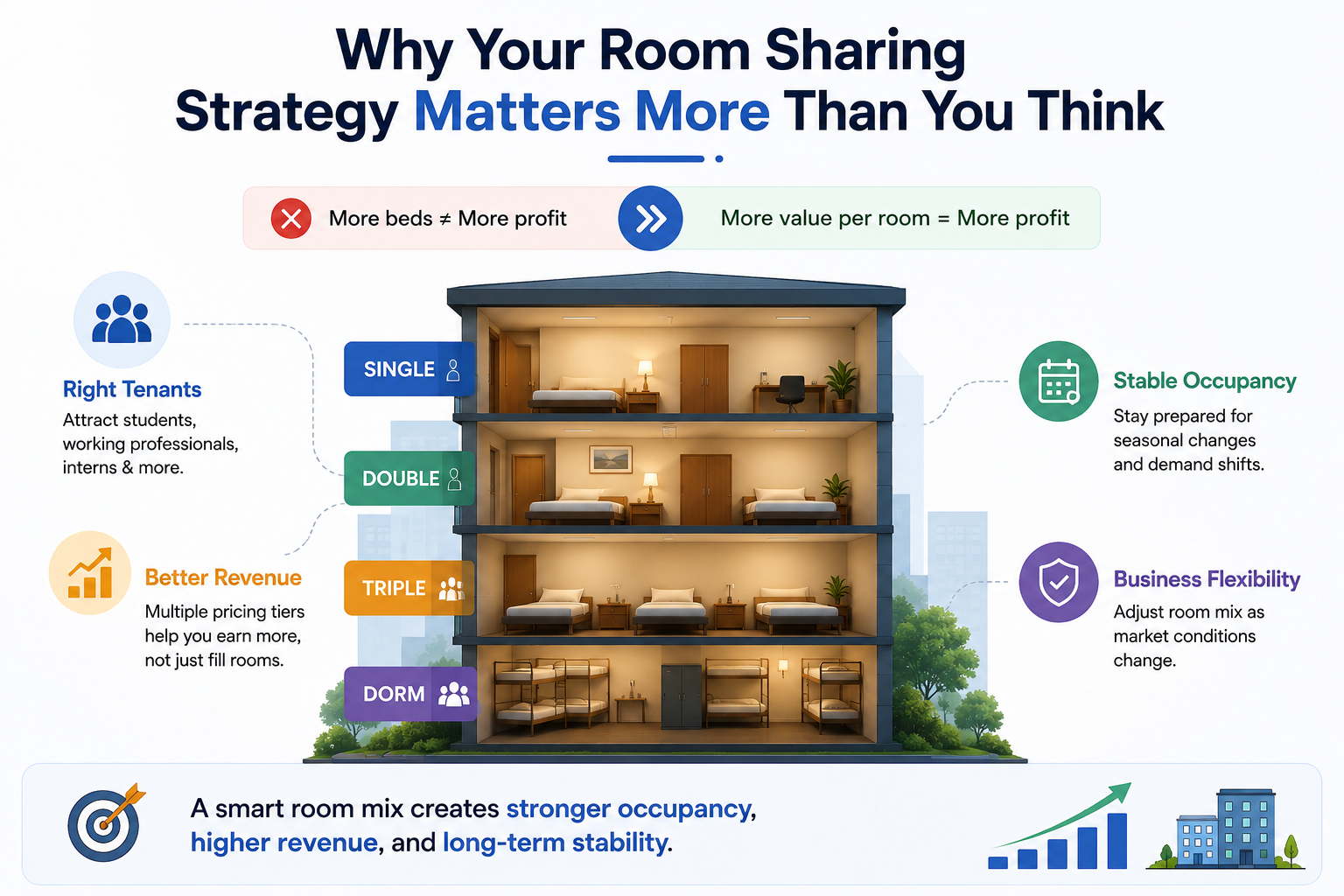
Why Your Room Sharing Strategy Matters More Than You Think
Many first-time property owners believe profitability is simply a numbers game.
The logic seems straightforward, the more beds you fit into a building, the more rent you can collect.
In reality, successful PG businesses don’t just maximize occupancy.
They maximize the value of every room.
A poorly planned room mix can quietly affect multiple parts of your business. You may receive plenty of enquiries but struggle with conversions because your pricing doesn’t match local demand. Or you may attract only one type of tenant, leaving large sections of the market untapped.
For example, a property offering only premium single-sharing rooms may struggle near a university where affordability is the biggest deciding factor. Likewise, a property with only triple-sharing rooms may lose working professionals looking for quieter accommodation.
The strongest operators don’t choose one room type over another.
They build a balanced inventory based on:
- Local demand, including nearby colleges, office hubs, and industrial areas that influence the type of tenants searching for accommodation.
- Target audience, ensuring students, working professionals, interns, or corporate employees all have suitable room options based on their budgets.
- Revenue potential, creating multiple pricing tiers instead of depending on one accommodation category to generate income.
- Long-term occupancy goals, making it easier to maintain stable occupancy throughout seasonal changes and fluctuations in rental demand.
A thoughtful room-sharing strategy doesn’t just improve occupancy.
It gives your property far greater flexibility as market conditions change.
Single Sharing Rooms: Privacy Comes at a Premium
Single-sharing rooms have become increasingly popular over the past few years. As more professionals relocate for work and remote jobs become common, privacy has become a valuable feature rather than just a luxury.
Unlike shared accommodation, these rooms offer residents complete control over their living space. They don’t need to coordinate schedules, share wardrobes, or worry about noise from roommates.
For many tenants, that convenience is worth paying extra for.
Single-sharing rooms are especially popular among:
- Working professionals relocating for long-term jobs.
- Remote employees who regularly attend virtual meetings.
- Consultants and corporate executives travelling between cities.
- Students preparing for competitive examinations.
- Residents planning to stay for an extended period.
From an operator’s perspective, single-sharing rooms serve as the premium category within the property.
Although each room accommodates only one tenant, the higher monthly rent often compensates for the lower occupancy. In premium locations, this room type can significantly improve overall revenue without requiring additional floor space.
The operational advantages are equally important.
Since the room is occupied by one resident, managers spend considerably less time resolving roommate disputes. Issues related to cleanliness, storage, personal belongings, or conflicting schedules become far less common.
That doesn’t mean every property should maximise single occupancy.
Location plays a critical role.
Properties near corporate offices, IT parks, and business districts usually experience stronger demand for private rooms because professionals prioritise comfort and convenience. However, the same strategy may not perform well near universities where affordability often drives decision-making.
Before deciding how many private rooms to create, operators should evaluate local demand rather than simply following competitors.
Sometimes, fewer premium rooms combined with shared accommodation generate stronger long-term occupancy than an entire building of private rooms.
Double Sharing Rooms: The Most Balanced Option
If one room category consistently performs well across almost every rental market, it’s double sharing.
Double-sharing rooms sit comfortably between affordability and privacy. They offer tenants a lower monthly rent than private accommodation while avoiding the crowding often associated with triple-sharing rooms or dormitories.
That’s exactly why this configuration continues to dominate the Indian PG market.
For tenants, the value is obvious.
They reduce accommodation costs without giving up too much personal space.
For operators, the benefits go much further.
Double-sharing rooms generally attract a wider audience than premium rooms. They remain relevant for students, fresh graduates, young professionals, and employees relocating to a new city.
This broad appeal makes occupancy far more predictable throughout the year.
Some of the biggest advantages include:
- Steady demand across different tenant segments, making these rooms easier to lease regardless of whether your property primarily serves students or working professionals.
- Healthier occupancy rates, since sharing the monthly rent makes the accommodation affordable for a much larger audience.
- Better revenue without overcrowding, allowing operators to increase room earnings while still maintaining a comfortable living environment.
Another reason experienced operators prefer double-sharing rooms is flexibility.
A spacious double-sharing room can often be repositioned depending on market demand. During periods when premium accommodation is in demand, it can temporarily be offered as a larger single room. When affordability becomes the deciding factor, it can quickly return to its original configuration.
This flexibility gives operators greater pricing control without requiring structural changes to the property.
It’s one of the reasons why double sharing forms the backbone of many successful PG businesses.
Triple Sharing Rooms: Maximising Space Without Compromising Operations
Triple-sharing rooms are often viewed purely as a budget option.
In reality, they can become one of the most profitable room categories when planned correctly.
Their success depends largely on location.
Areas surrounding universities, coaching institutes, industrial hubs, and manufacturing zones usually attract tenants who prioritise affordability above everything else. These residents are often willing to compromise on personal space if it significantly reduces their monthly expenses.
For many students and entry-level professionals, that’s a practical trade-off.
Lower rent means they can stay closer to their college or workplace without stretching their monthly budget.
However, operators should avoid assuming that adding another bed automatically increases profitability.
Higher occupancy also increases operational responsibility.
A successful triple-sharing room should always include:
- Well-planned storage solutions so every resident has adequate space for luggage, clothing, and study materials.
- Proper ventilation and natural lighting, helping maintain a comfortable living environment even with higher occupancy.
- Frequent housekeeping schedules, since shared rooms naturally experience higher daily usage and require greater attention to cleanliness.
- Clearly communicated house rules, reducing conflicts around visitors, study hours, shared facilities, and personal responsibilities.
Ignoring these operational details often results in poor tenant experiences, higher complaint volumes, and weaker online reviews.
On the other hand, well-managed triple-sharing rooms allow operators to maximise available space while serving one of the largest customer segments in India’s rental market.
For properties located near educational institutions or industrial areas, they often become an essential part of a balanced room inventory.
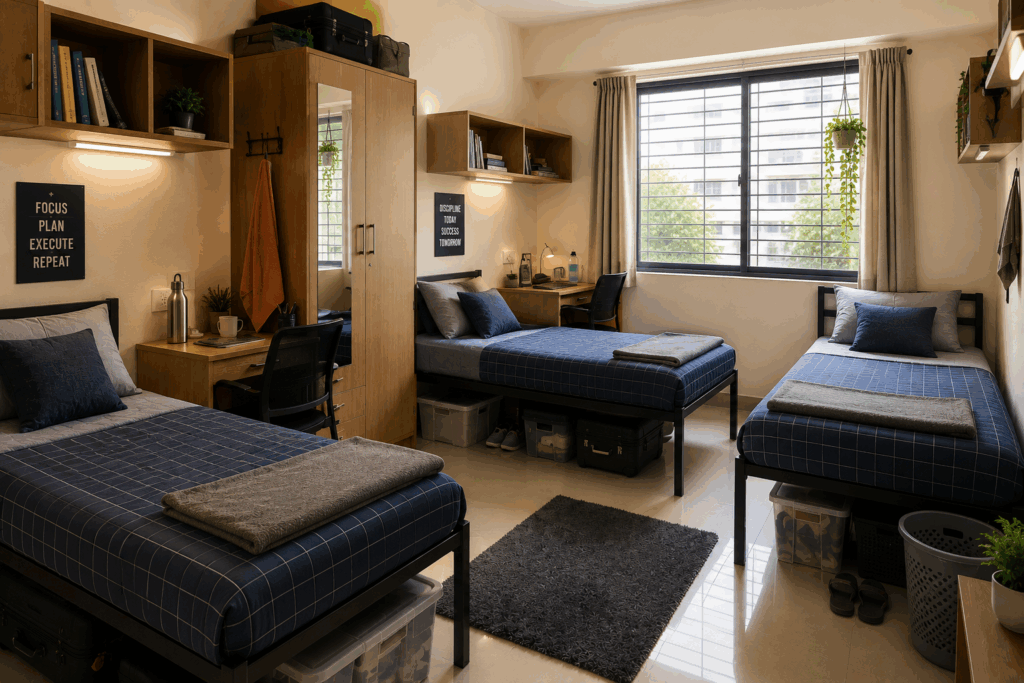
Dormitory Accommodation: Best for High-Capacity Properties
Dormitory accommodation follows a very different business model from traditional PG rooms.
Instead of focusing on privacy, dorms are designed to maximise bed capacity while keeping accommodation affordable. They are commonly seen in worker housing, student hostels, internship accommodations, transit stays, and large co-living spaces where short-term occupancy is common.
For operators, dormitories offer one major advantage.
Higher occupancy from the same built-up area.
However, higher occupancy also means greater operational complexity. More residents sharing the same space naturally leads to increased maintenance requirements, higher utility consumption, and more frequent coordination.
Managing a dorm successfully isn’t just about fitting more beds into a room.
It requires stronger operational systems.
Properties offering dorm accommodation should pay close attention to:
- Housekeeping frequency, as shared spaces require regular cleaning to maintain hygiene and tenant satisfaction.
- Security measures, including secure lockers, CCTV coverage, visitor management, and access control to build trust among residents.
- Common facility management, ensuring washrooms, kitchens, and shared spaces can comfortably support higher occupancy.
- Community rules, helping reduce conflicts related to noise, cleanliness, shared belongings, and visitor policies.
Dormitories work particularly well for:
- Students attending short-term coaching programs.
- Corporate interns relocating for temporary projects.
- Workers requiring affordable accommodation near industrial zones.
- Seasonal employees and trainees.
- Budget-conscious travellers looking for longer stays.
For premium co-living brands, dormitories may not always fit the positioning. However, for operators targeting affordability and high occupancy, they can become an important revenue driver when managed professionally.
Which PG Sharing Type Is the Most Profitable?
This is one of the most common questions new PG owners ask.
The answer is simple.
There isn’t a single room type that generates the highest profit in every market.
Profitability depends on three major factors:
- Your property’s location.
- The tenants you’re targeting.
- The demand in your local market.
For example, a property located near an IT park may earn better returns with a higher proportion of single-sharing rooms because professionals are willing to pay for privacy.
The same strategy could fail completely near a university.
Students often compare monthly accommodation costs before anything else. In those markets, double and triple-sharing rooms usually maintain stronger occupancy and generate more consistent revenue throughout the year.
Rather than asking,
“Which room type earns the most?”
Operators should ask,
“Which room mix suits my market?”
Experienced property owners rarely rely on one accommodation category.
Instead, they create a balanced inventory that serves multiple customer segments.
A typical mix might include:
- Premium single-sharing rooms for professionals willing to pay higher rents.
- Double-sharing rooms that serve as the property’s primary occupancy driver.
- Triple-sharing rooms for budget-conscious students and fresh graduates.
- Dormitory accommodation wherever high-capacity, affordable housing is in demand.
This diversified approach reduces business risk while helping operators maintain healthier occupancy throughout the year.
Factors to Consider Before Finalising Your Room Mix
Choosing room-sharing types shouldn’t be based solely on available floor space.
It should begin with understanding the local rental market.
Before planning your inventory, ask yourself a few important questions.
Who are the majority of tenants in your area?
Are they students, working professionals, factory employees, or corporate executives?
What monthly budget are they comfortable with?
How are nearby PGs positioning themselves?
The answers to these questions will help you design a room mix that aligns with actual demand instead of assumptions.
Some of the most important factors include:
- Location: Properties near colleges often perform better with double and triple-sharing rooms, while business districts generally see stronger demand for private accommodation.
- Room dimensions: Larger rooms may comfortably accommodate additional residents, but overcrowding should never compromise comfort or safety.
- Target audience: Every tenant segment values different things. Understanding those priorities helps operators create better room configurations.
- Amenities offered: Features like attached washrooms, air conditioning, study desks, and high-speed Wi-Fi influence the type of room tenants are willing to pay for.
- Competition: Studying nearby properties helps you identify gaps in the market instead of simply copying existing room configurations.
Ultimately, the objective isn’t to maximise beds.
It’s to maximise long-term occupancy, tenant satisfaction, and revenue.
Listing Your Rooms the Right Way Matters Too
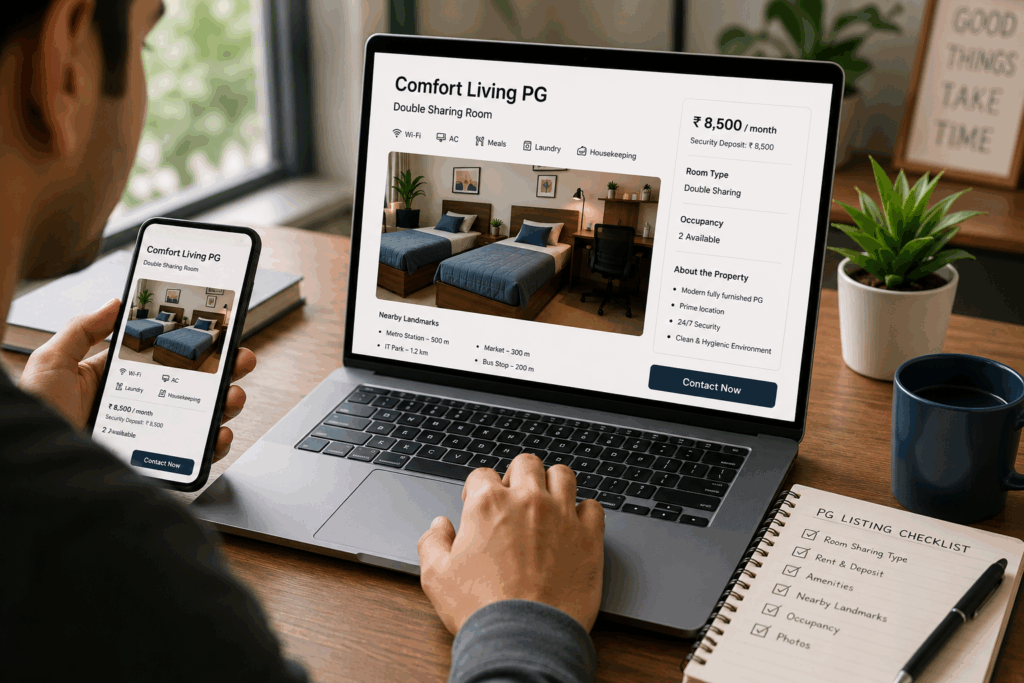
Even the best room mix won’t generate enquiries if your listings fail to communicate the value of each accommodation type.
Today’s tenants compare multiple properties before making a decision. They expect complete information before scheduling a visit.
Whether you’re listing your property on NoBroker, MagicBricks, 99acres, Flat & Flatmates, or promoting vacancies through Facebook Marketplace, your listings should clearly mention:
- The room-sharing type available.
- Monthly rent and security deposit.
- Included amenities.
- Nearby landmarks.
- Occupancy availability.
- High-quality room photographs.
Many operators lose potential tenants simply because their listings don’t answer basic questions.
A detailed listing not only improves enquiry quality but also reduces unnecessary follow-up calls from prospective tenants.
How RentOk Helps You Manage Different PG Sharing Types
Managing different room categories becomes increasingly difficult as your property grows.
Tracking occupancy, vacancies, pricing, tenant allocation, and rent collection across multiple room types using spreadsheets can quickly become confusing. The challenge becomes even greater when you’re managing multiple properties with different layouts and pricing structures.
RentOk helps simplify this entire process by bringing your room inventory and day-to-day operations onto one centralized platform.
With RentOk, operators can easily manage:
- Room availability across single, double, triple, and dormitory accommodation.
- Tenant allocation without manually updating multiple registers or spreadsheets.
- Occupancy and vacancy tracking for faster decision-making.
- Rent collection and payment records linked to individual rooms.
- Property listings and operational visibility as the business scales.
Instead of spending time juggling disconnected systems, operators gain a clear overview of their entire property. This allows them to optimise occupancy, respond to enquiries faster, and manage different room categories with greater confidence.
Conclusion
Selecting the right PG sharing types is about much more than deciding how many beds fit inside a room. It shapes your property’s pricing strategy, target audience, occupancy levels, and overall profitability.
Single-sharing rooms offer privacy and premium pricing. Double-sharing rooms strike the perfect balance between affordability and comfort. Triple-sharing rooms serve budget-conscious tenants, while dormitories maximise occupancy for high-demand properties.
The most successful operators understand that there is no universal formula.
Instead of relying on one room configuration, they build a balanced inventory that reflects local demand and evolving tenant preferences.
As your property grows, managing multiple room types also becomes more complex. Having the right operational systems in place can make the difference between reactive property management and sustainable growth.
Looking to simplify room management and improve occupancy across your PG? Book a free demo with RentOk today and discover how one platform can help you manage room inventory, tenants, rent collection, and property operations more efficiently.
About the Author
Ishika Pannu
Ishika Pannu brings you the latest insights and easy-to-apply strategies in property management—helping you simplify renting and grow with RentOk.