Market Trends
Real Estate Property Management Software Explained

Written by
Ishika Pannu
Read Time
7 min read
Posted on
April 6, 2026
Overview
Overview
Real Estate Property Management Software Explained
Real estate management has changed significantly over the last few years. What once worked with notebooks, spreadsheets, and manual follow-ups is no longer enough for growing property portfolios. As operators manage more properties, more tenants, and more financial transactions, the complexity of operations increases quickly.
Whether you’re managing residential apartments, PG accommodations, rental homes, or commercial spaces, day-to-day operations can become overwhelming without structured systems.
This is where real estate property management software becomes essential. Instead of managing everything manually, property managers can centralize operations, improve visibility, and reduce operational stress.
In this guide, we’ll break down how real estate property management software works, why the industry is shifting toward PropTech, what features matter most, and how platforms like RentOk help simplify property management.
Why Real Estate Management is Becoming More Complex
Managing real estate today is not just about collecting rent. As portfolios grow, operators must manage multiple responsibilities at once. What used to be a simple process quickly becomes operationally demanding.
Property managers today often handle:
- Multiple properties across locations
- Different tenant types and lease agreements
- Maintenance coordination
- Payment tracking and reconciliation
- Occupancy planning
- Financial reporting
At first, these tasks may seem manageable. But as your business grows, even small inefficiencies begin to create operational friction.
You may start noticing:
- Payments getting missed in records
- Difficulty tracking multiple tenants
- Delayed responses to maintenance requests
- Confusion around security deposits
- Lack of clarity on occupancy levels
These challenges don’t happen because of poor management. They happen because manual systems simply weren’t designed to handle growing portfolios.
This is why more operators are moving toward real estate rental management software.

What is Real Estate Property Management Software?
Real estate property management software is a centralized platform that helps property managers handle day-to-day operations in one place. Instead of using spreadsheets, notebooks, and multiple communication channels, everything is organized into a structured system.
A typical real property management software helps operators manage:
- Tenant onboarding and records
- Rent tracking and payment monitoring
- Lease and agreement management
- Maintenance requests
- Occupancy tracking
- Financial reporting
The biggest advantage of using software is clarity. Instead of switching between tools, property managers can see everything from a single dashboard.
This helps reduce manual work and improves operational efficiency.
Over time, structured systems also help property managers scale without increasing operational complexity.
The Shift to PropTech
The real estate industry is rapidly moving toward PropTech, or property technology. This shift is changing how properties are managed, rented, and maintained.
Earlier, property management relied heavily on manual processes:
- Paper agreements
- Manual rent tracking
- Phone-based communication
- Physical documentation
While these methods worked in smaller setups, they became inefficient as portfolios expanded.
Today, PropTech solutions are introducing:
- Automated rent reminders
- Digital tenant records
- Cloud-based documentation
- Real-time dashboards
- Centralized communication
These changes help property managers save time and reduce operational errors.
More importantly, PropTech helps operators run their real estate businesses more professionally. Instead of reacting to issues, managers can proactively monitor operations and make better decisions.
This shift is becoming increasingly important as tenant expectations also evolve.
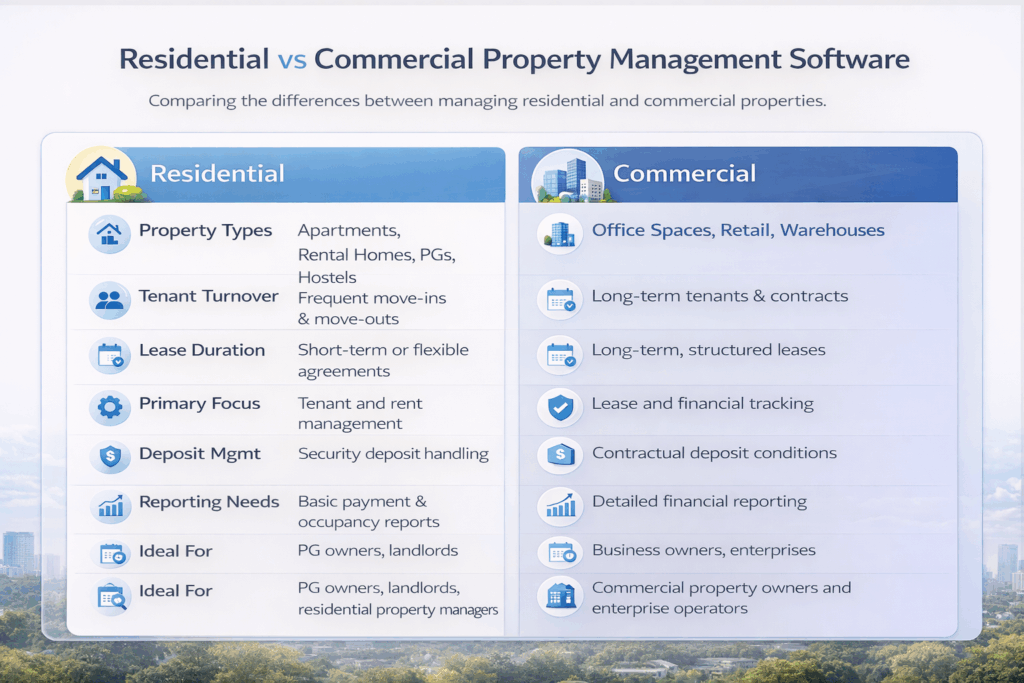
Residential vs Commercial Property Management Software
Real estate property management software often differs depending on the type of property being managed. Understanding this distinction helps property managers choose the right solution.
Residential Property Management Software
Residential property management software is typically used for:
- Apartments
- Rental homes
- PGs and hostels
- Co-living spaces
Unlike commercial properties, residential spaces often experience frequent tenant turnover and ongoing daily operations. As a result, efficient tenant management and accurate rent tracking become especially important for smooth property management.
Residential software usually focuses on:
- Tenant management
- Rent collection
- Deposit tracking
- Maintenance handling
These features help simplify daily operations and improve tenant experience.
Commercial Property Management Software
Commercial property management software is designed for:
- Office spaces
- Retail properties
- Warehouses
- Commercial buildings
These properties typically involve long-term leases and more structured agreements, making lease management and financial tracking especially important. Compared to residential properties, commercial assets often require more detailed reporting, compliance tracking, and tenant management.
Commercial solutions often focus on:
- Lease tracking
- Contract management
- Financial reporting
- Stakeholder coordination
Many operators manage both residential and commercial properties, which increases the need for flexible property management software.
Core Functionalities of Real Estate Property Management Software
While different platforms offer different features, certain core functionalities are essential for efficient property management.
Tenant Management
Tenant management is one of the most important aspects of property operations. Without proper tenant tracking, it becomes difficult to manage payments, agreements, and occupancy.
Property management software allows operators to:
- Store tenant details
- Track lease agreements
- View payment history
- Monitor occupancy
This creates a structured system where tenant information is easily accessible.
Rent Tracking and Payment Management
Rent collection is one of the most time-consuming parts of property management. Manual tracking often leads to confusion, especially when handling multiple tenants.
Software simplifies rent tracking by:
- Tracking payments automatically
- Showing pending dues
- Sending reminders
- Maintaining payment history
This reduces manual follow-ups and improves payment visibility.
Lease and Agreement Management
Managing lease agreements manually can become difficult, especially when handling multiple properties.
Software helps operators:
- Track lease start dates
- Monitor renewal timelines
- Store agreements securely
This improves documentation management and reduces errors.
Maintenance Management
Maintenance requests are a regular part of property management. Without a structured system, tracking requests becomes difficult.
Property management software helps operators:
- Log maintenance requests
- Track progress
- Assign tasks
This improves response time and tenant satisfaction.
Occupancy Tracking
Occupancy tracking helps property managers understand how their properties are performing.
Software allows operators to:
- View vacant units
- Track occupancy trends
- Plan tenant onboarding
This helps reduce vacancy and improve planning.
Financial Reporting
Financial reporting is essential for understanding property performance.
Software helps generate:
- Revenue reports
- Payment summaries
- Pending dues reports
These insights help property managers make informed decisions.
Why Manual Systems No Longer Work
Manual systems may work for small portfolios, but as operations grow, they quickly become inefficient. Managing properties through spreadsheets, notebooks, and scattered communication makes it harder to stay organized and maintain accuracy.
As the number of tenants, properties, and transactions increases, manual processes often lead to delays, errors, and limited visibility into operations.
Common challenges with manual systems include:
- Searching through multiple records
- Manual calculations and tracking
- Missed rent or lease updates
- Difficulty tracking tenants and payments
- Lack of visibility across properties
Over time, these inefficiencies slow operations and make scaling difficult. Property managers end up spending more time managing data instead of focusing on growth.
Digital property management software helps solve these issues by centralizing information, automating tasks, and improving operational visibility.
Future Trends in Real Estate Property Management Software
Property management technology continues to evolve as operators look for smarter and more efficient ways to manage growing portfolios. Modern software solutions are introducing features that improve visibility, reduce manual work, and support long-term growth.
Key trends shaping the future include:
- Automation
Automation helps reduce repetitive tasks such as rent reminders and payment tracking. - Mobile-First Platforms
Mobile apps allow property managers to manage operations from anywhere. - Cloud-Based Systems
Cloud systems improve accessibility and security. - Data Insights
Analytics help property managers make better decisions.
These advancements help property managers streamline operations, reduce errors, and scale more efficiently. As technology continues to evolve, digital property management software will play an even bigger role in modern real estate operations.

How RentOk Simplifies Real Estate Property Management
Managing multiple properties manually becomes increasingly difficult. This is where RentOk helps bring structure to operations.
RentOk provides a centralized dashboard where property managers can handle:
- Tenant management
- Rent tracking
- Occupancy monitoring
- Document storage
- Financial reporting
Instead of juggling multiple tools, everything is available in one place.
RentOk also helps improve operational visibility. Property managers can track performance, manage tenants, and monitor finances more efficiently.
This helps reduce manual work and improves operational clarity.
As portfolios grow, structured systems like RentOk help property managers scale without increasing operational complexity.
Moving Toward Smarter Real Estate Management
Real estate management is becoming more complex, and manual systems are no longer enough. Property managers are moving toward structured digital platforms that improve efficiency and visibility.
Real estate property management software helps operators manage tenants, track finances, and monitor occupancy more effectively.
RentOk provides a centralized solution designed to simplify property management and improve operational efficiency.
If you’re managing multiple properties and looking to bring structure to your operations, adopting a platform like RentOk can help you manage more efficiently while preparing for long-term growth.
About the Author
Ishika Pannu
Ishika Pannu brings you the latest insights and easy-to-apply strategies in property management—helping you simplify renting and grow with RentOk.