Market Trends
The Landlord’s Guide to SEO

Written by
Ishika Pannu
Read Time
11 min read
Posted on
May 11, 2026
Overview
Overview
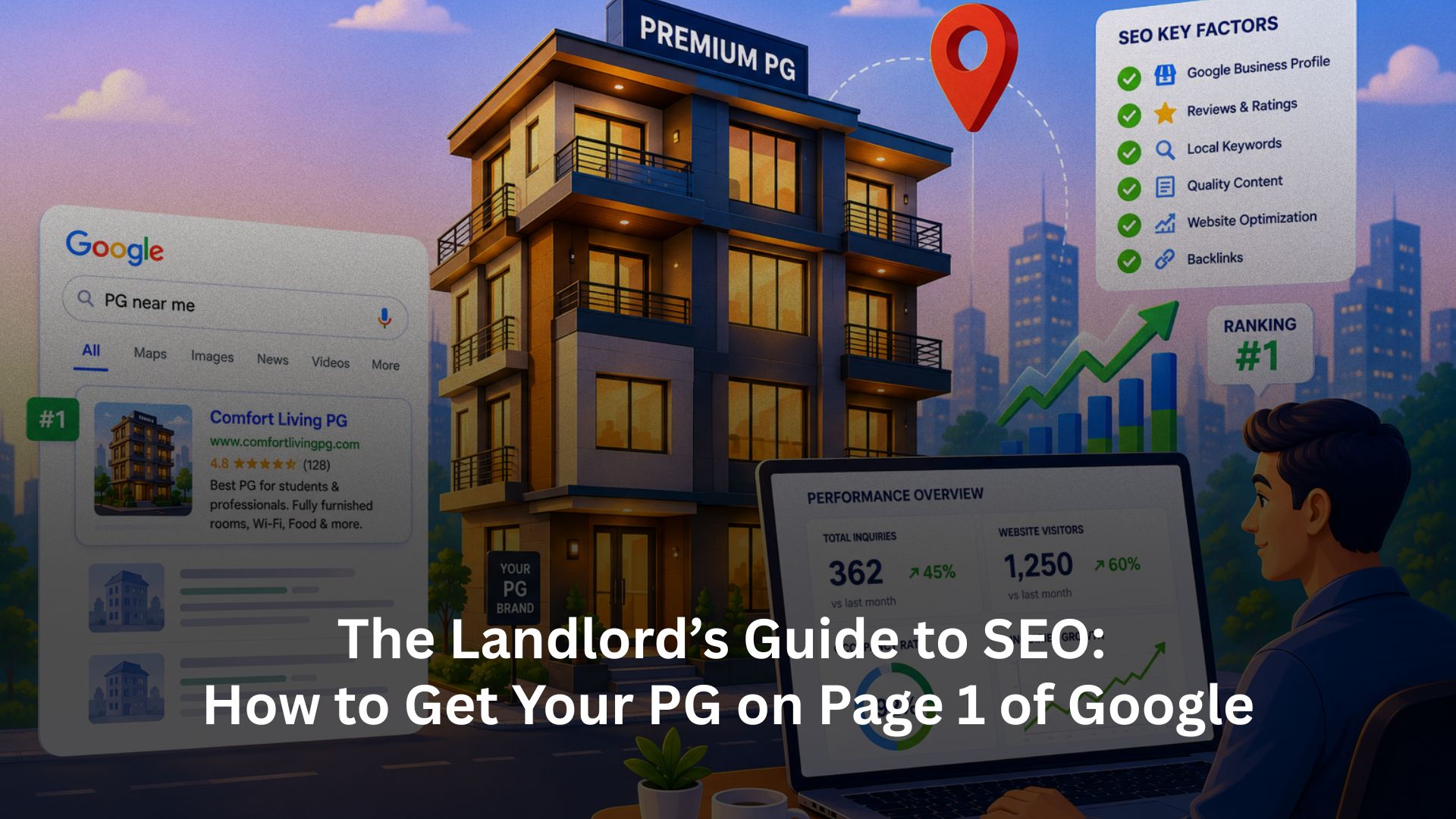
The Landlord’s Guide to SEO: How to Get Your PG on Page 1 of Google
The PG market has become extremely competitive over the last few years, but most operators are still approaching marketing with an old mindset. They continue depending heavily on brokers, listing platforms, WhatsApp forwards, and discounts whenever occupancy drops. While these methods still generate inquiries, they also create dependency. The moment broker activity slows down or listing visibility drops, occupancy immediately gets affected.
What has changed most is tenant behavior.
Today’s tenant journey begins online long before the first call happens. A student moving to Delhi or a working professional relocating to Bangalore will typically spend hours researching accommodation options before contacting anyone. They compare reviews, explore localities on Google Maps, analyze room photos, check metro connectivity, and subconsciously decide whether a property feels trustworthy enough to even consider.
This is exactly where SEO becomes critical.
Search Engine Optimization is no longer just a marketing tactic for large companies. For PG operators, it has become a long-term visibility system that directly influences occupancy. If your property consistently appears on Google when tenants search for accommodation in your area, you automatically reduce dependence on brokers and paid platforms because inquiries start coming directly through your own digital presence.
That changes the business entirely.
Instead of constantly chasing tenants, your online visibility starts attracting them naturally.
Why SEO Works Exceptionally Well for PG Businesses
SEO performs differently in the rental industry because accommodation searches are highly intent-driven. People searching for PGs are not casually browsing the internet. Most of them are actively planning a move and are already looking for a place to stay.
Searches like:
- “Girls PG near North Campus with food”
- “Single room PG in Koramangala”
- “Co-living near Cyber City Gurgaon”
- “PG near metro station for working professionals”
usually happen when someone has:
- a location preference already decided,
- a budget range in mind,
- and an expected move-in timeline.
That makes PG-related searches extremely valuable because the intent behind them is much stronger than general internet traffic.
This is one of the biggest reasons SEO creates long-term value for landlords. Unlike paid ads that stop producing inquiries the moment spending stops, SEO compounds over time. A properly optimized property page, Google Business Profile, or locality-specific blog can continue generating traffic and inquiries for months without additional advertising cost.
Over time, this reduces dependence on:
- broker commissions that keep increasing every year,
- listing platform boosts that only create temporary visibility,
- vacancy discounts that hurt profitability,
- and aggressive follow-up systems just to maintain occupancy.
Instead, your own online presence starts functioning like a long-term lead generation engine.
For a PG business where occupancy directly affects cash flow every month, that becomes a serious operational advantage.
Understanding How Google Actually Evaluates Your PG
One of the biggest misconceptions landlords have about SEO is that rankings improve simply by adding keywords repeatedly into a website. Modern SEO works very differently.
Google now evaluates overall trust and user experience. It tries to understand whether your property genuinely deserves to appear in front of someone searching for accommodation.
That evaluation includes factors like:
- how fast your website loads on mobile devices,
- whether your information stays consistent online,
- how frequently your property receives reviews,
- whether users spend time exploring your pages,
- and whether your content actually answers tenant concerns.
For example, if someone clicks your website and immediately leaves because:
- the photos look outdated,
- the layout feels cluttered,
- the pages load slowly,
- or the information feels incomplete,
Google notices that behavior.
Over time, those signals reduce your rankings because search engines interpret poor engagement as a weak user experience.
This is why strong SEO is closely connected to operational professionalism. Properties that are managed well offline usually perform better online because:
- tenant reviews improve naturally,
- communication stays clearer,
- information gets updated regularly,
- and the property appears more trustworthy digitally.
Good SEO is often the digital reflection of good operational systems.
Local SEO: The Foundation of PG Visibility
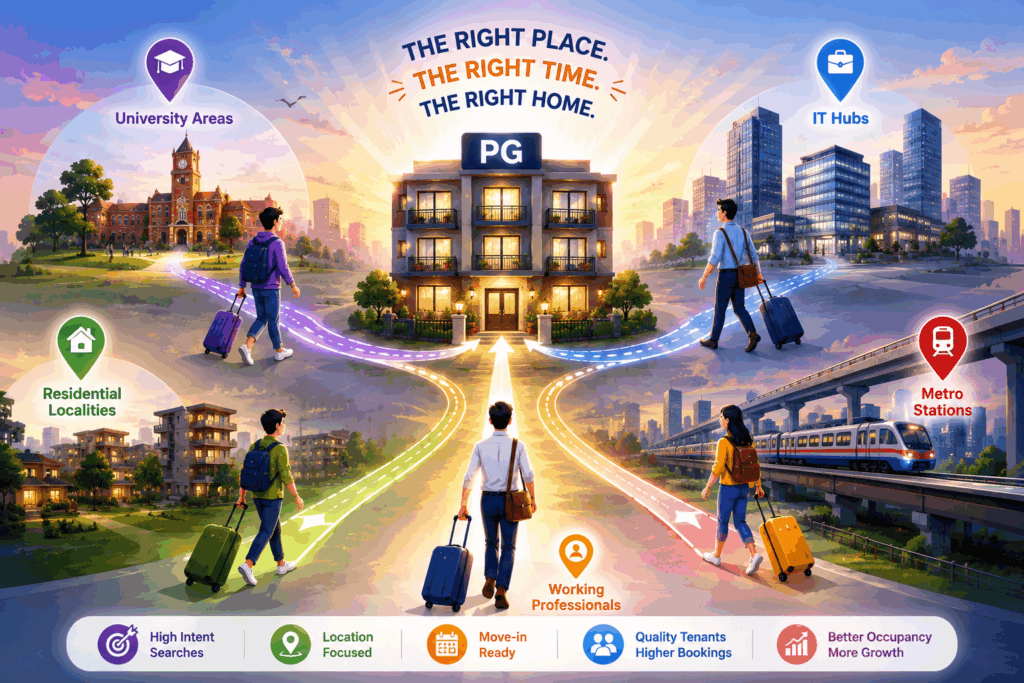
For PG businesses, local SEO matters far more than national visibility. You are not competing against every hostel or rental business in India. You are competing inside a very specific geography.
That geography could be:
- a university zone,
- a coaching hub,
- a metro-connected locality,
- or a corporate district.
This completely changes how SEO should be approached.
A PG near Delhi University should optimize visibility around:
- North Campus,
- Hudson Lane,
- Kamla Nagar,
- and nearby metro stations.
Similarly, a property targeting professionals in Bangalore should focus visibility around:
- tech parks,
- startup corridors,
- coworking districts,
- and office hubs.
The operators who dominate search results usually understand one thing very clearly:
local visibility drives occupancy.
And one of the strongest local SEO assets available today is Google Maps.
Most tenants now search directly through Maps because it instantly answers practical questions:
- How far is the property from office?
- Is metro connectivity good?
- What do the reviews look like?
- Does the locality feel safe?
- Are the room photos genuine?
That makes your Google Business Profile one of the most important digital assets your property has.
A properly optimized profile should include:
- accurate category selection that clearly reflects your accommodation type,
- professionally clicked room photos with proper lighting and cleanliness,
- detailed descriptions explaining amenities and tenant suitability,
- updated contact details and inquiry numbers,
- and consistent review activity from actual tenants.
Most PG profiles fail because they feel inactive. Old photos, missing descriptions, inconsistent contact details, and weak review activity immediately reduce trust.
Strong profiles, on the other hand, improve:
- local rankings,
- direct calls from search,
- walk-in inquiries,
- and overall conversion confidence.
And unlike paid visibility, this becomes stronger with time.
Reviews: The SEO Asset Most Landlords Underestimate
Most operators think reviews only affect tenant trust. In reality, reviews heavily influence Google rankings as well.
Search engines use reviews to understand:
- business credibility,
- tenant satisfaction,
- operational consistency,
- and activity levels.
Properties with:
- frequent reviews,
- detailed tenant experiences,
- and active engagement
usually rank significantly better locally because Google interprets them as more trustworthy and relevant.
But the real power of reviews lies in conversion psychology.
A review saying:
“Good PG”
creates almost no emotional confidence.
But a review saying:
“Stayed here for 11 months while working in Gurgaon. Internet was stable for office calls, housekeeping was regular, and metro connectivity made commuting much easier.”
instantly communicates:
- professionalism,
- operational reliability,
- and actual living experience.
That single review improves:
- click-through rates,
- inquiry confidence,
- and conversion probability simultaneously.
Encouraging genuine, experience-based reviews from tenants is one of the highest-ROI SEO activities available for landlords.
Keyword Strategy: Why Most PG Websites Target the Wrong Searches
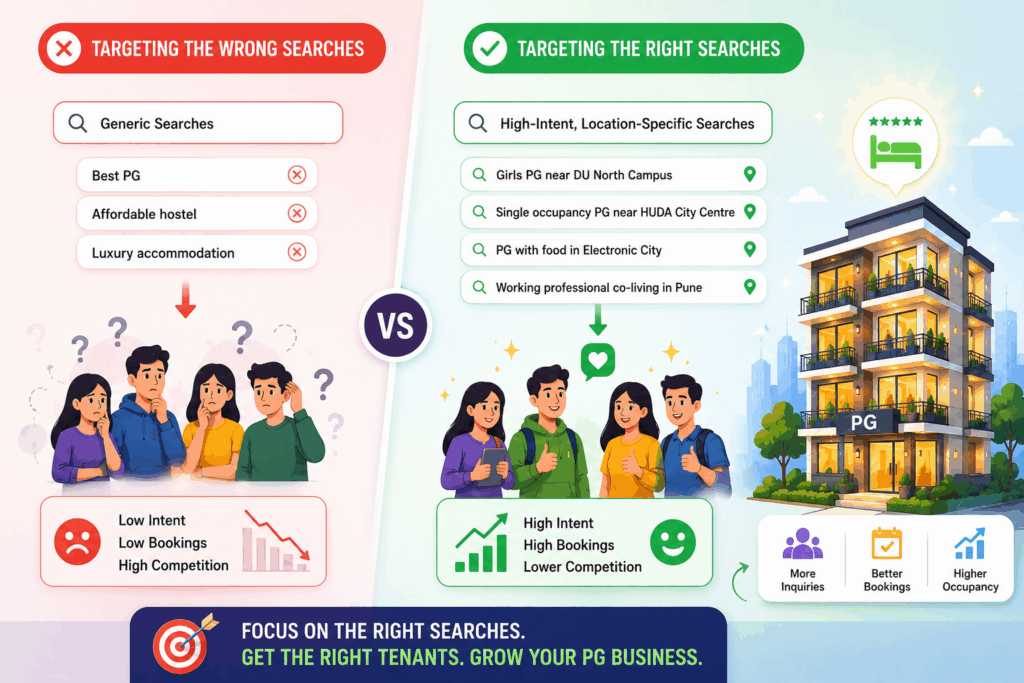
One of the most common SEO mistakes in the rental industry is targeting broad keywords like:
- “Best PG”
- “Affordable hostel”
- “Luxury accommodation”
These keywords sound attractive but usually perform poorly because they are:
- highly competitive,
- too generic,
- and often low-intent.
Strong SEO strategies focus on long-tail, location-specific searches instead.
For example:
- “Girls PG near DU North Campus”
- “Single occupancy PG near HUDA City Centre”
- “PG with food in Electronic City”
- “Working professional co-living in Pune”
These keywords may generate lower traffic individually, but the traffic is significantly more qualified because the user already knows:
- the locality they prefer,
- the accommodation type they need,
- and the amenities they care about.
That makes conversion far easier.
The difference between generic and high-intent searches becomes very clear when you compare them side by side:
| Generic Search | High-Intent Search |
|---|---|
| Best PG | Girls PG near North Campus |
| Affordable hostel | Single room PG near metro station |
| Co-living space | Co-living for professionals in Gurgaon |
| PG in Bangalore | PG near Electronic City with Wi-Fi |
The second category generates lower traffic volume but much stronger booking intent.
And in SEO, relevance matters more than raw traffic numbers.
Content Marketing: Why Blogs Build Long-Term SEO Strength
Most PG websites are extremely thin. They usually contain:
- room photos,
- pricing information,
- and a generic amenities section.
That is no longer enough to compete online.
Google rewards websites that consistently publish useful and experience-based content because it signals authority and expertise. This is where blogs become one of the strongest long-term SEO assets for landlords.
The best-performing blogs solve actual tenant concerns instead of aggressively promoting the property.
Topics that usually perform well include:
- relocation guides for students and professionals moving into a new city,
- budgeting advice for first-time renters trying to manage expenses,
- work-from-PG infrastructure setups for remote professionals,
- co-living trends and lifestyle expectations,
- safety checklists before choosing accommodation,
- and locality comparison guides explaining connectivity and convenience.
This kind of content improves:
- organic search visibility,
- tenant trust,
- and brand familiarity simultaneously.
Over time, your website stops feeling like “just another PG listing” and starts feeling like a reliable accommodation brand that genuinely understands tenant needs.
That authority matters heavily because shared accommodation decisions are deeply trust-driven.
Tenants are not just choosing a room.
They are choosing:
- a routine,
- a lifestyle,
- a sense of comfort,
- and a place where they may live for months or years.
Website Optimization: Where Most PG Websites Feel Weak
A website is not useful simply because it exists. Google evaluates the actual user experience.
If your website:
- loads slowly on mobile devices,
- feels cluttered,
- lacks proper navigation,
- or looks outdated,
users leave quickly.
And when users leave quickly, rankings eventually decline because search engines interpret that behavior as poor user satisfaction.
A strong PG website should immediately feel structured and trustworthy. It should contain:
- dedicated pages for room categories instead of mixing everything together,
- locality-focused pages targeting nearby landmarks and metro stations,
- high-quality real photos instead of low-resolution or stock-style visuals,
- mobile-first design because most searches happen through smartphones,
- FAQs answering real tenant concerns,
- and clear inquiry flow through WhatsApp or direct calls.
Most importantly, the website should instantly answer:
- who the property is designed for,
- what lifestyle it supports,
- and why someone should trust it over nearby options.
The clearer these answers become, the stronger both:
- inquiry conversion,
- and SEO performance become.
Local Link Building: The Authority Layer Most PGs Ignore
Google heavily values authority signals, and one of the strongest indicators of authority is backlinks, when other relevant websites mention or link to your property.
For PG businesses, local backlinks matter far more than random internet mentions.
Useful opportunities include:
- student community websites recommending nearby accommodation,
- coaching institute accommodation pages,
- local business directories,
- university references,
- and neighborhood blogs discussing housing options.
Partnerships also improve authority significantly.
Collaborating with:
- gyms,
- cafes,
- coworking spaces,
- and coaching institutes
helps strengthen local visibility because it signals that your property is genuinely connected to the surrounding ecosystem.
Over time, these local trust signals improve:
- search rankings,
- credibility,
- and discoverability.
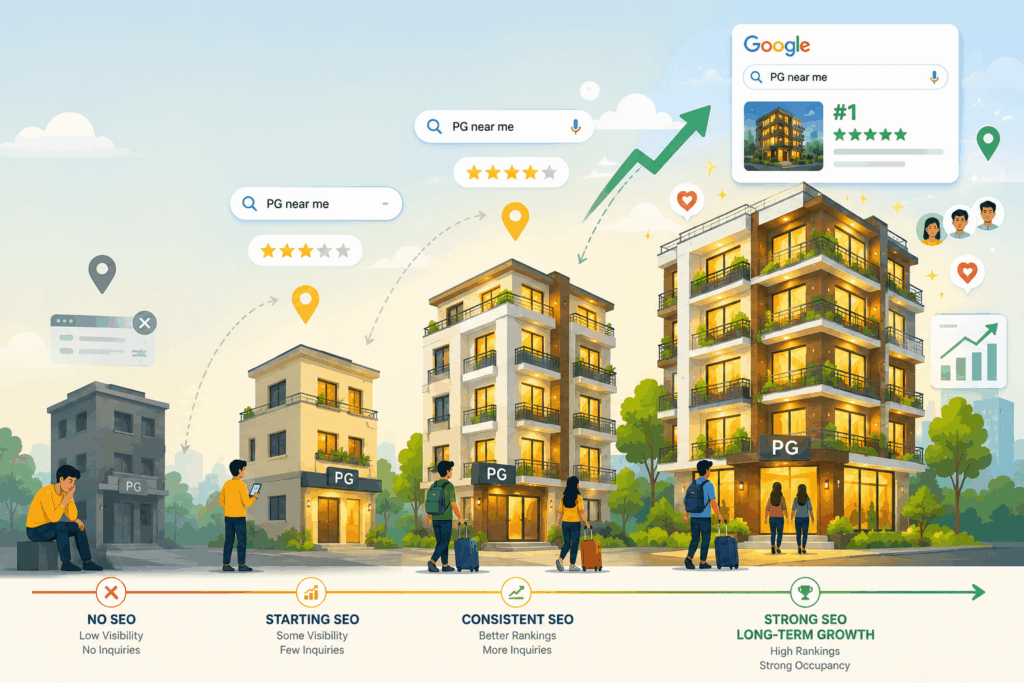
SEO Is a Long-Term Asset, Not a Short-Term Campaign
This is where many landlords become impatient.
SEO does not behave like paid advertising where visibility appears immediately after spending money.
Results take time.
But unlike paid ads, SEO compounds.
Once rankings strengthen, the long-term impact becomes extremely powerful:
- lower customer acquisition costs,
- reduced broker dependency,
- stronger direct inquiry flow,
- better occupancy stability,
- and stronger brand visibility.
Over time, your online presence starts attracting tenants naturally instead of constantly chasing them through external channels.
That shift changes the business fundamentally.
How RentOK Helps You Manage SEO-Driven Growth Efficiently
As your online visibility improves, inquiry volume naturally increases. But generating inquiries is only one side of growth. Managing those leads efficiently is what determines whether SEO actually converts into occupancy.
This is where RentOK helps operators create structure behind their digital growth efforts.
With RentOK, landlords can:
- track inquiries and occupancy through one centralized platform instead of scattered spreadsheets and chats,
- maintain organized tenant and booking records as lead volume increases,
- reduce operational confusion during room allocation and move-ins,
- improve communication handling for faster and more professional inquiry management,
- and maintain visibility across occupancy, tenant status, and operational workflows from one structured system.
As SEO begins generating more direct traffic, operational clarity becomes even more important. Better visibility without operational systems often creates chaos instead of scalable growth. RentOK helps ensure that increasing lead flow remains organized, manageable, and efficient.
Conclusion
The PG market has become digital-first.
Tenants now search online, compare online, evaluate online, and build trust online before they ever contact a landlord. That means your visibility on Google directly affects occupancy, credibility, and long-term growth.
The operators investing in SEO today are building far more than temporary traffic. They are building discoverability, authority, and a sustainable lead-generation engine that compounds over time.
Strong SEO is built through:
- consistent local optimization,
- useful content,
- stronger reviews,
- better user experience,
- and structured digital operations.
Over time, these efforts separate discoverable brands from invisible properties.
About the Author
Ishika Pannu
Ishika Pannu brings you the latest insights and easy-to-apply strategies in property management—helping you simplify renting and grow with RentOk.