Market Trends
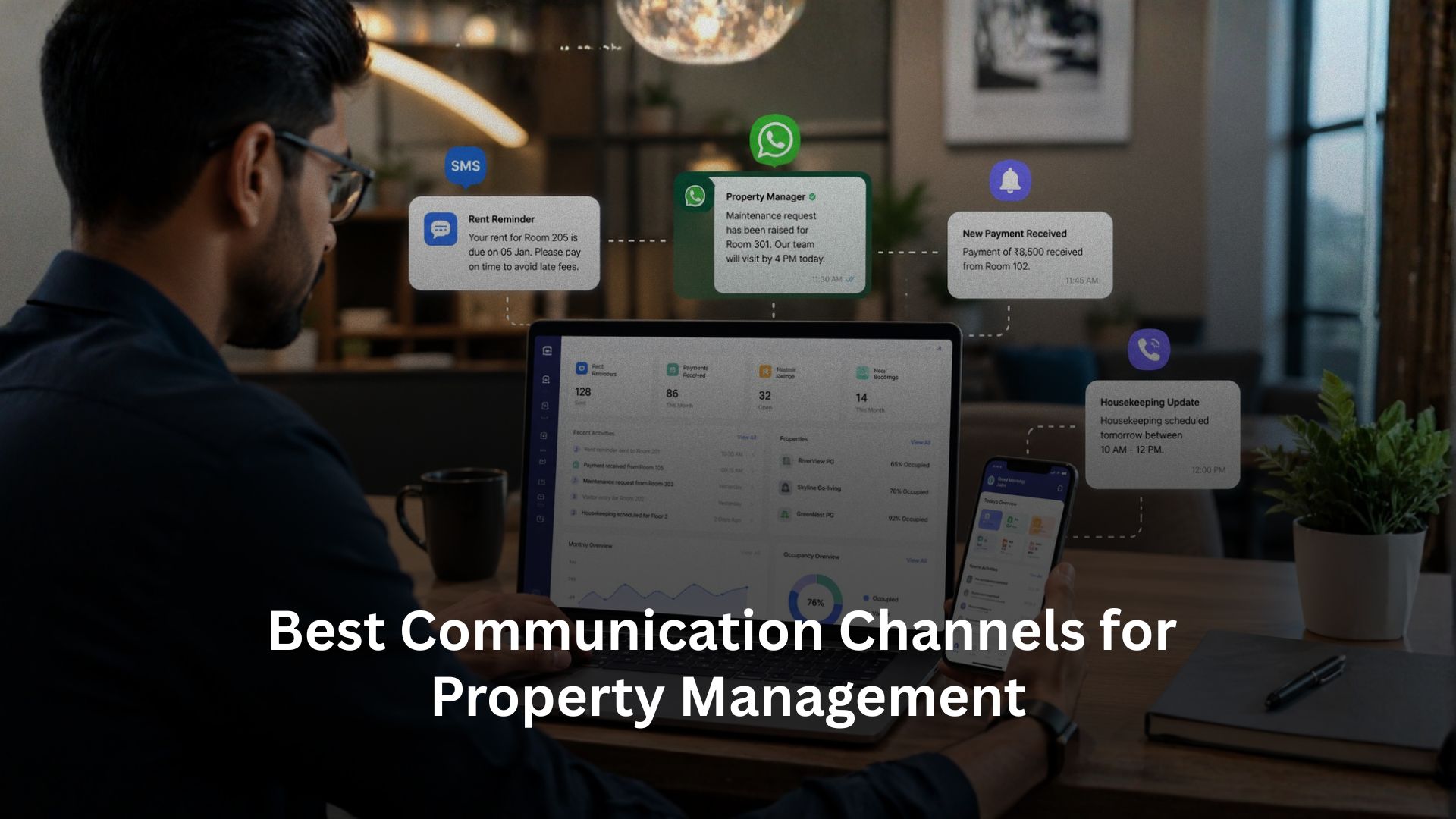
Best Communication Channels for Property Management

Written by
Ishika Pannu
Read Time
11 min read
Posted on
May 24, 2026
Overview
Overview
Best Communication Channels for Property Management
Communication is one of the few operational systems inside a rental business that affects almost everything simultaneously. Occupancy management, rent collection, complaint handling, maintenance coordination, tenant satisfaction, and even online reputation are all influenced by how clearly and consistently information moves across the property.
Yet, most PGs and co-living businesses still treat communication reactively.
Rent reminders are sent manually whenever staff members remember. Complaint updates happen through scattered WhatsApp chats. Operational announcements get buried inside noisy tenant groups. Property managers repeatedly answer the same questions every day because no structured communication system exists underneath.
Initially, this may not feel like a major issue. Smaller properties can often survive through informal coordination. But once occupancy starts growing, communication quickly becomes one of the biggest operational bottlenecks inside the business.
A property with:
- 20 tenants can survive on manual messaging and verbal coordination,
- but a property with 200 tenants operating across multiple floors or buildings cannot rely on the same system without eventually creating operational chaos.
This is exactly why modern rental businesses are increasingly investing in structured tenant notification systems powered through:
- SMS communication,
- WhatsApp automation,
- and app-based push notifications.
However, one of the biggest mistakes operators make is assuming all communication channels perform similarly.
They do not.
Each platform influences:
- tenant response behavior,
- communication visibility,
- operational efficiency,
- and engagement quality
in completely different ways.
The strongest operators are not the ones sending the highest number of notifications. They are the ones who understand:
- which communication channel works best for which operational purpose,
- how tenants interact with different notification formats,
- and how communication systems directly affect operational stability inside the property.
Why Communication Problems Quietly Damage Property Operations
Most operational issues inside PGs are not caused by one major failure. They usually develop slowly through repeated communication gaps that gradually create friction between management and tenants.
For example, delayed rent collection is often treated purely as a financial discipline issue. But operationally, payment delays frequently increase because reminder systems are inconsistent, communication timing is poor, or tenants lack proper visibility into pending balances and payment timelines.
Similarly, maintenance complaints often escalate not because the issue itself is severe, but because communication disappears after the complaint is raised. Once tenants stop receiving updates, the problem starts feeling ignored even if the maintenance process is already underway internally.
Over time, these communication gaps begin affecting multiple operational areas simultaneously:
- Staff productivity starts weakening because team members repeatedly answer identical operational questions throughout the day instead of relying on structured notification systems that proactively provide updates and reduce repetitive coordination workload.
- Complaint-resolution efficiency decreases because maintenance timelines, vendor updates, and tenant conversations remain scattered across calls, chats, and verbal discussions without centralized communication visibility.
- Tenant trust gradually weakens because inconsistent updates make the property feel reactive and unorganized, even when operational teams are actively trying to manage issues professionally behind the scenes.
- Management bandwidth gets consumed unnecessarily because unresolved communication gaps eventually escalate upward, forcing landlords and senior operators to repeatedly step into routine operational coordination.
This is exactly why communication should never be viewed as a small administrative function inside modern rental businesses.
Communication systems directly influence:
- operational efficiency,
- tenant experience,
- payment consistency,
- and long-term occupancy stability.
SMS Still Performs Better Than Most Operators Expect
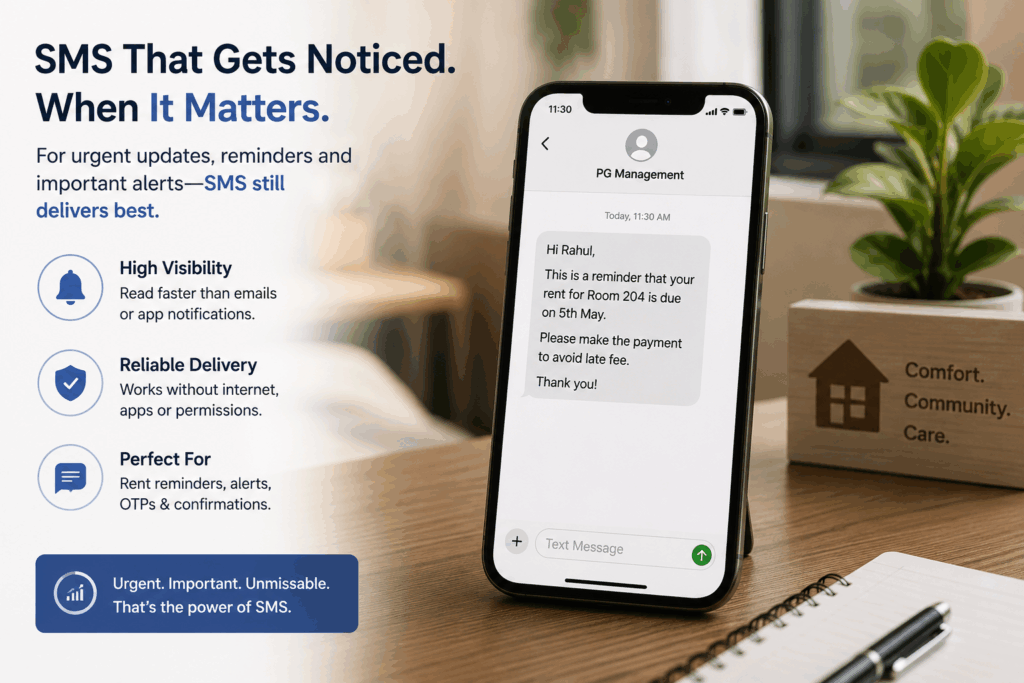
Many property managers assume SMS has become outdated because communication today revolves heavily around apps like WhatsApp and Telegram. But operationally, SMS continues to remain one of the strongest communication channels for urgent tenant notifications.
The reason is psychological.
People naturally treat SMS differently from app-based notifications. Emails often remain unread for hours. WhatsApp groups frequently get muted. Push notifications disappear quickly beneath dozens of social media alerts. But text messages still create a strong sense of urgency and importance.
That is why SMS continues performing extremely well for communication such as:
- rent due reminders where immediate visibility matters because delayed awareness directly affects collections and operational cash flow across the property.
- Emergency operational alerts involving electricity shutdowns, water maintenance, lift servicing, access restrictions, or security-related notices that tenants should notice quickly without depending on app engagement.
- OTP verification, payment confirmations, and transactional communication where delivery reliability matters far more than conversational interaction or media-sharing flexibility.
One major operational advantage of SMS is that it does not depend on:
- internet connectivity,
- app installation,
- notification permissions,
- or active user engagement with a platform.
The message reaches the resident directly.
This becomes especially valuable during urgent situations where management cannot risk delayed visibility because tenants muted a group or disabled application notifications.
Another important operational advantage is open-rate consistency. SMS notifications are generally checked much faster compared to emails or app-based promotional alerts because users instinctively associate text messages with important information.
However, despite these strengths, SMS also has very clear operational limitations.
It performs extremely well for:
- urgency,
- visibility,
- and transactional communication,
but becomes restrictive when communication requires interaction, workflow coordination, or ongoing operational updates.
Where SMS Starts Becoming Operationally Limited
Despite its reliability, SMS cannot independently support modern rental communication because the format itself lacks conversational flexibility.
For example, SMS becomes weak when operators need to handle:
- onboarding communication involving move-in instructions, Wi-Fi details, visitor policies, documentation requirements, and operational guidance spread across multiple steps.
- Complaint-resolution workflows where tenants expect regular updates regarding vendor coordination, issue timelines, maintenance progress, and completion visibility instead of one-time alerts.
- Payment-support communication where residents require clarification regarding pending dues, electricity calculations, invoice adjustments, or transaction confirmations through ongoing interaction.
The communication starts feeling fragmented because SMS lacks:
- conversational continuity,
- media-sharing capability,
- and structured workflow integration.
Another important operational challenge is overuse.
When operators begin using SMS for every small operational update, tenants gradually stop treating messages as urgent. Over time, important reminders lose visibility because the communication channel itself becomes overloaded.
This is why professionally managed properties use SMS strategically rather than excessively.
Strong operators generally reserve SMS for:
- urgent operational alerts,
- high-priority payment reminders,
- and communication where immediate visibility matters more than engagement depth or conversation flow.
That distinction becomes extremely important because urgency only works when communication remains selective.
WhatsApp Completely Changed Tenant Communication
If SMS represents urgency, WhatsApp represents engagement.
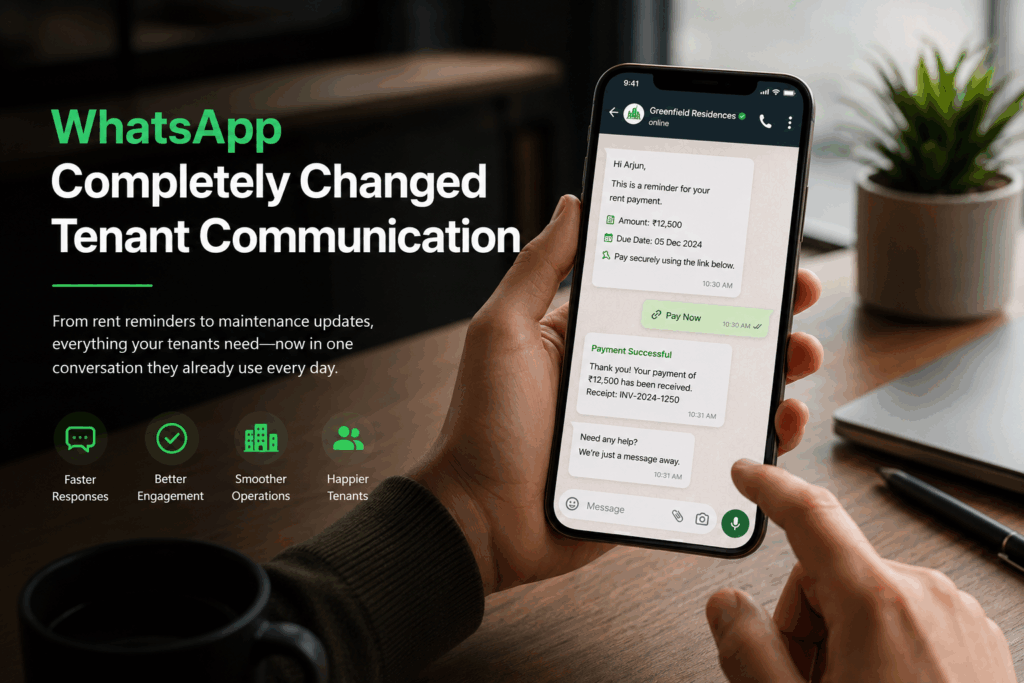
Over the last few years, WhatsApp has completely transformed tenant communication because it aligns naturally with how people already communicate every day. Most residents spend significant time inside the app, which automatically improves message visibility and response speed.
For property managers, this creates several operational advantages simultaneously.
Unlike SMS, WhatsApp allows businesses to manage communication through:
- invoices,
- payment links,
- onboarding instructions,
- room photos,
- maintenance updates,
- visitor approvals,
- and support coordination
inside one continuous interaction flow.
Operationally, this reduces friction enormously because tenants no longer need to switch between multiple communication channels just to complete basic operational tasks.
For example, a rent reminder through WhatsApp can include:
- the pending balance,
- due date,
- payment link,
- payment confirmation flow,
- and support assistance
inside the same interaction.
This improves:
- payment visibility,
- response speed,
- and communication clarity
simultaneously.
More importantly, WhatsApp communication feels conversational instead of transactional. That psychological difference matters because tenants generally respond much faster to communication that feels naturally integrated into their daily messaging behavior.
Over time, this helps operators reduce:
- repetitive follow-ups,
- payment confusion,
- delayed responses,
- and communication inconsistency
across property operations.
Why WhatsApp Automation Has Become Essential for Growing PGs
Manual communication becomes extremely difficult once occupancy scales across multiple rooms or properties. Property managers eventually struggle with:
- repeated tenant queries,
- delayed response times,
- fragmented communication history,
- and inconsistent operational updates.
This is where WhatsApp automation becomes operationally powerful.
Structured automation systems help operators:
- schedule rent reminders automatically before due dates instead of depending entirely on manual follow-up communication every month, which significantly reduces payment delays caused by inconsistent reminder timing.
- Send instant payment confirmations immediately after transactions so tenants receive proper acknowledgment without repeatedly contacting management regarding whether payments were successfully received.
- Acknowledge complaints automatically while also sharing expected timelines and workflow visibility, helping residents stay informed throughout the issue-resolution process instead of feeling ignored after raising complaints.
- Share onboarding instructions systematically with new residents, reducing repetitive staff coordination while ensuring every tenant receives consistent operational guidance during the move-in process.
The biggest operational advantage here is not just speed.
It is consistency.
Instead of communication quality depending entirely on which staff member happens to be available that day, automation creates:
- standardized workflows,
- organized communication history,
- and predictable tenant interaction patterns.
That consistency becomes increasingly important as rental businesses scale because operational structure directly affects scalability.
Push Notifications Work Very Differently From SMS and WhatsApp
Push notifications belong to a completely different communication category. Unlike SMS or WhatsApp, they depend heavily on app engagement and tenant interaction with the property platform itself.
This means their effectiveness depends on whether residents actively use the application regularly.
When implemented correctly, push notifications work extremely well for lightweight operational communication such as:
- complaint-status tracking that helps tenants monitor maintenance progress without requiring repeated follow-up conversations with staff members.
- Visitor approvals and entry coordination where quick operational visibility matters more than long-form communication or detailed interaction flows.
- Housekeeping schedules, maintenance reminders, and payment acknowledgments that keep tenants informed without overwhelming them through excessive direct messaging.
One major advantage of push notifications is that they feel less intrusive psychologically. Unlike repeated calls or messages, they function more like subtle operational nudges.
This matters because modern tenants already experience notification fatigue through:
- banking applications,
- delivery platforms,
- social media systems,
- and e-commerce alerts
throughout the day.
Overcommunication eventually weakens engagement across every platform.
Push notifications help reduce this pressure by delivering lightweight workflow visibility without making communication feel disruptive or overwhelming.
At the same time, they are not ideal for urgent escalation communication because:
- app engagement varies,
- notification permissions may be disabled,
- and visibility depends heavily on user behavior patterns.
This is why push notifications work best as a supporting communication layer instead of becoming the primary operational notification system.
Comparing SMS, WhatsApp, and Push Notifications Operationally
The strongest rental businesses rarely depend entirely on one communication platform. Instead, they build layered systems where each channel supports a different operational requirement.
| Communication Channel | Best Operational Use Case | Major Advantage | Operational Limitation |
|---|---|---|---|
| SMS | Rent reminders, emergency alerts, payment confirmations, urgent operational communication | Strong delivery reliability and high visibility even without internet connectivity or app engagement | Limited conversational depth and weak workflow flexibility for complex communication |
| Tenant engagement, onboarding, complaint coordination, payment workflows, and operational support communication | High interaction quality with conversational flexibility that improves tenant response rates significantly | Communication can become noisy and operationally unstructured if groups and workflows are poorly managed | |
| Push Notifications | Complaint tracking, workflow visibility, housekeeping reminders, visitor approvals, and lightweight operational updates | Non-intrusive communication that works well for app-driven workflow visibility and routine operational updates | Depends heavily on application engagement and notification permissions for visibility |
The important thing to understand is that there is no universal “best” communication platform.
The right communication structure depends on:
- occupancy size,
- tenant demographics,
- operational complexity,
- and property category.
For example:
- student housing,
- premium co-living spaces,
- and working professional PGs
often require very different communication systems because tenant expectations and engagement behavior vary significantly across categories.
Why Multi-Channel Communication Is Becoming the Industry Standard
Modern rental businesses are gradually moving toward integrated communication ecosystems instead of isolated messaging systems.
Future-ready operators increasingly combine:
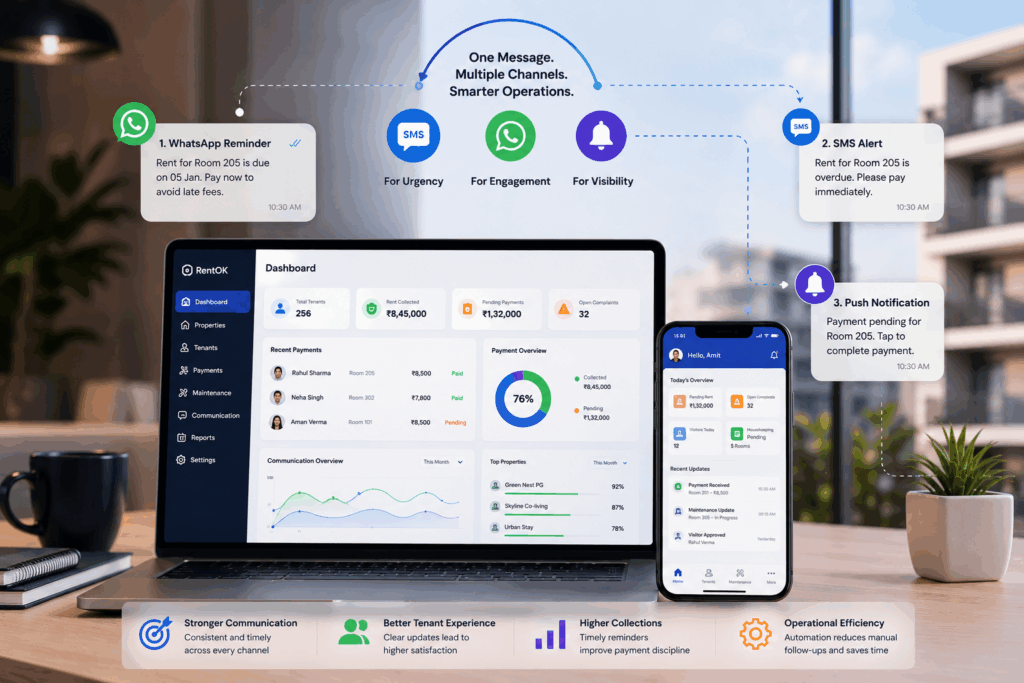
- SMS for urgency,
- WhatsApp for engagement,
- and push notifications for workflow visibility.
This layered communication structure improves operational efficiency because communication adapts based on:
- urgency level,
- tenant behavior,
- and action requirements.
For example, a rent reminder may initially appear through WhatsApp. If ignored, the system may escalate communication visibility through SMS while simultaneously continuing workflow tracking through push notifications.
This creates:
- stronger communication consistency,
- better operational visibility,
- and reduced dependency on manual follow-up coordination.
As rental businesses continue becoming more operationally structured and technology-driven, communication systems will increasingly influence:
- tenant satisfaction,
- occupancy retention,
- payment discipline,
- and operational efficiency overall.
Because communication is no longer just an administrative activity.
It has become part of the tenant experience itself.
How RentOk Helps Streamline Tenant Communication
Managing tenant communication manually becomes increasingly difficult as occupancy grows because reminders, operational updates, complaint coordination, and workflow visibility quickly become fragmented across multiple disconnected systems.
This often creates:
- delayed responses,
- repetitive follow-ups,
- inconsistent communication visibility,
- and unnecessary operational pressure on management teams.
RentOk helps operators streamline communication workflows by centralizing:
- automated rent reminders,
- payment visibility,
- complaint tracking,
- operational notifications,
- occupancy coordination,
- and tenant communication management
within one connected platform.
This allows property managers to improve:
- communication consistency,
- operational visibility,
- tenant engagement,
- and workflow efficiency
while reducing the coordination chaos that usually increases alongside occupancy growth.
Conclusion
Communication systems now play a central role in modern property management. The difference between organized and chaotic rental operations often comes down to how clearly and consistently information flows across the property ecosystem.
SMS, WhatsApp, and push notifications all serve different operational purposes. SMS creates urgency and delivery reliability. WhatsApp improves engagement and communication flexibility. Push notifications simplify workflow visibility without overwhelming tenants through excessive direct messaging.
The strongest property operators understand that effective communication is not about sending more notifications. It is about sending the right information through the right channel at the right time.
As PGs, co-living businesses, and rental operations continue becoming more digitally structured, communication systems will increasingly become a core operational advantage instead of just an administrative support layer.
Explore RentOk to automate reminders, streamline tenant communication, improve operational visibility, and manage modern rental properties more efficiently through one centralized platform.
About the Author
Ishika Pannu
Ishika Pannu brings you the latest insights and easy-to-apply strategies in property management—helping you simplify renting and grow with RentOk.