
Legal
What Documents Do You Need for Tenant Police Verification?

Written by
Ishika Pannu
Read Time
15 min read
Posted on
September 10, 2026
Overview
Overview
What Documents Do You Need for Tenant Police Verification?
Tenant police verification is often treated as a simple paperwork exercise. A landlord collects an ID, takes a photograph, fills out a form, and submits the details to the police. In practice, the process can be more detailed.
The documents required for tenant verification can differ based on the property’s location, the local police authority, and the type of verification service being used. There is no single document checklist that applies identically across every city in India.
This matters because incomplete documentation can delay verification. It can also leave landlords with tenant records that are difficult to rely on later.
For a rental property, the basic objective is straightforward. The authorities need enough information to establish who the tenant is, where the tenant is staying, and how the person can be contacted or identified.
That usually means collecting identity information, address details, photographs, contact information, and property-related details. Some jurisdictions may also ask for employment, workplace, or other supporting information.
For landlords and PG operators, the important part is knowing which documents are actually required for the property’s jurisdiction. A checklist used in Delhi should not automatically be treated as the checklist for Mumbai, Hyderabad, Haryana, or Uttar Pradesh.
Why Does Tenant Police Verification Need So Many Documents?
Tenant verification is not simply about confirming a person’s name. The information submitted should create a reasonably complete record connecting the individual with the property.
A tenant may have moved from another city for employment. Their permanent address may be different from their current rental address. Their workplace may also be located somewhere else.
These details help distinguish the tenant’s identity from the place where they currently live.
The same principle becomes even more important for PGs and co-living properties. A single property can have dozens of residents, with several move-ins happening within the same week. If tenant records are incomplete, identifying who occupied a particular room at a particular time becomes much harder.
RentOk’s Digital KYC and Police Verification: State-wise Compliance in India explains why verification should be treated as part of the broader tenant onboarding process rather than as an isolated administrative task.
The Documents Create a Complete Tenant Profile
Each document or information field serves a different purpose.
An identity document establishes who the tenant claims to be. Address information establishes where the tenant ordinarily lives or has lived. Rental details connect that individual to the specific property.
Together, these details create a more useful tenant record.
For landlords, this means collecting documents is only the beginning. The information should also be checked for consistency. A spelling difference between the tenant’s form and identity document, for example, can create avoidable confusion.
A structured verification process should therefore answer three basic questions:
- Who is the tenant? The identity document, photograph, contact details, and other personal information should consistently identify the person occupying the premises.
- Where is the tenant from and where are they staying now? Permanent and current address details help establish the tenant’s residential history and present location.
- Where are they living and under what arrangement? Property and rental information connects the tenant’s identity with the specific house, apartment, PG, hostel, or other accommodation.
The exact information required will still depend on the local authority.
Once the required documents are identified, the next step is submitting them through the appropriate verification channel. RentOk’s How to Get Online Police Verification for Your PG or Hostel in India provides additional context on the online verification workflow.

Standard Documents Required for Tenant Police Verification
Although requirements vary, several documents and information categories appear regularly in tenant verification processes.
A standard landlord checklist should begin with the documents most commonly requested. It should then be adjusted according to the official requirements of the property’s jurisdiction.
1. Tenant Identity Proof
A government-issued identity document is generally one of the most important parts of the verification record.
Depending on the authority, accepted identification may include documents such as Aadhaar, passport, driving licence, voter ID, or another government-issued identity document.
The important point is not to assume that one specific document is compulsory everywhere. The accepted options can vary by service.
The identity details submitted in the verification form should also match the document. Names, dates of birth, addresses, and identification numbers should be checked carefully before submission.
Document collection should also involve basic authenticity checks. For practical guidance, see RentOk’s How to Spot a Fake ID During Tenant Verification.
2. Current and Permanent Address Details
Tenant verification may require information about both the tenant’s permanent address and current rental address.
These are not necessarily the same.
A person working in Delhi may have a permanent address in Uttar Pradesh. A student in Bengaluru may have a permanent address in another state. A professional relocating to Mumbai may still retain their original address in another city.
The landlord should therefore collect the address information requested by the applicable verification process rather than replacing it with whichever address is easiest to obtain.
3. Recent Photograph
A photograph helps associate the verification record with the individual occupying the premises.
Some police portals and forms specifically ask for a tenant photograph. Mumbai Police’s current tenant-information service, for example, includes a tenant photograph and identity-proof upload among its fields.
The photograph should be clear enough to identify the tenant. Landlords should also avoid using an outdated image when the applicable process requires a recent photograph.
4. Rent Agreement or Property Details
The verification record needs to connect the tenant with the property.
Depending on the jurisdiction, this may involve details from the rent agreement or information about the rented premises. The property’s address should be entered accurately, especially where several units share the same building.
A mismatch between the tenant’s submitted address and the actual rented premises can create unnecessary verification issues.
5. Contact and Employment Details
Tenant verification forms can also ask for the tenant’s mobile number, email address, occupation, workplace, or work address.
Mumbai Police’s tenant-information form, for example, asks for the tenant’s mobile number, email address, occupation, and workplace details. It also requests information about people who know the tenant.
These details can make the tenant profile more complete and easier to identify.
6. Landlord or Property-Owner Information
The tenant’s information is only one side of the verification record.
Depending on the local process, the landlord or property owner may also need to provide their name, address, contact details, and identification information.
For larger rental operations, keeping the owner’s details ready as part of the onboarding checklist can prevent repeated document collection.
State-Wise Tenant Verification Requirements in India
One of the biggest mistakes landlords make is assuming that tenant verification follows a single national checklist.
It does not.
Police departments and local authorities can use different forms, portals, services, and information requirements. Some jurisdictions offer online submission. Others may use dedicated forms or local police-station processes.
The table below gives a practical overview of selected jurisdictions. It should be treated as a starting point, not a substitute for checking the current official process.
| State/City | Verification System | What Landlords Should Note |
|---|---|---|
| Delhi | Delhi Police tenant verification | Delhi Police maintains a dedicated Tenant Verification Form. Landlords should follow the current Delhi Police procedure applicable to the property. |
| Maharashtra – Mumbai | Mumbai Police Tenant Information service | The online form collects tenant identity, photograph, address, occupation, workplace, contact details, and other information. |
| Haryana | Haryana Police Tenant/PG Verification | Haryana Police provides a Tenant/PG Verification Request service. Its citizen-service information also lists verification for tenants from another district or state. |
| Uttar Pradesh | UP Police Tenant Verification | UP Police provides a dedicated tenant verification form through its official utility forms section. |
| Telangana | Police/MeeSeva service framework | Telangana’s MeeSeva system provides government service access, while tenant verification may follow the applicable local police/service procedure. |
This variation is exactly why landlords should identify the jurisdiction before collecting documents.
If you operate properties across multiple cities, maintain separate compliance checklists. The objective is not to create unnecessary paperwork. It is to ensure that the documents you collect actually match the verification process being followed.
What If the Tenant Does Not Have Aadhaar?
Aadhaar is commonly used for identity verification, but landlords should not automatically assume that every tenant must provide Aadhaar for police verification.
Other government-issued identity documents may be accepted depending on the relevant authority and verification service. These can include passports, driving licences, voter identification, or other accepted documents.
The correct approach is to check the official requirements of the jurisdiction instead of rejecting a tenant simply because Aadhaar is unavailable.
Alternative Identity Documents May Be Available
Aadhaar is not the only form of identity proof that may be used for tenant verification.
For example, Haryana’s tenant verification form includes identity-proof information and provides examples such as a voter card, driving licence, ration card, and other identification details.
The key distinction is between identity verification and Aadhaar collection.
Aadhaar is only one part of a broader tenant screening process. Identity checks, police verification, supporting documentation, and other screening measures may all form part of the process. RentOk’s The PG Owner’s Guide to Tenant Background Verification in 2026 provides additional context on how these checks can work together.
These requirements should not automatically be treated as the same thing.
If a tenant does not have Aadhaar, the landlord should determine which alternative identity document is accepted for the applicable verification process and record the document details accurately in the relevant application.
Landlords should also avoid collecting identity documents simply because they are available. Only the documents necessary for the applicable verification process should be collected, and all personal information should be handled securely.

What Documents Do Foreign Nationals Need?
Foreign nationals require additional attention because their identification and immigration documents are different from those of Indian citizens.
A landlord should not treat a foreign tenant as simply another applicant with a different passport. Their stay in India may involve visa conditions, registration requirements, and address documentation that need to be handled separately.
Under the current Immigration and Foreigners Rules, 2025, foreign nationals may be required to provide their passport or other travel document and visa or other applicable immigration documentation. The rules also provide for registration with the relevant Registration Officer in specified circumstances.
Passport and Visa Documentation
For a foreign national renting accommodation, the landlord should verify the documents relevant to the person’s lawful stay in India.
These may include:
- Valid passport and visa documentation: The passport establishes identity and nationality, while the visa provides information about the person’s permitted stay and purpose.
- Indian address proof: Depending on the applicable immigration service, a lease agreement or other accepted proof of address may be required.
- Registration or residential-permit documents, where applicable: Foreign nationals subject to registration requirements may need documentation issued through the relevant FRRO/FRO process.
- Recent photograph and supporting information: Immigration and registration procedures can require photographs and other supporting documents.
The Ministry of Home Affairs currently directs foreign nationals to use the relevant FRRO/FRO framework for immigration-related services.
FRRO guidance also lists passport, visa, and address-proof documentation for relevant registration services. For rented accommodation, a valid and notarised lease agreement is among the address-proof examples listed in its guidance.
For landlords, the safest approach is to distinguish tenant police verification from immigration compliance. They may overlap in documentation, but they are not necessarily the same process.
What If the Tenant Has Recently Moved From Another State?
Interstate tenants are common in India’s rental market.
Students move for university. Professionals relocate for jobs. Families move because of transfers or business opportunities.
A tenant’s permanent address may therefore be outside the state where the rental property is located.
This does not automatically mean the tenant’s verification should be rejected or treated as incomplete. Instead, landlords should provide the information requested by the local verification authority.
Haryana Police, for example, separately lists a tenant verification service for residents of another district or state after the required verification is received from the other district or state.
This shows why a tenant’s previous address can matter during verification.
Keep Previous Address Details Accurate
When a tenant has relocated recently, landlords should collect the correct permanent address and any other previous-address information required by the applicable form.
Do not shorten the address simply because it is inconvenient to enter.
A complete address can make the verification record more useful and reduce confusion when authorities need to distinguish between similarly named locations.
The tenant should also review the information before submission. A typo in a district, state, police station, or pincode can create unnecessary delays.
What Documents Should Landlords Keep After Verification?
Submitting documents is not the end of the compliance process.
A landlord or PG operator should retain the relevant tenant record and verification acknowledgement according to the applicable legal and operational requirements. The exact retention period can vary, so operators should follow the rules applicable to their business and jurisdiction.
The important operational principle is simple: you should be able to retrieve the tenant’s verification record when you need it.
For a property with five tenants, this may be manageable through organised digital folders. For a PG with hundreds of occupants, scattered WhatsApp images and personal-device storage quickly become difficult to manage.
RentOk’s How to Maintain Tenant KYC Records Digitally covers this larger operational challenge and explains why tenant documentation needs to remain structured and accessible.
Avoid Keeping Random Copies Everywhere
A common mistake is storing one tenant’s Aadhaar on WhatsApp, their photograph on a phone, and their verification receipt somewhere else.
This may appear manageable at first.
As the number of tenants increases, it creates a fragmented record. Staff members may also struggle to determine which document is the latest version or whether verification was actually completed.
A better system connects the tenant’s identity information, property details, agreement, and verification status within one organised record.
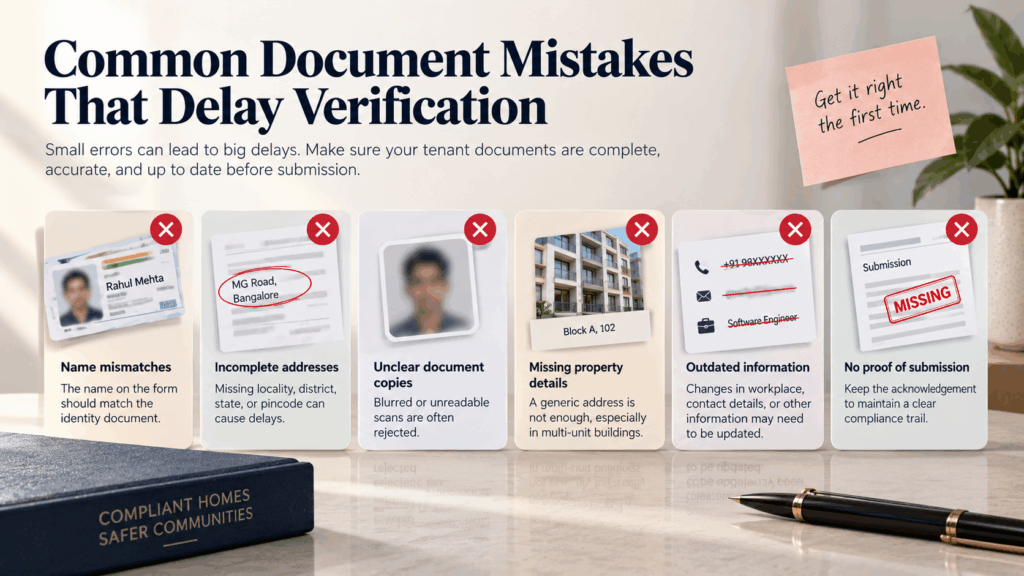
Common Document Mistakes That Delay Verification
Many verification problems are not caused by complicated legal issues. They happen because basic information is incomplete or inconsistent.
Landlords and operators should therefore check the tenant file before submission.
Common mistakes include:
- Name mismatches: The tenant’s name on the verification form should correspond with the submitted identity document. Differences in spelling can create avoidable questions.
- Incomplete addresses: Missing locality, district, state, or pincode information can make an address harder to verify and may result in additional clarification.
- Unclear document copies: Blurred photographs or unreadable scans can make otherwise valid documents difficult to process.
- Missing property details: Tenant information needs to be connected to the correct premises. A generic address is not enough when a building contains multiple units.
- Outdated information: If a tenant changes their workplace, phone number, or other relevant information during the tenancy, landlords should understand whether the local process requires an update.
- No proof of submission: A landlord may have completed the form but still be unable to demonstrate when or how the verification was submitted. Retaining acknowledgements helps maintain a clearer compliance trail.
These may appear like small administrative issues. Across dozens of tenants, however, they can become a significant operational burden.
How RentOk Helps With Tenant Verification
Tenant verification works best when it is built into the onboarding process from the start.
RentOk helps landlords and PG operators structure tenant information, manage documentation, and reduce the dependence on scattered manual records. Instead of treating KYC and police verification as tasks that someone remembers after move-in, operators can make them part of a defined tenant onboarding workflow.
This becomes particularly valuable as occupancy increases. A structured system can make it easier to know which documents have been collected, which tenant records are complete, and where verification stands.
The broader objective is simple: make compliance organised enough to become repeatable.
When tenant documentation is structured, landlords spend less time searching for individual files and more time managing the property itself.
Conclusion: Keep Tenant Verification Complete From Day One
Tenant police verification is not based on one universal document checklist. The exact requirements can change according to the state, city, police authority, and verification process applicable to the property.
That is why landlords should start with the property’s jurisdiction and then build the document checklist around the official requirements.
At a minimum, be prepared to manage identity information, address details, photographs, contact information, property details, and any additional documents requested by the relevant authority. For foreign nationals, passport, visa, address, and applicable immigration documentation require additional attention.
Most importantly, do not stop at collecting documents. Check the information, submit it through the correct channel, preserve the acknowledgement, and maintain the completed verification record.
For landlords and PG operators managing multiple residents, a structured digital workflow can make this process considerably easier.
Need a faster, more organised way to handle tenant verification? Complete Your Tenant Verification Fast with RentOk.
Frequently Asked Questions
Find answers to common questions about this topic
About the Author
Ishika Pannu
Ishika Pannu brings you the latest insights and easy-to-apply strategies in property management—helping you simplify renting and grow with RentOk.
You may also like these
Related Articles
1 min read
Why You Should Always Insist on a Registered Rent Agreement
Written by
Posted on
Ishika Pannu
Sep 10, 2026
1 min read
What Is the Legal Notice Period Before Vacating a Rented Property?
Written by
Posted on
Ishika Pannu
Sep 9, 2026

1 min read
Delhi’s Proposed PG Regulations: What Owners Need to Know
Written by
Posted on
Ishika Pannu
Sep 9, 2026

1 min read
The Satya Niketan PG Collapse: What It Means for Safety in Delhi PG’s
Written by
Posted on
Ishika Pannu
Sep 7, 2026
1 min read
How to File a Rental Dispute Complaint in India (Step-by-Step Guide)
Written by
Posted on
Ishika Pannu
Sep 6, 2026

1 min read
What to Do If Your Landlord Refuses to Return Your Security Deposit
Written by
Posted on
Ishika Pannu
Sep 5, 2026
1 min read
Why Landlords Cannot Legally Refuse Unmarried Tenants in India
Written by
Posted on
Ishika Pannu
Sep 5, 2026
1 min read
How to Get Your Security Deposit Back When Vacating a Rental Property
Written by
Posted on
Ishika Pannu
Sep 5, 2026
1 min read
What Is Tenant Police Verification and Why Is It Mandatory in India?
Written by
Posted on
Ishika Pannu
Sep 4, 2026

1 min read
How to Read a Rent Agreement Before Signing: What to Watch Out For
Written by
Posted on
Ishika Pannu
Sep 4, 2026
Stay ahead in property management with expert insights
Join thousands of property managers receiving exclusive tips delivered straight to your inbox.
Browse posts by category
Case Study
Cost of Living
Growth
Legal
Market Trends
News
Pg owner app
Property Management
Property Tax
Tech
RentOk
The easiest way to rent and manage your PGs and hostels.
Get the app


Contact us
hello@eazyapp.tech
HQ Office
COGROW, BASEMENT F-12/8A
BESIDE HOUSE OF STYLE SALON, SECTOR 28, DLF PHASE 1
GURUGRAM, HARYANA - 122002
South India Office
LUMIODESK COWORKING, 2ND FLOOR, 40, 14TH MAIN RD
BESIDE MC DONALD, 7TH SECTOR, HSR LAYOUT
BENGALURU, KARNATAKA - 560102
©️ 2026 EazyApp Tech Pvt Ltd. All rights reserved


