Property Management
Generating Owner Reports: For Property Managers and Franchisees

Written by
Ishika Pannu
Read Time
10 min read
Posted on
May 16, 2026
Overview
Overview
Generating Owner Reports: For Property Managers and Franchisees
In the rental housing industry, reporting is often treated like an administrative obligation. Something operators prepare at the end of the month because property owners expect updates on occupancy, rent collection, and expenses.
But professionally managed rental businesses understand that reporting plays a much bigger role than most people realize.
A well-structured owner report is not just a collection of numbers. It reflects how organized, transparent, and operationally mature a property management business actually is.
For franchise operators, co-living brands, and property management companies, reporting directly influences:
- owner confidence in the management process and long-term operational reliability,
- transparency around revenue, occupancy, and expenses across different properties,
- communication quality between operators and stakeholders,
- and the overall perception of professionalism within the business itself.
This has become increasingly important because many property owners today are passive investors rather than active operators. Some live in different cities, some manage multiple rental assets simultaneously, and many rely entirely on operators to manage occupancy, tenants, collections, maintenance, and day-to-day coordination.
In these situations, reports become the primary way owners evaluate whether their property is being managed properly.
And expectations have changed significantly.
A few years ago, simple WhatsApp updates or verbal summaries were enough for many owners. Today, they expect structured operational visibility. They want clarity around how the property is performing financially, whether occupancy is stable, where operational money is being spent, and whether the business is running efficiently overall.
This is exactly why reporting has become one of the strongest trust-building systems in modern property management.

Why Reporting Quality Directly Affects Owner Trust
Most operators focus heavily on occupancy numbers because occupancy directly affects monthly cash flow. But from an owner’s perspective, occupancy alone is not enough to evaluate the quality of management.
Owners also evaluate:
- how clearly information is communicated during operational fluctuations,
- whether financial visibility remains transparent and organized,
- how consistently operational updates are shared,
- and whether the operator appears proactive instead of reactive.
For example, even a profitable property can create owner frustration if reporting feels inconsistent or unclear. Delayed updates, unexplained deductions, or fragmented communication naturally reduce confidence over time.
On the other hand, strong reporting creates a very different experience.
When operators provide:
- organized occupancy summaries,
- categorized financial visibility,
- properly tracked expense reporting,
- and structured operational updates,
owners feel significantly more confident about the management process itself.
This is especially important in franchise-led rental businesses where operational trust directly influences expansion opportunities and long-term partnerships.
The operators who scale successfully are usually not just the ones generating occupancy. They are the ones creating confidence through visibility and operational consistency.
What Property Owners Actually Expect From Reports Today
One of the biggest mistakes rental operators make is assuming that owners want extremely detailed financial spreadsheets filled with accounting terminology.
Most do not.
What owners actually want is understandable visibility.
They want reports that help them quickly understand:
- whether the property is performing well operationally,
- how revenue is moving month-to-month,
- where major expenses are occurring,
- and whether there are any risks affecting occupancy or profitability.
This is why modern property management reports need to balance simplicity with operational depth.
The strongest reports are usually the ones that:
- simplify complex operational information without hiding important details,
- organize financial visibility clearly instead of overwhelming owners with raw data,
- and explain operational changes with enough context to avoid confusion later.
For example, a strong report does not just mention:
“Revenue decreased this month.”
Instead, it explains:
- whether occupancy dropped temporarily,
- whether tenant movement affected collections,
- or whether pending dues increased during that cycle.
This additional context immediately improves clarity because owners understand the operational reason behind the numbers rather than interpreting isolated data independently.
Occupancy Reporting Should Explain Performance, Not Just Percentages
Many property reports still approach occupancy reporting in an extremely basic way. Operators simply mention:
“Current occupancy: 89%”
But occupancy percentages alone do not explain the operational health of the property.
Professional reporting focuses on occupancy movement, not just static occupancy numbers.
A well-structured occupancy section usually provides visibility into:
- recent move-ins and move-outs affecting property stability during the reporting period,
- room-wise or category-wise vacancy distribution across the property,
- occupancy trends compared to previous months or seasonal cycles,
- and operational observations influencing occupancy performance.
For example, there is a major difference between:
- temporary vacancy caused by academic session changes,
- and vacancy caused by poor tenant retention or operational dissatisfaction.
Without context, owners cannot distinguish between healthy fluctuations and operational concerns.
This is why stronger occupancy reporting helps owners evaluate the property more strategically.
In franchise operations, occupancy visibility becomes even more important because operators often manage multiple properties simultaneously. Standardized occupancy reporting allows leadership teams and owners to compare:
- which locations are performing consistently,
- where occupancy retention is weakening,
- and which properties require stronger operational intervention.
Over time, occupancy reporting becomes more than just a monthly metric. It becomes a broader indicator of property performance and management efficiency.
Revenue Transparency Is One of the Biggest Indicators of Professional Management
Financial visibility remains one of the most sensitive areas in property management relationships.
Even small gaps in revenue reporting can create confusion quickly because owners naturally expect clarity around earnings and operational deductions.
This becomes a problem when operators only share:
- gross collection numbers,
- basic rent summaries,
- or incomplete payout calculations
without properly explaining the financial structure underneath.
Professional reporting works differently.
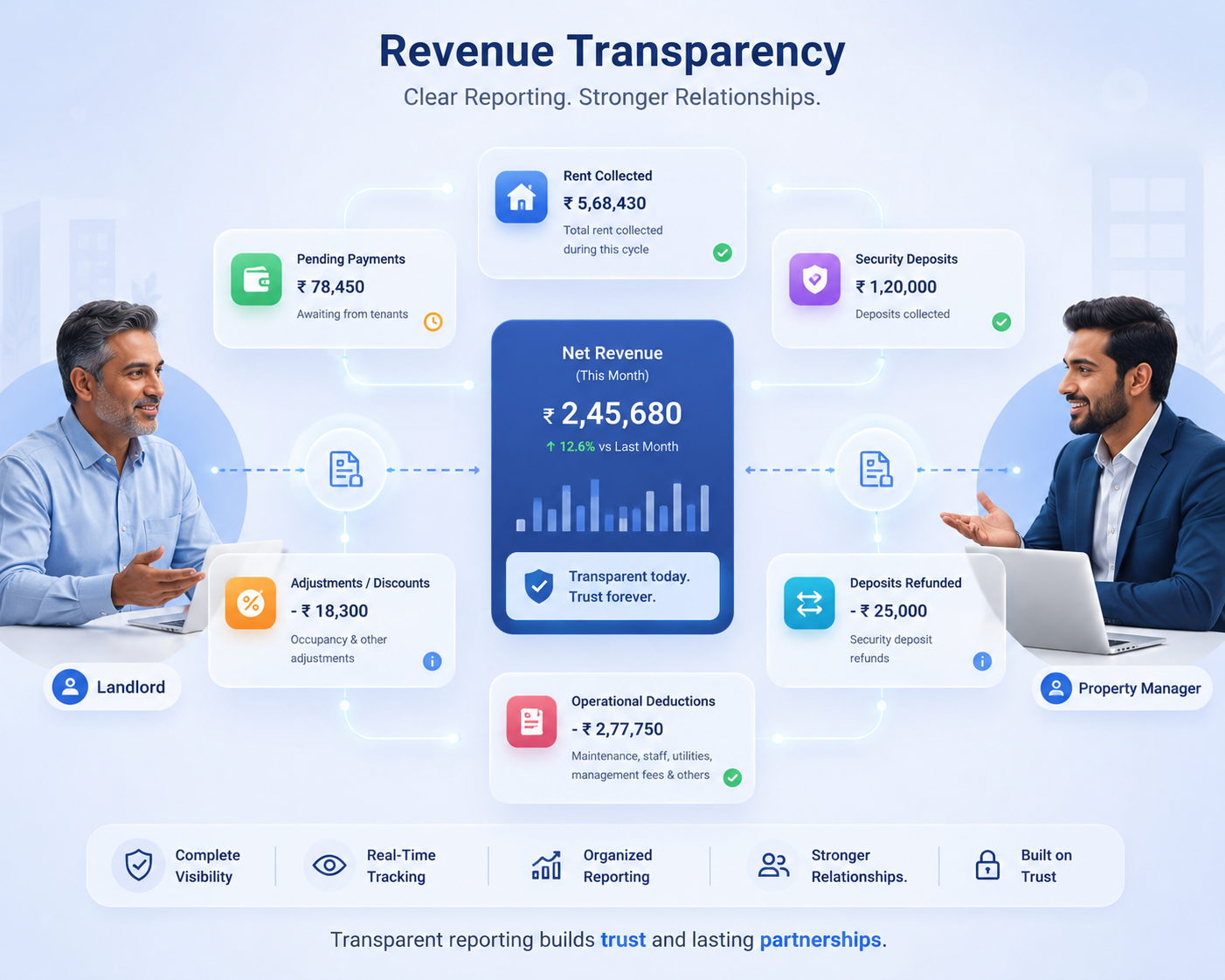
Instead of presenting fragmented numbers, structured reports organize revenue visibility into understandable categories such as:
- total rent generated during the reporting cycle,
- collected versus pending tenant payments,
- security deposit adjustments and refunds where applicable,
- discounts or occupancy-related adjustments,
- and realized net revenue after operational deductions.
This structure immediately improves owner confidence because the financial picture becomes easier to understand.
It also reduces unnecessary communication friction.
Instead of repeatedly asking:
“Why is this month’s payout lower?”
owners can already see:
- whether pending dues increased,
- whether operational expenses affected earnings,
- or whether occupancy movement influenced collections.
The more transparent the reporting becomes, the smoother owner communication usually gets.
Expense Reporting Is Where Many Operators Accidentally Lose Credibility
Most owners understand that rental properties involve recurring operational expenses. Maintenance, housekeeping, utilities, repairs, and staffing are all expected parts of managing a property properly.
The issue is rarely the expense itself.
The issue is unclear reporting around the expense.
For example, when reports mention vague deductions like:
“Maintenance expense – ₹18,000”
without explanation, owners naturally begin questioning:
- what exactly was repaired,
- whether the expense was unavoidable,
- and why costs increased suddenly.
This is why categorized expense reporting matters so much.
Strong property management reports usually separate operational spending into clearer categories such as:
- maintenance and repair activities affecting infrastructure or tenant experience,
- utility-related operational costs including electricity and water management,
- housekeeping or cleanliness expenses linked to operational upkeep,
- vendor and staff payments required for daily operations,
- and recurring operational purchases necessary for property management.
The objective is not to create overly technical accounting sheets.
The objective is to create financial transparency strong enough that owners understand where operational spending is happening and why it was necessary.
That distinction matters because trust grows much faster when visibility feels structured and honest.
Why Manual Reporting Starts Breaking Down as Operations Scale
Many property managers initially rely on spreadsheets, payment screenshots, and manual coordination for reporting because it feels manageable at smaller scales.
But once operations begin expanding across:
- multiple properties,
- higher tenant volumes,
- larger maintenance workflows,
- and franchise-level coordination,
manual reporting becomes increasingly difficult to sustain accurately.
The biggest issue is operational fragmentation.
Data starts getting scattered across:
- spreadsheets maintained by different staff members,
- WhatsApp conversations,
- payment confirmations,
- accounting tools,
- and disconnected occupancy records.
This creates several operational problems simultaneously:
- occupancy numbers stop matching financial summaries accurately,
- expense reconciliation becomes time-consuming,
- reporting timelines get delayed,
- and operational visibility weakens significantly.
Eventually, even generating a monthly owner report requires excessive coordination across teams.
More importantly, accuracy itself starts becoming difficult to maintain consistently.
This creates serious operational risk because incorrect reports damage owner trust very quickly.
Experienced operators eventually realize that scalable reporting requires centralized operational systems underneath. Without organized workflows, reporting becomes reactive instead of reliable.
Why Franchise Operators Need Standardized Reporting Systems
Reporting complexity increases dramatically in franchise-led rental businesses because multiple stakeholders are involved simultaneously.
Different properties may have:
- different occupancy levels,
- separate operational teams,
- varying expense structures,
- and multiple owners expecting visibility at the same time.
Without standardized reporting systems, communication quality starts becoming inconsistent across the business.
This creates several long-term operational issues:
- owners receive different reporting experiences depending on the property manager handling the location,
- financial visibility becomes fragmented across different properties,
- leadership teams struggle to compare operational performance accurately,
- and the franchise brand itself begins appearing inconsistent operationally.
Strong franchise operators solve this through centralized reporting structures.
Standardized reporting helps businesses maintain:
- uniform communication formats across properties,
- predictable financial visibility for stakeholders,
- cleaner occupancy and expense tracking systems,
- and stronger operational accountability internally.
This also improves strategic decision-making because leadership teams can evaluate:
- occupancy trends across locations,
- profitability differences between properties,
- operational cost fluctuations,
- and tenant retention performance more effectively.
As rental businesses grow, reporting consistency becomes one of the strongest indicators of operational scalability.
Modern Reporting Is Moving Toward Visibility, Not Just Documentation
One major shift happening across the property management industry is the movement away from static reporting toward continuous operational visibility.
Owners no longer want delayed monthly updates alone.
They increasingly expect real-time transparency into:
- occupancy movement,
- payment collection status,
- expense tracking,
- maintenance activity,
- and operational performance overall.
This is why owner portals and centralized dashboards are becoming increasingly important in professional property management ecosystems.
Instead of relying entirely on manual PDF reports, operators are now creating systems where owners can access visibility directly whenever required.
This improves:
- communication efficiency because fewer repetitive updates are required manually,
- operational transparency since owners feel continuously informed,
- and overall trust because visibility becomes structured rather than reactive.
Even psychologically, visibility changes owner confidence significantly.
When owners can clearly see:
- organized operational systems,
- updated financial tracking,
- and centralized reporting workflows,
they naturally perceive the business as more professional and scalable.
That perception matters enormously in long-term rental partnerships.
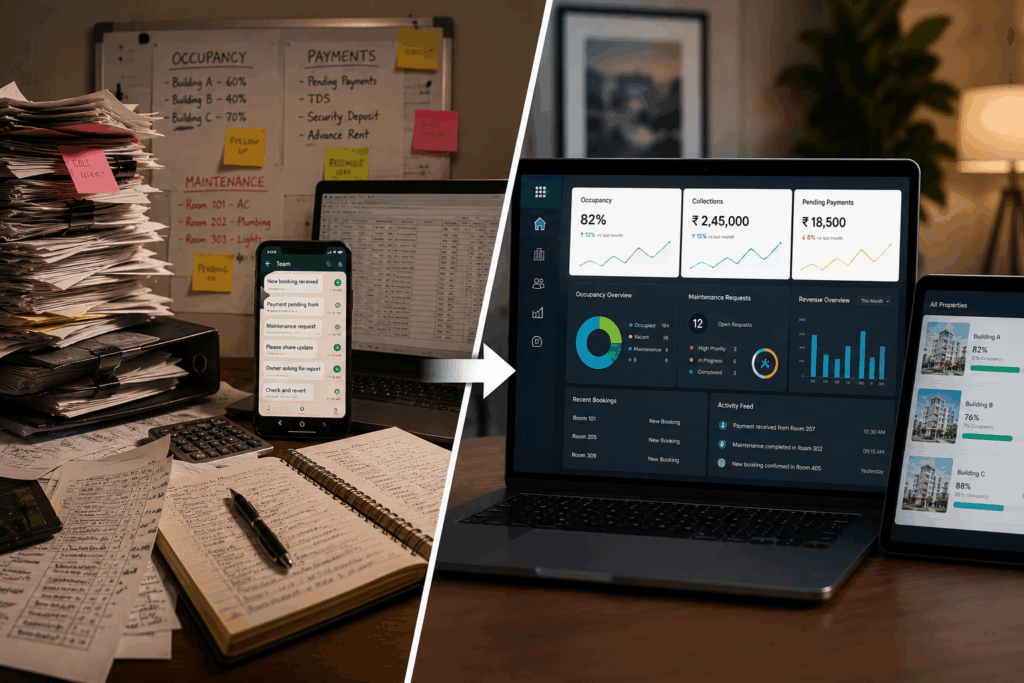
How RentOK Helps Property Managers Simplify Owner Reporting
As rental operations scale, maintaining organized reporting becomes increasingly difficult because occupancy tracking, payments, tenant management, maintenance coordination, and operational records often remain spread across multiple systems.
This is where centralized property management platforms become operationally critical.
RentOK helps property managers and franchise operators streamline reporting by organizing:
- occupancy visibility across rooms and properties through one connected system,
- payment tracking and pending dues monitoring for better financial clarity,
- expense categorization and operational record management,
- tenant coordination and communication workflows,
- and property-level operational visibility required for structured reporting.
Instead of relying heavily on fragmented spreadsheets and manual reconciliation processes every month, operators can maintain clearer operational oversight and generate more professional owner reports consistently.
For growing rental businesses, this becomes especially valuable because scalable reporting depends heavily on operational organization underneath.
Better operational visibility helps teams:
- improve owner communication quality,
- reduce reporting inconsistencies,
- streamline financial transparency,
- and manage multiple properties more efficiently through centralized workflows.
As reporting expectations continue rising across the rental industry, structured operational systems are becoming essential for maintaining professionalism at scale.
Conclusion
In modern property management, owner reporting is no longer just an administrative responsibility completed at the end of every month.
It has become one of the strongest indicators of professionalism, operational discipline, and management quality within rental businesses.
The operators who build stronger long-term owner relationships are usually the ones who provide:
- transparent financial visibility,
- organized occupancy reporting,
- structured expense tracking,
- and communication systems that create confidence consistently.
Because ultimately, owners are not only evaluating occupancy numbers or monthly earnings.
They are evaluating whether the property is being managed with clarity, consistency, and operational control.
As rental businesses continue expanding across franchise networks and multi-property portfolios, reporting quality will increasingly separate professionally managed operators from fragmented ones.
Explore RentOk to simplify owner reporting, improve operational transparency, and manage your rental business more efficiently through one centralized property management platform.
About the Author
Ishika Pannu
Ishika Pannu brings you the latest insights and easy-to-apply strategies in property management—helping you simplify renting and grow with RentOk.