Market Trends
Community Management in Co-living: Hosting Events that Drive Retention

Written by
Ishika Pannu
Read Time
10 min read
Posted on
May 9, 2026
Overview
Overview
Community Management in Co-living: Hosting Events that Drive Retention
The co-living industry has evolved significantly over the last few years. What was once positioned primarily as affordable shared accommodation has now become a lifestyle-driven housing model focused on convenience, flexibility, and experience. For modern tenants, especially students and young professionals relocating to new cities, accommodation decisions are no longer based only on rent and room size. The overall living environment matters just as much.
This shift has made community management one of the most important aspects of successful co-living operations.
Residents today want more than just a furnished room. They want spaces where they can interact comfortably, build routines, feel socially connected, and experience a sense of belonging. Properties that successfully create this environment often see stronger retention, better referrals, and healthier occupancy stability over time.
This is why community-building is no longer an optional engagement activity. It has become a direct business and retention strategy.
Why Community Directly Impacts Retention in Co-living
In traditional rental setups, tenant relationships with the property usually remain transactional. Residents pay rent, use the facilities, and eventually move out when they find a better alternative. But co-living works differently because the resident experience extends beyond infrastructure.
When tenants develop social connections inside a property, the accommodation becomes emotionally familiar. People begin associating the space with friendships, routines, shared experiences, and comfort. As a result, moving out no longer feels like changing a room. It feels like leaving an ecosystem they have adapted to.
This emotional attachment has a direct influence on retention.
Properties with stronger community engagement often experience:
- Higher renewal rates because residents feel socially settled within the property environment
- Better resident referrals as tenants naturally recommend spaces where they have had positive experiences
- Lower vacancy pressure since longer stays reduce frequent turnover cycles
- Stronger online reputation due to increased resident-generated content and reviews
- Better resident cooperation in shared spaces because social familiarity improves behavioral accountability
One of the most overlooked advantages of community-building is that it improves operational stability indirectly. Residents who feel comfortable within the property environment are often more patient with temporary operational issues because the overall experience still feels valuable.
That psychological comfort plays a major role in long-term tenant satisfaction.
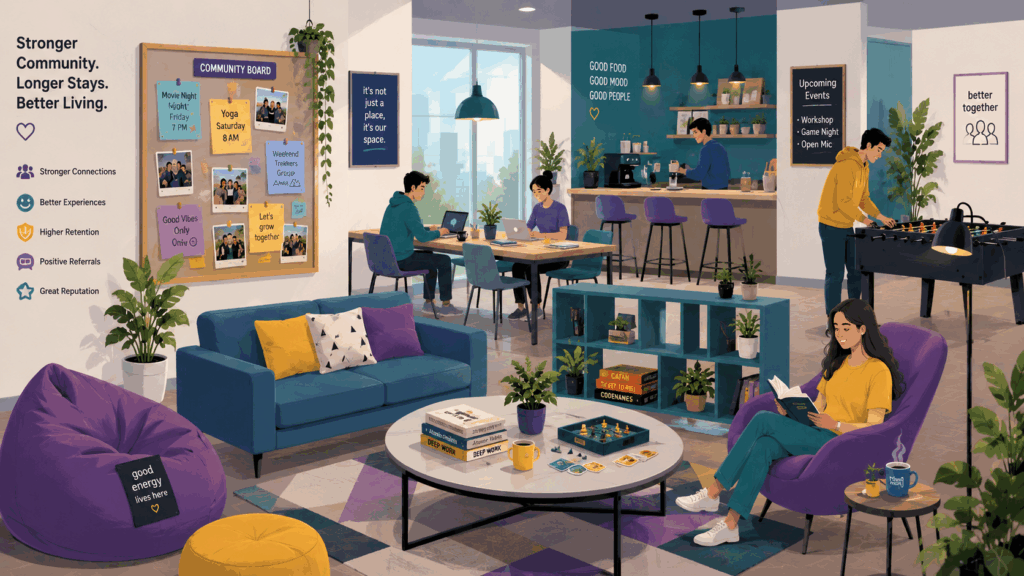
The Problem With Random Event Planning
Most operators understand that events help improve engagement, but the execution is often inconsistent.
A common pattern in many co-living properties is reactive event management. Activities are organized occasionally during festivals, occupancy drops, social media campaigns, or holiday periods. While these events may generate temporary excitement, they rarely create long-term engagement because there is no continuity behind them.
Community-building works best when it becomes part of the property culture rather than a marketing activity.
Residents should feel that interaction and engagement are naturally integrated into the living experience. That only happens when events are planned consistently and aligned with the lifestyle of the resident demographic.
Strong community management usually focuses on:
- Creating recurring engagement opportunities instead of one-time celebrations
- Encouraging casual interaction that feels natural rather than forced
- Designing activities around resident interests and behavioral patterns
- Maintaining consistency in communication and participation
- Making events easy to join without social pressure or excessive formality
The objective is not simply to host more events.
The objective is to create a living environment where residents feel connected enough to continue staying longer.
What Kind of Events Actually Work in Co-living Spaces?
One major misconception in community management is that large-scale or expensive events automatically perform better. In reality, engagement quality matters far more than production value.
Residents usually participate more actively in events that feel comfortable, repeatable, and socially approachable. Smaller activities often outperform heavily produced gatherings because they reduce awkwardness and encourage natural interaction.
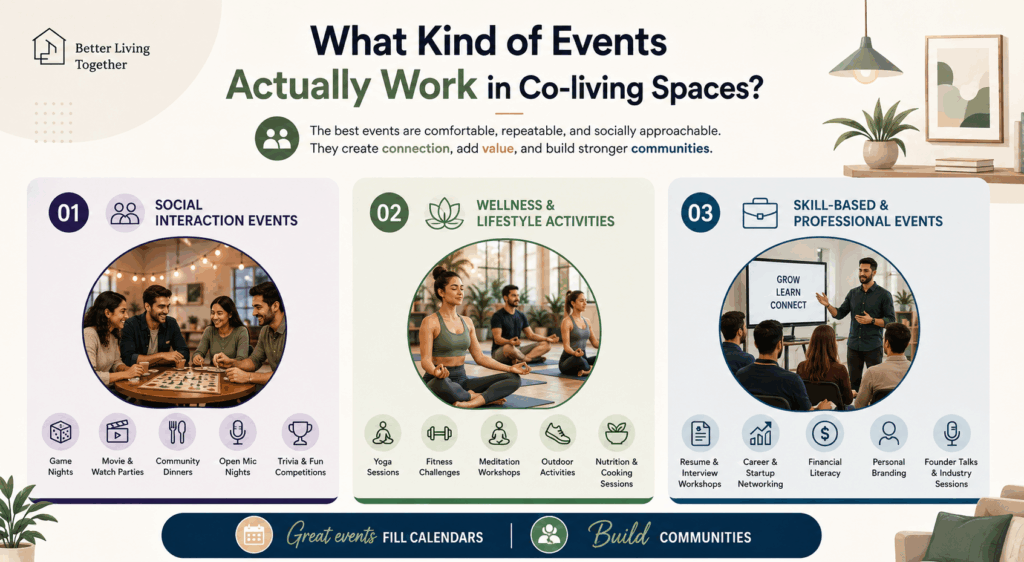
The most effective co-living events generally fall into a few high-performing categories.
Social Interaction Events
These events focus on helping residents interact casually without making networking feel forced. They work particularly well in co-living environments where many tenants may initially feel isolated after moving into a new city.
Some commonly successful formats include:
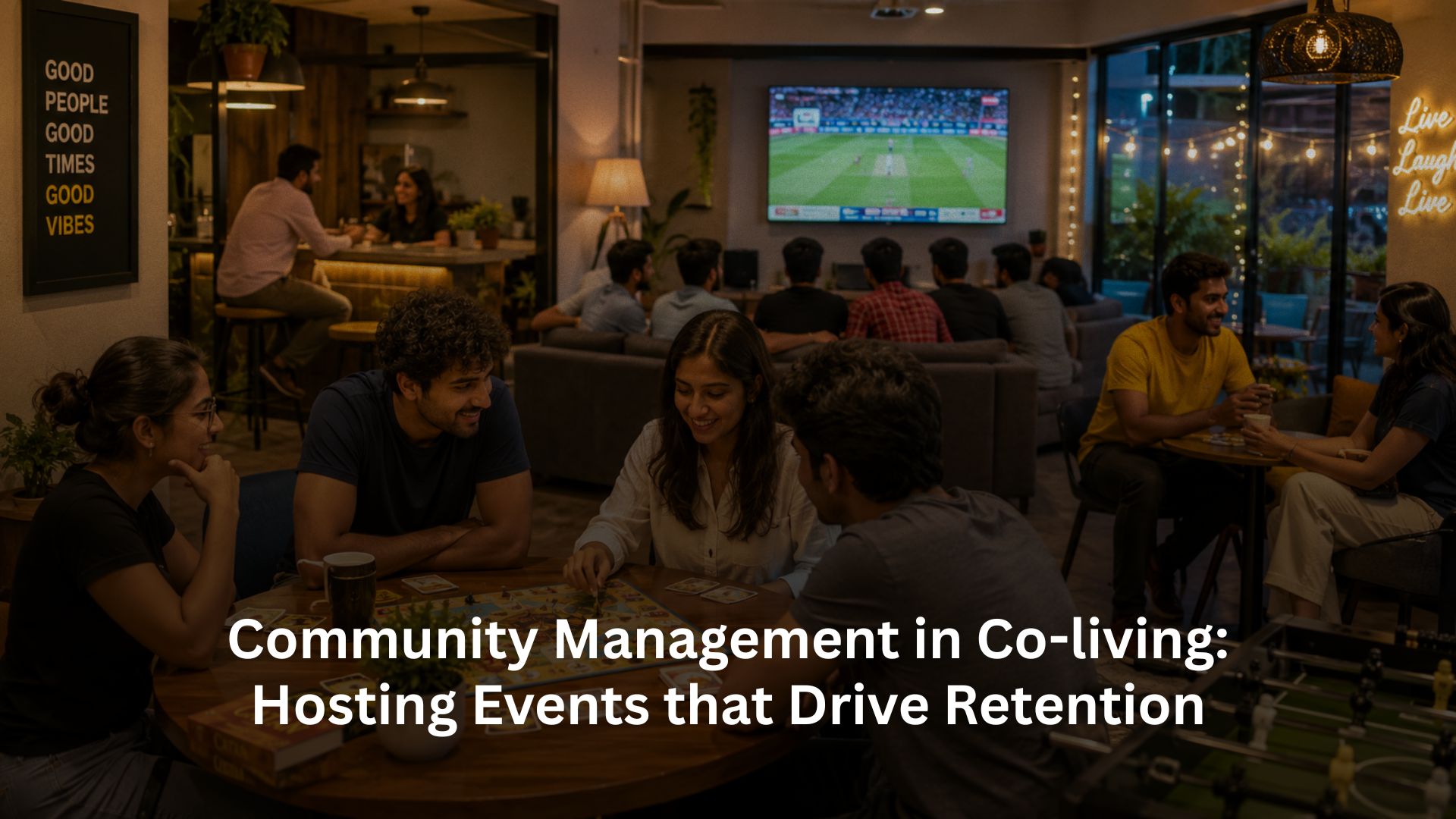
- Board game evenings that encourage small-group conversations and relaxed interaction
- Movie screenings or sports watch parties that create shared entertainment experiences among residents
- Community dinners and potluck sessions where participation feels collaborative rather than organized by management alone
- Open mic evenings where residents can showcase hobbies, music, comedy, or storytelling comfortably
- Trivia nights and casual competitions that increase participation without creating social pressure
These activities are effective because they remove the need for formal introductions. Interaction happens naturally through participation itself.
Over time, these repeated interactions create familiarity, and familiarity eventually creates emotional comfort within the property.
Wellness and Lifestyle-Based Activities
Modern tenants increasingly prioritize wellness, productivity, and balance in their daily routines. Co-living spaces that support these lifestyle expectations often create stronger resident satisfaction and higher engagement levels.
Lifestyle-focused events help position the property as an environment that contributes positively to residents’ routines rather than functioning only as accommodation.
Popular wellness-oriented activities include:
- Weekend yoga sessions that create calm and structured community interaction
- Group fitness challenges that encourage recurring engagement and healthy competition
- Meditation or mindfulness workshops designed to reduce stress among working professionals and students
- Running, cycling, or outdoor activity groups that encourage residents to build routines together
- Nutrition-focused workshops or healthy cooking sessions that add practical lifestyle value
These activities tend to perform well because they improve the resident experience beyond entertainment. They contribute to daily lifestyle quality, which creates stronger emotional value around the property itself.
Skill-Based and Professional Networking Events
Career-oriented engagement has become increasingly effective in co-living environments, especially those catering to students, freelancers, startup professionals, and early-career employees.
Residents appreciate activities that help them grow personally or professionally while also creating opportunities to connect with like-minded individuals inside the property.
Some high-engagement formats include:
- Resume-building and interview preparation workshops for students and fresh graduates
- Portfolio review sessions for designers, creators, and freelancers
- Startup networking meetups that encourage collaboration among entrepreneurial residents
- Financial literacy sessions covering investments, budgeting, and money management
- Personal branding and content creation workshops for digital professionals
- Founder talks or industry discussion sessions featuring experienced speakers
Unlike purely entertainment-focused activities, these events create long-term value perception around the property. Residents begin associating the co-living space with personal growth and opportunity, which strengthens retention significantly.
Why Low-Cost Community Engagement Often Works Better
A large number of operators avoid consistent engagement initiatives because they assume events require high budgets. But in reality, community-building depends far more on relevance and consistency than expensive execution.
Some of the highest-performing co-living activities are operationally simple and highly affordable.
For example, a weekly rooftop chai meetup may create more genuine interaction than a heavily marketed annual celebration. Similarly, resident-led hobby groups often perform better than professionally organized events because they feel authentic and participative.
The most important factor is whether residents feel comfortable engaging repeatedly.
Here’s how different low-cost engagement formats create long-term value:
| Event Type | Why It Works | Operational Benefit |
|---|---|---|
| Community Dinner Nights | Encourages relaxed interaction among residents in a familiar environment | Easy to organize consistently without large budgets |
| Board Game Sessions | Creates small-group conversations naturally without social pressure | Minimal infrastructure and setup required |
| Fitness Challenges | Builds recurring participation habits among residents | Improves routine-driven engagement |
| Skill-Sharing Workshops | Residents contribute knowledge and lead activities themselves | Reduces dependency on external organizers |
| Sports Screening Nights | Creates collective excitement and social participation | Drives strong engagement during recurring tournaments |
Residents rarely remember how expensive an event was.
They remember whether the experience felt enjoyable, welcoming, and socially meaningful.
Measuring the Social ROI of Community Management
Many operators struggle to evaluate whether community-building efforts are actually working because they focus on the wrong metrics.
Attendance alone does not accurately measure engagement quality.
The real impact of strong community management becomes visible gradually through operational and retention indicators.
Successful co-living operators usually monitor:
- Renewal rate improvements over longer periods
- Referral-driven occupancy growth from existing residents
- Reduction in vacancy gaps between move-outs and move-ins
- Increased resident participation consistency across activities
- Better online reviews and resident-generated social media content
- Lower complaint escalation frequency within shared spaces
- Improved utilization of common areas and community infrastructure
Even small retention improvements can create major long-term financial impact because acquisition costs in co-living continue increasing across competitive markets.
A resident who extends their stay by several additional months often generates significantly more value than constantly acquiring new short-term occupants through aggressive marketing efforts.
This is why community management should be viewed as an operational investment rather than simply an engagement expense.
Common Mistakes That Make Community Events Fail
Even well-intentioned engagement efforts fail when operators focus more on organizing events than understanding resident behavior.
One of the most common mistakes is overcomplicating activities. Residents generally prefer casual and approachable formats over highly structured events that feel overly formal or mandatory.
Inconsistency is another major issue. When activities happen irregularly, residents stop viewing them as part of the living experience. Community-building requires repetition and predictability to create real impact.
Operators also frequently ignore demographic differences between properties. A student-focused co-living space and a working-professional setup require completely different engagement styles. What works successfully in one environment may perform poorly in another.
Communication gaps also reduce participation significantly. If event information is scattered across multiple channels without proper coordination, residents naturally lose interest or remain unaware of activities entirely.
Strong community management depends just as much on operational structure as it does on creativity.
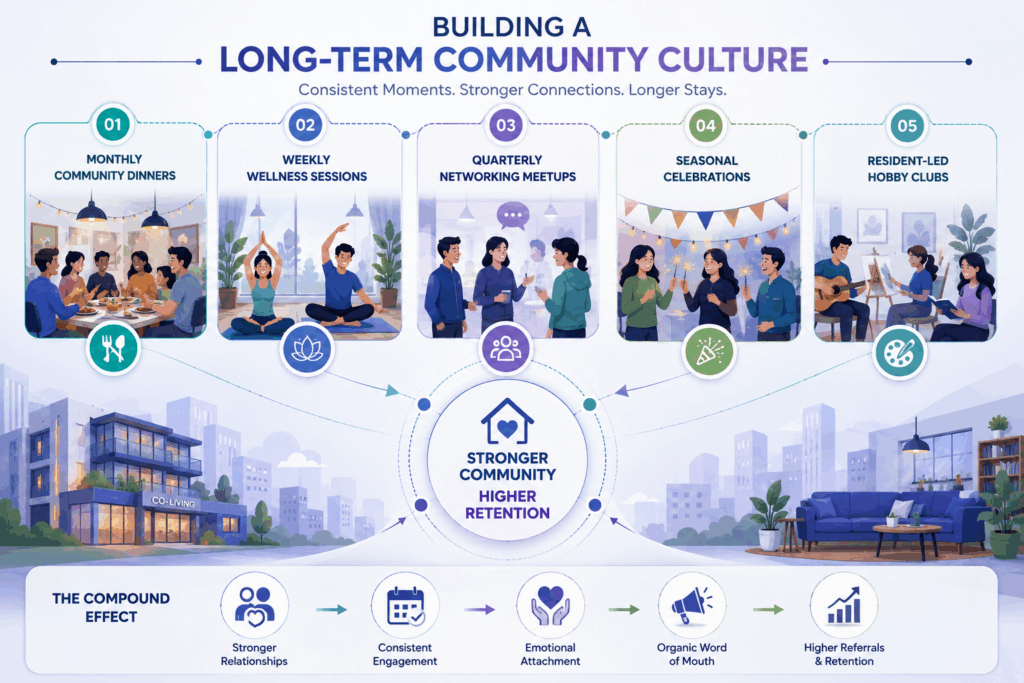
Building a Long-Term Community Culture
The strongest co-living brands do not rely on isolated engagement activities.
They build repeatable systems that gradually become part of the resident lifestyle experience.
This could include:
- Monthly community dinners that encourage recurring interaction among tenants
- Weekly wellness sessions that help residents build routines together
- Quarterly networking meetups tailored to the professional interests of residents
- Seasonal celebrations that involve resident participation rather than management-only execution
- Resident-led hobby clubs that create self-sustaining engagement ecosystems inside the property
Consistency is what transforms occasional activities into actual community culture.
When residents begin expecting interaction as part of their everyday environment, the property becomes significantly more valuable emotionally without requiring major infrastructure investments.
This also creates stronger organic marketing advantages because socially active properties naturally generate more resident referrals, online sharing, and word-of-mouth visibility.
How RentOk Helps Co-living Operators Build Better Resident Experiences
As co-living operations scale, managing resident communication, engagement coordination, occupancy tracking, and operational workflows manually becomes increasingly difficult. Many operators eventually struggle with fragmented systems spread across spreadsheets, WhatsApp groups, calls, and disconnected processes.
This operational inconsistency often affects resident experience directly.
RentOk helps co-living operators streamline and organize property management operations more efficiently by centralizing critical workflows in one place. From managing tenant records and occupancy visibility to improving communication consistency and operational coordination, the platform helps reduce the friction that frequently weakens resident satisfaction over time.
More importantly, strong community-building becomes much easier when the operational foundation already feels structured and reliable.
Residents engage more comfortably when they experience:
- smoother onboarding and move-in coordination that reduces confusion during initial settlement
- better communication systems that keep updates, announcements, and notices organized
- faster operational handling that improves trust in management responsiveness
- centralized tenant management processes that reduce administrative inefficiencies
- a more professional and structured living environment overall
Community culture performs best when the property itself already feels organized, responsive, and operationally dependable.
Conclusion
Community management is no longer an optional engagement layer in co-living operations. It has become one of the most effective ways to improve tenant retention, strengthen resident satisfaction, and create long-term operational stability.
Modern residents are not simply evaluating rooms anymore. They are evaluating the overall living experience surrounding those rooms. Properties that successfully create social comfort, recurring interaction, and meaningful engagement often outperform competitors even when infrastructure advantages are similar.
The strongest co-living spaces today understand that retention is not built through amenities alone. It is built through experiences that make residents feel connected enough to stay longer.
If you want to create a more engaging, retention-focused, and operationally efficient co-living experience, explore RentOk and discover how structured property management can help support stronger resident communities and long-term growth.
About the Author
Ishika Pannu
Ishika Pannu brings you the latest insights and easy-to-apply strategies in property management—helping you simplify renting and grow with RentOk.