
Property Management
PG Management Annual Planner: Month-by-Month Guide

Written by
Ishika Pannu
Read Time
18 min read
Posted on
July 31, 2026
Overview
Overview
PG Management Annual Planner: Month-by-Month Guide
Managing a PG or co-living property often feels like solving a new problem every day. One week you’re chasing rent payments, the next you’re dealing with unexpected maintenance requests, onboarding new tenants, or preparing for seasonal vacancies. While these responsibilities may seem unrelated, experienced property operators know that most operational challenges follow a predictable annual cycle.
The difference between an average PG and a professionally managed one isn’t the number of tenants it has, it’s how well the owner plans for what’s coming next.
Instead of reacting to problems as they arise, successful operators prepare months in advance. They know when admissions begin, when vacancies are likely to increase, when agreements are due for renewal, when maintenance should be scheduled, and when compliance deadlines need attention. This proactive approach helps them maintain healthier occupancy, improve cash flow, and reduce operational stress throughout the year.
This annual planner is designed to help PG owners stay one step ahead. Rather than treating property management as a series of isolated tasks, think of it as a yearly operational cycle where every month presents an opportunity to strengthen your business.
Why Every PG Owner Needs an Annual Management Calendar
Many property owners maintain monthly to-do lists, but very few follow a structured annual management plan. As a result, important activities are often delayed until they become urgent, creating unnecessary pressure for both the management team and tenants.
A yearly calendar provides much more than reminders, it creates operational discipline.
With an annual planner, you can:
- Prepare for seasonal occupancy fluctuations well in advance, allowing enough time to launch marketing campaigns, adjust pricing strategies, and reduce vacancy periods before demand changes.
- Spread operational workload across the year instead of handling maintenance, documentation, renewals, and inspections simultaneously during peak seasons.
- Improve financial planning by anticipating recurring expenses, tax filings, maintenance budgets, and revenue trends rather than making last-minute financial decisions.
- Create a better tenant experience because planned operations usually result in smoother move-ins, quicker issue resolution, and fewer disruptions throughout the year.
When these activities become part of a structured schedule, your property operates more predictably, giving you greater control over both occupancy and profitability.
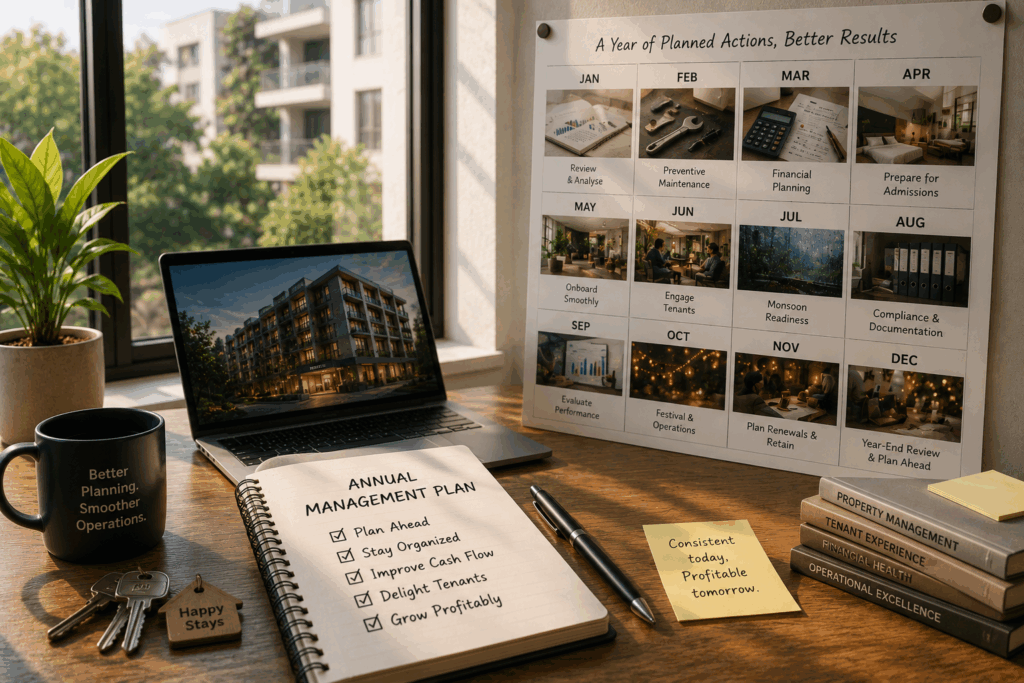
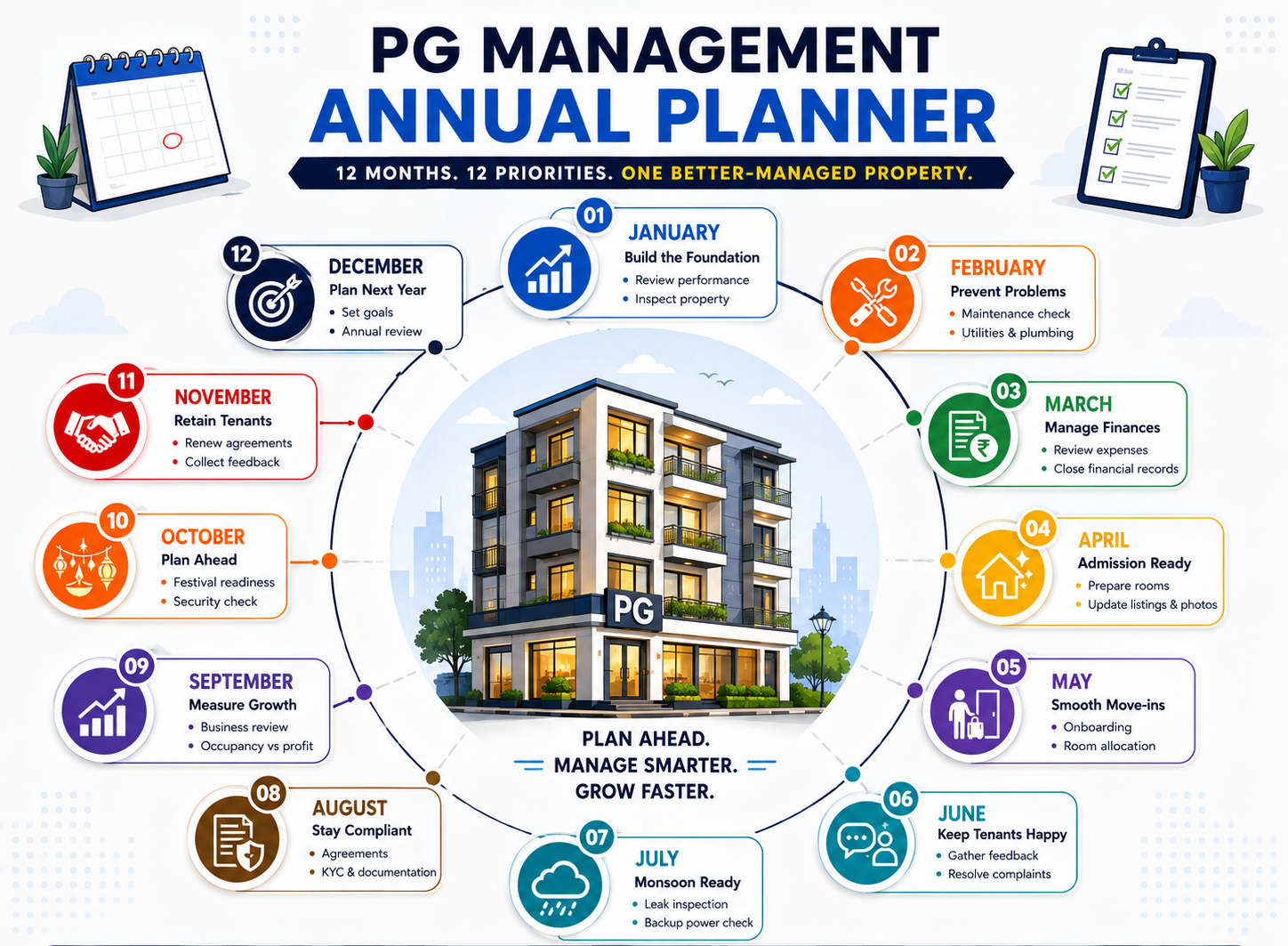
January: Start the Year with Operational Clarity
The beginning of the year is the ideal time to evaluate how your property performed over the previous twelve months. Before focusing on new tenants or expansion plans, take a step back and assess what worked, what didn’t, and where operational improvements are needed.
This month should focus on building a strong foundation for the year ahead.
Some important January tasks include:
- Review occupancy performance from the previous year. Identify seasonal vacancy trends, average occupancy rates, and months that generated the highest and lowest revenue. These insights can help you prepare more effectively for the coming year.
- Audit pending tenant dues and outstanding payments. Starting a new financial year with unresolved collections often affects cash flow and creates unnecessary follow-ups later.
- Inspect the property’s overall condition. Small maintenance issues identified early usually cost less than emergency repairs later in the year.
- Evaluate your current operational systems. If your team still relies on spreadsheets, handwritten registers, or scattered WhatsApp conversations, this is the right time to streamline processes before occupancy increases.
If your annual review reveals that you’re spending more time managing spreadsheets than managing your property, it may be time to rethink your operational systems. Here’s why growing PG operators eventually move beyond Excel.
January is also a good month to review your pricing strategy. Rental markets evolve constantly, and understanding local demand can help you make informed pricing decisions before peak admission seasons begin.
February: Focus on Preventive Maintenance
Preventive maintenance rarely receives the attention it deserves because most operators naturally prioritize visible problems over potential ones. However, experienced property managers understand that scheduled maintenance is significantly more cost-effective than emergency repairs.
Instead of waiting for complaints to appear, February should be dedicated to identifying issues before tenants notice them.
Areas worth inspecting include:
- Electrical wiring, switchboards, and backup power systems to ensure uninterrupted service during the coming months.
- Plumbing lines, water tanks, drainage systems, and bathroom fittings, especially in older properties where minor leaks can quickly become expensive repairs.
- Furniture, mattresses, appliances, and common areas to maintain a consistently good tenant experience and reduce replacement costs later.
This is also an excellent time to speak with your maintenance vendors. Confirm service schedules, update emergency contact information, and review vendor performance based on the previous year. Strong vendor relationships often translate into faster response times when urgent issues arise.
Preventive maintenance becomes much easier when complaints, repair history, and maintenance requests are documented properly instead of being scattered across calls and WhatsApp chats. This is one of the biggest reasons professionally managed properties invest in structured property management systems. If you’re exploring What is Rental Management? Tools to Manage Your Property Efficiently, you’ll find that having a centralized system for tracking maintenance is a key part of efficient rental management.
March: Prepare for the Financial Year-End
March is one of the busiest months for business owners across India, and PG operators are no exception. Financial records, tax-related documentation, and expense tracking become especially important during this period.
Waiting until the last week of March often leads to unnecessary stress, missing documents, and inaccurate records.
Your focus this month should include:
- Organizing rent collection records and payment histories.
- Reviewing operational expenses to identify areas where costs can be optimized.
- Reconciling security deposits, outstanding dues, and utility payments.
- Preparing financial reports that make tax filing and business planning much easier.
Accurate records don’t just simplify compliance, they also provide valuable insights into how efficiently your property is operating.
Financial reports become even more meaningful when you can relate them to occupancy trends, helping you understand whether your property is truly profitable or simply operating at high occupancy. As discussed in The Occupancy Trap: Why Full Buildings Still Lose Money, high occupancy alone doesn’t guarantee strong returns, combining occupancy insights with financial reporting gives property owners a clearer picture of overall profitability and operational performance.
April: Get Ready for the Admission Season
For many student-focused PGs, April marks the beginning of preparation for one of the busiest occupancy periods of the year. Even if admissions don’t start immediately in your city, this is the month to ensure your property is market-ready.
First impressions influence occupancy more than many owners realize.
Before marketing your property, make sure:
- Rooms are professionally cleaned, repaired, and ready for immediate occupancy rather than requiring work after inquiries begin.
- Property photographs accurately reflect the current condition of your rooms and common spaces. Outdated images often reduce inquiry quality.
- Amenities listed on your website and property listings remain accurate and up to date, preventing misunderstandings during the move-in process.
- Your inquiry handling process is organized so that prospective tenants receive timely responses and consistent information.
Remember, admission season is highly competitive. Properties that prepare early generally have an advantage over those that start marketing only after inquiries begin.
Preparation also includes evaluating whether your pricing strategy supports your business goals. Many operators fill rooms quickly but still struggle with profitability because they haven’t calculated their ideal occupancy and pricing together. Learning How to Calculate Your PG’s Break-Even Occupancy can help you determine the minimum occupancy required to cover costs, making it easier to set sustainable pricing and maximize long-term profits.
May: Prepare for Peak Occupancy and Faster Move-ins
For many PG owners, May is when inquiries start picking up, especially in cities with large student populations or a steady influx of working professionals. The groundwork laid over the previous few months now begins to pay off. However, generating inquiries is only half the job. The real challenge is converting those inquiries into confirmed move-ins without creating operational bottlenecks.
This is the month to review your entire onboarding journey. A delayed response, missing documents, or a confusing booking process can easily push prospective tenants toward another property.
Focus on strengthening these areas:
- Standardize your onboarding process by creating a checklist that covers KYC collection, agreement signing, security deposit collection, room allocation, and inventory handover. A structured process reduces errors and ensures every tenant receives a consistent experience.
- Keep room inventory updated in real time. Nothing frustrates prospective tenants more than being shown rooms that are already occupied. Accurate availability helps build trust and speeds up decision-making.
- Train your staff to handle inquiries consistently. Whether inquiries come through calls, WhatsApp, social media, or listing platforms, every potential tenant should receive clear information about pricing, amenities, policies, and availability.
This is also a great time to evaluate your lead management process. If inquiries are scattered across multiple platforms, following up becomes difficult, and valuable leads can easily slip through the cracks.
June: Strengthen Tenant Engagement Before Small Issues Become Bigger Problems
Once occupancy starts increasing, daily operations become much more dynamic. More tenants mean more maintenance requests, more payments to track, and significantly more communication.
Many operators spend June solving day-to-day issues without noticing recurring patterns. Instead, use this month to evaluate tenant experience proactively.
Ask yourself:
- Are maintenance requests being resolved within acceptable timelines?
- Are tenants receiving timely updates about complaints?
- Is rent collection becoming more difficult compared to previous months?
- Are staff members repeatedly answering the same questions every day?
Small operational inefficiencies often become much more visible once occupancy reaches higher levels.
Some useful activities for June include:
- Conducting informal tenant feedback sessions to identify recurring concerns before they appear in online reviews.
- Reviewing complaint-resolution timelines to understand whether operational processes need improvement rather than simply increasing manpower.
- Updating house rules, visitor policies, and communication guidelines wherever necessary to reduce misunderstandings during the busy season.
This is also a good opportunity to improve communication systems across the property. As occupancy grows, manual coordination becomes increasingly difficult.
July: Prepare Your Property for the Monsoon
The monsoon season brings a different set of operational challenges. Water seepage, plumbing issues, power fluctuations, damp walls, and drainage problems can quickly affect tenant satisfaction if preventive measures haven’t already been taken.
Rather than waiting for complaints, experienced operators inspect their properties before weather conditions worsen.
Your July checklist should include:
- Inspect rooftops, balconies, drainage systems, and exterior walls for signs of leakage or blocked water outlets. Addressing these issues early helps prevent expensive repairs later in the season.
- Test electrical backup systems and emergency lighting. Unexpected power cuts are common during heavy rainfall, and preparedness directly affects tenant comfort.
- Review housekeeping schedules, particularly for common areas that require more frequent cleaning due to mud, moisture, and increased foot traffic.
- Communicate emergency contacts and maintenance procedures so tenants know exactly whom to reach during urgent situations.
Monsoon preparedness isn’t just about protecting the building, it also reinforces tenant confidence that the property is professionally managed.
August: Review Compliance and Operational Documentation
By August, most properties have settled into their regular operational rhythm. This makes it an ideal time to step away from daily firefighting and review documentation that often gets overlooked during busier months.
Strong documentation protects your business just as much as good occupancy numbers.
Use this month to review:
- Tenant agreements nearing renewal and identify residents who should be contacted well in advance.
- KYC documentation to ensure records remain complete and properly organized.
- Vendor contracts, service agreements, and annual maintenance schedules that may require renewal during the coming months.
- Internal SOPs for staff members to ensure daily operations remain consistent even if responsibilities shift.
Many operational disputes arise not because policies are missing, but because documentation isn’t maintained consistently.
September: Evaluate Business Performance Before the Final Quarter
September is an excellent checkpoint before entering the last quarter of the year. Instead of waiting until December to review performance, analyze your business now while there’s still time to implement meaningful improvements.
Look beyond occupancy numbers and evaluate overall operational health.
Some important questions to consider include:
- Which marketing channels generated the highest-quality tenants this year?
- Has your average occupancy improved compared to the previous year?
- Which months experienced the highest vacancy rates, and what contributed to those gaps?
- Are operational costs increasing faster than rental income?
Performance reviews become much more valuable when supported by accurate operational data rather than assumptions. Identifying trends now gives you enough time to adjust pricing, marketing strategies, or operational processes before the year ends.
If your occupancy numbers look healthy but profitability still feels inconsistent, it may be worth reviewing whether your business is falling into the common occupancy trap experienced by many growing rental businesses. The Occupancy Trap: Why Full Buildings Still Lose Money explains why high occupancy doesn’t always translate into strong profits and highlights the financial metrics every property owner should monitor alongside occupancy rates.
October: Plan for Festivals and Year-End Occupancy
Festival seasons often affect both occupancy and daily operations. Some tenants travel home for extended periods, while others look for accommodation before joining new jobs after the festive break.
Planning ahead helps minimize disruption.
Consider focusing on:
- Scheduling preventive maintenance before holidays when vendors may have limited availability.
- Communicating festival schedules, office timings, and emergency support clearly to tenants.
- Launching seasonal marketing campaigns if your city typically experiences increased demand after major festivals.
- Reviewing housekeeping and security arrangements to ensure smooth operations during periods of reduced staff availability.
Good planning during October helps avoid operational disruptions when business activity becomes unpredictable.
November: Start Planning for Renewals and Retention
By November, most PG owners are focused on maintaining occupancy, but experienced operators begin preparing for something equally important, tenant retention. Retaining an existing tenant is often more cost-effective than acquiring a new one, especially when you factor in marketing expenses, room preparation, onboarding, and the revenue lost during vacant periods.
This is the right time to identify tenants whose agreements are nearing completion and understand whether they intend to continue their stay. Starting these conversations early gives both parties enough time to plan, reducing last-minute vacancies and improving occupancy predictability.
A few activities that deserve attention this month include:
- Reach out to tenants whose agreements are due for renewal instead of waiting until the final week. Early discussions allow you to understand concerns, negotiate renewals if necessary, and plan occupancy better.
- Review your rental pricing against the local market. If you intend to revise rents for the coming year, make sure the increase is backed by improvements in facilities, services, or market demand rather than arbitrary adjustments.
- Collect structured tenant feedback. Instead of asking, “Is everything okay?”, gather insights about cleanliness, food quality, maintenance response, staff behaviour, security, and overall living experience. These inputs often highlight operational improvements that directly impact retention.
Tenant retention is rarely influenced by a single factor. It is the cumulative result of consistent service, transparent communication, and well-managed daily operations throughout the year.
December: Review the Year and Plan the Next One
December isn’t just about closing the year’s books, it’s about preparing your business for the year ahead.
Many property owners delay their annual review until January, but reviewing performance in December helps capture fresh insights, identify trends, and address issues before the new year.
Look beyond revenue by evaluating your property’s overall operational performance.
Your year-end review should cover:
- Occupancy Trends: Which months consistently performed well? When did vacancies increase? Understanding seasonal patterns will help you allocate marketing budgets and operational resources more effectively next year.
- Financial Performance: Compare rental income against operating expenses, maintenance costs, and utility bills. This provides a clearer picture of profitability rather than simply looking at revenue.
- Maintenance History: Review recurring repair requests. If the same issues appear repeatedly, it may indicate that permanent upgrades are more cost-effective than temporary fixes.
- Operational Efficiency: Assess whether your current systems helped reduce manual work or created additional administrative effort. Businesses that continue growing eventually reach a stage where manual coordination becomes a significant bottleneck.
- Tenant Satisfaction: Review feedback collected throughout the year, online ratings, complaint trends, and move-out reasons. These insights often reveal opportunities to improve the overall tenant experience.
December is also the perfect month to define measurable goals for the coming year. Rather than setting broad objectives like “increase occupancy,” establish operational targets that can actually be tracked.
For example:
- Improve average occupancy from 82% to 92%.
- Reduce average complaint resolution time.
- Increase tenant renewals by a specific percentage.
- Automate routine operational tasks currently handled manually.
- Reduce rent collection delays through better payment tracking.
Businesses that measure their progress consistently are usually better positioned to grow sustainably.
The year-end review is also a good time to digitise your operations. Explore Property Management Apps to Replace Manual Registers to reduce paperwork and improve efficiency.
Annual Tasks That Shouldn’t Be Limited to Just One Month
While every month has its own priorities, some responsibilities remain equally important throughout the year. These activities contribute directly to operational consistency and should become part of your regular management routine.
These include:
- Monitoring occupancy levels continuously instead of reviewing them only during admission seasons. Regular tracking helps identify early warning signs of declining demand before vacancies begin affecting revenue.
- Maintaining accurate financial records throughout the year so reporting, tax filing, and business planning become significantly easier when deadlines approach.
- Conducting periodic property inspections to identify maintenance requirements before they become tenant complaints or expensive repairs.
- Reviewing operational workflows regularly to eliminate repetitive manual work that consumes valuable management time as the property grows.
- Staying connected with tenants through structured communication, ensuring important announcements, payment reminders, and policy updates reach everyone consistently.
These recurring activities may seem routine, but together they form the foundation of a professionally managed property.
How RentOk Helps You Stay Ahead Throughout the Year
Managing an annual calendar becomes increasingly difficult when rent collection, tenant records, maintenance requests, agreement renewals, complaints, and occupancy tracking are all handled through separate spreadsheets, notebooks, WhatsApp chats, and manual reminders.
As your property grows, it’s not the number of tasks that becomes overwhelming, it’s keeping track of when each task needs attention.
RentOk brings these recurring operational activities into one centralized platform, making it easier for PG owners to stay organized throughout the year. From monitoring occupancy and tracking rent collections to managing agreements, tenant records, maintenance requests, staff activities, and financial reports, the platform helps reduce manual coordination while improving operational visibility.
Instead of remembering dozens of recurring responsibilities every month, property managers can rely on structured workflows and centralized records that keep daily operations running smoothly. This not only saves time but also allows owners to focus on improving occupancy, tenant experience, and business growth rather than constantly reacting to operational issues.
Plan Your Year, Don’t Just Manage It
Running a successful PG isn’t about solving problems faster, it’s about preventing many of those problems from happening in the first place. An annual management calendar gives property owners a structured roadmap for handling seasonal occupancy, financial planning, maintenance, compliance, tenant communication, and business growth without relying on last-minute decisions.
The most successful operators don’t treat every month as a fresh start. They build systems that help them prepare for what’s coming next, allowing them to make smarter decisions throughout the year while creating a better experience for both tenants and staff.
Want to simplify your yearly property management planning? Schedule a free RentOk demo to see how one platform can help you manage tenants, automate recurring tasks, improve operational visibility, and keep your PG running efficiently all year round.
Frequently Asked Questions
Find answers to common questions about this topic
About the Author
Ishika Pannu
Ishika Pannu brings you the latest insights and easy-to-apply strategies in property management—helping you simplify renting and grow with RentOk.
You may also like these
Related Articles
1 min read
RentOk vs Crib vs My PG Manager: Which PG Software Actually Fits My Business?
Written by
Posted on
Ishika Pannu
Sep 30, 2026

1 min read
Women’s Safety in PGs: What Owners Should Know
Written by
Posted on
Ishika Pannu
Sep 28, 2026

1 min read
What’s the Best Free Rent Collection App in India?
Written by
Posted on
Ishika Pannu
Sep 24, 2026

1 min read
What to Do When Your Landlord Won’t Make Repairs
Written by
Posted on
Ishika Pannu
Sep 12, 2026

1 min read
Can Landlords Ban Pets in Rental Properties? What Indian Law Says
Written by
Posted on
Ishika Pannu
Sep 11, 2026
1 min read
Why You Should Always Insist on a Registered Rent Agreement
Written by
Posted on
Ishika Pannu
Sep 10, 2026

1 min read
How Landlords Must Legally Handle Your Personal Data During Verification
Written by
Posted on
Ishika Pannu
Sep 10, 2026

1 min read
What Fire Safety Rules Must PG Owners Follow in India?
Written by
Posted on
Ishika Pannu
Sep 2, 2026
1 min read
Why Landlords Need a Property Management App in 2025
Written by
Posted on
Ishika Pannu
Sep 2, 2026

1 min read
How to Manage Multiple Rental Properties Without Spreadsheets
Written by
Posted on
Ishika Pannu
Aug 31, 2026
Stay ahead in property management with expert insights
Join thousands of property managers receiving exclusive tips delivered straight to your inbox.
Browse posts by category
Case Study
Cost of Living
Growth
Legal
Market Trends
News
Pg owner app
Property Management
Property Tax
Tech
RentOk
The easiest way to rent and manage your PGs and hostels.
Grievance Officer
Get the app


Contact us
hello@eazyapp.tech
HQ Office
COGROW, BASEMENT F-12/8A
BESIDE HOUSE OF STYLE SALON, SECTOR 28, DLF PHASE 1
GURUGRAM, HARYANA - 122002
South India Office
LUMIODESK COWORKING, 2ND FLOOR, 40, 14TH MAIN RD
BESIDE MC DONALD, 7TH SECTOR, HSR LAYOUT
BENGALURU, KARNATAKA - 560102
©️ 2026 EazyApp Tech Pvt Ltd. All rights reserved


