
Growth
Leasing Your Building to a Co-living Operator: Fixed Rent or Revenue Share?


Written by
Ishika Pannu
Read Time
11 min read
Posted on
November 27, 2026
Overview
Overview
Leasing Your Building to a Co-living Operator: Fixed Rent or Revenue Share?
A co-living operator offers to take your building, furnish the rooms and manage residents. One proposal promises monthly rent; another offers a share of collections. The second may look more attractive at full occupancy, but your actual return depends on deductions, fit-out spending and what happens when beds remain empty.
For owners considering property leasing, fixed rent generally suits predictable cash flow, while revenue share offers variable income and potential upside. A hybrid can combine a minimum payment with additional participation. None removes every risk. Compare the rupees you retain, the capital you commit and the operator’s ability to honour the agreement before choosing.
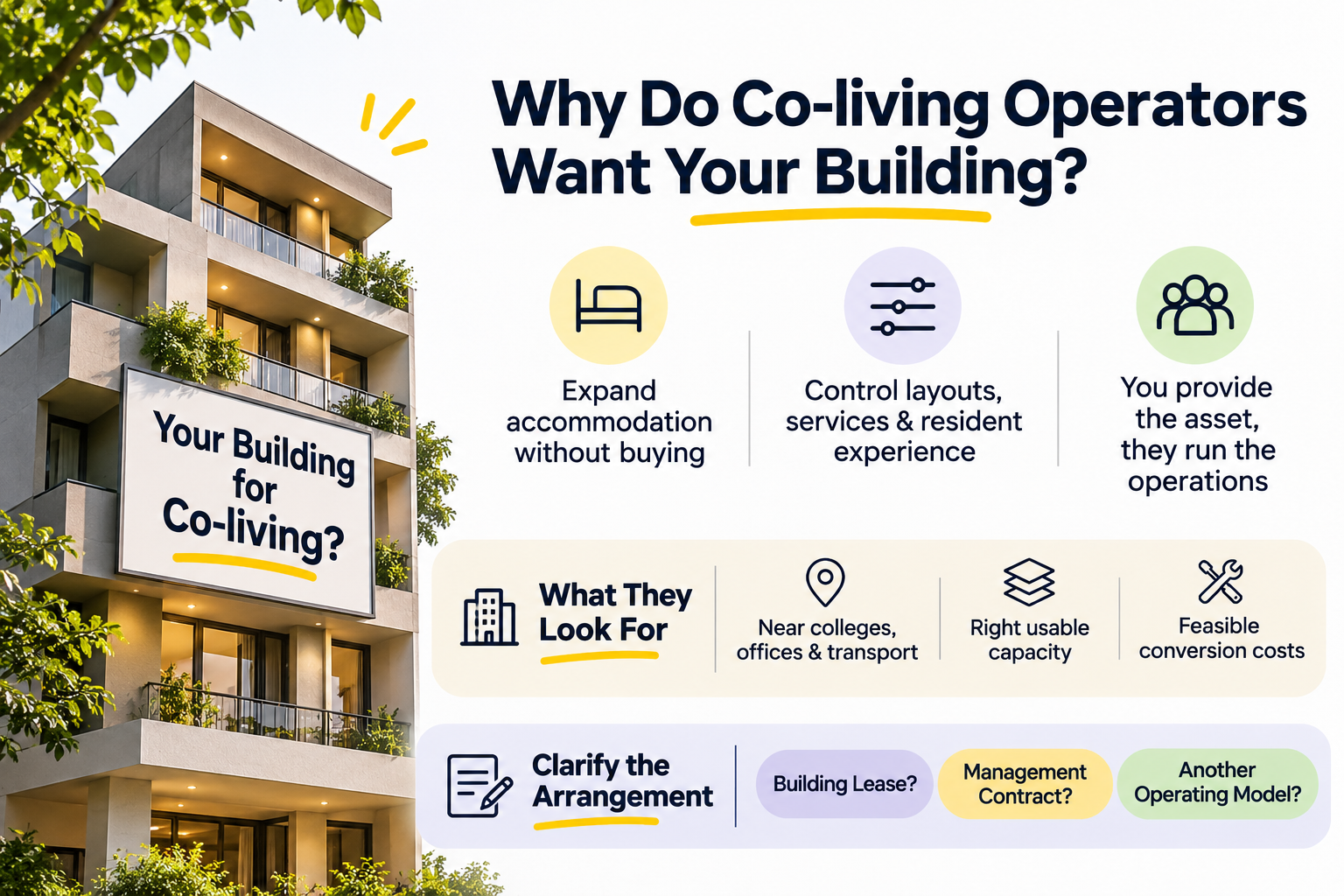
Why do co-living operators want your building?
An operator can expand accommodation capacity without buying every property. A suitable building gives it control over room layouts, services and resident experience, while the owner provides the underlying asset. Proximity to colleges, offices and transport matters alongside lawful usable capacity and conversion costs.
Different operators consider different property types. For example, Stanza Living’s owner-partnership page invites proposals involving houses, apartments, buildings and existing hostels or PGs. That establishes an acquisition channel, not a guaranteed offer for your premises.
Ask whether the proposal is a building lease, a management contract or another operating arrangement. Who contracts with residents, controls collections and bears expenses can differ. RentOk’s guide to co-living brands and independent PG owners explains the broader partnership-versus-independence decision.
Fixed rent, revenue share and hybrid models compared
Under a fixed-rent master lease, the operator commits to an agreed payment, subject to the contract. It generally bears vacancy and resident-turnover risk within that commitment. Your remaining exposure includes default, delayed payments, contractual rent suspensions and owner-funded expenses.
Under revenue share, your payment depends on a defined revenue base and percentage. “Forty per cent of gross collections” differs substantially from “forty per cent of profit after expenses”. The latter requires an agreed expense policy as well as reliable collection records.
| Deal feature | Fixed rent | Revenue share | Hybrid |
|---|---|---|---|
| Payment basis | Agreed rent | Defined revenue × share | Agreed minimum plus a defined upside formula |
| Vacancy exposure | Primarily operator, while its payment obligation continues | Directly affects owner receipts | Depends on the minimum’s terms |
| Strong-occupancy upside | Usually stays with operator | Owner participates | Owner participates above the agreed trigger |
| Essential protection | Payment security and default remedies | Reporting, collection definitions and audit rights | Both sets of protections |
Periodic escalation needs its own clause in any model. A “guaranteed” minimum also needs a payment date, commencement date, security and enforceable remedies. Marketing language cannot establish the strength of the guarantee.
What does revenue share pay at lower occupancy?
Consider 50 usable beds at ₹6,000 monthly resident rent. Assume full collection from occupied beds, no discounts and no additional service revenue. These illustrative figures are not operator quotations or market averages.
Compare fixed rent of ₹90,000, a 40% gross-collection share, and a hybrid of ₹75,000 plus 20% of collections above ₹1,50,000:
| Occupancy | Monthly collections | Fixed rent | 40% share | Hybrid payment |
|---|---|---|---|---|
| 40%: 20 beds | ₹1,20,000 | ₹90,000 | ₹48,000 | ₹75,000 |
| 70%: 35 beds | ₹2,10,000 | ₹90,000 | ₹84,000 | ₹87,000 |
| 90%: 45 beds | ₹2,70,000 | ₹90,000 | ₹1,08,000 | ₹99,000 |
These are owner receipts before owner-borne costs, financing and taxes. At the stated assumptions, the 40% share matches ₹90,000 at 75% occupancy. Poor collections would reduce that payout even if more beds appear occupied.
RentOk’s occupancy-versus-profitability guide explains why filled beds alone cannot establish financial performance. Test conservative, base and strong scenarios before accepting a percentage.
Understanding an operator’s per-bed offer
There is no verified universal amount an operator pays an owner per bed. Obtain written, property-specific proposals and compare them with ordinary whole-building lease offers. A resident-facing bed price does not tell you what the landlord will receive.
In the example, ₹90,000 fixed rent across 50 usable beds equals ₹1,800 per available bed monthly. That is a comparison measure, not a claim that operators generally offer ₹1,800. Confirm whether a quoted amount applies to approved capacity, installed beds or occupied beds.
Ask each bidder to specify the fit-out period, rent-free months, deposit, escalation, owner-paid charges and expected handover condition. If a ₹90,000 monthly lease includes two rent-free months in its first year, that year’s receipts total ₹9,00,000, averaging ₹75,000 a month before other costs.
Fit-out funding changes the economics
Allocate furniture, appliances, electrical work, bathrooms, safety upgrades and replacements explicitly. Owner-funded improvements can support negotiations for stronger rent or revenue participation, but they do not automatically produce a better return.
For planning, spreading an illustrative ₹6 lakh fit-out over 60 months adds a ₹10,000 monthly capital-recovery allowance. That is a budgeting assumption, not a tax deduction or guaranteed recovery. Address ownership of improvements and early-exit treatment separately.
RentOk’s PG startup-capital guide distinguishes setup spending from the operating buffer. Build your own local quotations rather than treating a furnishing allowance as the project’s complete cash requirement.
Revenue definitions and reporting rights
Before agreeing to a split, define what enters the revenue calculation. Address room charges, food and other services, discounts, refunds, cancellations, bad debts, taxes and platform commissions. Keep refundable resident deposits outside earned revenue unless a permitted adjustment changes their character.
Specify whether sharing follows money collected or amounts billed, who approves discounts, and when settlement occurs. For a net-revenue or profit-based deal, identify permitted deductions, caps and approval requirements. Otherwise, a strong percentage can deliver a weak payout.
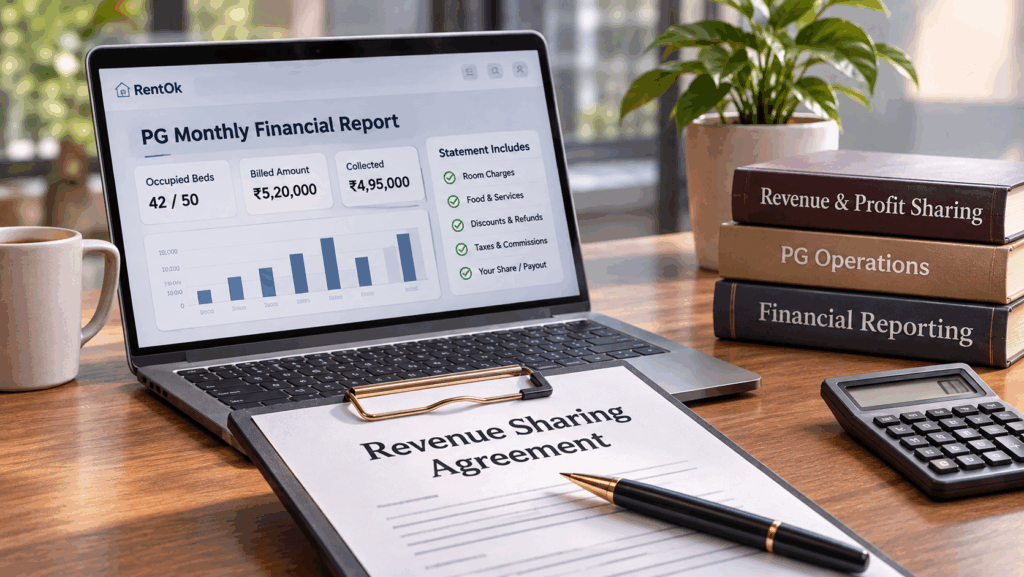
Require a monthly statement that connects occupied beds, billed amounts, collections, refunds and your entitlement. Include access to appropriate supporting records, reconciliation deadlines, audit rights and consequences for underreporting, while protecting residents’ personal data.
RentOk’s monthly PG financial-reporting guide provides useful context for connecting income and expenses. A presentation showing occupancy is not a substitute for the contractual reporting you need to verify a share.
Lock-in, default and handover clauses
In a co-living operator lease, the term, lock-in period and notice period answer different questions. Establish how long the arrangement runs, when either side can terminate without default, and what notice each route requires. Do not assume that a long term guarantees rent for every remaining month.
Negotiate these provisions together:
- Payment and security: State the deposit, due dates, escalation, permitted adjustments and any bank or corporate guarantee. Verify the guarantor’s identity and the guarantee’s scope.
- Default and cure: Define missed-payment triggers, notice, cure periods and termination rights. Discuss insolvency, abandonment and compliance failures with your lawyer.
- Repairs and approvals: Divide structural repairs, routine maintenance, insurance and operational permissions. Specify consent for alterations, assignment and further subletting.
- Exit condition: Attach a signed inventory and condition record. Allocate reinstatement, damage, utility dues and removal of operator-owned fixtures.
- Resident transition: Address notices, prepaid rent, resident deposits, records and vacant possession. Avoid an exit plan that assumes occupants simply disappear when the operator leaves.
Have local counsel review the documents and remedies. RentOk’s lease-versus-licence comparison explains why the actual rights matter more than a document’s heading; a resident PG agreement should not replace a properly drafted building-level contract.
Legal and tax checks before signing
For a multi-year building lease, check stamping and registration before handover. The general rule in Section 107 of the Transfer of Property Act requires a registered instrument for leases exceeding one year, among other specified cases. State amendments, stamp duty and the transaction’s legal character need local review.
Ask your chartered accountant to assess the owner’s supply to the operator separately from the operator’s supply to residents. GST can depend on the property, use, parties’ registration status and applicable reverse-charge rules. The accommodation exemption discussed in CBIC Circular 228/22/2024 does not automatically exempt the upstream building lease.
Clarify GST invoicing, any applicable TDS, payment certificates and whether quoted amounts include taxes. Separately confirm lawful use, building and fire requirements, society conditions and lender restrictions. A commercial agreement cannot itself authorise an otherwise prohibited operation.
Red flags that weaken an operator deal
A recognisable brand does not establish the creditworthiness of the entity signing your lease. Verify that entity, its authorised signatory, relevant financial information and references from existing landlords. Ask those landlords about payment history and exit experience.
Be cautious when the proposal includes:
- A high share with undefined deductions: The operator can add management fees or related-party costs without limits.
- An unsupported minimum guarantee: Payment depends on occupancy, fundraising or discretionary approval despite the sales pitch.
- One-sided exit rights: The operator can leave quickly while the owner carries a long lock-in and unrecovered fit-out costs.
- Control without accountability: The operator controls pricing and collections but refuses records, inspection arrangements or audit access.
- Unclear resident liabilities: Nobody explains who holds deposits or refunds prepaid charges when the arrangement ends.
Request a revised term sheet that resolves these points before paying for conversion work or granting possession. Do not rely on assurances that the final lease will address them later.
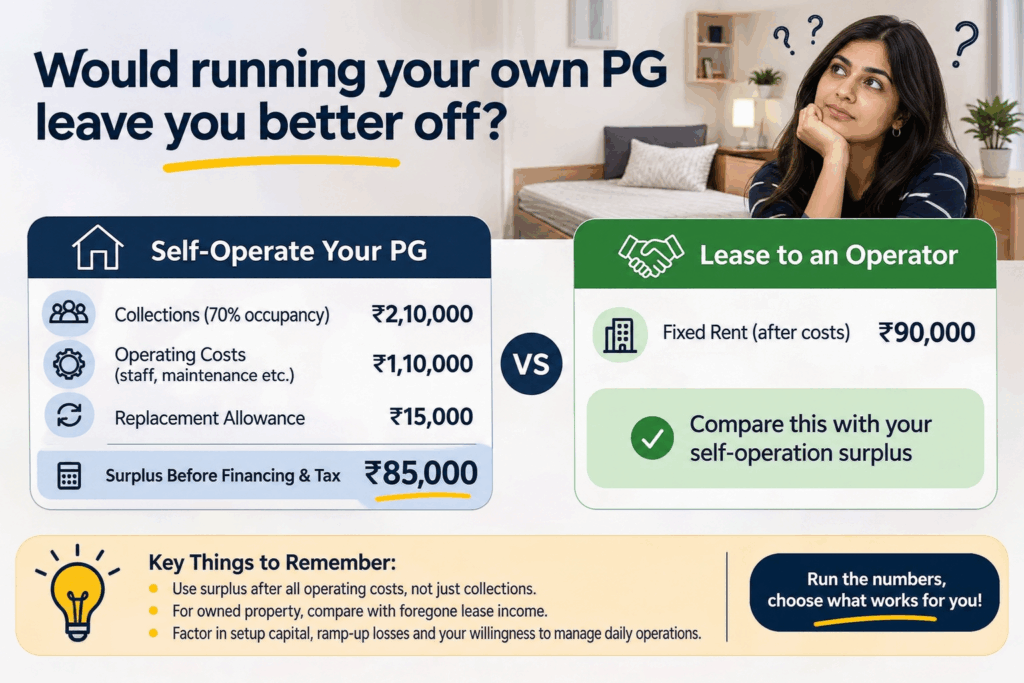
Would running your own PG leave you better off?
Self-operation gives you control over pricing, services and resident relationships, but also responsibility for staffing, collections, compliance and vacancies. Compare the surplus after operating costs, rather than gross resident collections, with the operator’s offer.
At the example’s 70% occupancy, collections total ₹2,10,000. If your operating costs, including management time, total an illustrative ₹1,10,000 and you allow ₹15,000 for replacements, the remaining amount is ₹85,000 before financing and tax. Compare that with fixed rent of ₹90,000 after subtracting the costs you would still bear as landlord.
For an owned building, treat foregone lease income as the comparison benchmark; do not subtract an imaginary rent expense and then compare the reduced result with that rent again. Include setup capital, ramp-up losses and your willingness to manage daily operations.
How RentOk helps you compare with running your own PG
RentOk supports the operating records you need when assessing an independent PG business. Use actual results where available and a separate forecast for a proposed property, keeping assumptions distinct from recorded transactions.
- Review beds and occupancy: Track filled, vacant and under-notice rooms or beds. Use those records to assess whether your planning assumptions reflect actual performance.
- Follow dues and collections: Review tenant ledgers and payment histories alongside occupancy. This helps distinguish an occupied bed from money received.
- Compare income and expenses: Monthly and property-wise money reports show recorded financial performance. Use them to review staffing, utilities and other costs against collections.
RentOk does not guarantee occupancy, operator payments or investment returns. Its records support your comparison; your financial model and legal review still determine whether the proposed deal works.
Conclusion
Choose fixed rent when dependable contracted income and lower day-to-day involvement matter most, while checking the operator’s ability to pay. Choose revenue share when the downside remains affordable and the agreement gives you a clear calculation, reliable reporting and audit rights. A hybrid can combine protection and upside if the minimum genuinely operates as a floor.
Before committing, compare conservative scenarios, owner-funded capital and exit costs across every proposal. The strongest percentage or highest headline rent may not produce the best retained income. Compare with running your own PG on RentOk, using realistic occupancy, complete costs and the level of responsibility you want to keep.
Frequently Asked Questions
Find answers to common questions about this topic
About the Author
Ishika Pannu
Ishika Pannu brings you the latest insights and easy-to-apply strategies in property management—helping you simplify renting and grow with RentOk.
You may also like these
Related Articles

1 min read
How to Start a PG in Bangalore: Areas, Costs, Licences and Profit
Written by
Posted on
Ishika Pannu
Nov 3, 2026
1 min read
Converting Your Family Home Into a PG: Legal, Layout and Payback Checklist
Written by
Posted on
Ishika Pannu
Oct 29, 2026

1 min read
How to Start a PG Business Legally in India: Step-by-Step Guide
Written by
Posted on
Ishika Pannu
Aug 27, 2026

1 min read
How to Increase PG Occupancy During Off-Season Months
Written by
Posted on
Ishika Pannu
Aug 9, 2026

1 min read
How to Price Your PG for Maximum Occupancy
Written by
Posted on
Ishika Pannu
Jul 28, 2026

1 min read
How to List Your PG on Google for Free (Google Business Profile Guide)
Written by
Posted on
Ishika Pannu
Jul 10, 2026
1 min read
How to Calculate Your PG’s Break-Even Occupancy
Written by
Posted on
Ishika Pannu
Jun 29, 2026

1 min read
Top 5 Mistakes New PG Owners Make in Their First 3 Months
Written by
Posted on
Ishika Pannu
Jun 22, 2026

1 min read
How to Create a Free PG Logo in 5 Minutes
Written by
Posted on
Ishika Pannu
Jun 21, 2026
1 min read
How to Collect Rent Online for Free: Complete Guide for Owners
Written by
Posted on
Ishika Pannu
Jun 5, 2026
Stay ahead in property management with expert insights
Join thousands of property managers receiving exclusive tips delivered straight to your inbox.
Browse posts by category
Case Study
Cost of Living
Growth
Legal
Market Trends
News
Pg owner app
Property Management
Property Tax
Tech
RentOk
The easiest way to rent and manage your PGs and hostels.
Grievance Officer
Get the app


Contact us
hello@eazyapp.tech
HQ Office
COGROW, BASEMENT F-12/8A
BESIDE HOUSE OF STYLE SALON, SECTOR 28, DLF PHASE 1
GURUGRAM, HARYANA - 122002
South India Office
LUMIODESK COWORKING, 2ND FLOOR, 40, 14TH MAIN RD
BESIDE MC DONALD, 7TH SECTOR, HSR LAYOUT
BENGALURU, KARNATAKA - 560102
©️ 2026 EazyApp Tech Pvt Ltd. All rights reserved


