Property Management
The Occupancy Trap: Why Full Buildings Still Lose Money

Written by
Ishika Pannu
Read Time
9 min read
Posted on
June 15, 2026
Overview
Overview
The Occupancy Trap: Why Full Buildings Still Lose Money
For most PG, hostel, and co-living operators, occupancy is the first metric they look at when assessing business performance. A full property feels like a successful property. Empty rooms represent lost revenue, while occupied beds create the impression that everything is running smoothly.
But experienced operators know that occupancy can sometimes be misleading.
A property may be operating at 100% occupancy and still struggle with cash flow, rising expenses, tenant turnover, and profitability. At the same time, another property running at slightly lower occupancy may generate stronger margins and healthier financial performance.
The difference lies in understanding what occupancy actually measures, and what it doesn’t.
Occupancy tells you how many rooms or beds are occupied. It does not tell you whether those tenants are paying on time, whether pricing is sustainable, whether operational costs are under control, or whether the property is generating healthy profits.
This is where many rental businesses fall into what can be called the occupancy trap. They focus heavily on keeping rooms full while overlooking the metrics that ultimately determine whether the business is growing profitably.
What Does Occupancy Really Measure?
Occupancy is one of the most widely tracked metrics in property management because it provides a quick snapshot of demand. If a property has 100 beds and 95 are occupied, occupancy stands at 95%.
At first glance, it seems like a reliable indicator of performance. Higher occupancy usually means more tenants and more potential revenue. However, occupancy only measures utilization of available space. It does not measure business health.
This distinction becomes important as properties grow.
Many operators start making decisions purely to improve occupancy numbers. They focus on filling rooms as quickly as possible because occupancy is easy to track and easy to celebrate. The problem is that a strong occupancy percentage can sometimes hide deeper operational issues.
For example, occupancy does not tell you:
- Whether rent is being collected efficiently, or if a growing portion of revenue remains stuck in unpaid dues and delayed payments.
- Whether rooms are being filled at profitable rates, or if aggressive discounts are reducing margins simply to maintain high occupancy numbers.
- Whether tenants are staying long enough to support stability, or if constant move-ins and move-outs are creating recurring operational costs.
- Whether operational expenses are increasing faster than revenue, making the property more difficult to manage despite being fully occupied.
Because of this, occupancy should be viewed as a starting point rather than a final measure of success.
A full building may indicate strong demand, but demand alone does not guarantee profitability. To understand the true performance of a rental business, operators need to look beyond occupancy and examine what is happening behind those numbers.

Why Doesn’t Full Occupancy Guarantee Profits?
One of the biggest misconceptions in rental operations is that occupancy and profitability move together automatically.
In reality, a property can achieve full occupancy and still face significant financial challenges. This usually happens when operators become focused on filling rooms without paying equal attention to revenue quality and operational efficiency.
Consider two PGs operating in the same market.
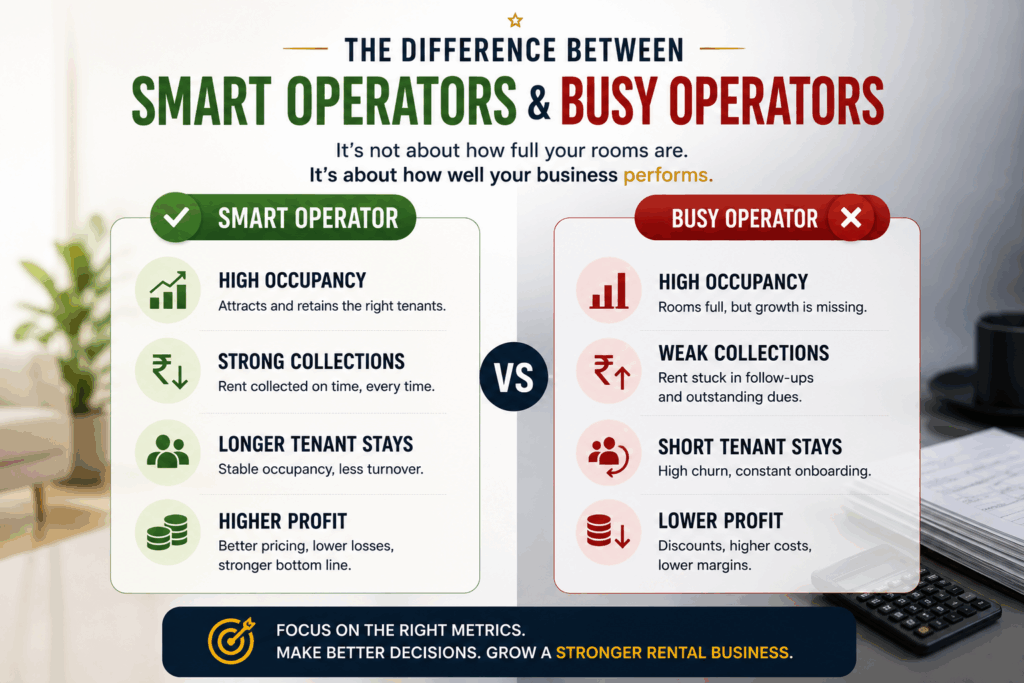
Both properties report 100% occupancy. From the outside, they appear equally successful. However, one property generates stronger profits because it maintains healthy pricing, attracts long-term tenants, and controls operating expenses. The other relies heavily on discounts, experiences frequent turnover, and struggles with delayed collections.
The occupancy numbers may look identical, but the business outcomes are completely different.
Several factors contribute to this gap:
- Discount-driven occupancy can reduce profitability significantly. Lowering rents may help fill vacancies quickly, but if pricing falls too far, revenue growth slows even when every room is occupied.
- High turnover creates hidden expenses. Frequent move-ins and move-outs require additional cleaning, maintenance, onboarding, and marketing efforts that gradually eat into profits.
- Poor collection efficiency affects cash flow. Occupied rooms only generate value when rent is actually collected. Delayed payments can create financial pressure even in fully occupied properties.
- Operational costs often rise with occupancy. Utilities, housekeeping, repairs, and staff coordination typically increase as more tenants use the property.
This is why occupancy should never be evaluated in isolation.
The goal of a rental business is not simply to keep beds occupied. The goal is to ensure that each occupied bed contributes positively to revenue, profitability, and long-term business stability.
Properties that focus exclusively on occupancy often discover problems only after profitability begins to decline. By then, the warning signs have usually been present for months, they were simply hidden behind strong occupancy figures.
Which Metrics Matter More Than Occupancy?
Occupancy is useful because it tells you whether people want to live in your property. But once a property reaches a healthy occupancy level, operators need to shift their focus toward the metrics that actually influence profitability.
This is where many growing rental businesses separate themselves from the competition.
Instead of asking, “How many beds are occupied?” they start asking, “How much value is each occupied bed creating?”
That single shift in perspective changes how decisions are made across pricing, operations, tenant management, and growth planning.
Some of the most important metrics to monitor alongside occupancy include:
- Revenue per occupied bed, which helps operators understand whether pricing strategies are generating healthy returns or simply filling rooms at lower margins.
- Collection efficiency, which measures how much of the billed rent is actually collected on time rather than remaining stuck in follow-ups, reminders, and outstanding dues.
- Average tenant stay duration, which reveals whether occupancy is stable or being maintained through constant tenant turnover and repeated onboarding cycles.
- Maintenance cost per tenant, which helps identify whether operational expenses are growing faster than expected as occupancy increases.
- Net profit per bed, which ultimately provides a clearer picture of business performance than occupancy percentages alone.
These metrics work together to tell a more complete story.
For example, a property operating at 90% occupancy with strong collections, healthy pricing, and long tenant stays may be significantly more profitable than a property running at 100% occupancy but struggling with discounts and turnover.
The strongest operators understand that occupancy is only one part of the equation. Sustainable growth comes from optimizing the entire business, not just keeping rooms full.
When High Occupancy Becomes a Warning Sign
Most operators view rising occupancy as a positive development. In most situations, it is. However, there are instances where high occupancy can actually signal underlying operational problems.
The issue is not occupancy itself. The issue is when occupancy grows while other business metrics start moving in the wrong direction.
This often happens gradually.
Management celebrates full occupancy while profitability remains stagnant. Expenses continue increasing, complaints become more frequent, and staff spend more time handling operational issues. Because occupancy looks healthy, these warning signs are often overlooked until they begin affecting revenue.
Some common indicators include:
- Occupancy is increasing but profits remain flat, suggesting that pricing, discounts, or operating costs may be offsetting revenue gains.
- Tenant turnover remains unusually high, creating the appearance of stable occupancy while generating constant room preparation and acquisition expenses.
- Outstanding dues continue growing, indicating that occupied rooms are not translating into healthy cash flow.
- Maintenance requests and operational complaints increase sharply, placing additional pressure on staff and operational budgets.
- Heavy discounts become necessary to maintain occupancy, reducing the profitability of every occupied bed.
These situations are more common than many operators realize.
In fact, some of the most challenging properties to manage are not those with low occupancy. They are properties that appear successful because occupancy is high while deeper operational issues continue accumulating beneath the surface.
This is why experienced operators regularly review occupancy alongside collections, expenses, retention, and profitability.
A single metric rarely tells the full story.
How Can Operators Improve Profitability?
Improving profitability does not always require increasing occupancy.
In many cases, the biggest opportunities come from improving the quality of existing occupancy rather than chasing additional tenants.
This approach creates a more sustainable business because it focuses on maximizing the value generated from each occupied room.
One of the most effective strategies is strengthening tenant retention.
When tenants stay longer, operators spend less on marketing, room preparation, onboarding, and vacancy management. Stable occupancy often creates stronger profits than constantly replacing departing residents.
Operators can also improve profitability through:
- Better pricing discipline, ensuring that occupancy growth is not being driven by discounts that weaken long-term revenue potential.
- Stronger collection processes, helping convert billed revenue into actual cash flow while reducing dependence on manual follow-ups.
- Proactive maintenance management, which helps prevent larger repair costs while improving tenant satisfaction and retention.
- Data-driven occupancy planning, allowing operators to identify seasonal demand patterns and make better pricing decisions.
- Careful expense monitoring, ensuring that utility costs, staffing expenses, and operational spending remain aligned with revenue growth.
Another important factor is tenant quality.
Not every occupied bed contributes equally to business performance. Tenants who pay on time, stay longer, and require fewer operational interventions often create significantly more value than those who generate constant coordination and support requirements.
As rental businesses scale, profitability increasingly depends on operational efficiency rather than occupancy alone.
The operators who understand this are usually the ones able to grow sustainably across multiple properties.

How RentOk Helps Operators See Beyond Occupancy
As rental businesses grow, tracking performance through occupancy numbers alone becomes increasingly difficult.
A property may appear healthy because rooms are occupied, while revenue leaks continue through unpaid dues, inconsistent collections, rising expenses, or high tenant turnover. Without visibility into these areas, operators often struggle to identify what is actually affecting profitability.
This is where connected operational data becomes valuable.
RentOk helps property owners and managers track occupancy alongside collections, dues, expenses, tenant movement, and property-level performance from a single platform. Instead of relying on one metric, operators gain a clearer understanding of how different parts of the business influence profitability.
This visibility helps answer important questions such as:
- Which properties are generating the strongest returns?
- Are rising expenses affecting profitability?
- Is occupancy being supported by healthy tenant retention?
- How much revenue remains locked in outstanding dues?
- Where are operational inefficiencies creating unnecessary costs?
By bringing these insights together, operators can make more informed decisions and focus on the metrics that truly drive business growth.
Conclusion
Occupancy will always remain one of the most important metrics in rental housing. Empty rooms represent lost opportunities, and maintaining healthy occupancy is essential for long-term success.
However, occupancy alone does not determine whether a property is profitable.
A building can be completely full and still struggle with poor collections, rising expenses, tenant turnover, and shrinking margins. At the same time, a property operating at slightly lower occupancy may generate stronger profits because it focuses on pricing, retention, operational efficiency, and revenue quality.
The most successful operators understand that occupancy is a performance indicator, not the final destination.
They look beyond how many beds are occupied and focus on how much value those occupied beds are creating for the business.
Want better visibility into occupancy, collections, expenses, and property performance? Explore RentOk’s property management platform and discover how modern operators make smarter decisions with connected operational insights.
About the Author
Ishika Pannu
Ishika Pannu brings you the latest insights and easy-to-apply strategies in property management—helping you simplify renting and grow with RentOk.