
Legal
How Foreign Nationals Can Rent Property in India (Verification Guide)

Written by
Ishika Pannu
Read Time
13 min read
Posted on
September 14, 2026
Overview
Overview
How Foreign Nationals Can Rent Property in India: Verification Guide
India’s rental market is becoming more international. Students arrive from different countries to study at Indian universities. Professionals relocate for work. Researchers, consultants, and expatriate families may also need accommodation for months or even years.
For landlords and PG operators, this creates a wider tenant pool. It also creates additional responsibilities.
Renting a property to a foreign national is not simply a matter of collecting a passport copy and signing a rent agreement. The landlord needs to establish the tenant’s identity and understand the documentation connected with their stay. Depending on the tenant’s circumstances, immigration registration and accommodation reporting requirements may also apply.
This makes the onboarding process more important than ever. A well-organised process helps the landlord maintain accurate records from the beginning. It also reduces confusion when the tenant moves in, changes accommodation, or eventually leaves.
The first step is understanding the difference between renting property, tenant verification, and immigration compliance. These processes can overlap, but they are not automatically the same.
Can Foreign Nationals Rent Property in India?
Yes, foreign nationals can rent accommodation in India, subject to the rules applicable to their immigration status and the terms of their stay.
The process can look different from a standard Indian tenancy. A foreign tenant may use a passport as their primary identity document. Their visa may also determine the purpose and duration of their stay. In some situations, additional registration or reporting requirements may apply.
For a landlord, the goal should not be to make assumptions about every foreign tenant. Instead, the onboarding process should identify what information is relevant to that particular tenant and property.
A basic foreign-tenant onboarding process should cover:
- Identity verification: Check the tenant’s passport and ensure the information matches the person occupying the property.
- Immigration documentation: Review the relevant visa or immigration document and note information that affects the tenant’s stay.
- Accommodation details: Record the complete address and details of the property being rented.
- Verification requirements: Identify the police verification or other local requirements applicable to the property’s jurisdiction.
- Reporting obligations: Check whether the accommodation provider has any reporting responsibilities for the foreign national.
The exact process can vary. Landlords should therefore check the current requirements applicable to the property instead of relying on an old checklist.
This approach is similar to the broader tenant-verification process. RentOk’s What Documents Do You Need for Tenant Police Verification? explains why identity, address, property, and supporting information need to be brought together into a complete tenant profile.

Does a Foreign Tenant Need FRRO Registration?
FRRO registration is one of the areas where landlords often give overly broad answers.
The Foreigners Regional Registration Office, or FRRO, deals with several immigration-related services for foreign nationals. However, a person should not automatically be told that they need FRRO registration simply because they are renting a property in India.
The requirement depends on the foreign national’s circumstances and the rules applicable to their visa and stay.
This distinction matters because a landlord’s role is not to provide immigration advice. The landlord should maintain the accommodation records and complete the reporting responsibilities that apply to the property.
The foreign national, meanwhile, should check whether their visa or immigration status creates a registration requirement.
The official e-FRRO system provides online services for foreign nationals. These services include registration and other immigration-related processes where applicable.
For landlords, the practical approach is simple. Do not treat FRRO registration, tenant police verification, and accommodation reporting as one single task. They may involve some of the same information, but each serves a different purpose.
What Documents Should a Landlord Collect?
Documentation is one of the biggest differences between foreign and domestic tenant onboarding.
The landlord needs enough information to establish who the tenant is and connect that person with the rented property. At the same time, collecting every possible document is not a good compliance practice. The checklist should be based on the requirements applicable to the property and tenant.
Common documentation may include:
- Passport: This is generally the primary identity document for a foreign national and should be checked against the tenant’s submitted information.
- Visa or immigration document: This provides information about the basis and duration of the person’s stay in India.
- Recent photograph: A photograph may be required for verification or accommodation records.
- Current Indian address: The complete rental address should be recorded accurately across the relevant documents.
- Rental agreement: The agreement establishes the relationship between the tenant and the property owner.
- Contact information: A current phone number and email address make the tenant record easier to maintain.
- Additional registration documents: Where applicable, documents issued through the relevant immigration or registration process may also need to be considered.
The exact requirements can differ by authority. A landlord should therefore confirm the current process before collecting or submitting documents.
This is particularly important for PGs and co-living businesses. They may have several international tenants moving in during the same period. A manual process can quickly result in missing documents or inconsistent records.
For a broader understanding of verification documentation, RentOk’s Tenant Police Verification: A Guide for Landlords covers the standard documentation involved in tenant verification and explains how digital submission can simplify the process.
What Is the Landlord Required to Report?
This is where foreign-tenant accommodation differs significantly from ordinary rental onboarding.
The current Immigration and Foreigners Rules, 2025 include rented accommodation within the definition of accommodation covered by the rules. This can include forms of accommodation such as PGs, hostels, homestays, and other rented arrangements.
The rules place responsibilities on the keeper of accommodation. These responsibilities include obtaining prescribed information from foreign nationals and maintaining the relevant records.
The rules also provide for electronic transmission of Form III information to the Registration Officer within the prescribed period. Departure information is also subject to reporting requirements.
For a landlord or PG operator, this means the process should not end when the tenant’s documents are collected.
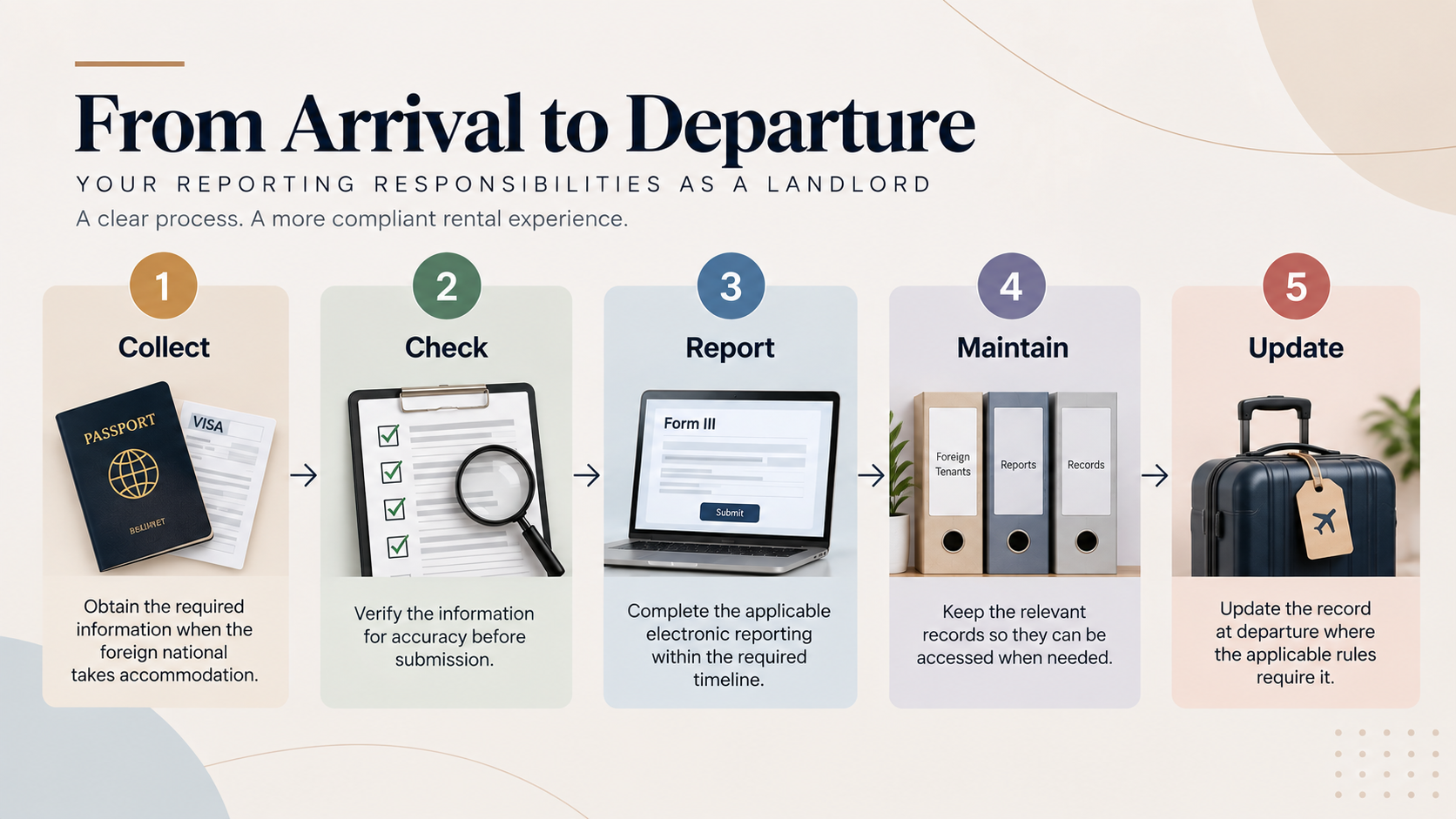
There should be a clear workflow from arrival to departure:
- Collect the required information when the foreign national takes accommodation.
- Check the information for accuracy before submitting it.
- Complete the applicable electronic reporting within the required timeline.
- Maintain the relevant records so they can be accessed when needed.
- Update the record at departure where the applicable rules require departure reporting.
The important point is that the exact obligations depend on the accommodation arrangement and current rules. Operators should check the applicable government requirements rather than relying on an old process.
What Is Form III and Why Does It Matter?
Form III is part of the foreign-national accommodation reporting framework.
The current rules require the keeper of accommodation to transmit prescribed information electronically through the designated system. The reporting process is therefore not simply a paper-based record kept inside the property office.
This is particularly relevant for professional PG and co-living operators.
Imagine a property with 150 residents. Five foreign tenants move in during one month. If their documentation is kept across email threads, WhatsApp messages, and separate spreadsheets, the property team can quickly lose track of what has been submitted and what still needs attention.
A structured process avoids that confusion.
The operator should know:
- Which foreign tenant has moved in and when: Arrival information should be connected to the tenant’s occupancy record.
- Which documents have been collected: Missing information should be visible before the reporting deadline.
- Whether the required reporting has been completed: Submission status should not depend on someone’s memory.
- When the tenant leaves: Departure information should be updated as required.
This is why foreign-tenant compliance should be treated as an operational workflow rather than a one-time paperwork exercise.
RentOk’s Digital KYC and Police Verification: State-wise Compliance in India also looks at why digital KYC and verification need to become part of structured property management as rental operations grow.
What About Embassy Letters and Other Special Cases?
Foreign tenants do not all arrive in India under the same circumstances.
One tenant may be moving because of an international company. Another may be joining a university. Someone else may be staying in India for research, consulting, or another professional purpose.
As a result, supporting documents can vary.
An employer letter, university document, or embassy-related letter may provide useful context about the tenant. However, landlords should not automatically treat such a document as a replacement for the passport, visa, or other documentation required by the applicable process.
The better approach is to understand what each document establishes.
For example, an employer letter may confirm employment or an accommodation arrangement. A university document may establish the tenant’s connection with an educational institution. Neither document should automatically be treated as proof that all immigration or accommodation requirements have been completed.
Special cases should be handled carefully. If there is uncertainty about a foreign national’s immigration status or registration requirement, the tenant should be directed to the relevant immigration authority or qualified professional.
Landlords should focus on fulfilling their own accommodation and reporting responsibilities rather than trying to interpret immigration law for every tenant.
How Does Tenant Police Verification Fit Into the Process?
Foreign-national accommodation reporting and tenant police verification should be treated as related but separate processes.
Tenant police verification connects the tenant with the rented property through the applicable local police or government process. Immigration reporting deals with the foreign national’s stay and the accommodation provider’s responsibilities under the relevant immigration framework.
The documents may overlap. The purpose does not.
This distinction is useful because it prevents a common mistake: assuming that submitting a passport copy for one process automatically completes everything required for the other.
Local police procedures can also differ. Some jurisdictions provide online verification systems, while others use different submission methods.
RentOk’s How to Do Tenant Police Verification Online: A State-by-State Guide explains why landlords should identify the correct local process before submitting tenant information.
For foreign tenants, this becomes even more important. Their passport and visa documents may form part of the verification file, but the landlord should still follow the process prescribed by the relevant authority.
What If the Foreign Tenant Has Recently Moved From Another State?
A foreign national may already have lived somewhere else in India before renting your property.
For example, an employee may move from Mumbai to Delhi. A student may shift from Bengaluru to Hyderabad. A professional may relocate from one city to another for a new assignment.
The previous address can therefore be important.
Landlords should record the information requested by the applicable verification or immigration process. They should not replace a previous address with the current rental address simply because the latter is easier to obtain.
This is especially relevant when a tenant has recently moved.
A complete address record can help establish the tenant’s residential history and make the verification file more useful.
The same principle applies to contact information. If the tenant has changed their phone number, employer, or other relevant details, the landlord should understand whether the applicable process requires those details to be updated.
The key is accuracy. A detailed record is much more useful than a collection of documents with inconsistent information.
Common Mistakes Landlords Should Avoid
Most foreign-tenant verification problems do not begin with a complicated legal issue. They begin with small administrative gaps.
A landlord may collect the passport but forget another required document. A PG manager may complete the tenant form but fail to retain the acknowledgement. Another property may use a checklist created for a different city.
These problems become harder to fix once the tenant has already moved in.
Some common mistakes include:
- Treating every foreign tenant the same: Visa type, length of stay, and registration requirements can differ. A single blanket checklist may not work for every case.
- Confusing verification with immigration registration: Police verification and immigration-related registration serve different purposes. Completing one does not automatically complete the other.
- Submitting inconsistent information: Names, passport details, addresses, and contact information should be checked before submission.
- Leaving reporting until later: If a prescribed deadline applies, waiting until the end of the tenancy can create unnecessary compliance problems.
- Keeping documents in scattered locations: WhatsApp messages, email attachments, and paper files make it difficult to establish a complete tenant history.
- Ignoring the departure stage: Where departure reporting applies, the process should include the tenant’s exit rather than stopping at move-in.
A professional rental business should build these checks into onboarding. That makes the process repeatable even when staff members change or occupancy increases.
For more context on building a broader screening process, RentOk’s What Is Tenant Police Verification and Why Is It Mandatory in India? explains why verification should be treated as part of responsible rental management rather than as an isolated formality.

How RentOk Helps With Foreign Tenant Onboarding
Foreign-tenant onboarding becomes easier when documentation, tenant information, occupancy records, and verification workflows are organised in one place.
RentOk helps landlords and PG operators manage tenant information and verification-related workflows through a more structured property-management system. Instead of relying on scattered spreadsheets and messaging threads, property teams can keep important tenant information connected to the relevant occupancy record.
This becomes particularly useful for properties that manage frequent move-ins. International students, working professionals, and expatriate tenants may arrive throughout the year. A centralised workflow makes it easier for the property team to identify missing information and keep tenant records organised.
The value is not simply digital record-keeping. It is operational consistency.
When the same onboarding process is followed for every new resident, landlords can reduce manual follow-ups and maintain better visibility over their rental operations.
Conclusion
Foreign nationals can rent property in India, but landlords should approach the process with more structure than a standard rental onboarding.
The first step is to establish the tenant’s identity. The next is to understand the documentation connected with their stay. From there, landlords need to identify the police verification process and any accommodation reporting responsibilities that apply to the property.
FRRO or other immigration requirements should not be assumed to apply identically to every foreign national. The tenant’s circumstances matter. So do the current rules and the jurisdiction in which the property is located.
For landlords and PG operators, the safest approach is therefore straightforward: verify the tenant, maintain accurate records, follow the applicable reporting process, and keep the documentation organised from move-in to move-out.
As India’s rental market becomes increasingly international, a structured verification process can help property owners serve foreign tenants while maintaining better operational control.
Looking to simplify tenant onboarding and manage verified rental operations more efficiently? Explore Verified Rental Properties with RentOk.
Frequently Asked Questions
Find answers to common questions about this topic
About the Author
Ishika Pannu
Ishika Pannu brings you the latest insights and easy-to-apply strategies in property management—helping you simplify renting and grow with RentOk.
You may also like these
Related Articles

1 min read
What Happens If You Break Your Rent Agreement Before the Lock-In Period?
Written by
Posted on
Ishika Pannu
Sep 14, 2026

1 min read
How Rent Increases Work in India and When They’re Illegal
Written by
Posted on
Ishika Pannu
Sep 11, 2026
1 min read
What Documents Do You Need for Tenant Police Verification?
Written by
Posted on
Ishika Pannu
Sep 10, 2026

1 min read
Why You Should Always Insist on a Registered Rent Agreement
Written by
Posted on
Ishika Pannu
Sep 10, 2026

1 min read
What Is the Legal Notice Period Before Vacating a Rented Property?
Written by
Posted on
Ishika Pannu
Sep 9, 2026

1 min read
Delhi’s Proposed PG Regulations: What Owners Need to Know
Written by
Posted on
Ishika Pannu
Sep 9, 2026

1 min read
The Satya Niketan PG Collapse: What It Means for Safety in Delhi PG’s
Written by
Posted on
Ishika Pannu
Sep 7, 2026
1 min read
How to File a Rental Dispute Complaint in India (Step-by-Step Guide)
Written by
Posted on
Ishika Pannu
Sep 6, 2026

1 min read
What to Do If Your Landlord Refuses to Return Your Security Deposit
Written by
Posted on
Ishika Pannu
Sep 5, 2026

1 min read
Why Landlords Cannot Legally Refuse Unmarried Tenants in India
Written by
Posted on
Ishika Pannu
Sep 5, 2026
Stay ahead in property management with expert insights
Join thousands of property managers receiving exclusive tips delivered straight to your inbox.
Browse posts by category
Case Study
Cost of Living
Growth
Legal
Market Trends
News
Pg owner app
Property Management
Property Tax
Tech
RentOk
The easiest way to rent and manage your PGs and hostels.
Get the app


Contact us
hello@eazyapp.tech
HQ Office
COGROW, BASEMENT F-12/8A
BESIDE HOUSE OF STYLE SALON, SECTOR 28, DLF PHASE 1
GURUGRAM, HARYANA - 122002
South India Office
LUMIODESK COWORKING, 2ND FLOOR, 40, 14TH MAIN RD
BESIDE MC DONALD, 7TH SECTOR, HSR LAYOUT
BENGALURU, KARNATAKA - 560102
©️ 2026 EazyApp Tech Pvt Ltd. All rights reserved


