
Legal
What Is Tenant Police Verification and Why Is It Mandatory in India?

Written by
Ishika Pannu
Read Time
17 min read
Posted on
September 4, 2026
Overview
Overview
What Is Tenant Police Verification and Why Is It Mandatory in India?
A tenant moves into a PG, hostel, co-living space, or rental property after submitting an ID, signing the agreement, and paying the required deposit. From an operational point of view, it may feel like the onboarding process is complete. But for a landlord or property manager, one important responsibility still needs attention: making sure the tenant’s details are properly verified and recorded according to the requirements applicable to that property.
This is where tenant police verification becomes important.
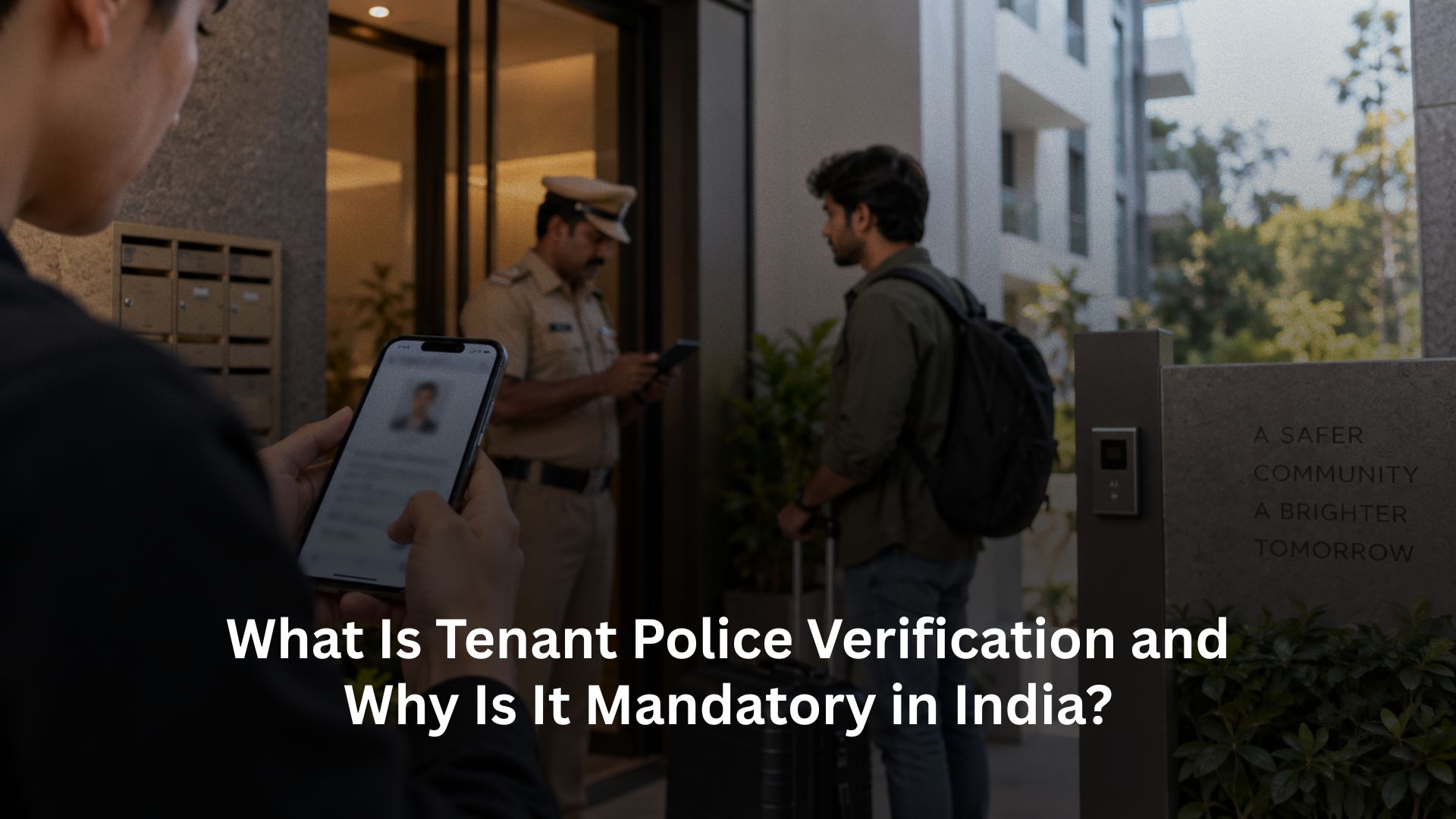
Tenant police verification is a process through which information about a tenant is submitted to the relevant police authority for verification and record purposes. It helps establish a formal connection between the tenant, the rented premises, and the information provided during onboarding. For rental businesses managing multiple occupants, this creates an additional layer of accountability and documentation.
However, tenant verification in India is not governed by one single process that applies identically everywhere. Requirements, forms, portals, and submission methods can differ between states, cities, police commissionerates, and local jurisdictions. Delhi Police, for example, maintains a dedicated tenant verification form and states that house owners are required to inform the local police when they keep a tenant.
For this reason, landlords should think about verification as more than a formality. It should be built into the tenant onboarding process from the beginning.
What Is Tenant Police Verification?
Tenant police verification is the process of providing tenant and property details to the police or designated government authority. The tenant’s information is then checked and recorded through the applicable process.
The purpose is not simply to collect another identity document. An ID proves a person’s identity. Police verification serves a different purpose. It creates an official record through the applicable police or government process.
For rental operators, this distinction matters. A tenant may submit an Aadhaar card or another government-issued ID during onboarding. However, this does not automatically mean police verification is complete.
Police verification and identity verification are separate steps. Both may form part of a broader tenant verification workflow.
A properly managed verification process can help establish:
- Tenant identity and traceability, by connecting the resident’s submitted information with the property where they are staying and the occupancy period associated with that record.
- Better compliance documentation, because the landlord has a clearer record of the verification process rather than relying only on documents exchanged informally over WhatsApp or email.
- Greater operational accountability, particularly for PGs, hostels, and co-living properties where a large number of residents may be moving in and out throughout the year.
- Faster access to tenant information, because properly organized records are easier to retrieve when information is required by management or an authorized authority.
This is also why police verification should not be confused with a general tenant background check. The exact nature and scope of verification depend on the process followed by the relevant authority.
For landlords looking to understand the wider tenant-verification process, RentOk’s guide on Aadhaar vs Police Verification: A Security Guide for Indian Landlords provides a useful distinction between identity validation and police verification.

Why Does Tenant Police Verification Matter to Landlords?
For a landlord managing one apartment, maintaining tenant information may seem simple. However, rental operations become more complex with multiple rooms or properties. Frequent move-ins can add to the workload. Different employees may also handle tenant onboarding.
At this scale, verification becomes an important part of risk management.
A property owner needs to know who occupies the premises and when they moved in. They also need to track the information submitted during onboarding. Records should show whether the required verification process was initiated or completed.
Incomplete or scattered records can create problems. These issues may not become visible until a dispute, inspection, or security concern arises. They can also cause delays when authorities or other parties request information.
Tenant verification therefore contributes to a more structured rental operation in several ways.
It gives property managers a clearer occupancy trail, supports better documentation practices, and reduces dependence on informal records. More importantly, it encourages landlords to treat tenant onboarding as a defined operational process rather than simply handing over a room after collecting rent and an ID.
For PG and hostel operators, this becomes even more significant. A property may have dozens of tenants occupying rooms simultaneously, with new residents arriving every week. A missed verification for one tenant can easily become difficult to identify when records are maintained manually.
This is one reason digital KYC and tenant verification are increasingly becoming part of organized rental operations. You can also read RentOk’s Digital KYC and Police Verification: State-wise Compliance in India to understand how verification fits into a broader compliance workflow.
Is Tenant Police Verification Legally Mandatory Everywhere in India?
This is where landlords need to avoid a common misconception.
There is no single nationwide tenant verification procedure that operates identically across every state and city. Whether a landlord needs to provide tenant information to the police, how that information is submitted, and what documents or forms are required can depend on the local jurisdiction.
That means the safest approach is not to ask, “Is tenant police verification mandatory in India?” in isolation. The more useful question is:
What tenant verification requirement applies to my property’s location?
Delhi provides a clear example. Delhi Police maintains a Tenant Verification Form and states in its published material that house owners are required to inform the local police whenever they keep a tenant.
Mumbai follows a different model. Mumbai Police’s tenant-information service explicitly states that a police NOC is not required merely for renting a flat or house. At the same time, it provides mechanisms for citizens to furnish tenant information online, directly to the concerned police station, or through registered post within the Brihanmumbai Police Commissioner’s jurisdiction.
Hyderabad also demonstrates why location matters. Hyderabad Police lists Tenant Verification among its MeeSeva-related services. Uttar Pradesh Police, meanwhile, provides a dedicated Tenant/PG Verification citizen service as well as a tenant verification form.
The practical takeaway for landlords is straightforward: do not assume that a process followed in one city automatically satisfies the requirements in another.
Before onboarding a tenant, identify the official police or government procedure applicable to the property’s jurisdiction and follow the current instructions provided there.
Which States and Cities Enforce Tenant Verification?
There is no single verification list for every rental property in India. Tenant verification practices can vary by state, city, commissionerate, district, or local police authority.
Landlords should not treat “state-wise verification” as a fixed checklist. Instead, they should check the requirements for the property’s specific jurisdiction.
For example, official mechanisms exist in places such as:
- Delhi, where Delhi Police provides tenant verification facilities and requires house owners to inform local police when keeping tenants.
- Mumbai, where Mumbai Police provides an online tenant-information facility and also allows information to be submitted through the concerned police station or registered post.
- Hyderabad, where Tenant Verification is listed among the police services available through the state’s service framework.
- Uttar Pradesh, where the state police website provides Tenant/PG Verification as a citizen service and publishes a tenant verification form.
This is particularly important for rental businesses operating in more than one city. A company managing PGs in Delhi, Mumbai, Hyderabad, and Lucknow should not rely on one generic verification checklist and assume that the same procedure applies everywhere.
Instead, its internal process should identify the relevant jurisdiction first and then apply the applicable verification workflow.
What Documents Are Required for Tenant Police Verification?
The exact document requirements can vary depending on the authority and the location of the property. Therefore, landlords should always verify the current requirements through the relevant official portal or police authority before submitting an application.
However, tenant verification commonly involves information that establishes the tenant’s identity, address, occupation or background details, and connection with the rented property.
Depending on the jurisdiction, landlords or tenants may be asked for:
- Government-issued identity proof, such as Aadhaar, passport, driving licence, voter ID, or another accepted identification document.
- Permanent and current address details, particularly when a tenant has relocated from another city or state for work, education, or other reasons.
- Recent photograph and contact information, allowing the submitted tenant record to be clearly associated with the person occupying the premises.
- Rental property details, including information that connects the tenant with the specific house, room, PG, hostel, or rented premises.
- Employment or educational information, where the relevant local verification process requires details about the tenant’s workplace, institution, or occupation.
- Landlord or property-owner information, where required as part of the verification submission.
Mumbai Police’s current tenant-information form, for instance, asks for tenant identity information, contact details, occupation, workplace details, and information about persons who know the tenant.
The important point is that collecting documents is not the same as completing verification. A landlord should be able to distinguish between documents received, documents checked, verification submitted, and verification completed.
That distinction becomes extremely useful when managing a large number of tenants.
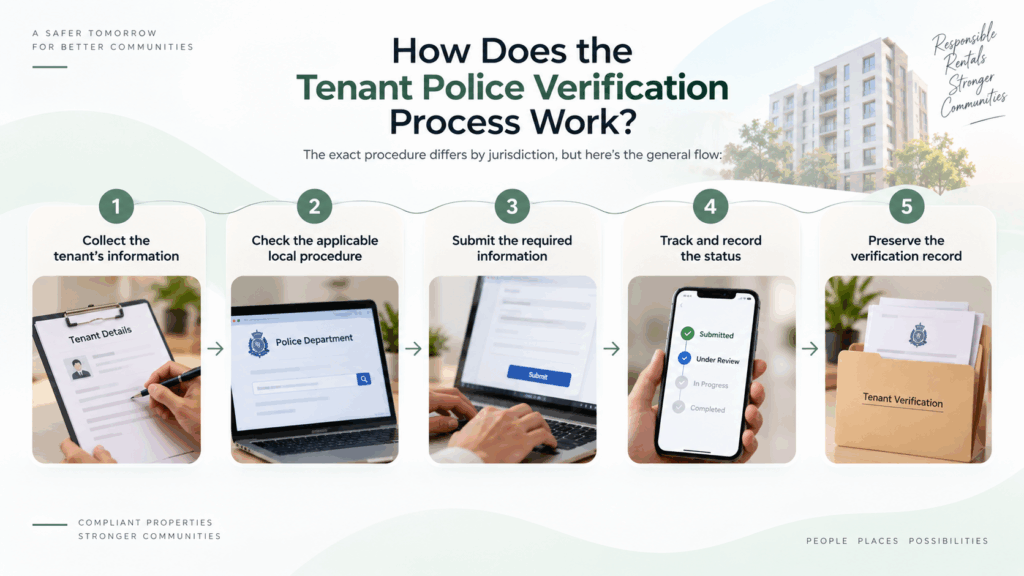
How Does the Tenant Police Verification Process Work?
The exact procedure differs by jurisdiction, but the overall workflow generally begins with collecting accurate tenant information and identifying the official process applicable to the property.
A landlord should first determine which police station, commissionerate, state portal, or government service is responsible for the property’s location. Once that is established, the tenant’s required information and supporting documents can be prepared according to the prescribed format.
The process generally involves the following stages:
1. Collect the tenant’s information
The first step is to ensure that the tenant’s basic details, identity information, address, contact details, and other required information have been collected accurately. Errors at this stage can create problems later during submission or verification.
2. Check the applicable local procedure
The landlord should identify the official police or government portal, form, or submission mechanism applicable to the property. This is important because online verification in one city does not necessarily mean that another city uses the same system.
3. Submit the required information
Depending on the jurisdiction, information may be submitted online or through another prescribed method. The landlord should retain evidence of submission wherever the system provides an acknowledgement, reference number, receipt, or confirmation.
4. Track and record the status
Verification should not disappear into a folder after submission. For professional property operations, the status should remain visible until the process is completed or otherwise resolved.
5. Preserve the verification record
The final step is maintaining the relevant confirmation or record alongside the tenant’s other onboarding information. This creates a more complete tenant file and makes future retrieval considerably easier.
RentOk’s How to Do Tenant Police Verification Online: A State-by-State Guide also explores the practical differences between jurisdictions and the importance of following the process applicable to each property.
What Happens If You Skip Tenant Verification?
The consequences of failing to complete a required verification process depend on the applicable local rules and circumstances. That is precisely why landlords should not rely on generic assumptions about penalties.
The bigger operational problem is that incomplete verification creates a documentation gap.
Imagine a PG with 150 occupants. The owner has collected identity documents from nearly everyone, but verification was completed for some tenants, submitted for others, and never initiated for a few residents. If those records are maintained through WhatsApp conversations and spreadsheets, identifying the exact status of every tenant can become unnecessarily difficult.
A professional verification system should make it possible to answer basic questions immediately:
- Which tenants have submitted all required information, and which records are still incomplete?
- Which verification applications have been submitted, and when were they initiated?
- Which tenant records are awaiting an update or confirmation from the relevant authority?
- Can the management team retrieve the tenant’s documentation without searching through multiple devices or conversations?
These questions show why verification is not only a compliance issue. It is also an information-management issue.
For growing rental businesses, a missing document is rarely just a missing document. It can indicate that the overall onboarding workflow is not structured enough to handle scale.
Why Manual Tenant Verification Becomes Difficult at Scale
Manual verification often works until the number of tenants increases.
A landlord handling five tenants may remember who has submitted their documents. A property manager handling several hundred residents cannot depend on memory, WhatsApp messages, paper files, or a spreadsheet with manually updated statuses.
The problem becomes particularly visible when multiple move-ins happen simultaneously. Employees may collect documents at different times, tenants may send incomplete information, and verification submissions may happen days after the actual move-in.
Without a centralized system, the management team can end up spending significant time simply figuring out what has already been completed.
This creates several recurring problems:
- Duplicate data entry, where the same tenant information has to be copied repeatedly into agreements, verification forms, spreadsheets, and internal records.
- Missing documentation, because a document shared with one staff member may never reach the person responsible for completing the verification process.
- Poor status visibility, making it difficult to distinguish between verification that is pending, submitted, completed, or requiring further action.
- Delayed follow-ups, because there is no structured reminder mechanism for incomplete tenant onboarding requirements.
- Fragmented records, where tenant information is divided between physical files, email attachments, messaging applications, and different employees’ devices.
The solution is not simply to ask employees to be more careful. As operations scale, the workflow itself needs to become more structured.
Build Tenant Verification Into the Onboarding Process
The strongest rental businesses do not treat police verification as something that happens after everything else has been completed. They incorporate it into the tenant’s onboarding journey.
Once a tenant is added, the property team should know what information needs to be collected, what documents are pending, what verification process applies to that property, and what remains incomplete before the tenant file is considered properly documented.
This also creates a better experience for tenants. Instead of receiving multiple requests from different employees at different times, they can complete their required information through a clearly defined process.
For landlords managing multiple properties, the process should ideally be standardized at the operational level while remaining flexible enough to accommodate different local requirements.
That means the internal workflow can remain consistent even when the external verification process differs.
A simple structure could look like:
Tenant added → KYC collected → Documents checked → Local verification initiated → Status tracked → Record preserved
The specific police procedure may change by location, but the internal discipline of tracking the process does not have to.
For a broader look at organizing this entire journey, RentOk’s How to Onboard a New Tenant in Under 10 Minutes can be useful for understanding how documentation, payments, room allocation, and onboarding activities can be brought into one structured workflow.
You can also explore RentOk’s official YouTube channel for visual content around digital property-management workflows and tenant operations.
Common Mistakes Landlords Should Avoid
Tenant verification problems are often caused less by a lack of awareness and more by inconsistent execution.
One of the most common mistakes is assuming that collecting Aadhaar or another identity document automatically completes police verification. It does not. Identity documentation and police verification serve different purposes and should be tracked separately.
Another mistake is relying on one verification process for every property. Local requirements can differ, so landlords should verify the procedure applicable to each property’s jurisdiction rather than copying an old form or workflow from another city.
Landlords should also avoid allowing documentation to remain scattered across personal phones and messaging applications. Even when the information is technically available, poor organization makes it difficult to establish a reliable tenant record.
Finally, verification should not be treated as a one-time administrative task that disappears after submission. The status, acknowledgement, and relevant records should remain connected to the tenant’s profile for future reference.

How RentOk Helps With Tenant Verification
For landlords and PG operators, the biggest challenge is often not understanding that tenant verification matters. It is managing the process consistently for every resident while keeping tenant information organized.
RentOk helps bring tenant onboarding and verification-related workflows into a more structured digital system. Instead of relying entirely on scattered spreadsheets, paper records, and individual conversations, property managers can maintain tenant information and documentation in a centralized environment.
This can help operators improve visibility across:
- Tenant records and KYC information, so the details collected during onboarding remain connected to the resident’s property and occupancy information.
- Documentation workflows, making it easier for teams to identify missing or incomplete information instead of discovering gaps later.
- Verification-related processes, helping property teams bring tenant verification into the broader onboarding workflow rather than treating it as an isolated administrative task.
- Occupancy and tenant management, allowing verification information to sit alongside the operational records that property managers already need to manage every day.
The larger advantage is consistency. When tenant verification becomes part of a defined digital onboarding process, operators can reduce the amount of manual coordination required and create a more organized record of who is staying at the property and what documentation has been completed.
For a growing PG, hostel, or co-living business, that structure can make compliance easier to manage while giving the management team better visibility over everyday tenant operations.
Conclusion
Tenant police verification is an important part of responsible rental management, but landlords should understand that the process is not identical across India. Requirements and submission methods can differ by state, city, police commissionerate, and local jurisdiction, which makes it essential to follow the procedure applicable to the property’s exact location.
For property owners, the objective should go beyond simply completing a form. A strong tenant verification process connects accurate tenant information, documentation, local compliance requirements, status tracking, and record management into one organized onboarding workflow.
As rental businesses grow, this structure becomes increasingly valuable. What can be managed manually for a handful of tenants becomes difficult when hundreds of residents, multiple properties, and frequent move-ins are involved.
The right approach is therefore simple: verify according to local requirements, maintain complete records, and make tenant verification a defined part of your property-management workflow.
Complete Tenant Verification Digitally with RentOk and bring tenant onboarding, documentation, and property operations into a more organized digital workflow.
Frequently Asked Questions
Find answers to common questions about this topic
About the Author
Ishika Pannu
Ishika Pannu brings you the latest insights and easy-to-apply strategies in property management—helping you simplify renting and grow with RentOk.
You may also like these
Related Articles

1 min read
The Satya Niketan PG Collapse: What It Means for Safety in Delhi PG’s
Written by
Posted on
Ishika Pannu
Sep 7, 2026
1 min read
How to File a Rental Dispute Complaint in India (Step-by-Step Guide)
Written by
Posted on
Ishika Pannu
Sep 6, 2026

1 min read
What to Do If Your Landlord Refuses to Return Your Security Deposit
Written by
Posted on
Ishika Pannu
Sep 5, 2026
1 min read
Why Landlords Cannot Legally Refuse Unmarried Tenants in India
Written by
Posted on
Ishika Pannu
Sep 5, 2026
1 min read
How to Get Your Security Deposit Back When Vacating a Rental Property
Written by
Posted on
Ishika Pannu
Sep 5, 2026
1 min read
How to Read a Rent Agreement Before Signing: What to Watch Out For
Written by
Posted on
Ishika Pannu
Sep 4, 2026
1 min read
What Are Your Rights as a Tenant Under the Model Tenancy Act?
Written by
Posted on
Ishika Pannu
Sep 3, 2026

1 min read
How to Get FSSAI Licence for Your Hostel Mess or Canteen
Written by
Posted on
Ishika Pannu
Sep 3, 2026
1 min read
How to Use Digital Signatures on Rent Agreements Legally in India
Written by
Posted on
Ishika Pannu
Sep 1, 2026
1 min read
How to Get Society Permission Before Renting Out Your Flat
Written by
Posted on
Ishika Pannu
Aug 31, 2026
Stay ahead in property management with expert insights
Join thousands of property managers receiving exclusive tips delivered straight to your inbox.
Browse posts by category
Case Study
Cost of Living
Growth
Legal
Market Trends
News
Pg owner app
Property Management
Property Tax
Tech
RentOk
The easiest way to rent and manage your PGs and hostels.
Get the app


Contact us
hello@eazyapp.tech
HQ Office
COGROW, BASEMENT F-12/8A
BESIDE HOUSE OF STYLE SALON, SECTOR 28, DLF PHASE 1
GURUGRAM, HARYANA - 122002
South India Office
LUMIODESK COWORKING, 2ND FLOOR, 40, 14TH MAIN RD
BESIDE MC DONALD, 7TH SECTOR, HSR LAYOUT
BENGALURU, KARNATAKA - 560102
©️ 2026 EazyApp Tech Pvt Ltd. All rights reserved


