
Legal
What Happens If You Break Your Rent Agreement Before the Lock-In Period?

Written by
Ishika Pannu
Read Time
14 min read
Posted on
September 14, 2026
Overview
Overview
What Happens If You Break Your Rent Agreement Before the Lock-In Period?
Signing a rent agreement usually marks the beginning of a stable rental arrangement. But if you need to break your rent agreement before the lock-in period ends, the situation can become more complicated than simply handing back the keys.
The tenant gets a place to live, while the landlord gets a defined period of occupancy and a predictable rental arrangement. Both sides generally expect the agreed terms to remain in place for the duration of the tenancy.
But plans can change.
A tenant may get transferred to another city. A student may change colleges. Family circumstances may require an unexpected move. Sometimes, the property simply stops working for the tenant.
The situation becomes more complicated when this happens during the lock-in period.
A lock-in clause creates a minimum commitment between the parties. Leaving before that period ends can have financial or contractual consequences. However, there is no single rule that applies to every rental agreement in India.
The answer depends on the terms of the agreement, the circumstances of the exit, and the law applicable to the tenancy.
This is why understanding your agreement before moving out is important. A tenant should know what the lock-in clause says, how it differs from the notice period, and what may happen to the security deposit.
What Is a Lock-In Period in a Rent Agreement?
A lock-in period is the minimum period for which the tenant agrees to remain in the rental arrangement.
It is primarily designed to provide stability. A landlord may spend money on finding a tenant, preparing the property, completing documentation, and getting the room ready for occupancy. An unexpected move-out can force the entire process to start again.
For tenants, the lock-in period represents a contractual commitment. If they decide to leave before it ends, the agreement may contain specific conditions for early termination.
A typical lock-in clause may address:
- Minimum stay: The agreement states the period for which the tenant is expected to remain in the property before exercising certain exit rights.
- Early termination: The contract may explain what happens when a tenant leaves before the lock-in ends, including any agreed financial consequences.
- Notice requirements: A notice period may apply separately from the lock-in and should be read alongside it.
- Deposit settlement: The agreement may explain how outstanding dues or other legitimate deductions are handled during the final settlement.
The wording is important. A six-month lock-in with a 30-day notice period may work very differently from an agreement that includes a specific early-exit charge.
Before signing any rental agreement, it is worth reviewing the clauses that could affect you later. RentOk’s guide on how to read a rent agreement before signing covers several of these areas in detail.

Lock-In Period vs Notice Period: What Is the Difference?
These two terms are often used together, but they do not mean the same thing.
A lock-in period establishes a minimum commitment under the agreement. A notice period establishes how much advance notice should generally be given before ending the tenancy.
For example, imagine a tenant signs an agreement with a six-month lock-in and a 30-day notice period. The tenant decides to leave after three months.
The tenant cannot automatically assume that giving 30 days’ notice removes the lock-in obligation. The agreement may contain a separate condition for leaving during those first six months.
This distinction matters because the notice period deals with communication and timing, while the lock-in deals with contractual commitment.
RentOk’s guide on the legal notice period before vacating a rented property explains why there is no universal notice period that applies to every rental arrangement.
The agreement should therefore be the first document you check before deciding your move-out date.
Can You Legally Exit Before the Lock-In Period Ends?
A tenant may decide to physically leave a property before the lock-in expires. But that does not automatically answer whether any contractual obligations remain.
The first question is what the signed agreement says.
A rental agreement may contain an early-termination clause. It may specify a notice requirement or a particular financial consequence. It may also provide exceptions or conditions under which the parties can mutually agree to end the tenancy.
This is why it is risky to rely on statements such as “you cannot leave during the lock-in” or “you can leave whenever you want” without checking the written agreement.
The legal position can also depend on the type of tenancy and the applicable state or local law. The Transfer of Property Act, 1882 contains general rules relating to leases, including provisions concerning termination. However, the contractual terms and applicable local rules also matter.
The safest approach is to consider the agreement and the relevant law together.
Before sending a move-out notice, check:
- The lock-in clause: Confirm when the lock-in starts and when it ends.
- The termination clause: Look for provisions covering early exit, surrender, or premature termination.
- The notice clause: Check how much notice is required and whether special conditions apply during the lock-in.
- The deposit clause: Understand how the security deposit is treated at the end of the tenancy.
- The settlement process: Check how rent, utilities, damages, and other outstanding amounts are handled.
For a significant dispute, legal advice is more appropriate than relying on a general online explanation.
What Happens to the Security Deposit?
The security deposit is often the first financial concern when a tenant wants to leave early.
Many tenants assume that breaking the lock-in automatically means losing the entire deposit. That is not necessarily the case. The actual treatment depends on the rental agreement and applicable law.
A deposit may be used to settle legitimate outstanding obligations. These could include unpaid rent, utility charges, damage beyond normal wear and tear, or other amounts covered by the agreement.
That is different from simply assuming that the entire deposit can be kept without explanation.
A proper final settlement should make the calculation clear. The tenant should know the amount originally paid, the deductions being made, the reason for those deductions, and the remaining amount, if any.
This is also why documenting the property at move-in is useful. Photos, videos, inventory records, and written communication can help establish the condition of the property before and after the tenancy.
RentOk’s rent agreement checklist also highlights the importance of clearly documenting deposits, responsibilities, termination terms, and other conditions.
Good documentation does not prevent every dispute. It does, however, make disagreements much easier to understand.
What Are the Common Consequences of Leaving Early?
There is no single penalty for breaking a rent agreement before the lock-in period ends.
The outcome depends on the agreement and the circumstances surrounding the exit. Some agreements are more flexible, while others contain specific early-termination provisions.
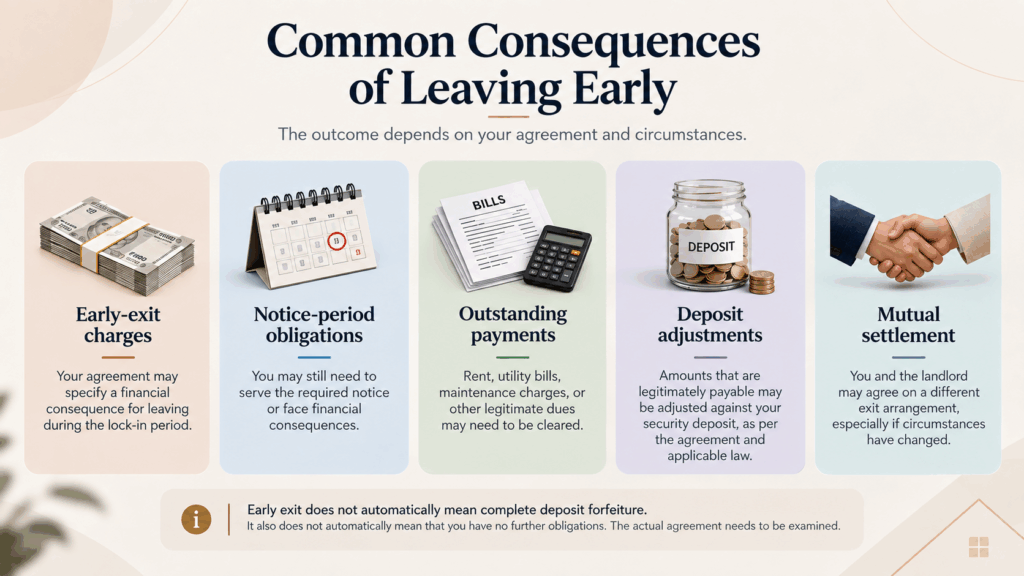
A tenant may encounter several possibilities:
- Early-exit charges: The agreement may specify a financial consequence for leaving during the lock-in period. The wording and enforceability of such a clause depend on the particular agreement and applicable law.
- Notice-period obligations: The tenant may still need to serve the required notice or deal with the financial consequences of not serving it fully.
- Outstanding payments: Rent, utility bills, maintenance charges, or other legitimate dues may need to be cleared before the tenancy is closed.
- Deposit adjustments: Amounts that are legitimately payable may be adjusted against the security deposit where the agreement and applicable law permit it.
- Mutual settlement: The landlord and tenant may agree on a different exit arrangement. This can be particularly useful when circumstances have changed unexpectedly.
The important point is that early exit does not automatically mean complete deposit forfeiture. It also does not automatically mean that the tenant has no further obligations.
The actual agreement needs to be examined.
Why Do Landlords Use Lock-In Periods?
From a tenant’s perspective, a lock-in period can feel restrictive. From a landlord’s perspective, it is mainly about reducing occupancy uncertainty.
A vacant room creates more than lost rent. The landlord may need to restart advertising, arrange property visits, clean the room, complete maintenance, process a new agreement, and onboard another tenant.
For PGs and co-living properties, the impact can be wider. Occupancy affects housekeeping, utilities, food planning, staffing, room allocation, and other daily operations.
This is why lock-in periods are common in managed rental businesses.
But a lock-in works best when tenants understand it before signing. If the clause is explained poorly, the same provision that was meant to create stability can become a source of conflict later.
RentOk’s article on how to set a lock-in period for PG tenants looks at the issue from the operator’s perspective. It focuses on setting clear terms and communicating them during onboarding.
The principle applies to tenants as well: a clause is easier to follow when its implications are understood from the beginning.
Can You Negotiate an Early Exit?
Leaving during a lock-in period does not always have to become a confrontation.
If you know that you need to move, communicate as early as possible. Advance notice gives the landlord time to plan for another occupant. It also gives both parties more time to discuss the financial and practical aspects of the exit.
Start by explaining the situation clearly.
A job transfer, change in education, family circumstances, or another genuine reason may provide useful context. You should then move the conversation towards the actual terms of the agreement.
A practical discussion can cover:
- Move-out date: Agree on a realistic date that gives both sides enough time to prepare.
- Notice requirements: Check the agreement and confirm how the notice period applies to your situation.
- Financial settlement: Ask for a clear calculation of rent, utilities, deductions, and any other claimed amount.
- Replacement tenant: Where appropriate, discuss whether a replacement tenant could reduce the landlord’s vacancy concerns, subject to approval.
- Handover: Confirm the inspection, keys, room condition, pending bills, and deposit settlement process.
The objective is not necessarily to eliminate every cost.
The objective is to reach a clear and documented exit arrangement that both sides understand.
What If the Landlord Refuses to Agree?
A disagreement can become difficult when the landlord and tenant interpret the agreement differently.
At this stage, avoid relying only on phone calls or informal conversations. Keep important communication in writing and preserve the documents connected to the tenancy.
The signed agreement should remain the starting point. Payment records, notices, deposit receipts, property-condition photographs, and written settlement discussions can also become important.
A landlord saying “you cannot leave” does not by itself explain the legal position. Likewise, a tenant leaving without addressing the agreement does not necessarily remove contractual obligations.
The better approach is to identify the exact clause causing the disagreement.
Ask what the landlord believes is payable. Ask where that obligation appears in the agreement. If a deduction is being proposed, request the calculation and supporting basis.
This keeps the discussion focused on the actual tenancy rather than turning it into an argument based on assumptions.
If the amount involved is substantial, or if either party believes their legal rights have been breached, professional legal advice should be considered.
What Does the Model Tenancy Act Say About Early Exit?
The Model Tenancy Act, 2021 is often mentioned when discussing rental rights in India. But it is important to understand what it actually is.
The Model Tenancy Act is a model framework for States and Union Territories to adopt. It is not a single tenancy law that automatically applies to every rental arrangement across India.
That distinction matters when discussing early termination.
A tenant should not assume that one provision of the Model Tenancy Act automatically determines the outcome of their agreement. The applicable state framework, the nature of the tenancy, and the written contract all need to be considered.
The broader lesson is still useful.
A rental agreement should clearly record the rights and obligations of both parties. Important terms should not be left to verbal understanding.
This includes:
- The duration of the tenancy and any lock-in period
- The notice period and termination process
- Security deposit conditions and settlement
- Maintenance and payment responsibilities
- Conditions for early termination
- Procedures for handing back possession
RentOk’s article on creating a legally valid rent agreement in India provides a broader look at these clauses and explains why a rental agreement should be treated as more than routine paperwork.
What Should You Do Before Breaking the Agreement?
If you have already decided to leave, do not wait until the final few days.
Start with the agreement. Identify the lock-in period, notice period, termination clause, deposit conditions, and final-settlement requirements. Then calculate the dates carefully.
Next, communicate with the landlord or property manager in writing. Keep the message clear and factual. Mention your proposed move-out date and ask for confirmation of the next steps.
You should also keep your own records throughout the process.
Before handing over the property, make sure you have:
- The signed agreement: Keep the complete document available so you can refer to the actual terms rather than relying on memory.
- Payment records: Retain rent, utility, maintenance, and deposit payment records until the final settlement is complete.
- Move-out communication: Keep your notice and subsequent discussions in a written format wherever possible.
- Property-condition evidence: Take reasonable photographs or videos during the handover process to document the condition of the premises.
- Final settlement details: Ask for a clear record of deductions, outstanding amounts, refunds, and the date on which the tenancy is formally closed.
The goal is simple: leave with the tenancy properly documented.
That protects both sides and reduces the chance of a disagreement continuing after the keys have been handed over.

How RentOk Helps You Manage Your Rental Journey
Rental management becomes harder when agreements, payments, tenant communication, and move-out details are spread across different places.
RentOk helps bring these rental workflows into a more structured digital environment. For property operators, this can improve visibility across tenant information, agreements, payments, communication, and occupancy-related processes.
For tenants, better access to rental information can make everyday tenancy management easier. Important payment details and property communication can be easier to track than when everything depends on scattered messages or paper records.
This becomes especially valuable during a move-out.
A well-organised rental process gives both sides better visibility into what happened during the tenancy. It can help reduce confusion around payments, communication, and important dates.
For growing rental businesses, that structure matters even more. Managing a few tenants through informal systems may be possible. Managing hundreds of tenants across multiple properties requires a more consistent approach.
RentOk is built to support that shift from fragmented rental management to a more organised digital workflow.
Conclusion
Leaving a rented property before the lock-in period ends does not have one universal outcome.
The consequences depend on the agreement, the circumstances of the early exit, and the laws that apply to the tenancy. A tenant should therefore avoid assuming that the entire security deposit will automatically be lost. The opposite assumption can also be risky.
Start by reading the lock-in and notice clauses carefully. Communicate early. Keep the move-out process documented. Ask for a clear settlement of rent, utilities, deductions, and the security deposit.
Most importantly, understand the agreement before you need to challenge or rely on it.
Understand Your Lease with the RentOk Tenant Portal and keep your rental information, payments, and property communication organised in one place.
Frequently Asked Questions
Find answers to common questions about this topic
About the Author
Ishika Pannu
Ishika Pannu brings you the latest insights and easy-to-apply strategies in property management—helping you simplify renting and grow with RentOk.
You may also like these
Related Articles

1 min read
How Foreign Nationals Can Rent Property in India (Verification Guide)
Written by
Posted on
Ishika Pannu
Sep 14, 2026

1 min read
How Rent Increases Work in India and When They’re Illegal
Written by
Posted on
Ishika Pannu
Sep 11, 2026

1 min read
What Documents Do You Need for Tenant Police Verification?
Written by
Posted on
Ishika Pannu
Sep 10, 2026
1 min read
Why You Should Always Insist on a Registered Rent Agreement
Written by
Posted on
Ishika Pannu
Sep 10, 2026
1 min read
What Is the Legal Notice Period Before Vacating a Rented Property?
Written by
Posted on
Ishika Pannu
Sep 9, 2026

1 min read
Delhi’s Proposed PG Regulations: What Owners Need to Know
Written by
Posted on
Ishika Pannu
Sep 9, 2026

1 min read
The Satya Niketan PG Collapse: What It Means for Safety in Delhi PG’s
Written by
Posted on
Ishika Pannu
Sep 7, 2026
1 min read
How to File a Rental Dispute Complaint in India (Step-by-Step Guide)
Written by
Posted on
Ishika Pannu
Sep 6, 2026

1 min read
What to Do If Your Landlord Refuses to Return Your Security Deposit
Written by
Posted on
Ishika Pannu
Sep 5, 2026
1 min read
Why Landlords Cannot Legally Refuse Unmarried Tenants in India
Written by
Posted on
Ishika Pannu
Sep 5, 2026
Stay ahead in property management with expert insights
Join thousands of property managers receiving exclusive tips delivered straight to your inbox.
Browse posts by category
Case Study
Cost of Living
Growth
Legal
Market Trends
News
Pg owner app
Property Management
Property Tax
Tech
RentOk
The easiest way to rent and manage your PGs and hostels.
Get the app


Contact us
hello@eazyapp.tech
HQ Office
COGROW, BASEMENT F-12/8A
BESIDE HOUSE OF STYLE SALON, SECTOR 28, DLF PHASE 1
GURUGRAM, HARYANA - 122002
South India Office
LUMIODESK COWORKING, 2ND FLOOR, 40, 14TH MAIN RD
BESIDE MC DONALD, 7TH SECTOR, HSR LAYOUT
BENGALURU, KARNATAKA - 560102
©️ 2026 EazyApp Tech Pvt Ltd. All rights reserved


