
Legal
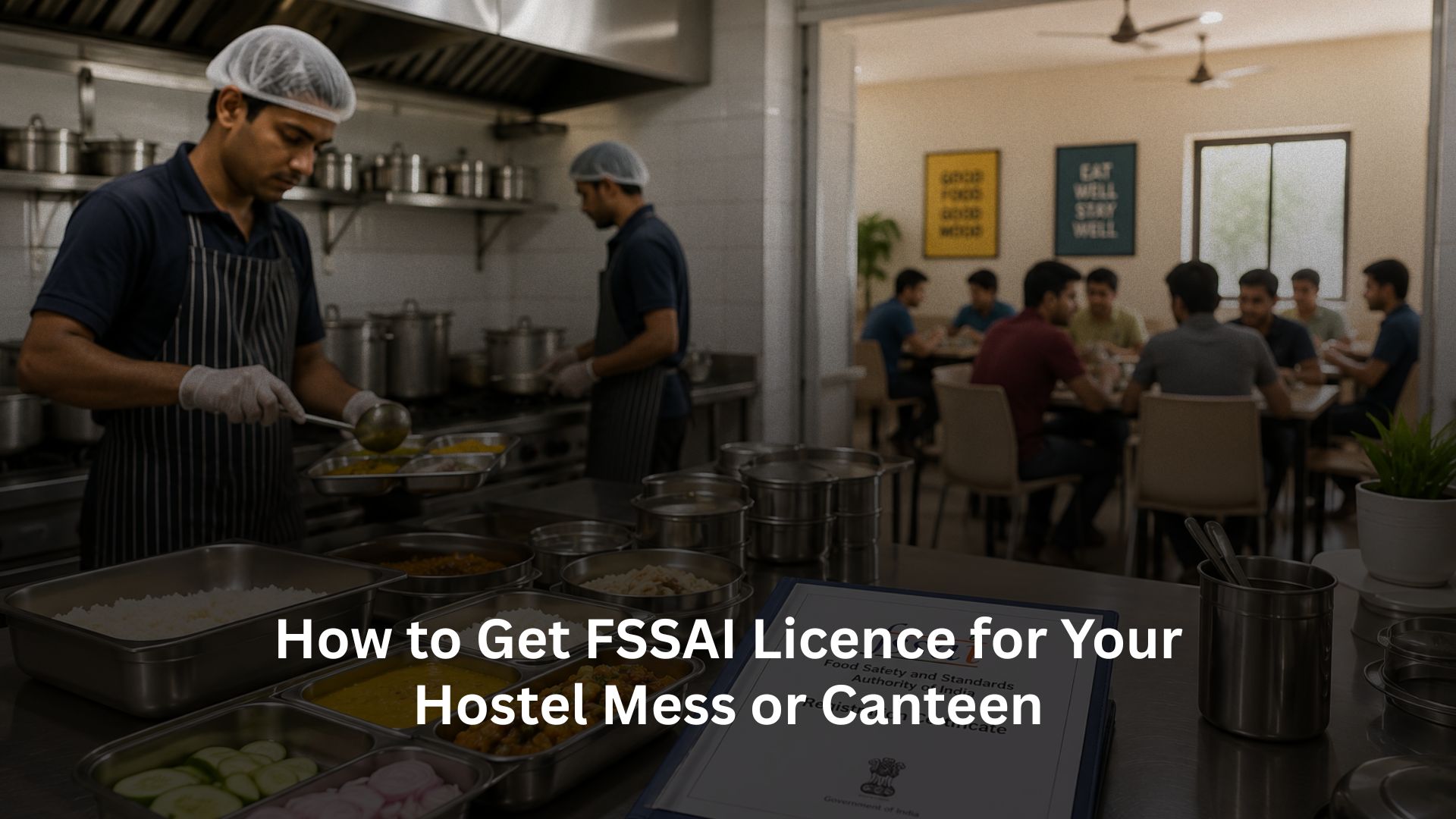
How to Get FSSAI Licence for Your Hostel Mess or Canteen

Written by
Ishika Pannu
Read Time
15 min read
Posted on
September 3, 2026
Overview
Overview
How to Get FSSAI Licence for Your Hostel Mess or Canteen
Running a hostel or PG with a mess involves more than providing rooms and collecting rent. Once meals become part of the accommodation, the kitchen becomes an important part of the operation. Food must be purchased, stored, prepared, handled, and served safely. These steps help protect residents and support business compliance.
This is where some hostel and PG operators may overlook an important requirement. Food may be served only to residents and treated as an added facility. However, that does not necessarily remove the need for FSSAI registration or licensing. FSSAI’s food-business framework recognizes boarding houses serving food as a food-service category. The current FoSCoS framework also covers club and canteen operations separately.
For operators, food compliance should be part of the initial business setup. It should not be considered only after an inspection or complaint. The same applies when the food operation expands or changes.
The process becomes easier when the food activity is classified correctly. It also helps to keep the required information and documents ready. This guide explains how FSSAI registration or licensing applies to hostel messes and canteens. It also covers the relevant category, required documents, and the FoSCoS application process. Finally, it explains the key requirements to manage after receiving the registration or licence.
Understanding FSSAI Requirements for Hostel Food Services
The first thing a hostel owner should understand is simple. Accommodation and food are two different activities. A property may mainly operate as a PG or hostel. However, if it also prepares or serves food, the food-service activity must be considered separately for FSSAI purposes.
FSSAI’s current classification describes a boarding house serving food as a building that provides food and lodging for paying guests. This makes the category particularly relevant to PGs and hostels where meals are provided as part of the resident experience.
The distinction becomes even more important when the food model changes. Some hostels operate a kitchen with their own cooks and support staff. Others work with an external caterer that supplies meals to residents. Some larger properties may operate a dedicated canteen. Each model needs to be assessed according to the actual food activity being carried out.
For a PG owner, therefore, the question should not simply be whether the property is called a “hostel,” “PG,” or “co-living space.” The more useful question is what food-related activity is actually taking place at the premises.
This approach also fits into the broader compliance framework of running a PG. Food licensing is only one area that operators need to think about. Depending on the location and business model, a property may also have requirements relating to fire safety, tenant verification, local permissions, agreements, taxation, and other operational matters. RentOk’s guide on What Licenses Do You Need to Run a PG in India? provides a broader overview of the regulatory areas PG operators should consider.
Choosing the Right FSSAI Registration or Licence
Not every hostel mess will require the same type of FSSAI approval. The applicable category depends on the nature of the food business and the turnover criteria specified by FSSAI.
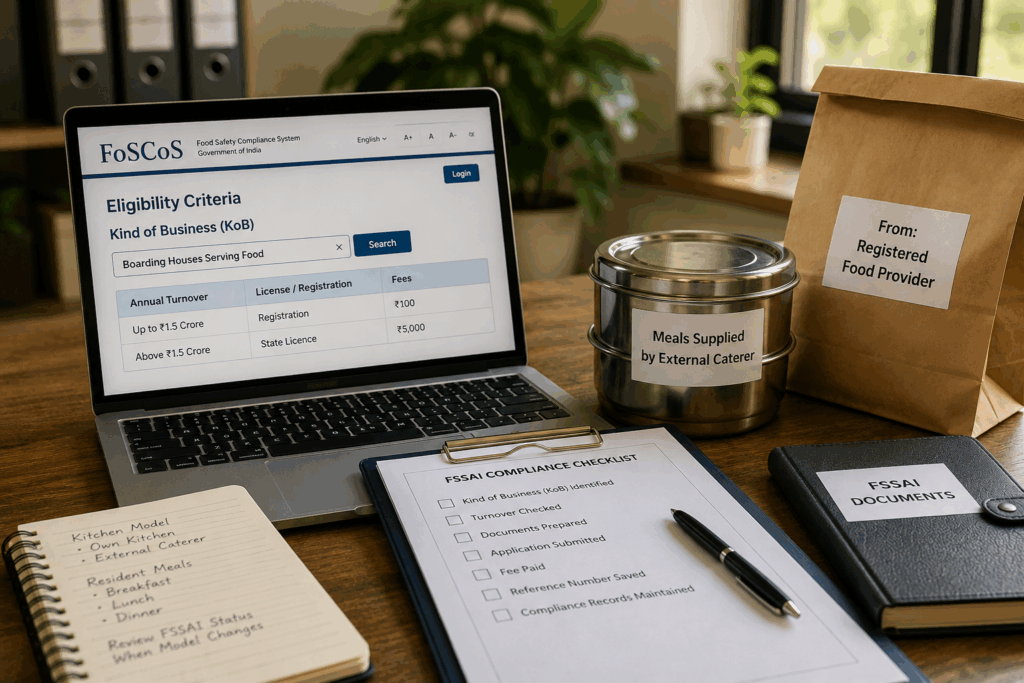
The current FoSCoS eligibility framework, updated on April 1, 2026, lists boarding houses serving food under the relevant food-service activities. For this category, the current turnover-based eligibility is:
- Annual turnover up to ₹1.5 crore: FSSAI Registration, with the listed annual fee of ₹100.
- Annual turnover above ₹1.5 crore: State Licence, with the listed annual fee of ₹5,000.
The revised framework also lists Club/Canteen separately, with the same ₹1.5 crore turnover threshold for Registration versus State Licence under the applicable category.
This updated threshold is particularly important for anyone researching FSSAI requirements online. Older articles and documents may still mention a ₹12 lakh threshold because that was part of the earlier framework. Hostel operators should therefore check the current FoSCoS eligibility criteria before applying rather than relying on an outdated article or an application completed several years ago.
The safest way to approach the process is to first identify the correct Kind of Business (KoB) and then determine which registration or licence applies to that activity.
What if meals are supplied by an outside caterer?
Outsourcing food preparation does not automatically make food compliance irrelevant.
If a hostel purchases meals from an external caterer, the food provider has its own responsibilities as a food business. At the same time, the hostel operator should maintain clarity about how the food is received, stored, distributed, and served to residents.
This is particularly important when a property grows. A small PG may initially purchase meals from a nearby kitchen, while a larger operation may later move to an in-house kitchen or appoint a dedicated catering partner. Any significant change in the food-service arrangement should prompt the operator to review the applicable FSSAI requirements again.
The objective is simple: the registration or licence should accurately reflect the food activity being conducted.
Information to Prepare Before Starting the Application
A major part of compliance difficulty comes from starting without the required information. For a hostel mess, preparation should begin with the business structure, premises, food activity, and turnover. Having these details ready can make the application process smoother.
FoSCoS provides an online process for applying for a new licence or registration. Applicants must provide details about the premises and food business. These include the complete address, state, district, sub-district, PIN code, and annual turnover.
Before starting the application, keep the following information ready:
- Business and applicant details: Keep the operator’s name and details consistent with supporting documents. Differences may lead to clarification requests.
- Premises information: Keep the exact food business address ready. Also keep relevant proof of possession, where required. The address should match the proof submitted.
- Food activity and turnover: Identify the correct food-service category. Keep annual turnover details ready before choosing Registration or State Licence.
- Supporting documents: Prepare identity proof, address proof, premises documents, and other category-specific documents.
For basic registration, FSSAI requires a photograph and government-issued photo ID. Accepted IDs include Aadhaar, PAN, and Voter ID. Proof of address is also required when the business address differs from the ID address.
A State Licence may require additional documents. These can include Form B, identity and address proof, and proof of possession of the premises. Other documents may apply based on the type of food business.
Not every document on the general FoSCoS list applies to every hostel mess. Operators should check the requirements for their specific food activity before submitting the application. Preparing the correct documents in advance can reduce delays and avoid unnecessary follow-ups.
Applying Through the FoSCoS Portal
The FSSAI registration and licensing process is handled online through FoSCoS, the Food Safety Compliance System. The platform provides the application route for new licences and registrations and also supports tracking, renewal, and modification of applications.
For a hostel operator, the application can be approached as a series of straightforward steps.
Step 1: Identify the applicable Kind of Business
Begin by identifying what the food operation actually represents. If the property provides food and lodging to paying guests, the boarding house serving food category may be relevant. If the operation functions as a canteen or cafeteria within an establishment, the applicable canteen category should be considered instead.
This is one of the most important stages of the process because the rest of the application depends on the classification selected.
Step 2: Check the turnover-based eligibility
Once the category has been identified, compare the food business’s annual turnover against the current FoSCoS criteria.
For the relevant boarding-house food-service category, turnover up to ₹1.5 crore falls under Registration, while turnover above ₹1.5 crore falls under State Licence.
Do not use an older turnover limit simply because it appears on another website. FSSAI’s eligibility framework can change, and the current official criteria should take precedence.
Step 3: Enter the premises details carefully
The premises address should be entered exactly and accurately. FoSCoS specifically instructs applicants to provide the complete address according to the proof of possession of the premises. It also notes that the information entered can appear on the licence, making accuracy especially important.
This becomes particularly relevant for operators managing more than one hostel. FoSCoS states that each location is issued a separate licence or registration, subject to the applicable rules. Where a food business has premises in more than one state, additional requirements apply for the head office and other locations.
A growing PG business should therefore avoid assuming that one certificate automatically covers every kitchen or property it operates.
Step 4: Upload the required documents
After entering the application details, upload the documents applicable to the selected category. The exact list depends on whether the application is for Registration or a State Licence and on the nature of the food activity.
Before uploading, check that documents are readable and that the names and addresses appearing on them are consistent with the application.
Step 5: Pay the fee and submit the application
Once the application and supporting documents have been completed, pay the applicable fee and submit the application through FoSCoS.
The current revised eligibility framework lists ₹100 for Registration and ₹5,000 for the applicable State Licence for the relevant boarding-house food-service category.
After submission, retain the application reference number. FoSCoS provides an online facility for tracking applications using the reference number, allowing operators to monitor progress and respond to any requirements that may arise during processing.
Documents and Records You Should Keep Organized
Getting the FSSAI application submitted is one part of the process. Maintaining a clean compliance record is equally important for a hostel that serves food every day.
The documentation should not be treated as something that exists only for the application. A well-managed food operation should be able to quickly locate its registration or licence, premises records, relevant food-safety documentation, and other applicable records when required.
The same principle applies to tenant documentation. When onboarding involves collecting identity details, agreements, payments, and other records across different channels, it becomes harder to maintain a clear operational trail. “How to Onboard a New Tenant in Under 10 Minutes” explores how a structured onboarding process can reduce this administrative friction.
For operators, it is useful to maintain a dedicated compliance folder containing:
- FSSAI registration or licence: Keep the current certificate easily accessible and ensure that the details continue to match the food operation being conducted.
- Premises and business records: Maintain relevant address, ownership or possession, and business documentation together rather than distributing them across unrelated files.
- Food-operation records: Keep applicable records relating to food procurement, handling, hygiene, and other operational requirements in an organized manner.
- Renewal and modification information: Record important validity dates and any changes to the business that may require an update to the existing registration or licence.
This becomes increasingly important as a property expands. When compliance information is scattered between physical files, spreadsheets, emails, and individual employees’ phones, even simple verification can become unnecessarily difficult.
Food Safety Doesn’t End Once You Receive the Certificate
An FSSAI registration or licence establishes that the food business has completed the applicable regulatory process, but the responsibility of operating a safe kitchen continues every day.
A hostel kitchen deals with a constantly changing environment. Ingredients arrive regularly, meals are prepared in batches, utensils and surfaces are repeatedly used, and different staff members may be involved in food preparation and serving. A single certificate cannot replace consistent food-safety practices.
Operators should therefore pay attention to areas such as:
- Kitchen hygiene and cleanliness: Food preparation areas, utensils, storage spaces, and food-contact surfaces should be cleaned and maintained consistently rather than only when an inspection is expected.
- Safe storage and handling: Raw materials and prepared food should be handled and stored appropriately to reduce contamination and food-safety risks.
- Staff hygiene: People involved in food preparation and serving should follow appropriate hygiene practices and understand their responsibilities within the kitchen.
- Operational records: Relevant food-safety and compliance records should be maintained systematically so that management can verify what has been done and identify gaps.
- Ongoing supervision: Food operations should be reviewed periodically instead of assuming that the same practices will remain effective as the kitchen, menu, staffing, and occupancy change.
For a hostel owner, this is ultimately a management issue as much as a food-safety issue. The more structured the operation becomes, the easier it is to maintain consistent standards.
Renewal and Compliance for a Growing Hostel Business
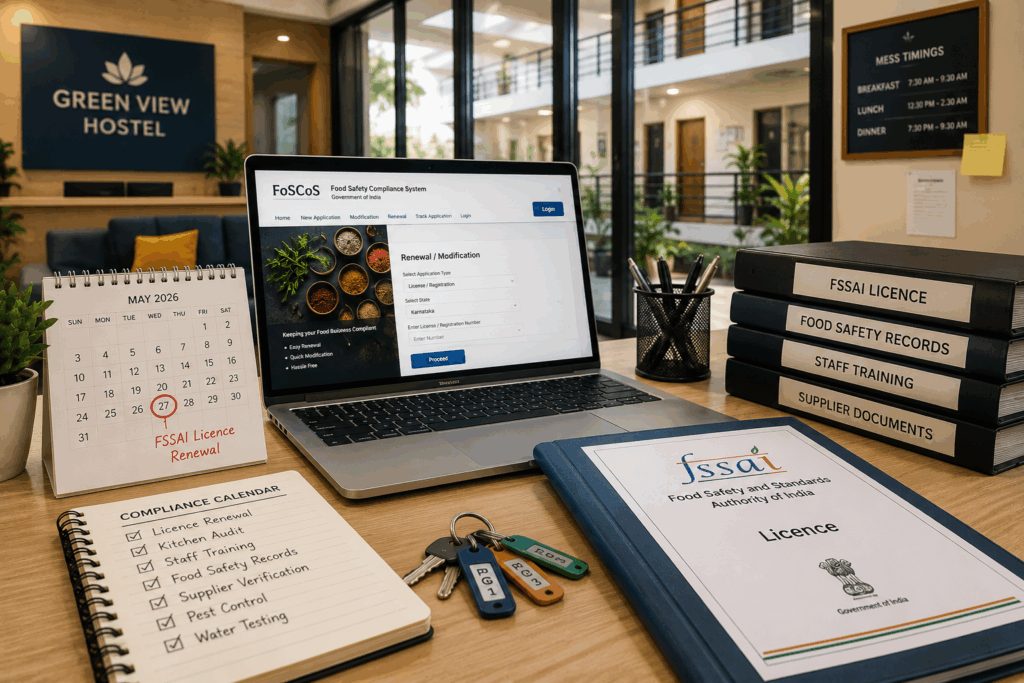
Renewal should not be treated as a last-minute administrative task. FSSAI’s FoSCoS system provides functionality for renewal as well as modification of licences and registrations, allowing food businesses to manage these requirements through the same platform.
Operators should also review their FSSAI status when the food business changes significantly. A hostel that increases its resident capacity, expands its kitchen, changes its food-service model, or begins operating food services at another premises may need to reassess its applicable requirements.
This is particularly important for businesses operating several PGs. FoSCoS states that each location is issued a separate licence or registration, subject to the applicable eligibility criteria.
A good compliance calendar can therefore help the management team keep track of:
- licence or registration validity and renewal timelines;
- changes in premises, food activity, or business structure;
- important food-safety documentation and records;
- responsibilities assigned to kitchen and operations staff; and
- other property-level compliance requirements that need periodic review.
When compliance is built into the operating system of the property, it becomes much easier to manage than when every requirement is handled separately and only when a deadline approaches.
This becomes even more important when the owner is not physically present at the property every day. In “How to Manage a PG Without Being On-Site Every Day,” RentOk looks at how owners can build systems that maintain visibility over daily operations even when they are managing the property remotely.
Common Mistakes Hostel Operators Should Avoid
Most compliance problems do not necessarily begin with deliberate non-compliance. They often develop because operators rely on assumptions or outdated information.
One common mistake is assuming an internal mess is not a food business. This is often based on the fact that meals are served only to residents. Another mistake is copying the FSSAI category used by another hostel. The correct category depends on the actual food operation.
Operators should also avoid using outdated turnover limits. The current FoSCoS framework has revised the relevant threshold for these food-service categories to ₹1.5 crore. Using older information could lead to the wrong registration or licence decision.
Other avoidable issues include:
- Inaccurate premises information: Entering an incomplete or inconsistent address can create unnecessary complications because the premises details form an important part of the application.
- Incomplete documentation: Starting the application without preparing the relevant documents can lead to delays and repeated corrections.
- Treating the certificate as the entire compliance system: Registration is important, but daily food handling, hygiene, storage, staff practices, and record keeping still need attention.
- Forgetting about expansion: A food operation can change as the hostel grows, so the applicable requirements should be reviewed whenever the business model or premises changes.
A compliance-first approach is ultimately more efficient than fixing gaps after they become operational problems.
How RentOk Helps You Run a More Organized PG Business
FSSAI compliance is only one part of managing a hostel or PG professionally. Operators must also handle tenant onboarding, KYC, rent collection, complaints, and maintenance. Occupancy tracking, agreements, and move-in or move-out coordination are also important.
Managing these tasks through separate spreadsheets, registers, chats, and records can create confusion. The challenge becomes greater as occupancy increases. Operators may find it harder to track information and maintain clear operational visibility.
RentOk helps PG and hostel operators manage key property workflows in one structured system. These include tenant management, occupancy tracking, payment visibility, complaints, communication, and daily operations. By bringing these tasks together, operators can reduce time spent managing scattered records. They can also focus more on running the property efficiently.
This becomes particularly valuable when compliance is viewed as part of the larger operating framework of the business. A property with organized tenant records, payment information, agreements, operational workflows, and compliance-related information is easier to manage consistently as it expands.
For operators looking to understand how technology can bring different parts of PG management together, RentOk’s PG and Hostel App Solutions explores how centralized digital systems can help manage areas such as tenant information, fees, complaints, occupancy, and other recurring property workflows.
Conclusion
Running a hostel mess or canteen comes with responsibilities that extend beyond preparing meals for residents. Food safety, documentation, licensing, and day-to-day kitchen practices all form part of operating a professional accommodation business.
The first step is to understand the food activity being conducted and identify the correct FSSAI category. From there, the operator can check the latest FoSCoS eligibility criteria, prepare the relevant documents, submit the application, track its progress, and maintain the required standards after registration or licensing.
Most importantly, FSSAI compliance should not exist in isolation. As a PG or hostel grows, the ability to manage tenants, payments, occupancy, documentation, communication, and compliance in an organized manner becomes increasingly important.
Run a Compliant PG Business with RentOk and build a more organized, efficient, and professionally managed rental operation.
Frequently Asked Questions
Find answers to common questions about this topic
About the Author
Ishika Pannu
Ishika Pannu brings you the latest insights and easy-to-apply strategies in property management—helping you simplify renting and grow with RentOk.
You may also like these
Related Articles
1 min read
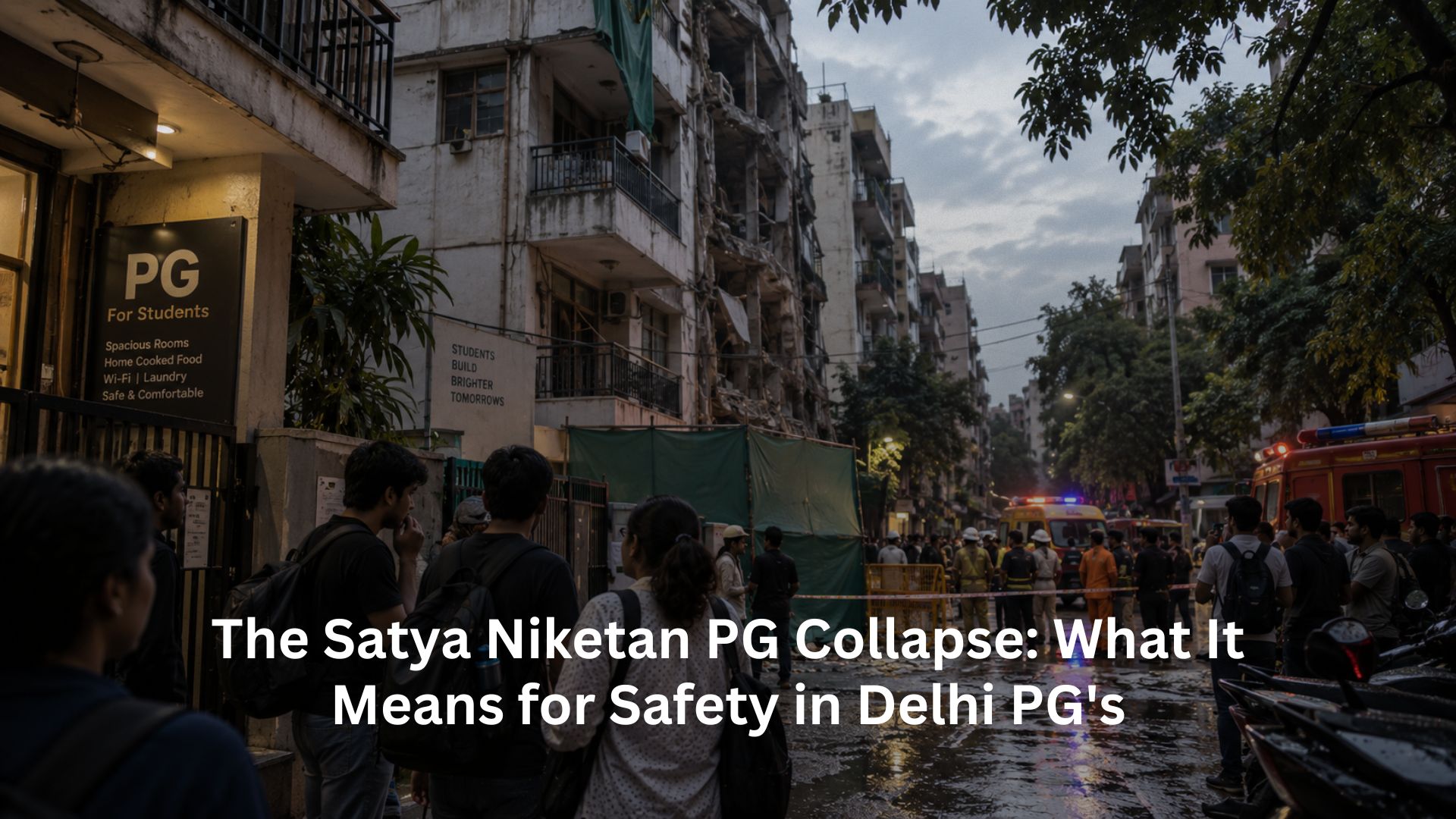
The Satya Niketan PG Collapse: What It Means for Safety in Delhi PG’s
Written by
Posted on
Ishika Pannu
Sep 7, 2026
1 min read
How to File a Rental Dispute Complaint in India (Step-by-Step Guide)
Written by
Posted on
Ishika Pannu
Sep 6, 2026

1 min read
What to Do If Your Landlord Refuses to Return Your Security Deposit
Written by
Posted on
Ishika Pannu
Sep 5, 2026

1 min read
Why Landlords Cannot Legally Refuse Unmarried Tenants in India
Written by
Posted on
Ishika Pannu
Sep 5, 2026

1 min read
How to Get Your Security Deposit Back When Vacating a Rental Property
Written by
Posted on
Ishika Pannu
Sep 5, 2026
1 min read
What Is Tenant Police Verification and Why Is It Mandatory in India?
Written by
Posted on
Ishika Pannu
Sep 4, 2026

1 min read
How to Read a Rent Agreement Before Signing: What to Watch Out For
Written by
Posted on
Ishika Pannu
Sep 4, 2026

1 min read
What Are Your Rights as a Tenant Under the Model Tenancy Act?
Written by
Posted on
Ishika Pannu
Sep 3, 2026
1 min read
How to Use Digital Signatures on Rent Agreements Legally in India
Written by
Posted on
Ishika Pannu
Sep 1, 2026

1 min read
How to Get Society Permission Before Renting Out Your Flat
Written by
Posted on
Ishika Pannu
Aug 31, 2026
Stay ahead in property management with expert insights
Join thousands of property managers receiving exclusive tips delivered straight to your inbox.
Browse posts by category
Case Study
Cost of Living
Growth
Legal
Market Trends
News
Pg owner app
Property Management
Property Tax
Tech
RentOk
The easiest way to rent and manage your PGs and hostels.
Get the app


Contact us
hello@eazyapp.tech
HQ Office
COGROW, BASEMENT F-12/8A
BESIDE HOUSE OF STYLE SALON, SECTOR 28, DLF PHASE 1
GURUGRAM, HARYANA - 122002
South India Office
LUMIODESK COWORKING, 2ND FLOOR, 40, 14TH MAIN RD
BESIDE MC DONALD, 7TH SECTOR, HSR LAYOUT
BENGALURU, KARNATAKA - 560102
©️ 2026 EazyApp Tech Pvt Ltd. All rights reserved


