
Legal
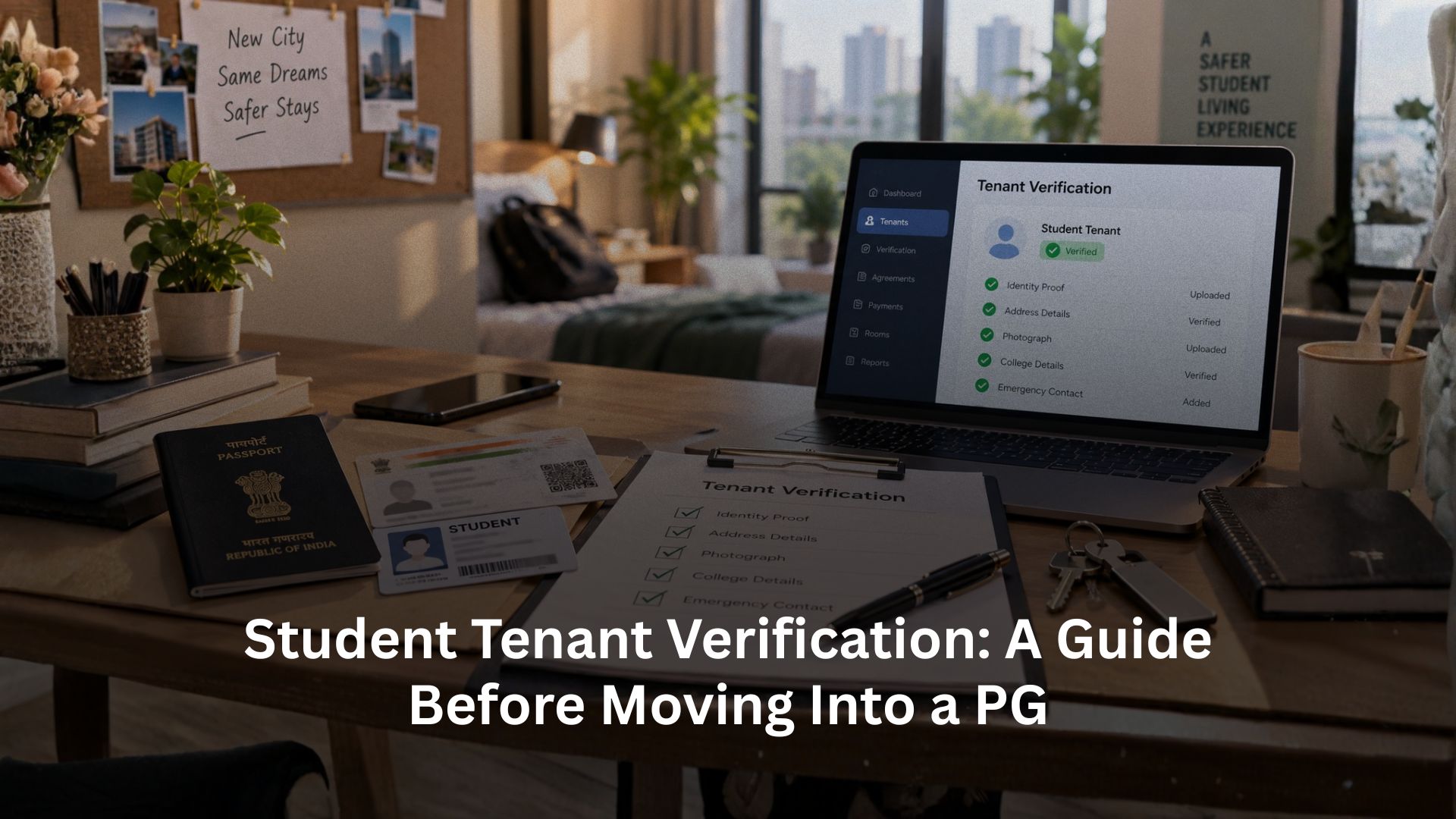
Student Tenant Verification: A Guide Before Moving Into a PG

Written by
Ishika Pannu
Read Time
14 min read
Posted on
September 16, 2026
Overview
Overview
Student Tenant Verification: A Guide Before Moving Into a PG
Moving to a new city for college is often a student’s first experience of living away from home. Finding the right PG becomes one of the first priorities. Students compare rent, location, food, room facilities, and distance from college before making a decision.
But there is another part of moving into a PG that often gets less attention: tenant verification.
For students, verification can feel like another piece of paperwork. Many are moving from another city or state. Some may not have a local address proof yet. Others may not know which documents their PG expects.
For PG owners, however, verification is part of maintaining accurate tenant records. It becomes even more important when a property houses dozens of students. The number of move-ins can rise sharply during college admission periods.
Tenant verification is therefore more than a paperwork exercise. It connects the tenant, the property, and the information collected during onboarding.
There is also an important point to remember. Verification requirements are not identical across India. The process can depend on the state, city, police jurisdiction, and type of accommodation.
Some police departments have dedicated tenant or PG verification services. Others follow different procedures. Students and PG owners should therefore follow the process that applies to their specific location.
For students moving to a new city, understanding this process before handing over documents can make the entire move-in experience much smoother.
Why does tenant verification matter for students?
A student living in a PG is still a resident of that property. Their status as a student does not remove the need for proper tenant records where verification is required.
This becomes especially relevant in student-heavy cities. A single PG may have residents from several states. Each student can have a different permanent address, college, emergency contact, and move-in date.
A structured verification process brings these details together.
For the PG owner, this creates a clearer record of who is occupying the property. For the student, it provides greater clarity around the information being submitted.
Verification also works better when it is treated as part of onboarding. It should not be something the management team remembers only after the student has already moved in.
A student tenant record may include several types of information:
- Identity information: This establishes who the student is and connects their personal details with the accommodation they are renting.
- Permanent and current addresses: A student’s family home may be in another city, while the PG becomes their current residence during college.
- Contact information: Updated phone numbers and other relevant details help the property maintain reliable communication with the resident.
- Accommodation details: The tenant record should connect the student with the relevant property, building, room, or bed.
- Educational information: Depending on the local verification process, the student’s college or institution may also be requested.
The exact requirements can vary. Students should not assume that a document list used by a friend in another city will automatically apply to them.
For a broader look at the documentation involved, RentOk’s guide on documents required for tenant police verification is also useful.

What documents do students usually need?
There is no single document checklist that applies identically to every PG in India.
The applicable requirements depend on the local verification process. Still, students can expect the process to involve basic identity and residential information.
A government-issued identity document is usually an important starting point. Depending on the procedure, students may also need photographs, address details, contact information, and property-related information.
Some processes may also request educational or occupation-related details.
The important point is to understand what is actually required. Students should not submit every document they have simply because they are unsure what the PG needs.
There is also a difference between identity proof and address proof.
An identity document establishes who the student is. It does not automatically establish where the student currently lives.
Similarly, a student’s permanent address is not necessarily the same as their current PG address.
Understanding this difference can prevent confusion during onboarding.
Keep the information consistent
Small errors can create unnecessary back-and-forth during verification. Students should therefore check their details before submitting documents.
In particular, they should confirm:
- Their name and other personal details are entered correctly across the required forms and documents.
- Their permanent address includes the relevant city, district, state, and other requested information.
- Their current PG address is complete and matches the actual accommodation.
- Their phone number and other contact information are current.
- Any college, emergency-contact, or supporting information requested by the applicable process is accurate.
These checks take very little time. They can save considerable effort later.
For PG operators, consistent information also makes tenant records easier to maintain. This becomes important when agreements, payments, complaints, room changes, or move-outs need to be tracked.
What if a student does not have a local address proof?
This is one of the biggest concerns for students moving to a new city.
Consider a student from Lucknow who moves to Delhi for college. Their permanent address remains their family home in Lucknow. Their new PG becomes their current residence.
Naturally, they may not have a Delhi electricity bill or another traditional document showing a long residential history at the new address.
That does not mean they should provide incorrect information.
The better approach is to clearly distinguish between the permanent address and the current address.
The permanent address can remain the student’s family address. The PG can be recorded as the current place of residence wherever the applicable process requires it.
Some verification formats specifically distinguish between present and permanent residence details. The exact requirements still depend on the relevant jurisdiction.
Students should speak to the PG manager if they are unsure about the required documentation. They should not try to solve the problem by using an address that does not belong to them.
Students should also avoid:
- Changing their permanent address to the PG address when the form specifically asks for permanent residence.
- Providing a friend’s or relative’s address simply because it is easier to document.
- Submitting documents that do not belong to them.
- Assuming that having no local address history makes verification impossible.
Instead, they should explain their situation and ask what information or supporting documentation is accepted under the applicable process.
This is one reason why the verification process should be explained during onboarding. Students should know what is expected before they are asked to submit documents.
Why can the process differ from one city to another?
Tenant verification in India is not based on one identical workflow for every rental property.
The responsible police authority can differ. The form can differ. The online portal can differ. The information requested can also vary.
This matters because students often move between cities for education.
A student may have heard that their friend completed verification through an online portal. That does not mean the same procedure applies to their new PG.
The same issue is important for operators with properties in multiple cities. A process that works in one location may need to be adapted for another.
RentOk’s guide to digital KYC and police verification across Indian states covers this issue in greater detail.
The key takeaway is simple: verification should be based on the property’s location and applicable procedure, not assumptions.

How do PG owners handle student verification?
From a PG owner’s perspective, student verification becomes more difficult as occupancy increases.
Imagine a 100-bed PG near a university. At the beginning of an academic session, several students may move in within the same week.
Each student can have different documents and a different permanent address. Some may come from another state. Others may already live locally.
If verification is handled through WhatsApp messages, paper files, and spreadsheets, keeping track of every tenant becomes difficult.
A structured process should begin during onboarding.
The PG team should know what information needs to be collected. It should also know which documents are missing and where each tenant stands in the process.
A practical workflow can include:
- Collecting tenant information during onboarding: Student details should be captured as part of the move-in process rather than being requested repeatedly later.
- Checking document completeness: The management team should identify missing information before the tenant file is considered complete.
- Following the local verification process: The PG should use the relevant police or government procedure for its location.
- Recording verification status: Management should know whether verification is pending, submitted, completed, or requires further action.
- Connecting verification with occupancy: The tenant’s information should remain connected to the relevant property and occupancy record.
This becomes even more important when multiple employees handle different parts of the tenant journey.
A verification process should not depend on one employee remembering what happened several months earlier.
Why should verification be part of the move-in process?
One common operational mistake is treating verification as a separate activity.
A student moves in. Rent is collected. The room is assigned. The agreement is signed. Then someone remembers that verification still needs to be completed.
By this point, the tenant’s information may already be spread across several systems.
A better approach is to make verification part of the onboarding workflow.
The exact sequence can vary by property. However, the broader process can look like:
Tenant details → KYC and document collection → agreement → verification → room allocation → move-in
The important thing is that every stage has a defined place.
This makes incomplete tenant files easier to identify. It also reduces the chances of important information getting lost between departments.
RentOk’s article on how to onboard a new tenant in under 10 minutes looks at the larger onboarding challenge and explains how a more structured process can reduce repetitive administrative work.
Verification should be part of that same system.
What should students check before submitting their documents?
Tenant verification is not only the responsibility of the PG owner.
Students are also sharing personal information during the rental process. They should understand what they are submitting and why.
Before handing over documents, students should ask the PG manager what information is required. They should also make sure the accommodation details are clear.
A student should ideally know:
- Which documents are required: Students should understand the purpose of each document instead of sending every personal document available.
- The full property details: The PG name and address should be clear so the current residence is recorded correctly.
- Who handles the submission: Students should know whether the PG submits the information or whether they need to complete part of the process themselves.
- Whether the agreement matches the discussed terms: Rent, deposit, notice period, and other key terms should be reviewed before signing.
- How important records are retained: Students should keep copies of their agreement, payment records, and other important tenancy documents.
This is especially useful for students renting for the first time.
A transparent PG should be able to explain its onboarding process clearly. Verification should not feel mysterious or unnecessarily complicated.
For a related perspective, RentOk’s article on how to spot a fake ID during tenant verification explains why collecting an ID is only one part of a proper verification process.
What happens when verification is handled manually?
Manual processes can work when a property has only a few tenants.
The problems become much more visible as occupancy increases.
A PG with ten tenants may manage documents through a simple spreadsheet. A property with 100 or 500 residents needs far greater visibility.
Manual verification creates several possible gaps.
A staff member may forget to submit information. Another employee may not know whether a document was already collected. A verification acknowledgement may remain buried in an email or WhatsApp conversation.
The problem is not always a lack of effort. It is often a lack of structure.
A property management system should help the team answer basic questions quickly:
Has the tenant submitted the required information? Is anything missing? Has verification started? What is the current status? Which property and room are linked to the tenant?
When these answers are available in one place, management spends less time searching for information.
RentOk’s guide on maintaining tenant KYC records digitally explores this shift from scattered paperwork to structured digital tenant records.
Verification is also about building trust
There is another reason tenant verification matters.
It can influence how students perceive the PG from the beginning.
A property that clearly explains its onboarding requirements creates a different experience from one that suddenly asks for documents through multiple WhatsApp messages.
Professionalism is visible in small processes.
When a PG explains what is required, keeps records organized, and communicates the next steps, students are more likely to feel that the property is being managed properly.
The same principle applies to personal information.
Students should expect PG operators to handle their documents responsibly. Operators should also avoid collecting unnecessary information simply because it is convenient.
Verification should create clarity, not confusion.
This is particularly relevant for operators building a broader tenant screening process. RentOk’s PG owner’s guide to tenant background verification explains how identity verification, police verification, and other screening steps can serve different purposes.

How RentOk Helps With Student Tenant Verification
Managing student tenants becomes difficult when KYC documents, agreements, occupancy records, payments, and verification information are maintained separately.
RentOk helps PG and hostel operators bring key tenant-management activities into a more organized digital workflow. This gives operators better visibility over tenant information and onboarding activity.
The benefit becomes especially clear during student admission periods. Many residents may move in within a short window. A structured system helps the team manage information without relying entirely on spreadsheets, paper records, or scattered conversations.
RentOk supports digital KYC and tenant verification workflows as part of its wider property-management system. This can help operators reduce repetitive administrative work and maintain more structured tenant records.
For a PG owner, the real value is not completing verification for one student. It is building a repeatable process that can work for the next tenant, the next room, and eventually the next property.
Conclusion
For students moving to a new city, tenant verification is an important part of responsible PG onboarding. It creates a clearer record of who is living at the property and connects the tenant with their accommodation.
The exact requirements can vary by location. Students should therefore follow the applicable local process and provide accurate information.
For PG owners, the bigger challenge is consistency. Verification becomes harder when tenant information is scattered across files, spreadsheets, and conversations.
A structured onboarding process can make the experience easier for both the student and the property team.
A well-managed PG should not make verification feel like unnecessary paperwork. It should make the process clear, organized, and easy to understand.
Find Verified Student PGs on RentOk and make your move to a new city simpler.
Frequently Asked Questions
Find answers to common questions about this topic
About the Author
Ishika Pannu
Ishika Pannu brings you the latest insights and easy-to-apply strategies in property management—helping you simplify renting and grow with RentOk.
You may also like these
Related Articles

1 min read
New UPI MDR Rule: What It Means for Rent Payments
Written by
Posted on
Ishika Pannu
Sep 16, 2026

1 min read
What Happens If You Break Your Rent Agreement Before the Lock-In Period?
Written by
Posted on
Ishika Pannu
Sep 14, 2026

1 min read
How Foreign Nationals Can Rent Property in India (Verification Guide)
Written by
Posted on
Ishika Pannu
Sep 14, 2026

1 min read
How Rent Increases Work in India and When They’re Illegal
Written by
Posted on
Ishika Pannu
Sep 11, 2026
1 min read
What Documents Do You Need for Tenant Police Verification?
Written by
Posted on
Ishika Pannu
Sep 10, 2026

1 min read
Why You Should Always Insist on a Registered Rent Agreement
Written by
Posted on
Ishika Pannu
Sep 10, 2026
1 min read
What Is the Legal Notice Period Before Vacating a Rented Property?
Written by
Posted on
Ishika Pannu
Sep 9, 2026

1 min read
Delhi’s Proposed PG Regulations: What Owners Need to Know
Written by
Posted on
Ishika Pannu
Sep 9, 2026

1 min read
The Satya Niketan PG Collapse: What It Means for Safety in Delhi PG’s
Written by
Posted on
Ishika Pannu
Sep 7, 2026
1 min read
How to File a Rental Dispute Complaint in India (Step-by-Step Guide)
Written by
Posted on
Ishika Pannu
Sep 6, 2026
Stay ahead in property management with expert insights
Join thousands of property managers receiving exclusive tips delivered straight to your inbox.
Browse posts by category
Case Study
Cost of Living
Growth
Legal
Market Trends
News
Pg owner app
Property Management
Property Tax
Tech
RentOk
The easiest way to rent and manage your PGs and hostels.
Get the app


Contact us
hello@eazyapp.tech
HQ Office
COGROW, BASEMENT F-12/8A
BESIDE HOUSE OF STYLE SALON, SECTOR 28, DLF PHASE 1
GURUGRAM, HARYANA - 122002
South India Office
LUMIODESK COWORKING, 2ND FLOOR, 40, 14TH MAIN RD
BESIDE MC DONALD, 7TH SECTOR, HSR LAYOUT
BENGALURU, KARNATAKA - 560102
©️ 2026 EazyApp Tech Pvt Ltd. All rights reserved


