
Legal
How Working Professionals Can Complete Tenant Verification Quickly

Written by
Ishika Pannu
Read Time
17 min read
Posted on
September 17, 2026
Overview
Overview
How Working Professionals Can Complete Tenant Verification Quickly
Moving to a new city for work involves more than finding a suitable rental property. Working professionals must manage house hunting, rental agreements, documentation, relocation expenses, and tenant verification. When these responsibilities overlap with a demanding work schedule, even a routine process can become stressful.
Tenant verification is an important part of responsible rental onboarding. It helps landlords and property managers maintain accurate records of the people living on their premises. For tenants, completing the process correctly can prevent unnecessary follow-ups, documentation issues, and move-in delays.
However, completing tenant verification quickly does not mean rushing through the process or ignoring required checks. Speed comes from preparation, accurate information, and a clear understanding of the applicable verification procedure.
A professional relocating from Jaipur to Gurgaon, for example, may have a permanent address in Rajasthan, a new workplace in Haryana, and a rental property in a different locality. These details must be recorded correctly. The requirements may also differ depending on the local police authority and the type of accommodation.
This guide explains how working professionals can prepare for employee tenant verification, understand the role of employer documentation, use online verification facilities, and avoid common delays during the rental onboarding process.
Why Working Professionals Face Tenant Verification Challenges
Tenant verification often becomes difficult when the process begins without clear instructions. A landlord may request an identity document through WhatsApp, ask for an employer letter later, and then request additional address details before submission. For someone managing a full-time job, these repeated requests can quickly become inconvenient.
The issue is not always a lack of documentation. More often, delays occur because the tenant does not know what information is needed or which authority is responsible for verification.
Working professionals commonly face the following challenges:
- Different permanent and current addresses: Employees frequently relocate for work. Their permanent address may be in one state, while their current rental property is in another. Confusing these details can result in incomplete or inaccurate forms.
- Limited availability during working hours: Some verification procedures may involve physical visits or additional communication with the landlord. Employees may find it difficult to manage these tasks during office hours.
- Unclear employer requirements: Certain landlords or verification processes may request employment details or an HR letter. Tenants may need additional time to obtain these documents from their organisation.
- Different procedures across locations: Tenant verification requirements can vary between states, cities, and local police authorities. A process followed in Delhi may not be identical to one followed in Bengaluru or Hyderabad.
- Last-minute onboarding: When documentation begins only after the tenant moves in, missing information can delay the submission. It may also create additional work for property managers.
The best approach is to understand the verification requirements before the move-in date. Tenants should ask the landlord or property manager which documents are required and whether the verification will be completed online or offline.
This initial clarity can reduce unnecessary communication and help both parties complete the process in a more organised manner.

Understand the Verification Process Before You Move In
Tenant verification is not the same as simply submitting an identity document. The process usually involves collecting relevant information, checking the documents, submitting details through the appropriate channel, and retaining proof of submission.
The exact steps depend on the location and the authority handling the request. Therefore, working professionals should not rely on a generic checklist without confirming the local requirements.
Before beginning the process, ask the landlord or property manager a few practical questions:
- Which authority handles tenant verification for this property?
- Is an online verification facility available?
- Who is responsible for submitting the form?
- Which documents must the tenant provide?
- Is an employer letter required for this rental arrangement?
- Will the tenant receive an acknowledgement or application number?
- Are any additional steps required after online submission?
These questions help establish responsibility at the beginning. They also prevent a situation where both the tenant and landlord assume that the other person has completed the submission.
For a broader overview, you can read RentOk’s Tenant Police Verification: A Guide for Landlords. The guide explains the general verification process, documentation, and the role of digital systems in rental management.
A clear process should ideally begin before the tenant receives the keys. This gives both parties enough time to address missing documents without disrupting the move-in schedule.
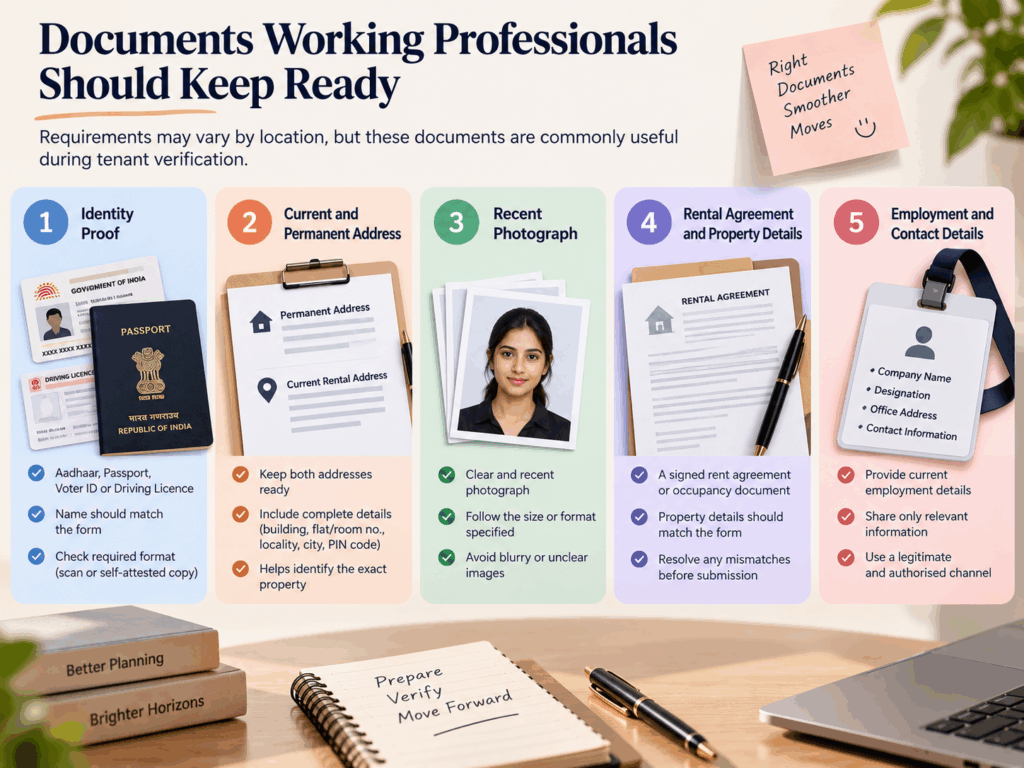
Documents Working Professionals Should Keep Ready
The documents required for tenant verification vary by location. There is no single checklist that applies identically across every city in India. Still, keeping certain details prepared can make the process more efficient.
Tenants should confirm the exact requirements with the relevant authority or property manager. The following documents and information are commonly useful during rental onboarding.
1. Identity Proof
A valid government-issued identity document may be required to establish the tenant’s identity. Depending on the process, this could include an Aadhaar card, passport, voter ID, or driving licence.
The name entered in the verification form should match the submitted document. Even small spelling differences can lead to additional clarification.
Tenants should also check whether the authority requires a particular document format, a clear scan, or a self-attested copy.
2. Current and Permanent Address
Working professionals should keep both their permanent and current address details available. These addresses may be different, especially when the tenant has recently moved for employment.
The current rental address should be written completely. It may include the building name, flat or room number, street, locality, city, and PIN code.
Incomplete addresses can make it difficult to identify the exact property. This is particularly important in buildings, PGs, and hostels with several rooms or units.
3. Recent Photograph
Some verification procedures may require a recent photograph. The image should be clear and should follow the size or format specified by the relevant authority.
Tenants should avoid submitting unclear photographs or images that do not meet the stated requirements. A document checklist should mention the expected format before collection begins.
4. Rental Agreement and Property Details
A signed rent agreement or occupancy document may be required as part of the verification process. The exact requirement depends on the local procedure and the type of accommodation.
The property details should correspond with the address entered in the verification form. Any mismatch between the agreement and the submitted information should be resolved before submission.
5. Employment and Contact Details
Working professionals may be asked to provide their company name, designation, office address, or contact information. These details should reflect their current employment status.
Tenants should not share confidential workplace information unless it is specifically required and appropriate. Only relevant details should be provided through a legitimate channel.
For more information about documentation, refer to RentOk’s What Documents Do You Need for Tenant Police Verification?. The article explains common documents and the importance of maintaining accurate tenant records.
The Role of an Employer Letter in Tenant Verification
An employer letter can help confirm a working professional’s employment details when it is requested during rental onboarding or verification. It may establish the employee’s connection with an organisation and provide supporting information about their workplace.
However, an employer letter is not automatically mandatory for every tenant or every location. Its requirement depends on the landlord, property manager, local process, or verification authority.
Tenants should first confirm whether the document is needed. Requesting an employer letter without understanding the requirement can create unnecessary work for both the employee and the HR team.
When an employer letter is required, it should contain accurate and relevant information. Depending on the purpose, it may include:
- Employee name and designation: These details help identify the employee and establish their association with the company. The information should match the tenant’s submitted documents.
- Employment confirmation: The letter may confirm that the individual works for the organisation. It should be issued by an authorised department or representative.
- Office details: The employer’s office address or work location may be included if required. This can be useful when an employee has relocated for a new role.
- Official contact information: Where appropriate, the letter may include an HR or administrative contact for verification-related communication.
Employees should contact their HR department early if an employer letter is required. A clear request should mention the purpose of the letter and any format specified by the landlord or authority.
Tenants should also protect their personal and professional information. Salary details, internal employment documents, and confidential company information should not be shared unless there is a legitimate and clearly explained requirement.
Online vs Offline Tenant Verification
Digital services have made several rental documentation processes more convenient. Where an official online facility is available, tenants or landlords may be able to submit information without visiting a police station for every step.
However, online verification does not always mean immediate completion. The timeline depends on the local authority, document quality, verification process, and any additional clarification required.
Online Verification
Online verification can be convenient for professionals who have limited time. It may allow the applicant to complete forms, upload documents, and receive a submission acknowledgement digitally.
The main advantages include:
- Fewer physical visits: Tenants may be able to complete certain steps remotely. This can reduce disruption to their office schedule and daily responsibilities.
- Digital acknowledgements: Some portals may provide an application number or submission receipt. This gives the applicant a record that the request has been submitted.
- Easier document handling: Digital uploads can reduce dependence on physical paperwork. Tenants should still retain copies of all submitted documents.
- Better convenience during relocation: Employees moving between cities may complete available online steps from their current location. The process remains subject to the rules of the relevant authority.
Offline Verification
Offline verification may still be required in some locations. Authorities may request physical documents, an in-person interaction, or additional information.
Tenants should follow the instructions provided by the relevant authority. They should not assume that an online process is available simply because similar services exist in another city.
Offline steps may be required when:
- The local authority does not provide the relevant online service.
- The portal is unavailable or does not support the required application.
- Physical documents or additional verification have been requested.
- The tenant’s information requires clarification through an in-person process.
The right choice depends on the applicable local procedure. The goal is to complete the correct process accurately, rather than selecting an online option only because it appears faster.
State-Specific Online Portals and Local Requirements
Tenant verification procedures can differ across Indian states and cities. Police departments and local authorities may use different forms, portals, documentation requirements, and submission processes.
This makes it important for working professionals to identify the authority responsible for their rental property. A tenant moving to Gurgaon should not automatically follow instructions intended for Mumbai. Similarly, a process used in Delhi may not apply to a property in Bengaluru or Hyderabad.
Before submitting personal information, tenants should verify the following:
- Official source: Use the website or service provided by the relevant government or police authority. Avoid relying on unverified links shared through informal groups.
- Applicant eligibility: Check whether the application must be submitted by the landlord, tenant, property manager, or another authorised person.
- Required documents: Review the current list of documents and confirm whether photographs, address proof, agreements, or employment details are needed.
- Submission method: Determine whether the process is fully online or includes physical verification or additional steps.
- Status tracking: Check whether an application number, receipt, or confirmation message is provided after submission.
- Local instructions: Review any requirements specific to the city, property type, or local police jurisdiction.
RentOk’s How to Do Tenant Police Verification Online: A State-by-State Guide provides additional information about the importance of checking local procedures.
Tenants should also be careful when sharing identity documents. Personal information should be submitted only through legitimate channels and to people or organisations with a clear, relevant purpose.
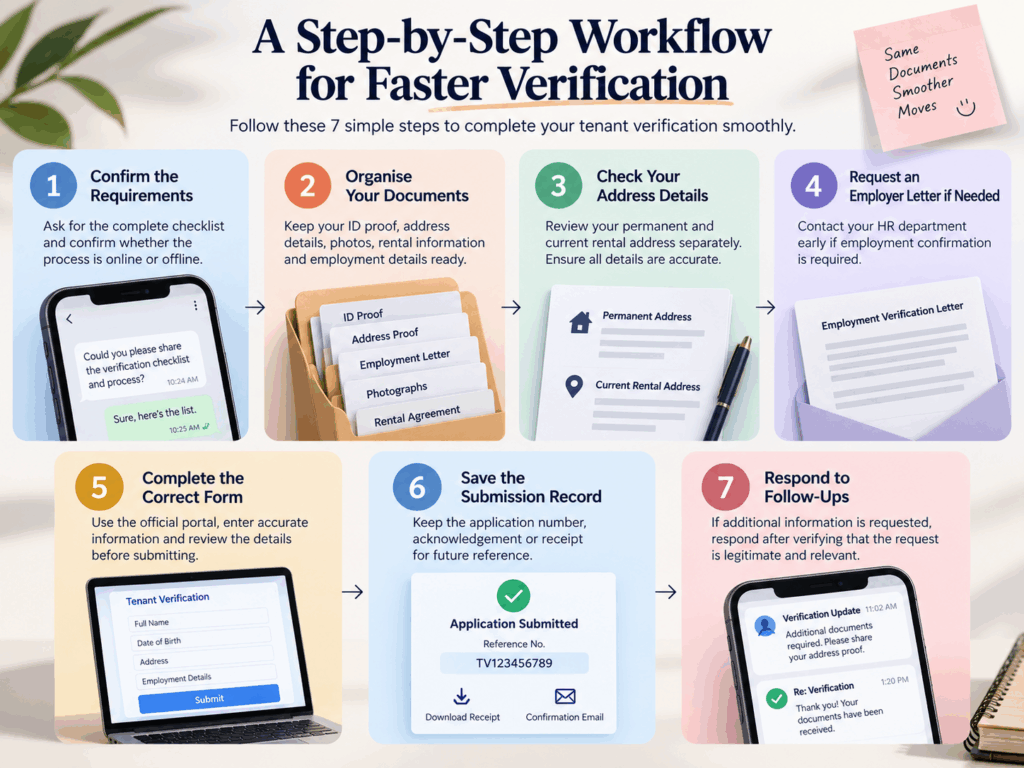
A Step-by-Step Workflow for Faster Verification
A structured workflow can help working professionals complete tenant verification without repeated delays. The process should begin before move-in and continue until the required information has been submitted and recorded.
Step 1: Confirm the Requirements
Ask the landlord or property manager for the complete verification checklist. Confirm whether the property follows an online or offline process.
This step prevents confusion about documents, responsibilities, and submission methods.
Step 2: Organise Your Documents
Keep identity proof, address details, photographs, rental information, and employment details ready. Check the documents for clarity and consistency before sharing them.
A secure digital folder can help keep the records organised. Avoid storing sensitive documents across multiple personal devices or unrelated messaging conversations.
Step 3: Check Your Address Details
Review the permanent address and current rental address separately. Ensure that the property address includes all relevant details.
If you have recently relocated, ask whether previous address information is required. Do not replace the permanent address with the rental address unless the form specifically asks for the current address.
Step 4: Request an Employer Letter if Needed
Contact your HR department early if the landlord or authority requires employment confirmation. Share the purpose of the request and ask whether the company has a standard format.
This reduces the possibility of last-minute delays during onboarding.
Step 5: Complete the Correct Form
Use the official portal or submission process identified for the property. Enter information carefully and check the details before submitting the form.
Avoid copying information from old applications without reviewing it. Address, employment, and contact details may have changed.
Step 6: Save the Submission Record
Retain the application number, acknowledgement, email, or receipt provided after submission. These records can help when following up on pending verification.
A completed form should not automatically be treated as completed verification. The tenant or landlord should confirm the status through the appropriate channel.
Step 7: Respond to Follow-Ups
If additional information is requested, respond after confirming that the request is legitimate and relevant. Delayed responses can extend the overall processing time.
A clear record of pending requirements makes follow-up easier for both tenants and property managers.
Common Mistakes That Delay Employee Tenant Verification
Many verification delays occur because of small administrative mistakes. These issues can become more difficult when the tenant has already moved into the property or is unavailable during working hours.
Some common mistakes include:
- Incomplete addresses: Missing locality, district, state, or PIN code information can make the property or residential history difficult to identify.
- Name mismatches: Differences between the verification form and identity document may lead to additional questions or corrections.
- Unclear document copies: Blurred scans, cropped images, or unreadable documents can delay the review process.
- Incorrect property information: The tenant’s details must be connected to the correct rental property, room, or unit. This is especially important in PGs and shared accommodation.
- Unconfirmed employer requirements: Employees may spend time requesting documents that are not required. They should confirm the need for an employer letter before approaching HR.
- No proof of submission: Without an acknowledgement or application number, it can be difficult to establish whether the form was submitted successfully.
- Unsecured document sharing: Sending identity documents to multiple unverified recipients can create privacy risks. Tenants should confirm the legitimacy of the receiving party.
A reliable process should focus on accuracy and accountability. Completing verification quickly is useful, but the information must remain correct and properly recorded.
For additional information, read RentOk’s How to Spot a Fake ID During Tenant Verification. The article explains why document collection alone is not enough and why structured verification practices matter.
Tenant Verification Should Be Part of the Move-In Process
Verification should not be treated as a task that begins only after a tenant has occupied the property. It should form part of the overall onboarding process.
When documentation is collected early, tenants understand their responsibilities before moving in. Property managers also gain enough time to check information and identify missing documents.
A professional onboarding process should connect several activities:
- Tenant information collection
- Identity and document checks
- Rental agreement completion
- Verification submission
- Move-in coordination
- Record maintenance
This approach is especially useful for PGs, hostels, and co-living operators. These properties may manage several move-ins within a short period. Manual processes can make it difficult to track which tenants have submitted their documents and which applications remain pending.
A structured system improves visibility. Staff members can identify incomplete records and follow up with the right tenant instead of checking multiple spreadsheets or messaging conversations.
Tenant experience also improves when the process is explained clearly. A resident is more likely to trust the property management team when documentation requests are organised, transparent, and consistent.
For a broader perspective on digital documentation, explore RentOk’s How to Maintain Tenant KYC Records Digitally. It discusses the importance of organised tenant records and the limitations of scattered manual files.
How RentOk Helps Working Professionals With Tenant Verification
RentOk helps property owners and managers organise tenant onboarding and rental operations through a digital platform. By bringing tenant information into a structured system, it can reduce dependence on scattered documents, spreadsheets, and repeated manual follow-ups.
During onboarding, property teams can collect and maintain relevant tenant details. This makes it easier to access information when documentation or verification-related tasks need to be completed.
RentOk’s tenant management workflows can also support better visibility into tenant records and pending information. Instead of relying entirely on individual employees to remember each step, property managers can follow a more consistent process across residents.
This is useful for PGs, hostels, and co-living properties with frequent move-ins. As the number of tenants increases, manual record management becomes more difficult. A centralised digital workflow can help teams organise information and reduce administrative confusion.
RentOk does not replace the requirements of local police authorities. Tenants and property managers must still follow the applicable verification procedure. However, a structured platform can make the surrounding onboarding and documentation process easier to manage.
For property owners, the objective is simple: collect accurate information, track pending requirements, maintain records, and make verification part of a consistent tenant onboarding workflow.
Conclusion: Complete Tenant Verification Without Unnecessary Delays
Working professionals can make tenant verification easier by preparing their documents before move-in. Accurate identity details, complete addresses, timely employer communication, and knowledge of the local process can reduce avoidable delays.
Online verification may offer greater convenience, but tenants should always follow the requirements of the relevant authority. They should also retain submission records and share personal information only through legitimate channels.
For landlords and property managers, a structured onboarding process creates better visibility and reduces dependence on manual follow-ups. When tenant verification becomes part of everyday property operations, the process becomes easier to repeat and manage.
Looking for a smoother rental experience? Verify Fast and Find Rentals on RentOk to simplify your search and make your next move more organised.
Frequently Asked Questions
Find answers to common questions about this topic
About the Author
Ishika Pannu
Ishika Pannu brings you the latest insights and easy-to-apply strategies in property management—helping you simplify renting and grow with RentOk.
You may also like these
Related Articles

1 min read
Why Rent Agreement Rules Are Different in Every Indian State
Written by
Posted on
Ishika Pannu
Sep 17, 2026
1 min read
Student Tenant Verification: A Guide Before Moving Into a PG
Written by
Posted on
Ishika Pannu
Sep 16, 2026

1 min read
New UPI MDR Rule: What It Means for Rent Payments
Written by
Posted on
Ishika Pannu
Sep 16, 2026
1 min read
What Happens If You Break Your Rent Agreement Before the Lock-In Period?
Written by
Posted on
Ishika Pannu
Sep 14, 2026
1 min read
How Foreign Nationals Can Rent Property in India (Verification Guide)
Written by
Posted on
Ishika Pannu
Sep 14, 2026
1 min read
How Rent Increases Work in India and When They’re Illegal
Written by
Posted on
Ishika Pannu
Sep 11, 2026
1 min read
What Documents Do You Need for Tenant Police Verification?
Written by
Posted on
Ishika Pannu
Sep 10, 2026
1 min read
Why You Should Always Insist on a Registered Rent Agreement
Written by
Posted on
Ishika Pannu
Sep 10, 2026
1 min read
What Is the Legal Notice Period Before Vacating a Rented Property?
Written by
Posted on
Ishika Pannu
Sep 9, 2026

1 min read
Delhi’s Proposed PG Regulations: What Owners Need to Know
Written by
Posted on
Ishika Pannu
Sep 9, 2026
Stay ahead in property management with expert insights
Join thousands of property managers receiving exclusive tips delivered straight to your inbox.
Browse posts by category
Case Study
Cost of Living
Growth
Legal
Market Trends
News
Pg owner app
Property Management
Property Tax
Tech
RentOk
The easiest way to rent and manage your PGs and hostels.
Get the app


Contact us
hello@eazyapp.tech
HQ Office
COGROW, BASEMENT F-12/8A
BESIDE HOUSE OF STYLE SALON, SECTOR 28, DLF PHASE 1
GURUGRAM, HARYANA - 122002
South India Office
LUMIODESK COWORKING, 2ND FLOOR, 40, 14TH MAIN RD
BESIDE MC DONALD, 7TH SECTOR, HSR LAYOUT
BENGALURU, KARNATAKA - 560102
©️ 2026 EazyApp Tech Pvt Ltd. All rights reserved


