Market Trends
The Cost of Vacancy: How to Calculate and Minimize Unoccupied Room Loss

Written by
Ishika Pannu
Read Time
9 min read
Posted on
April 28, 2026
Overview
Overview
The Cost of Vacancy: How to Calculate and Minimize Unoccupied Room Loss
Vacancy in a PG is often misunderstood because it rarely presents itself as an urgent or visible problem. A bed remains empty for a few days, a room takes slightly longer than expected to fill, and the assumption is that this is simply part of the business cycle. Most operators accept it as a normal fluctuation rather than something that needs to be actively controlled.
That assumption is where the real loss begins.
Vacancy is not a one-time gap. It is a recurring operational inefficiency that compounds over time and directly affects profitability. The issue is not just that a room is empty—it is that during this period, income stops instantly while costs continue without interruption. More importantly, these gaps are rarely isolated. They occur repeatedly across rooms, across months, and across tenant cycles, quietly eroding revenue without being clearly tracked.
The difference between a PG that performs well and one that consistently struggles with margins is not demand. It is how seriously vacancy is understood, measured, and managed.
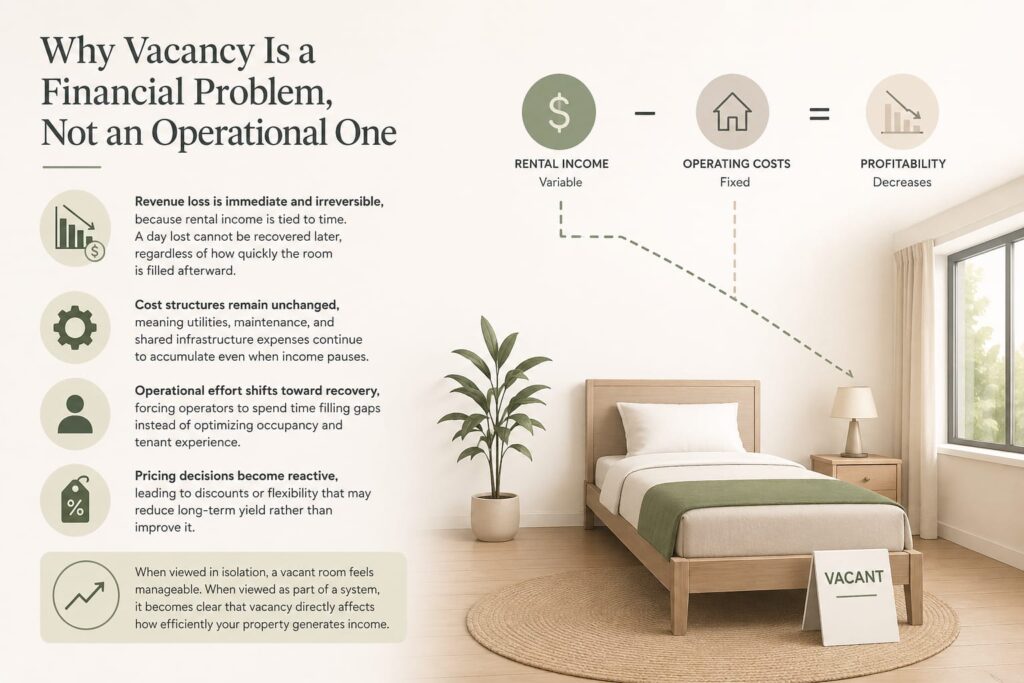
Why Vacancy Is a Financial Problem, Not an Operational One
Most landlords instinctively categorize vacancy as an operational issue, something related to marketing, tenant acquisition, or timing. While those factors play a role, they are not the core problem. Vacancy is fundamentally a financial inefficiency, because it disrupts the balance between predictable costs and variable income.
When a room remains unoccupied, the impact is not limited to lost rent. It creates a chain reaction across the business:
- Revenue loss is immediate and irreversible, because rental income is tied to time. A day lost cannot be recovered later, regardless of how quickly the room is filled afterward.
- Cost structures remain unchanged, meaning utilities, maintenance, and shared infrastructure expenses continue to accumulate even when income pauses.
- Operational effort shifts toward recovery, forcing operators to spend time filling gaps instead of optimizing occupancy and tenant experience.
- Pricing decisions become reactive, leading to discounts or flexibility that may reduce long-term yield rather than improve it.
When viewed in isolation, a vacant room feels manageable. When viewed as part of a system, it becomes clear that vacancy directly affects how efficiently your property generates income.
Calculating the True Cost of Vacancy
Most PG operators track occupancy as a percentage, but very few translate that percentage into actual revenue impact. Without this conversion, vacancy remains abstract and easy to ignore.
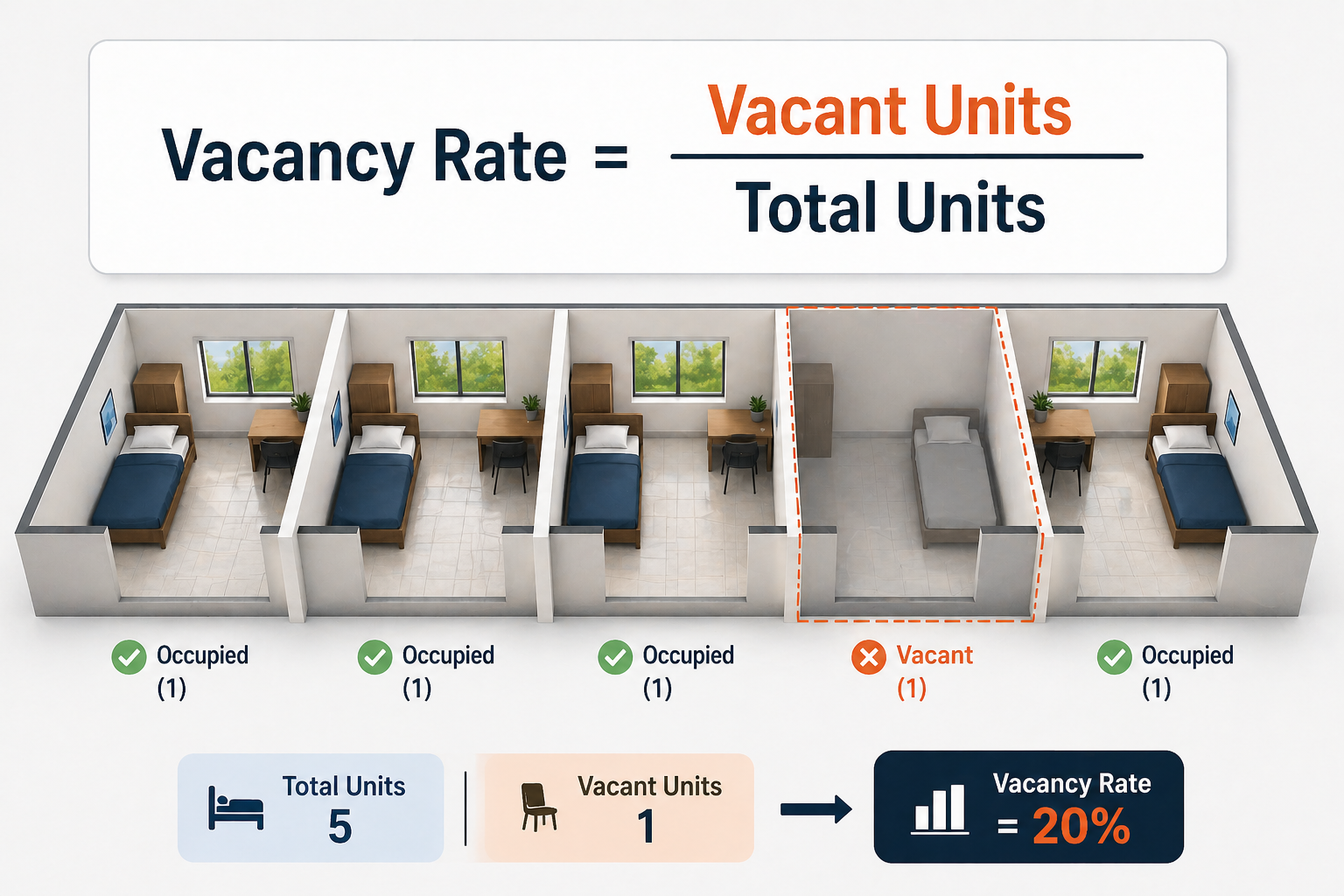
At its most basic level, vacancy rate is calculated as:
Vacancy Rate = Vacant Units \Total Units
However, this formula only provides a surface-level understanding. The real insight comes when you connect vacancy to financial performance.
Consider a PG with the following structure:
- Total capacity of 50 beds with consistent demand in the area
- 45 beds occupied at any given time, leaving 5 beds vacant
- Average rent of ₹9,000 per bed across the property
At a 10% vacancy rate, the numbers translate into:
- ₹45,000 in lost revenue every single month
- ₹5.4 lakhs in lost income over the course of a year
This is not a one-time loss. It is a recurring pattern. And this calculation assumes stable vacancy, which is rarely the case. In reality, short-term gaps between tenants, delayed move-ins, and inconsistent filling cycles increase the actual loss beyond what is immediately visible.
The key realization here is simple:
Vacancy is not a percentage metric. It is a cash flow leakage.
The Hidden Components That Increase Vacancy Loss
Vacancy is rarely caused by one large issue. It is usually the result of multiple smaller inefficiencies that accumulate over time. To manage it effectively, you need to understand its deeper structure.
Transition Gaps Between Tenants
The most common source of vacancy loss is the time between one tenant leaving and another moving in. These gaps are often ignored because they seem minor, but they occur frequently enough to create significant financial impact.
- Even a 7–10 day delay in filling a ₹9,000 room results in ₹2,000–₹3,000 in lost income per cycle, which multiplies across multiple rooms and months.
- These gaps are rarely tracked as a metric, which means operators underestimate how much revenue is being lost in transitions alone.
- Over the course of a year, short vacancy periods often contribute more to total loss than long-term empty rooms.
Discounting as a Reactive Strategy
When vacancy extends beyond expectations, the immediate response is often to reduce pricing to accelerate occupancy. While this approach may work in the short term, it introduces long-term inefficiencies.
- Lower pricing reduces the average revenue per bed, even after occupancy improves, creating a permanent impact on yield.
- It creates inconsistency in tenant expectations, making it harder to maintain pricing discipline across new and existing residents.
- Over time, pricing becomes reactive rather than strategic, driven by urgency instead of demand.
This means vacancy does not just reduce revenue, it reshapes how pricing decisions are made.
Fixed Costs That Continue Regardless of Occupancy
One of the most overlooked aspects of vacancy is that it does not reduce your cost structure. Even when a room is empty, the property continues to operate as usual.
- Utilities and shared infrastructure continue to function, contributing to overall operational costs.
- Maintenance and readiness efforts are required to ensure the room remains suitable for immediate occupancy.
- Staff and operational overheads remain unchanged, regardless of whether the property is fully occupied or partially vacant.
This creates a scenario where:
Costs remain constant, while revenue becomes inconsistent.
Missed Demand Due to Timing, Not Availability
In most PG markets, vacancy is not caused by lack of demand. It is caused by timing inefficiencies.
An empty room often represents:
- A delayed listing that could have been prepared earlier
- A missed inquiry that was not followed up in time
- A gap in visibility where availability was not clearly communicated
This reframes vacancy from being a demand problem to being a conversion problem.
Lead Time: The Metric That Controls Vacancy
Vacancy is the outcome. Lead time is the driver.
Lead time refers to the gap between when a tenant leaves and when the next tenant moves in. Most operators do not track this explicitly, which is why vacancy feels unpredictable.
In an unstructured system:
- Tenant leaves, vacancy begins, and only then does the search for a replacement start
In a structured system:
- Move-out dates are tracked in advance, allowing operators to prepare for replacement
- Marketing and tenant acquisition begin before the room becomes vacant
- Incoming tenants are aligned with expected availability, reducing downtime
The difference between these two approaches is not effort. It is timing and visibility.
Dynamic Pricing: Managing Occupancy Without Losing Control
Pricing in PGs is often treated as static, but it can be used strategically to reduce vacancy duration without compromising long-term positioning.
Dynamic pricing does not mean frequent changes. It means making controlled adjustments based on demand and timing conditions.
When used effectively, it allows operators to:
- Adjust pricing slightly during low-demand periods to reduce idle time without permanently lowering benchmarks
- Maintain premium pricing during high-demand cycles where occupancy is naturally strong
- Offer flexibility for short-term gaps without disrupting long-term pricing structure
The goal is not to maximize rent per tenant, but to maximize revenue across time by minimizing empty days.
Occupancy Forecasting: From Reactive to Predictive Management
Vacancy often feels unpredictable because it is not tracked systematically. In reality, tenant movement follows patterns influenced by external factors.
- Academic cycles create predictable inflow and outflow of students across specific months
- Job relocation trends influence demand in corporate-heavy areas
- Seasonal variations affect migration patterns and short-term stays
By analyzing these patterns over time, operators can:
- Anticipate vacancy periods instead of reacting to them
- Prepare listings and tenant pipelines in advance
- Align pricing strategies with expected demand cycles
This transforms vacancy management from reactive to predictive.
Why Vacancy Is Ultimately a Visibility Problem
Most PG operators believe vacancy is a demand issue. In reality, it is a visibility issue.
Without structured data, you cannot clearly answer:
- Which beds are currently available across the property
- Which tenants are expected to leave in the coming weeks
- How long rooms typically remain vacant before being filled
This lack of clarity leads to delayed action. And delayed action leads to vacancy.
Improving visibility improves response time. And improved response time directly reduces vacancy.
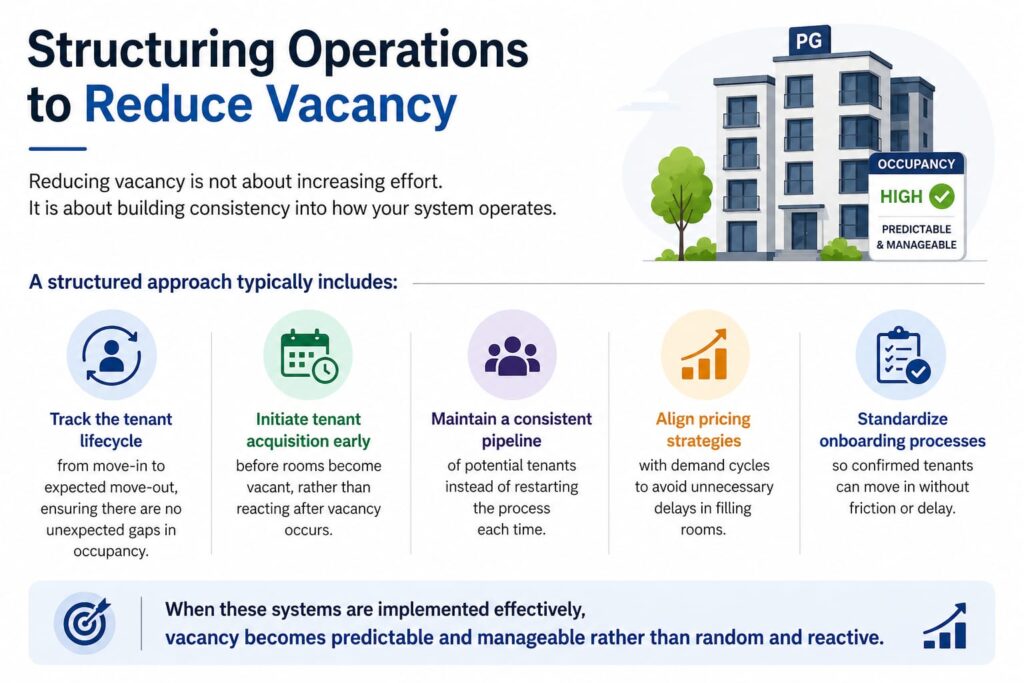
Structuring Operations to Reduce Vacancy
Reducing vacancy is not about increasing effort. It is about building consistency into how your system operates.
A structured approach typically includes:
- Tracking tenant lifecycle from move-in to expected move-out, ensuring there are no unexpected gaps in occupancy
- Initiating tenant acquisition before rooms become vacant, rather than reacting after vacancy occurs
- Maintaining a consistent pipeline of potential tenants instead of restarting the process each time
- Aligning pricing strategies with demand cycles to avoid unnecessary delays in filling rooms
- Standardizing onboarding processes so confirmed tenants can move in without friction or delay
When these systems are implemented effectively, vacancy becomes predictable and manageable rather than random and reactive.
Vacancy Calculator: Turning Observation Into Insight
To control vacancy, it must be measured consistently and translated into financial terms.
Start by tracking:
- Total number of beds within the property
- Number of occupied beds at any given time
- Average rent per bed across different room types
From this, calculate:
- Vacancy rate as a percentage
- Monthly revenue loss due to unoccupied units
- Annual financial impact of recurring vacancy
This simple exercise creates clarity. Once vacancy is expressed in numbers, it becomes easier to identify patterns, track improvements, and make informed decisions.
How Rentok Helps You Reduce Vacancy Systematically
As PG operations scale, vacancy is rarely caused by lack of demand, it is caused by fragmented information and delayed action. Data related to tenant movement, availability, and occupancy often exists across multiple channels, making it difficult to respond at the right time.
Rentok brings this entire layer into a single structured system where operators can track real-time availability, monitor upcoming move-outs, and maintain full visibility across tenant lifecycles. This allows you to anticipate vacancies before they occur, rather than reacting after revenue is already lost.
By centralizing operational data and improving clarity, Rentok reduces lead time gaps, improves response speed, and ensures that occupancy is managed proactively. Instead of relying on memory or scattered tools, you operate with a system that keeps everything aligned and predictable.
Conclusion: Vacancy Reflects System Efficiency, Not Market Demand
Vacancy is often accepted as an unavoidable part of PG operations. In reality, it reflects how well your system is structured.
When visibility is low, decisions are delayed. When decisions are delayed, rooms remain empty. And when rooms remain empty, profitability declines, consistently and quietly.
The difference between average and high-performing PGs is not demand. It is how effectively vacancy is controlled.
If you want to move from reactive occupancy management to a structured, predictable system, explore Rentok and discover how it helps you track, reduce, and control vacancy with clarity.
About the Author
Ishika Pannu
Ishika Pannu brings you the latest insights and easy-to-apply strategies in property management—helping you simplify renting and grow with RentOk.