Market Trends
What the Modern Indian Tenant (Gen Z) Actually Wants

Written by
Ishika Pannu
Read Time
8 min read
Posted on
April 28, 2026
Overview
Overview
What the Modern Indian Tenant (Gen Z) Actually Wants
For years, PG operators have approached their properties with a simple operational mindset: provide a functional room, ensure basic amenities are in place, and keep pricing competitive. If those three boxes are checked, occupancy should follow.
And for a long time, it did.
But that model is now showing visible cracks.
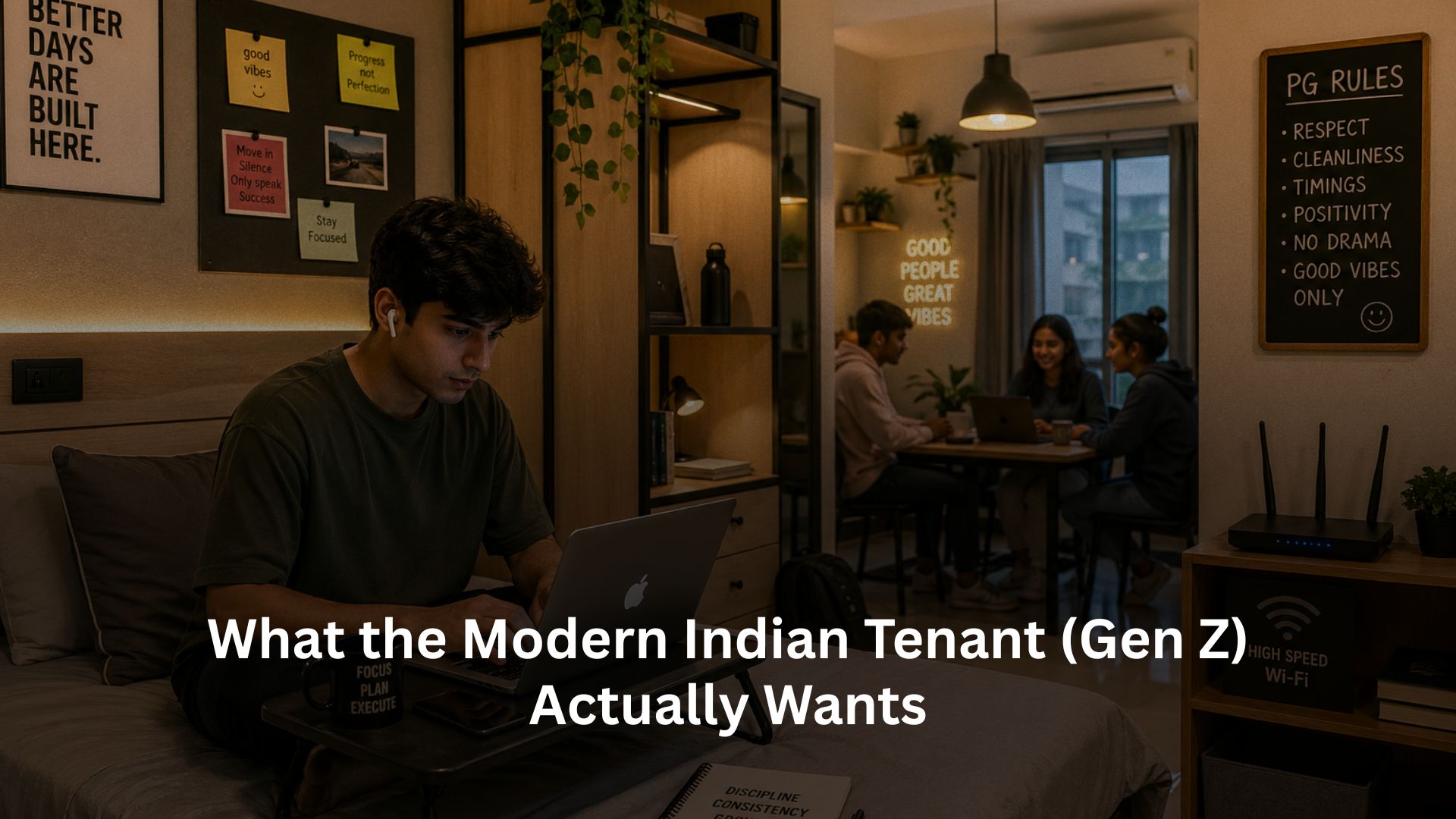
The modern Indian tenant, especially Gen Z, is no longer evaluating a PG as a static product. They are evaluating it as a living system that directly affects how their day unfolds. From how they wake up to how they work, relax, interact, and recharge, the PG is no longer just a place to stay, it’s part of their lifestyle infrastructure.
This shift is not loud, but it is decisive.
And operators who miss it often don’t realize the problem until churn starts increasing despite stable demand.
From Beds to Experiences: A Fundamental Shift in Evaluation
Traditional PG models are designed around occupancy efficiency. The goal is to maximize bed utilization while maintaining acceptable pricing and basic service delivery. This approach focuses on filling capacity, not optimizing experience.
Gen Z tenants evaluate differently.
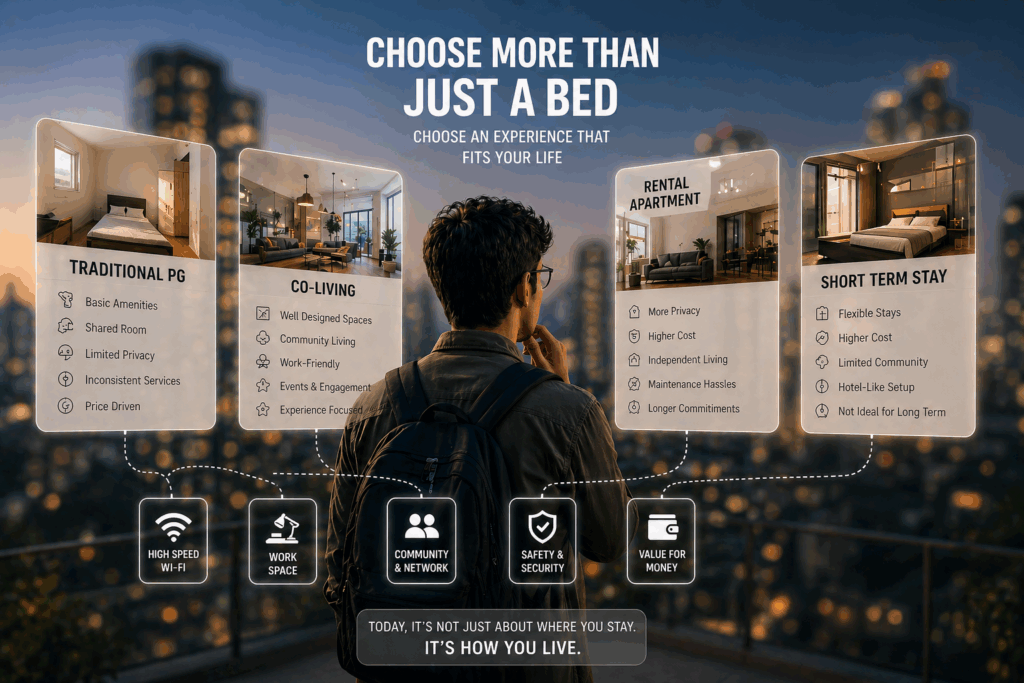
They are not asking whether a bed is available. They are assessing whether the environment supports their lifestyle without friction. This includes how seamlessly they can live, work, and interact within the space.
This shift introduces a new evaluation framework:
- Tenants are comparing not just PGs, but also co-living brands, managed rentals, and even short-term platforms that offer better structured experiences.
- Price sensitivity still exists, but it is moderated by perceived value, tenants are willing to pay more for predictability and ease.
- Retention is no longer tied to initial satisfaction; it depends on how consistently the property performs over time.
In effect, occupancy is no longer secured at move-in. It is continuously validated through daily experience.
Understanding the Gen Z Tenant Mindset
Gen Z tenants bring a fundamentally different baseline into the rental ecosystem.
They are accustomed to systems that are:
- Immediate in response and execution
- Transparent in pricing and communication
- Personalized in interaction and usage
- Digitally integrated into everyday decision-making
These are not aspirational expectations, they are normalized experiences.
When these tenants move into a PG environment that operates on manual processes, delayed responses, or unclear communication, the friction becomes immediately visible. This is not because the PG is underperforming in absolute terms, but because it is underperforming relative to the tenant’s existing reference point.
This mismatch typically results in:
- Reduced tolerance for delays, even when the issue itself is minor or occasional.
- Increased sensitivity to communication gaps, especially around payments, complaints, and policies.
- Faster decision cycles when considering relocation, often triggered by cumulative small inefficiencies rather than a single major issue.
The implication is clear:
Tenants are not adjusting their expectations downward. The system must move upward.
High-Speed Wi-Fi: The Backbone of Daily Functioning
One of the most consistent failures in PG setups is the underestimation of internet infrastructure.
Wi-Fi is often positioned as an amenity. For Gen Z tenants, it is core infrastructure, as critical as electricity or water.
Its importance is not limited to entertainment. It underpins:
- Remote work, internships, and freelance opportunities
- Academic commitments, online courses, and skill development
- Communication, collaboration, and social connectivity
When connectivity fails, the impact is immediate and multi-dimensional.
A poorly structured system results in:
- Bandwidth congestion during peak hours, affecting productivity
- Frequent interruptions that disrupt work or study sessions
- Increased frustration that quickly translates into negative perception
A reliable setup requires deliberate planning:
- Bandwidth allocation aligned with occupancy levels and usage patterns
- Network distribution that prevents concentration of load in specific areas
- Quick resolution mechanisms to minimize downtime
The key distinction is not availability.
It is consistency without intervention.
Privacy: Defined Space Within Shared Environments
Gen Z tenants are comfortable with shared living, but they are not comfortable with undefined boundaries.
Privacy, in this context, is not about isolation. It is about control within a shared system.
This expectation manifests in practical ways:
- Clearly defined storage areas that prevent overlap and confusion
- Reasonable occupancy per room, avoiding overcrowding that reduces comfort
- Respect for personal routines within shared spaces, including noise and usage boundaries
When these elements are not structured, the experience becomes unpredictable.
Tenants begin to feel:
- Disrupted by others’ routines
- Unable to maintain their own schedules effectively
- Less connected to the space as a personal environment
Over time, this leads to disengagement.
Privacy, therefore, is not a premium offering. It is a stability requirement.
Common Areas: Designed for Use, Not Just Presence
Common areas are often included as a checkbox feature rather than a functional component of the property.
Gen Z tenants assess these spaces based on usability.
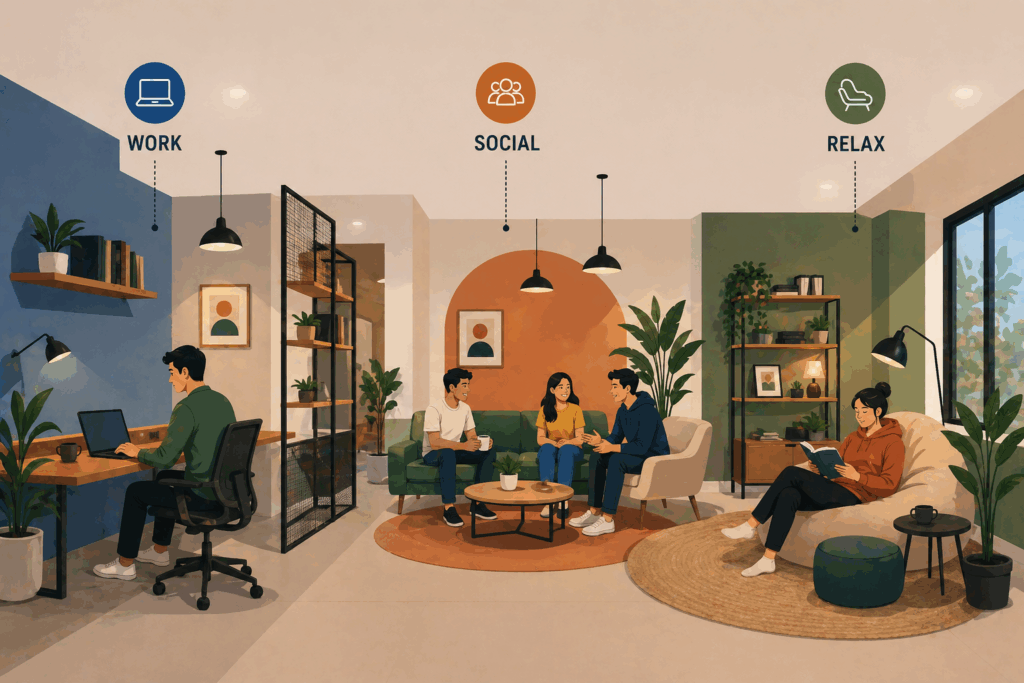
A functional common area is expected to support multiple use cases without requiring adaptation from the tenant:
- Workspaces that allow focused activity without constant disturbance
- Social zones that enable interaction without forcing participation
- Relaxation areas that provide a mental shift from private rooms
To achieve this, design must prioritize:
- Layout efficiency that supports movement and interaction
- Comfortable seating that encourages longer use rather than temporary occupancy
- Lighting and environment that adapt to both work and leisure
When these elements are aligned, common areas contribute significantly to:
- Increased time spent within the property
- Improved social interaction among tenants
- Higher perceived value without structural changes to pricing
Convenience: The Core Metric of Modern Living
Convenience is not an additional benefit in modern PGs. It is the central metric that defines experience.
Tenants expect everyday interactions to be effortless, predictable, and clear.
This includes:
- Onboarding processes that are structured, quick, and transparent
- Payment systems that eliminate confusion and reduce manual follow-ups
- Complaint handling that does not require repeated escalation
- Access to services that does not involve multiple steps or uncertainty
When convenience is missing, friction accumulates.
That friction does not always result in immediate complaints. Instead, it creates a background dissatisfaction that gradually reduces retention.
When convenience is present, the opposite happens:
- Daily life feels smoother
- Interactions require less effort
- The property feels more reliable
This is what defines a modern living experience.
Communication: The System That Holds Everything Together
Communication is often underestimated because it does not appear as a physical feature.
In reality, it is the layer that connects every operational component.
Gen Z tenants expect communication to be structured, not reactive.
This means:
- Payment updates should be visible without requiring confirmation
- Complaint statuses should be trackable without repeated follow-ups
- Policies and changes should be communicated clearly and proactively
When communication is inconsistent, tenants fill gaps with assumptions. These assumptions tend to skew negative, even when operations are functioning reasonably well.
Strong communication creates:
- Predictability in interactions
- Trust in the system
- Reduced need for manual follow-ups
It is not just about information flow. It is about confidence in the system.
Cleanliness and Maintenance: Consistency as a Signal of Control
Cleanliness is rarely highlighted as a differentiator, but it is one of the strongest indicators of operational quality.
Gen Z tenants expect:
- Regular cleaning schedules that are followed without variation
- Maintenance issues to be resolved within defined timelines
- Common areas to be maintained with the same consistency as private spaces
The critical factor here is consistency.
Occasional lapses signal a lack of control. Once that perception is formed, it affects how tenants interpret every other aspect of the property.
Maintenance delays, in particular, create a strong negative signal because they directly impact daily comfort and functionality.
Flexibility: Aligning with a More Dynamic Tenant Base
Gen Z tenants operate with higher mobility.
They:
- Transition between jobs and cities more frequently
- Prefer shorter commitment cycles
- Value adaptability in living arrangements
This creates an expectation for flexibility in PG systems.
Key areas include:
- Notice periods that are reasonable and clearly defined
- Exit processes that are transparent and not unnecessarily restrictive
- Onboarding and offboarding that do not involve excessive friction
Rigid systems, even if well-structured, feel outdated in this context.
Flexible systems, on the other hand, align with how tenants plan and adapt their lives.
Where Most PGs Fall Behind
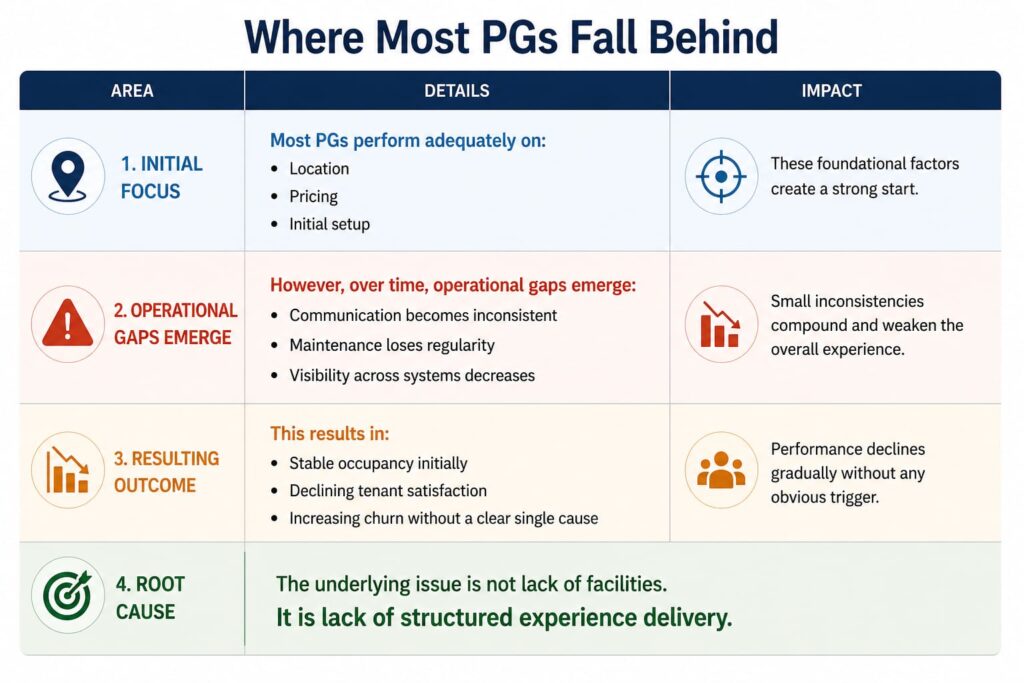
The gap between expectation and delivery is rarely immediate. It builds gradually through small inconsistencies.
Most PGs perform adequately on:
- Location
- Pricing
- Initial setup
However, over time, operational gaps emerge:
- Communication becomes inconsistent
- Maintenance loses regularity
- Visibility across systems decreases
This results in:
- Stable occupancy initially
- Declining tenant satisfaction
- Increasing churn without a clear single cause
The underlying issue is not lack of facilities.
It is lack of structured experience delivery.
How Rentok Helps You Deliver a Consistent Tenant Experience
As expectations increase, manual systems struggle to keep up with the complexity of operations. What begins as manageable quickly becomes fragmented, with communication scattered, records inconsistent, and processes dependent on memory.
Rentok addresses this by introducing structure into everyday operations.
With Rentok, you can:
- Maintain centralized and organized tenant records, ensuring clarity at every stage of the tenant lifecycle
- Track complaints and service requests through a structured workflow, reducing delays and missed follow-ups
- Monitor rent payments and dues with complete visibility, eliminating confusion and improving consistency
- Standardize communication so that updates, reminders, and information are delivered clearly and on time
This transforms operations from reactive to predictable.
Instead of relying on multiple tools and manual coordination, the system becomes:
- Connected
- Transparent
- Consistent
And that consistency is what modern tenants value most.
Conclusion: Experience Is Now the Baseline, Not the Advantage
The modern Indian tenant is not asking for luxury. They are asking for alignment, between how they live in other systems and how they live in your property.
PGs that continue to operate as basic accommodation providers will find it increasingly difficult to retain tenants. Those that evolve into structured, experience-driven environments will see stronger engagement, higher retention, and more stable occupancy.
The shift does not begin with adding more features. It begins with improving how your existing system works.
Explore RentOk to understand how structured operations can help you deliver a modern, consistent tenant experience, one that meets expectations, reduces friction, and keeps your property competitive in a changing market.
About the Author
Ishika Pannu
Ishika Pannu brings you the latest insights and easy-to-apply strategies in property management—helping you simplify renting and grow with RentOk.