Property Management
How to Onboard a New Tenant in Under 10 Minutes

Written by
Ishika Pannu
Read Time
13 min read
Posted on
July 4, 2026
Overview
Overview
How to Onboard a New Tenant in Under 10 Minutes
Moving a new tenant into your PG or co-living property should feel like the beginning of a smooth experience, not the start of endless paperwork, missed documents, and back-and-forth communication. Yet for many property managers, tenant onboarding remains one of the most time-consuming administrative tasks of the entire tenant lifecycle.
The problem isn’t that onboarding is complicated. It’s that the process is often scattered. Tenant details are collected on WhatsApp, identity documents arrive over email, payments are tracked in spreadsheets, agreements are prepared separately, and room allocations are updated manually. Every additional platform adds another opportunity for mistakes, delays, and miscommunication.
As occupancy grows, these small inefficiencies quickly become operational challenges. What may take ten minutes for one tenant can stretch into hours when you’re onboarding multiple residents in a single day. More importantly, incomplete onboarding doesn’t just create problems during move-in, it affects rent collection, complaint resolution, agreement management, and even move-out months later.
The good news is that it doesn’t have to be this way.
With a structured tenant onboarding process, property managers can complete every essential step in under ten minutes while maintaining accurate records, improving the tenant experience, and reducing manual work. The key lies in following a standardized workflow instead of treating every move-in as a separate administrative task.
Why Tenant Onboarding Is More Than Just Collecting Documents
Many operators view onboarding as a one-time formality that ends once the tenant receives the room keys. In reality, it lays the foundation for every operational process that follows.
A well-executed onboarding process ensures that tenant information is complete, payments are correctly recorded, agreements are legally documented, and property policies are communicated from day one. When these details are captured accurately, teams spend significantly less time correcting errors later.
On the other hand, rushed onboarding often leads to issues such as:
- Incomplete tenant records that require repeated follow-ups for missing ID proofs, emergency contacts, or address details whenever they’re needed later.
- Payment discrepancies because deposits, advance rent, or additional charges were recorded manually across multiple systems instead of one centralized platform.
- Agreement-related confusion when unsigned documents, incorrect move-in dates, or missing clauses create unnecessary disputes during the tenant’s stay.
- Operational delays as staff members repeatedly answer basic questions about Wi-Fi credentials, visitor policies, food timings, or house rules that could have been communicated during onboarding itself.
These aren’t isolated problems. They gradually increase the workload of your operations team and create an inconsistent experience for tenants.
Professional property managers understand that onboarding isn’t about completing paperwork quickly, it’s about setting up every future interaction for success.

What Should Be Ready Before the Tenant Arrives?
One of the biggest reasons onboarding takes longer than expected is that preparation starts after the tenant walks in. Efficient properties work differently. Most of the groundwork is completed beforehand, allowing the move-in process to focus only on verification and confirmation.
Before welcoming a new resident, ensure the following essentials are already in place:
- The room is fully prepared, including housekeeping, maintenance checks, furniture inspection, and any repairs required before handing over the space.
- Digital or physical agreements are ready for review, reducing waiting time and eliminating last-minute edits that delay the move-in process.
- Payment details have been communicated in advance, so tenants know exactly what needs to be paid, including rent, security deposits, and any additional charges.
- Property policies are clearly documented, covering visitor guidelines, curfew timings, meal schedules, parking rules, and other important operational information.
Taking these steps before the tenant arrives transforms onboarding into a verification exercise rather than an administrative marathon.
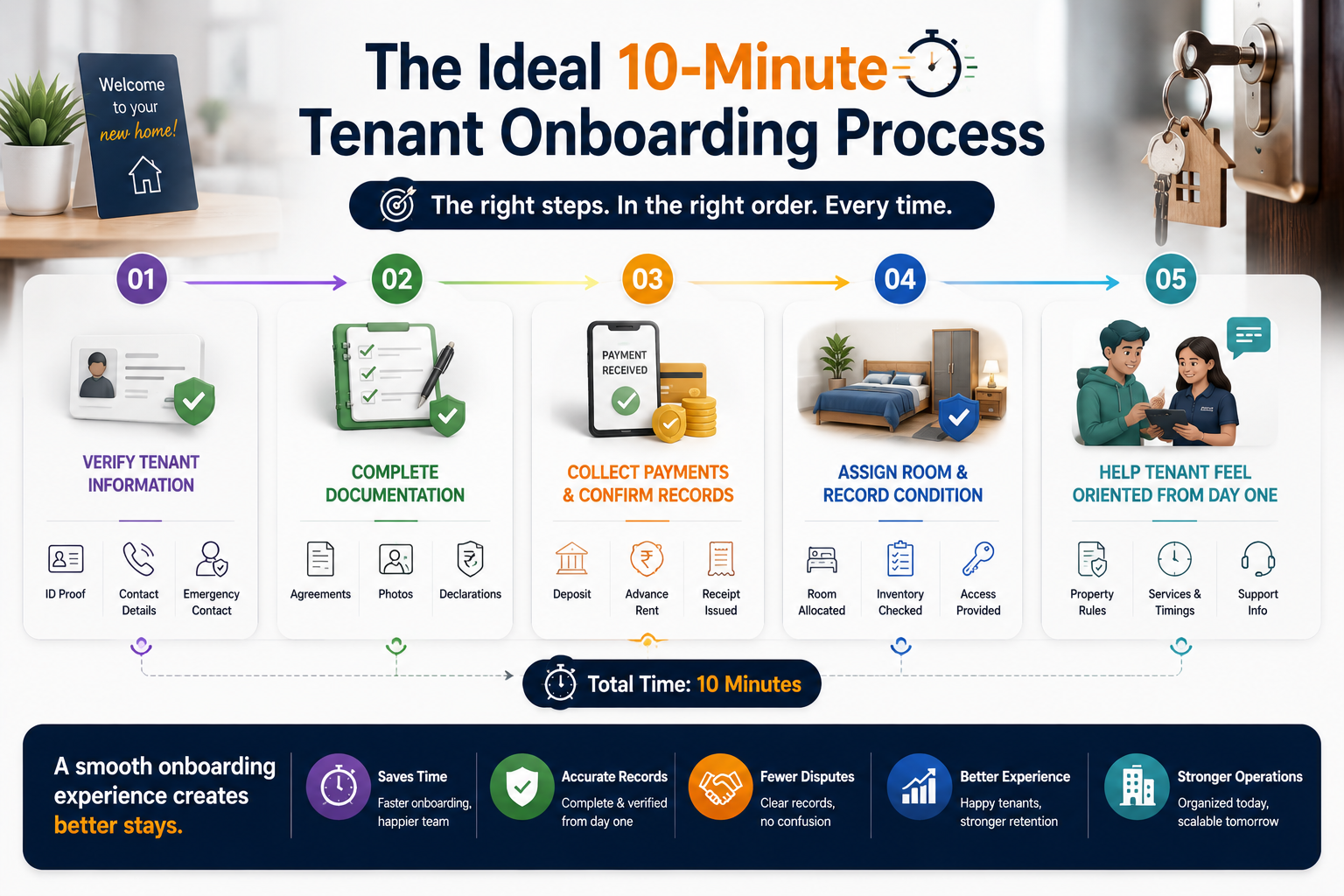
The Ideal 10-Minute Tenant Onboarding Process
An efficient onboarding workflow isn’t about skipping important steps, it’s about completing them in the right order. When every stage flows naturally into the next, property managers can significantly reduce delays without compromising accuracy.
Step 1: Verify Tenant Information
The first few minutes should focus on confirming the tenant’s identity and basic details.
Rather than collecting information across multiple conversations, ensure every essential record is verified in one go.
This typically includes:
- Government-issued identity proof such as Aadhaar, Passport, Driving Licence, or any other valid document required for verification.
- Permanent and current address details to maintain accurate tenant records and simplify future communication if required.
- Emergency contact information, ensuring the property has someone to reach in case of medical emergencies or unexpected situations.
- Basic personal details, including occupation, organisation or educational institution, contact number, and email address for official communication.
Collecting complete information at the beginning prevents repeated follow-ups and ensures your records remain accurate throughout the tenant’s stay.
Step 2: Complete Documentation Without Delays
Documentation often becomes the slowest part of onboarding, not because there are too many documents, but because they’re collected inconsistently.
Instead of requesting files over several days, create a checklist that both your team and the tenant can follow during the move-in itself.
A standard documentation process should include:
- Identity verification documents required for compliance and tenant record management.
- Signed rental agreement with clearly defined rent amount, security deposit, notice period, lock-in conditions, and property rules.
- Recent passport-size photographs, if required for tenant records, visitor management, or local authority documentation.
- Additional declarations or consent forms, depending on the property’s operational requirements and local regulations.
Once documentation is completed in a single workflow, the chances of missing paperwork reduce significantly.
Step 3: Collect Payments and Confirm Financial Records
Once the tenant’s details have been verified, the next step is to complete all financial formalities before the room is officially assigned. This is one of the most important stages of the onboarding process because payment records become the foundation for future rent collection, security deposit settlements, and financial reporting.
Unfortunately, many properties still rely on screenshots, handwritten receipts, or spreadsheet entries to track payments. While this may seem manageable for a few tenants, it quickly becomes difficult to maintain as occupancy grows. Missing receipts, incorrect entries, and delayed confirmations often create confusion for both the management and the tenant.
A standardized payment process helps eliminate these issues by ensuring every transaction is recorded accurately from the very beginning.
Before completing the onboarding, make sure you have:
- Collected the agreed security deposit and advance rent, ensuring that both amounts match the terms mentioned in the rental agreement.
- Issued a payment acknowledgement or digital receipt so the tenant has a clear record of every transaction completed during move-in.
- Recorded the payment against the tenant’s profile, making it easier to track future dues, deposits, and outstanding balances without maintaining separate records.
- Clarified recurring payment details, including monthly rent due dates, accepted payment methods, penalties for late payments, and any additional utility charges that may apply.
When financial records are documented properly from day one, future rent collection becomes far more organized, and disputes regarding deposits or pending dues are significantly reduced.
Step 4: Assign the Room and Record Its Condition
Once documentation and payments are complete, the next priority is handing over the room. While this may appear to be a simple step, it often becomes the source of avoidable disagreements during move-out if proper records are not maintained.
Instead of simply giving the tenant the keys, treat room allocation as an operational handover. This ensures both parties have a clear understanding of the room’s condition and the assets being provided.
Before the tenant settles in, take a few minutes to verify:
- The allotted room and bed number, ensuring occupancy records remain updated and no duplicate allocations occur.
- Furniture and appliance inventory, including wardrobes, study tables, mattresses, fans, air conditioners, geysers, or any other amenities available in the room.
- Existing damages or maintenance observations, which should be documented beforehand to avoid disputes when the tenant moves out.
- Access credentials, such as room keys, digital access cards, Wi-Fi passwords, or biometric registrations, depending on how your property operates.
These checks may take only a few minutes, but they save hours of investigation later when inventory or maintenance-related questions arise.
Step 5: Help the Tenant Feel Oriented From Day One
An efficient onboarding process doesn’t end after documents are signed and payments are collected. A tenant who is unfamiliar with your property’s daily operations is likely to have the same questions repeatedly over the next few days.
This is why onboarding should also include a short orientation that helps residents settle in quickly and confidently.
Rather than expecting tenants to discover everything on their own, communicate the essentials upfront.
Some of the most important topics include:
- Visitor and guest policies, including entry timings, approval procedures, and any restrictions that residents should be aware of.
- Meal schedules and food services, explaining dining hours, meal plans, and the process for reporting food-related concerns if applicable.
- Maintenance and complaint reporting, so tenants know exactly whom to contact and how issues will be resolved instead of relying on informal WhatsApp messages.
- Property rules and shared responsibilities, covering housekeeping schedules, common area etiquette, parking policies, noise guidelines, and other operational expectations.
This brief orientation not only reduces repetitive questions for your staff but also creates a more professional first impression for new residents.
Common Mistakes That Slow Down Tenant Onboarding
Most onboarding delays don’t happen because the process is inherently complex. They happen because small inefficiencies accumulate over time. What begins as a five-minute delay for one tenant can become several hours of additional work when multiple move-ins are scheduled on the same day.
Some of the most common mistakes include:
- Collecting documents across multiple platforms, forcing staff to search through WhatsApp chats, emails, and shared folders whenever information is required later.
- Preparing agreements only after the tenant arrives, leading to unnecessary waiting time and increasing the chances of last-minute corrections.
- Recording payments manually, which often results in duplicate entries, missing receipts, or reconciliation challenges during month-end accounting.
- Failing to communicate property policies clearly, causing tenants to repeatedly seek clarification about house rules, visitor access, or payment schedules after moving in.
- Maintaining separate records for different operations, making it difficult to track tenant information, occupancy, agreements, and payments from a single source.
Individually, these issues may appear minor. Collectively, however, they reduce operational efficiency, increase staff workload, and create an inconsistent onboarding experience for every new tenant.
Best Practices for Scaling Tenant Onboarding
As your property portfolio expands, onboarding cannot depend entirely on individual staff members remembering every step. Instead, it should follow a standardized process that delivers the same experience across every property and every move-in.
Successful operators typically focus on a few key practices:
- Create a fixed onboarding checklist that every team member follows, ensuring no document, payment, or verification step is overlooked.
- Digitize routine administrative tasks wherever possible, reducing manual paperwork while improving the accuracy of tenant records.
- Maintain centralized tenant information, allowing agreements, payments, occupancy details, and communication history to remain connected in one place.
- Review and refine the onboarding process regularly, identifying bottlenecks and improving workflows as occupancy grows and operational requirements evolve.
A standardized onboarding process doesn’t just save time, it creates consistency. Whether you’re welcoming five tenants a month or fifty, every resident receives the same professional experience while your team spends less time on repetitive administrative work.
Streamline Every Move-In With a Standardized Process
As your property grows, tenant onboarding stops being just another administrative task, it becomes an operational system that directly impacts occupancy, staff productivity, and tenant satisfaction. The more consistent your onboarding process is, the easier it becomes to manage every stage of the tenant lifecycle.
This is why successful PGs and co-living operators rely on standardized workflows instead of handling every move-in differently. When every tenant follows the same onboarding journey, your team spends less time correcting mistakes and more time delivering a better living experience.
A well-designed onboarding process also creates long-term operational benefits that often go unnoticed during the move-in itself.
Some of the biggest advantages include:
- Improved record accuracy, as every tenant profile contains verified documents, payment history, agreement details, and emergency contacts from the very beginning. This reduces the need for repeated follow-ups and keeps information readily available whenever required.
- Faster day-to-day operations, because staff members no longer need to search through WhatsApp conversations, spreadsheets, or physical files to retrieve tenant information. Everything follows a structured workflow.
- Greater financial transparency, with rent payments, security deposits, and additional charges linked directly to each tenant’s records. This simplifies accounting while reducing the chances of payment disputes later.
- A better tenant experience, as residents receive consistent communication, clear expectations, and a professional onboarding journey that builds trust from the first day of their stay.
When onboarding becomes a repeatable process rather than an improvised task, every future operation, from rent collection to move-out, becomes easier to manage.
Continue Building Better Tenant Operations
Tenant onboarding is only one part of effective property management. Once residents move in, maintaining organized operations becomes equally important for delivering a seamless living experience.
If you’re looking to strengthen other aspects of your rental business, you may also find these resources helpful:
- How to Manage Tenant Agreements Efficiently – Learn how standardized agreements help reduce disputes, improve compliance, and simplify move-in and move-out processes.
- Best Communication Channels for Property Management – Explore how structured communication improves rent collection, complaint resolution, operational visibility, and tenant satisfaction across growing properties.
- Managing Tenant Lock-in Periods Without Conflict – Understand practical ways to handle notice periods, early exits, and security deposits while maintaining positive tenant relationships.
- Building a Referral Program: Turn Your Tenants into Your Sales Team – Discover how better tenant experiences naturally encourage referrals and reduce customer acquisition costs.
Together, these operational practices help create a rental business that is easier to manage, easier to scale, and more consistent for both property managers and tenants.

How RentOk Helps Simplify Tenant Onboarding
Managing tenant onboarding manually becomes difficult as occupancy grows. Documents get scattered across multiple platforms. Payments are tracked separately. Agreements require repeated follow-ups, and room allocations often rely on manual coordination. What begins as a simple process for a few tenants can quickly become an operational bottleneck.
RentOk brings every stage of the onboarding journey into a single, connected workflow. Instead of switching between spreadsheets, messaging apps, and paperwork, property managers can complete the entire onboarding process from one platform.
With RentOk, you can:
- Collect and organize tenant information digitally. Documents, contact details, emergency information, and KYC records stay securely linked to every tenant profile.
- Generate and manage rental agreements efficiently. This reduces manual paperwork while keeping records accurate and easy to access.
- Record security deposits, rent payments, and other charges automatically. Your team gets complete visibility into every financial transaction from the day a tenant moves in.
- Assign rooms and update occupancy instantly. This minimizes manual errors and keeps occupancy records accurate at all times.
- Centralize tenant records, payments, agreements, and operational information. Future tasks such as rent collection, complaint management, renewals, and move-outs become much easier to manage.
As your property grows, these structured workflows reduce administrative effort. They improve operational visibility and create a more professional onboarding experience for every new resident.
Conclusion
A fast tenant onboarding process isn’t about rushing paperwork, it’s about creating a structured system that captures the right information at the right time. When documentation, payments, agreements, room allocation, and tenant communication follow a standardized workflow, property managers spend less time handling administrative issues and more time focusing on delivering a better living experience.
The most successful PGs and co-living businesses understand that onboarding is the first step in building efficient property operations. A few extra minutes spent creating accurate records today can save hours of manual work, reduce disputes, and improve tenant satisfaction throughout the entire tenancy.
Want to see how a complete tenant onboarding process can be completed in under 10 minutes? Watch the RentOk demo to explore how digital onboarding, tenant management, agreement creation, payment tracking, and occupancy management come together in one seamless workflow.
About the Author
Ishika Pannu
Ishika Pannu brings you the latest insights and easy-to-apply strategies in property management—helping you simplify renting and grow with RentOk.