Property Management
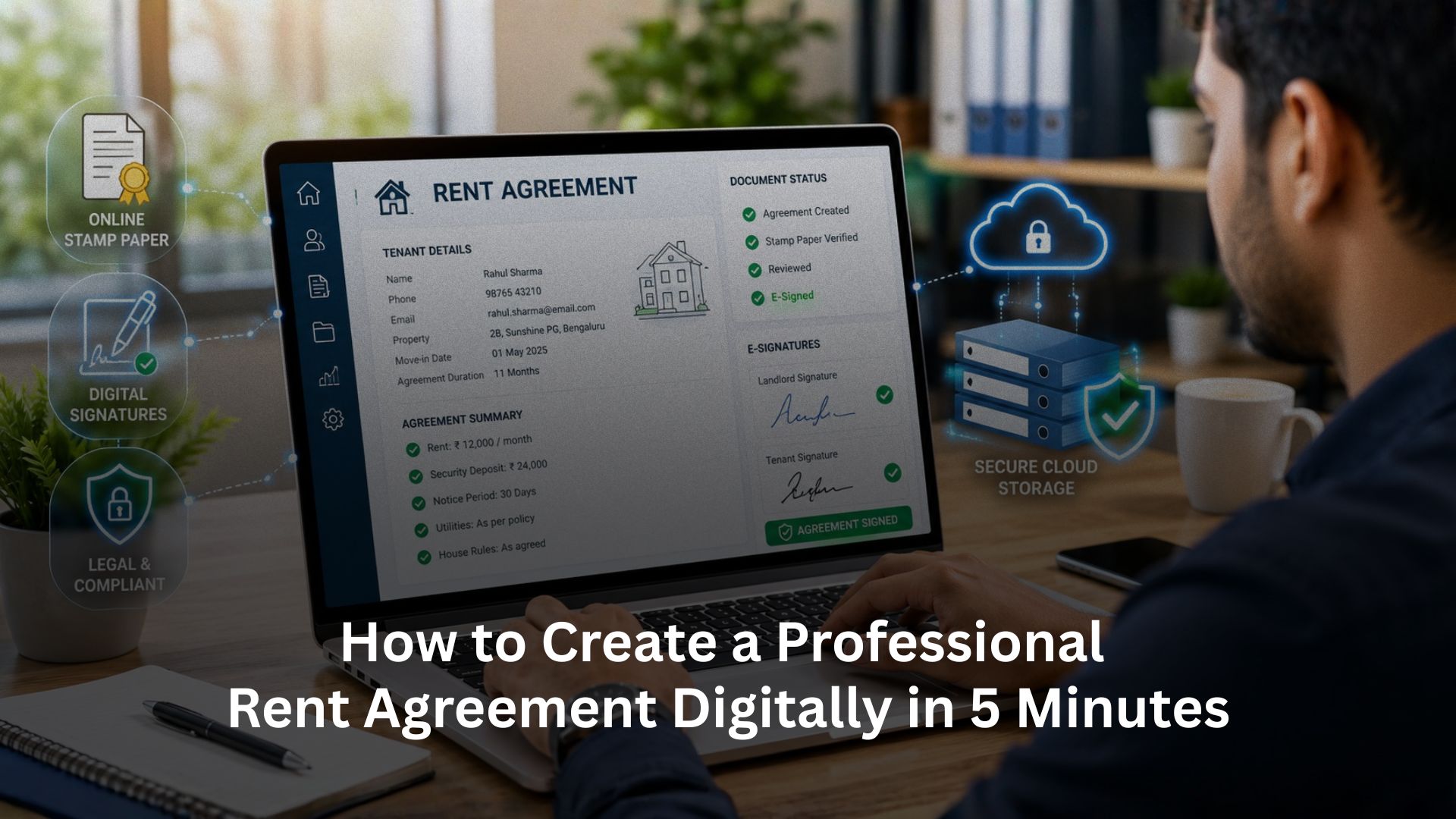
How to Create a Professional Rent Agreement Digitally in 5 Minutes

Written by
Ishika Pannu
Read Time
13 min read
Posted on
June 14, 2026
Overview
Overview
How to Create a Professional Rent Agreement Digitally in 5 Minutes
A rent agreement is often treated as a routine document in the rental business. A tenant moves in, signatures are collected, a copy is shared, and the process is considered complete. But experienced property operators know that the real value of a rent agreement is not visible on the day it is signed. Its importance becomes clear months later when questions arise around deposits, notice periods, rent dues, property rules, or early exits.
In many cases, disputes are not caused by bad tenants or unreasonable landlords. They happen because expectations were never documented clearly. A clause was missing, a policy was communicated verbally, or an old template was reused without considering the specific requirements of the property. What starts as a small misunderstanding can quickly turn into an operational issue that consumes valuable management time.
This is one of the reasons why professionally managed PGs, hostels, co-living spaces, and rental properties are moving toward digital agreement systems. The shift is not simply about reducing paperwork. It is about creating standardized, legally structured, and easily accessible documentation that supports the day-to-day realities of property management.
Today, creating a professional online rent agreement in India can take just a few minutes when the right process is in place. More importantly, digital agreements help operators maintain consistency, improve compliance, and reduce documentation-related confusion as occupancy grows.
Why Traditional Rent Agreements Create Problems Later
Most agreement-related issues do not appear during onboarding. They surface when a tenant wants to move out earlier than expected, disputes a deduction, requests a refund, or claims they were never informed about a particular rule.
The challenge is that many rental businesses still rely on locally drafted agreements that were created years ago and modified repeatedly over time. While these agreements may appear sufficient on the surface, they often fail to address the operational realities of modern rental properties.
For example, a residential rental agreement designed for a family renting an apartment may not adequately cover visitor policies, room-sharing arrangements, maintenance responsibilities, or utility billing structures that are common in PGs and co-living spaces.
Some of the most common weaknesses found in traditional agreements include:
- Generic clauses copied from older templates that fail to address practical issues such as notice periods, lock-in durations, utility charges, or occupancy rules specific to managed rental properties.
- Inconsistent documentation practices where different tenants receive slightly different agreement versions, creating confusion when policies need to be enforced uniformly.
- Dependence on physical paperwork that becomes difficult to retrieve during renewals, audits, move-outs, or disputes because records are stored across multiple locations.
- Missing operational policies that are explained verbally during onboarding but never formally documented, leaving room for misunderstandings later.
These problems may seem manageable when occupancy is low. However, as properties scale, even minor documentation gaps can create significant administrative challenges. Property managers spend more time clarifying rules, locating documents, and resolving avoidable disputes instead of focusing on growth and operations.
This is why successful rental businesses increasingly view agreements as operational tools rather than simple legal formalities. A well-structured agreement creates clarity, improves consistency, and helps both landlords and tenants operate with clear expectations from the very beginning.

What Defines a Professional Rent Agreement Today?
A professional rent agreement is not defined by the number of pages it contains. It is defined by how effectively it protects all parties while supporting efficient property operations.
The expectations of tenants have changed significantly over the last few years. They expect faster onboarding, transparent communication, digital access to documents, and clearly documented policies. Property owners, on the other hand, need agreements that reduce risk while making management easier.
A modern agreement should create a clear framework for the entire tenancy period rather than simply documenting a rental transaction.
Strong agreements typically include:
- Clear financial terms covering rent amounts, due dates, security deposits, penalties for delayed payments, and any additional recurring charges that tenants are expected to pay.
- Defined occupancy policies that explain notice periods, lock-in requirements, guest rules, property usage guidelines, and responsibilities shared between management and residents.
- Operational protection clauses that address damages, maintenance responsibilities, dispute resolution procedures, and situations where the agreement may need to be terminated.
- Complete identity and compliance records that help maintain proper documentation standards while reducing risks associated with incomplete tenant information.
Just as importantly, professional agreements are standardized. Every tenant should receive documentation that follows the same structure, uses the same policy language, and maintains the same compliance standards.
Consistency becomes particularly important in properties with frequent tenant turnover. Without it, operational decisions become dependent on individual interpretations rather than documented policies.
Professional operators understand that agreements are not simply about legal protection. They are also about creating predictable systems that support smoother onboarding, better communication, and more organized property management.
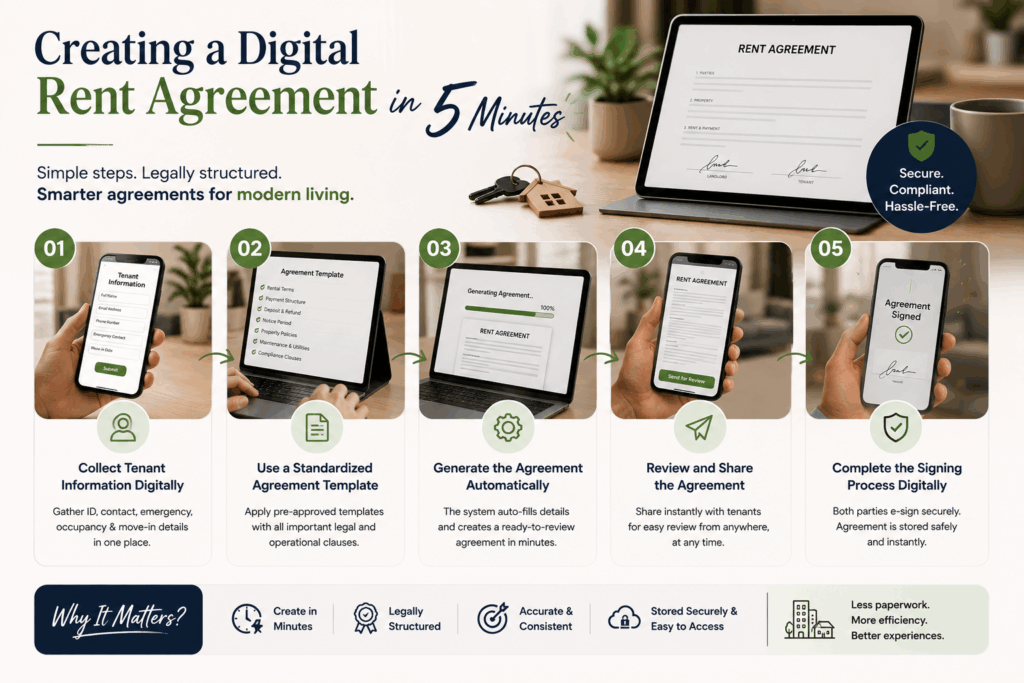
Creating a Digital Rent Agreement in 5 Minutes
One of the biggest misconceptions about digital lease software is that it requires complicated technical knowledge or lengthy setup processes. In reality, modern agreement creation has become remarkably simple when supported by the right workflow.
The goal is not just to generate a document quickly. The objective is to create a legally structured agreement while reducing repetitive administrative work.
Step 1: Collect Tenant Information Digitally
Every agreement begins with accurate tenant information. Instead of requesting details through multiple messages, calls, and documents, professional operators centralize the collection process from the beginning.
Essential information typically includes identification details, contact information, emergency contacts, occupancy information, and move-in dates.
When this information is collected digitally:
- Data entry errors are reduced because information is captured directly from the source.
- Supporting documents remain linked to the tenant profile instead of being stored separately.
- Agreement generation becomes significantly faster because information can be populated automatically.
- Future renewals and updates require far less manual effort.
The result is a cleaner onboarding process for both management and tenants.
Step 2: Use a Standardized Agreement Template
One of the biggest advantages of digital agreement systems is consistency.
Instead of creating a new document every time, operators can use standardized templates that already include the legal and operational clauses required for their property type. This ensures that important terms are not accidentally omitted during busy onboarding periods.
A well-designed template should include:
- Rental terms and payment structures.
- Deposit and refund conditions.
- Notice period requirements.
- Property usage policies.
- Utility and maintenance clauses.
- Compliance and identification requirements.
This approach saves time while also improving documentation quality across the entire property portfolio.
Step 3: Generate the Agreement Automatically
Once tenant information and property details have been entered, the agreement can be generated automatically.
This is where digital workflows provide significant operational advantages. Instead of manually editing documents, copying information, and checking formatting repeatedly, the system creates a ready-to-review agreement within minutes.
For property managers handling multiple move-ins every month, this eliminates a considerable amount of repetitive work.
More importantly, automated agreement generation helps maintain:
- Better document accuracy.
- Consistent formatting across tenants.
- Reduced administrative workload.
- Faster onboarding timelines.
The process becomes scalable without sacrificing professionalism.
Step 4: Review and Share the Agreement
Before signing, both parties should review the document carefully. Digital workflows make this process much easier because agreements can be shared instantly without requiring physical meetings.
This flexibility becomes especially valuable when tenants are relocating from another city or need to complete formalities before arriving at the property.
Rather than coordinating schedules for document collection and signing, operators can simply share the agreement digitally and allow tenants to review it at their convenience.
The result is a smoother onboarding experience and fewer delays during occupancy preparation.
Step 5: Complete the Signing Process Digitally
Once both parties are satisfied with the agreement, the signing process can be completed electronically.
Digital signatures have transformed agreement management because they remove one of the biggest bottlenecks in traditional documentation workflows. Property owners no longer need to print multiple copies, coordinate physical meetings, or manage stacks of paperwork.
For growing rental businesses, this creates several practical advantages:
- Agreements can be executed faster regardless of geographical location.
- Move-ins can be completed without unnecessary administrative delays.
- Documentation remains organized from the moment the agreement is finalized.
- Agreement history becomes easier to track and audit when required.
Most importantly, the process feels significantly more professional and convenient for modern tenants who increasingly expect digital-first experiences.
Are Digital Signatures and Online Stamp Papers Legally Valid in India?
One of the biggest reasons some landlords still hesitate to adopt digital agreements is uncertainty around legality. Many property owners assume that unless an agreement is printed, signed physically, and stored in a file cabinet, it may not hold the same legal value.
In reality, India’s digital ecosystem has evolved significantly over the last decade. From banking and taxation to business contracts and government services, digital documentation has become a normal part of daily operations. Rental agreements have naturally followed the same path.
Today, depending on the state and the specific transaction requirements, property owners can create agreements using online stamp paper services and digital execution workflows that simplify the entire documentation process.
However, legality is only one part of the discussion.
The bigger operational advantage is that digital agreements create a documented trail. Every version, modification, signature, and supporting document can be tracked and stored systematically, reducing the likelihood of disputes caused by missing paperwork or incomplete records.
When evaluating a digital agreement process, property owners should ensure that:
- The agreement contains all mandatory details, including tenant information, property details, financial terms, and occupancy conditions, just as a traditional agreement would.
- The signing process creates a verifiable record of acceptance so both parties can clearly demonstrate their consent to the terms outlined in the document.
- Supporting documentation such as identity proofs, payment records, and occupancy details remain linked to the agreement instead of being scattered across multiple systems.
- State-specific requirements related to stamping, registration, or documentation are reviewed carefully to ensure compliance wherever applicable.
The important thing to remember is that professional documentation is not defined by paper. It is defined by clarity, traceability, and compliance.
As rental businesses continue becoming more technology-driven, digital agreements are increasingly viewed as an operational upgrade rather than a legal shortcut.
What Legal Clauses Should Every PG and Rental Property Include?
Many agreement disputes occur because property owners focus heavily on rent and deposits while overlooking the clauses that govern everyday operations.
A tenant may understand how much rent needs to be paid each month. The confusion usually begins when questions arise about visitors, maintenance responsibilities, move-out procedures, damage recovery, or security deposit adjustments.
This is why strong agreements anticipate operational scenarios before they become problems.
Every professionally managed rental property should include clauses covering:
- Notice period requirements and move-out procedures, clearly explaining how much advance notice must be provided and how the exit process will be handled operationally.
- Security deposit terms and refund timelines, including circumstances where deductions may occur and how final settlements will be calculated.
- Utility and service charges, specifying whether expenses such as electricity, internet, housekeeping, or maintenance are included in rent or billed separately.
- Guest and visitor policies, particularly important for PGs and co-living spaces where shared living environments require additional operational controls.
- Property damage responsibilities, outlining how damages will be assessed and how repair costs may be recovered if required.
- Late payment procedures, ensuring tenants understand penalties, reminders, and escalation processes if rent payments are delayed.
- Lock-in periods and early exit conditions, where applicable, to reduce occupancy uncertainty and create clearer expectations for both parties.
The strongest agreements are not necessarily the most restrictive. They are the ones that eliminate ambiguity.
When expectations are documented clearly, management spends less time resolving misunderstandings and more time focusing on tenant experience, occupancy management, and business growth.
This is particularly important for PG operators because tenant turnover tends to be much higher than traditional residential rentals. Agreements must therefore address operational realities that occur regularly rather than only focusing on worst-case scenarios.
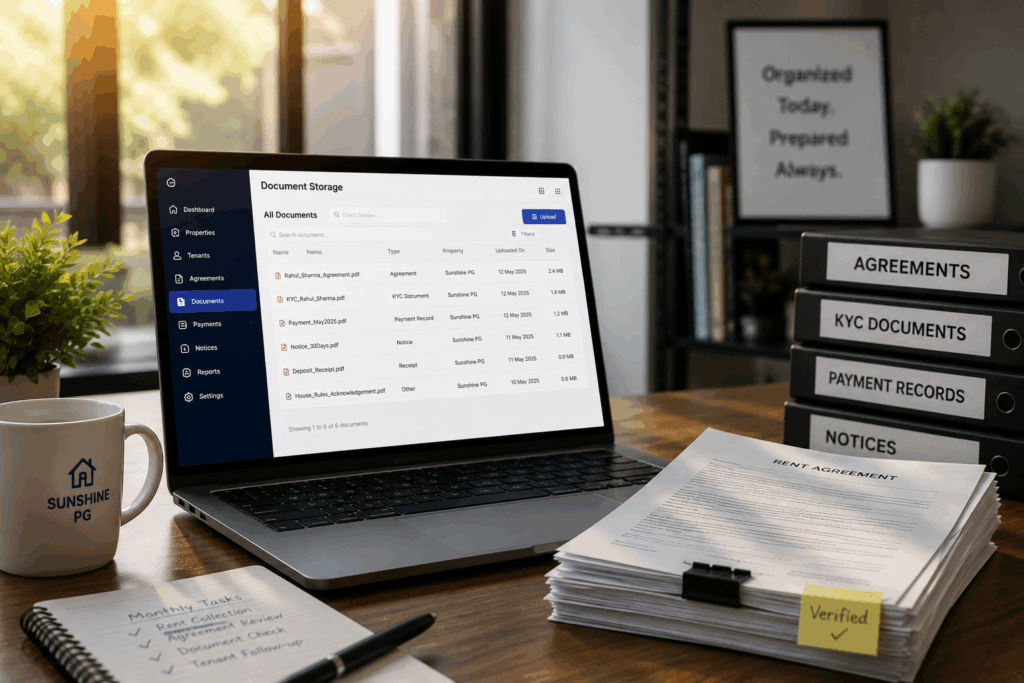
Why Safe Document Storage Matters More Than Most Owners Realize
Creating a professional agreement is only the beginning. The real challenge often starts months later when the document needs to be retrieved.
Many property owners still maintain agreement records across multiple folders, email threads, WhatsApp conversations, hard drives, and physical files. While this may seem manageable initially, it becomes increasingly difficult as occupancy grows.
Imagine needing to locate a specific agreement from eighteen months ago while simultaneously checking payment records, KYC documents, deposit details, and notice period information. Without a centralized system, even routine requests can become surprisingly time-consuming.
Poor document storage creates several operational risks:
- Important agreements may become difficult to locate during disputes, renewals, audits, or legal verification processes, increasing administrative workload significantly.
- Staff members may rely on outdated versions of agreements because documents are stored across multiple devices without proper version control.
- Supporting records such as KYC documents, payment histories, and communication logs may become disconnected from the agreement itself, making verification harder when issues arise.
- Physical documents remain vulnerable to accidental loss, damage, misplacement, or deterioration over time, particularly in businesses managing large volumes of paperwork.
Modern rental businesses increasingly treat documentation as a searchable operational asset rather than a collection of static files.
When agreements and supporting records are stored securely in one location, property managers gain faster access to information, stronger visibility into tenant history, and significantly better control over day-to-day operations.
The value of organized documentation often becomes most visible during high-pressure situations such as disputes, audits, or occupancy transitions. By that stage, having immediate access to accurate records can save substantial time and effort.
How RentOk Helps Simplify Agreement Management
As occupancy grows, agreement management becomes much more than a documentation task. Property managers need visibility into tenant records, payment histories, occupancy timelines, move-in dates, notice periods, and supporting documentation simultaneously.
Managing these processes manually often results in fragmented records spread across spreadsheets, email threads, WhatsApp chats, and physical paperwork. Over time, this creates unnecessary administrative complexity and makes it harder to maintain consistency across properties.
RentOk helps simplify this process by bringing tenant management and documentation workflows into a single connected system. Instead of treating agreements as standalone files, operators can manage them alongside occupancy records, payment tracking, communication history, and operational data.
This enables property managers to:
- Maintain organized tenant documentation without relying on multiple disconnected storage systems.
- Improve visibility into occupancy timelines, agreement renewals, and move-in or move-out coordination.
- Access important records quickly when handling disputes, audits, or tenant queries.
- Reduce manual administrative effort while maintaining better documentation consistency across properties.
As rental businesses scale, structured documentation becomes increasingly important. The ability to create, manage, retrieve, and track agreements efficiently helps operators spend less time handling paperwork and more time focusing on growth, occupancy, and tenant experience.
Conclusion
A rent agreement should do far more than satisfy a legal requirement. It should create clarity, protect both parties, and support the operational needs of a modern rental business.
As PGs, hostels, co-living spaces, and rental properties continue becoming more organized, digital agreement workflows are helping operators reduce paperwork, improve documentation standards, and streamline tenant onboarding. What once required multiple visits, printed documents, and extensive coordination can now be completed within minutes through structured digital processes.
The real advantage is not simply speed. It is consistency, accessibility, and operational control. When agreements, tenant records, and supporting documents are managed professionally, property owners are better positioned to handle renewals, exits, disputes, and day-to-day operations with confidence.
If you’re looking to modernize documentation workflows, simplify tenant onboarding, and create a more organized rental management process, discover how RentOk helps property operators manage agreements, occupancy, and property operations through a single centralized platform.
About the Author
Ishika Pannu
Ishika Pannu brings you the latest insights and easy-to-apply strategies in property management—helping you simplify renting and grow with RentOk.