Property Management
Tired of “Kal Deta Hoon”? Manage Late Rent Better

Written by
Ishika Pannu
Read Time
16 min read
Posted on
June 13, 2026
Overview
Overview
Tired of “Kal Deta Hoon”? Manage Late Rent Better
Every landlord, PG owner, or property manager has heard some variation of the same promise:
“Kal deta hoon.”
Sometimes it becomes, “Salary aate hi transfer kar deta hoon.” Other times, it is “Bas do din aur de do.” Individually, these conversations rarely feel like a major concern. A delay of a few days does not seem serious enough to disrupt an entire business.
The real problem begins when these delays stop being occasional and start becoming predictable.
Many rental businesses unknowingly develop a culture where late payments become normal. Tenants learn that due dates are flexible, reminders can be ignored for a few days, and penalties are either negotiable or rarely enforced. Over time, rent collection becomes less about receiving payments and more about chasing them.
This is where many operators make a critical mistake. They treat late rent as a tenant problem.
In reality, late rent is usually a systems problem.
Properties with strong collection discipline rarely achieve it because they have stricter tenants. They achieve it because they have clearer processes, better visibility, consistent enforcement, and systems that remove ambiguity from the collection cycle.
The goal of a good late rent fee policy is not to punish tenants. The goal is to create predictable payment behavior that protects cash flow while maintaining professional tenant relationships.
Why Late Rent Is More Expensive Than Most Owners Realize
Most operators focus only on the obvious impact of delayed payments: money arriving late.
While that is certainly a concern, the actual cost of late rent extends much further than the amount sitting in an outstanding balance sheet.
Rental businesses operate on predictable monthly cash flow. Salaries, maintenance expenses, housekeeping costs, utility bills, vendor payments, and operational investments are all planned around expected collections. When payments become inconsistent, financial planning becomes increasingly difficult.
Consider a property with 100 occupied beds. If ten residents delay their payments by a week every month, the business may still survive. However, management gradually loses confidence in projected collections. Decisions start getting postponed because actual cash inflow rarely matches expected cash inflow.
The operational impact often appears in areas such as:
- Staff members spending significant time following up with tenants individually instead of focusing on occupancy management, tenant experience, and day-to-day operations that directly contribute to business growth.
- Vendors and service providers experiencing payment delays, which can affect maintenance quality, response times, and overall operational efficiency across the property.
- Property managers struggling to identify real collection performance because expected revenue and collected revenue no longer align consistently throughout the month.
- Administrative workload increasing as teams manually track dues, verify payments, calculate penalties, and maintain collection records across multiple disconnected systems.
The financial impact is important, but the behavioral impact is often even more damaging.
When residents repeatedly observe that due dates carry little significance, payment discipline starts weakening across the property. What begins as a few isolated delays can eventually influence the payment habits of other tenants as well.
That is why experienced operators focus on preventing late-payment culture rather than simply recovering overdue rent after the fact.
Understanding the Psychology Behind “Kal Deta Hoon”
One of the biggest misconceptions in rent collection is assuming that every late-paying tenant behaves for the same reason.
In practice, delayed payments are usually driven by different motivations, and understanding those motivations can dramatically improve collection outcomes.
The Forgetful Payer
Not every delayed payment is intentional.
Some tenants genuinely lose track of dates because of work schedules, exams, travel, or personal commitments. They often pay immediately once reminded and rarely create long-term collection issues.
For these tenants, the problem is not willingness to pay. It is visibility.
Automated reminders and clear payment notifications usually solve the issue without requiring repeated follow-ups.
The Habitual Delayer
This group is far more challenging.
Habitual late payers often have the financial ability to pay but have learned that delaying payments carries little consequence. Over time, paying late becomes part of their routine.
These tenants typically operate on assumptions such as:
- The management will eventually send multiple reminders before taking any action, giving them extra time without any immediate consequences.
- Previous delays were tolerated without penalties, so future delays are unlikely to create serious issues either.
- Payment deadlines are flexible suggestions rather than operational commitments that need to be respected consistently.
This behavior is rarely corrected through individual conversations alone. It usually requires structured systems and consistent enforcement.
The Cash-Flow Struggler
Some tenants face legitimate financial difficulties.
Unexpected expenses, family emergencies, delayed salaries, or temporary employment challenges can affect their ability to pay rent on time.
These situations require balance.
Being overly rigid can damage tenant relationships unnecessarily. Being overly flexible can create operational instability. The strongest operators create documented payment plans and structured extension processes that provide support without compromising collection discipline.
The Strategic Negotiator
Every property eventually encounters tenants who intentionally push payment boundaries.
These residents often promise future payments, request repeated extensions, or attempt to negotiate penalties after due dates have passed. Their objective is usually to gain additional time without facing immediate consequences.
The key challenge here is avoiding emotional decision-making.
Once rent collection becomes a negotiation every month, consistency disappears. Strong systems help prevent this by ensuring that policies remain the same regardless of who is collecting the payment.

The Biggest Mistake Property Owners Make With Late Rent
Most rent collection issues are not caused by a lack of policies.
They are caused by inconsistent policies.
Many operators unknowingly fall into one of two extremes.
The first group becomes extremely strict at the first sign of delay. Every missed payment results in aggressive follow-ups, heated conversations, and immediate threats of penalties.
The second group takes the opposite approach. They continuously extend deadlines, waive charges, and rely heavily on verbal assurances instead of structured processes.
Neither approach works particularly well.
Aggressive collection methods may generate short-term compliance, but they can also create unnecessary friction with otherwise reliable tenants. Excessive flexibility, on the other hand, gradually weakens payment discipline because tenants begin assuming that deadlines are optional.
The most effective collection systems operate somewhere in the middle.
They combine clarity with consistency.
Tenants know:
- When rent is due and how payments should be completed through clearly defined processes that leave little room for confusion or interpretation.
- What happens if payments are delayed, including applicable penalties, reminder schedules, and escalation procedures that are communicated well in advance.
- How outstanding balances are tracked and displayed, ensuring that dues remain visible instead of becoming subjects of recurring discussion.
- What options exist if genuine financial difficulties arise, allowing management to support residents without compromising operational standards.
When expectations are clear, collections become significantly less emotional and far more predictable.
What a Strong Late Rent Fee Policy Actually Looks Like
Many rental businesses technically have a late rent fee policy.
The problem is that the policy often exists only inside agreements.
Tenants rarely understand it fully, staff members enforce it inconsistently, and management ends up making exceptions on a case-by-case basis. Eventually, the policy loses credibility because nobody is entirely sure how it works in practice.
A strong late rent fee policy should create clarity rather than complexity.
It should be simple enough for tenants to understand immediately while remaining structured enough to protect the business from recurring delays.
The most effective policies usually include several key components:
- Clearly defined due dates that remain consistent every month, ensuring tenants know exactly when payment obligations begin and end.
- Reasonable grace periods, where appropriate, that provide flexibility without creating confusion around actual payment deadlines.
- Transparent penalty structures that explain how late fees are calculated, when they are applied, and how they affect outstanding balances.
- Escalation procedures that outline the next steps if payments remain overdue for extended periods, helping both tenants and management understand the process ahead.
Most importantly, these policies should be discussed during onboarding rather than after problems appear.
By the time the first payment is due, residents should already understand how rent dues management works inside the property.
Good collection systems reduce surprises.
And in property management, fewer surprises usually mean fewer disputes.
Why Manual Rent Tracking Eventually Breaks Down
Many properties begin with simple collection methods because they seem practical at smaller scales.
A spreadsheet tracks payments. WhatsApp reminders are sent manually. Outstanding balances are noted inside registers. Staff members maintain separate records for different tenants.
Initially, this appears manageable.
The challenge emerges when occupancy grows.
A process that works reasonably well for twenty tenants often becomes increasingly inefficient at one hundred. As properties expand, management teams spend more time tracking information and less time using it.
Manual collection systems typically create challenges such as:
- Payment records becoming fragmented across spreadsheets, chat conversations, bank statements, and handwritten notes, making verification increasingly difficult.
- Collection follow-ups depending heavily on individual staff members rather than standardized workflows, reducing consistency and accountability.
- Outstanding dues becoming harder to monitor because there is no centralized view of pending balances, payment status, and collection performance.
- Late fee calculations requiring manual intervention, increasing the likelihood of errors, disputes, and administrative inefficiencies.
The biggest issue is not the extra workload.
It is the loss of visibility.
When operators cannot instantly identify who has paid, who is overdue, and how much remains outstanding, collections become reactive instead of proactive.
That is usually the point where technology stops being a convenience and starts becoming an operational necessity.
Auto-Fine Calculations Remove Emotion from Collections
One reason rent collection becomes uncomfortable in many properties is because penalties are often calculated manually. A tenant delays payment, management decides on a fine, the tenant questions the amount, and a discussion begins. Before long, what should have been a straightforward collection process turns into a negotiation.
The problem is not the penalty itself. The problem is inconsistency.
When penalties depend on individual decisions, tenants naturally start looking for exceptions. One resident may argue that they were only a few days late. Another may point out that someone else received a waiver last month. Over time, collection policies become difficult to enforce because every case feels open for discussion.
This is why professionally managed properties increasingly rely on automated systems instead of manual calculations.
When late fees are calculated automatically based on predefined rules, the conversation changes completely. The penalty is no longer viewed as something imposed by management. Instead, it becomes part of a transparent process that applies equally to everyone.
This creates several operational advantages simultaneously.
First, it removes subjectivity from collections. Staff members no longer have to decide which tenant should receive a penalty and which tenant should not. The system follows the same rules for every resident.
Second, it reduces disputes because tenants can clearly see how the amount was calculated. Transparency often prevents arguments before they begin.
Third, it reinforces payment discipline because consequences become predictable. Residents understand that delaying payments automatically affects their outstanding balance, making deadlines more meaningful.
Properties that successfully track unpaid rent usually do not rely on constant follow-up calls. They rely on systems that create visibility and accountability from the moment a payment becomes overdue.
The objective is not to collect more penalties.
The objective is to create fewer late payments.

When Should Property Owners Escalate the Matter?
Not every delayed payment deserves aggressive action.
In fact, treating every overdue balance like a major crisis often creates unnecessary tension between management and tenants. Most collection issues can be resolved through reminders, structured communication, and clear follow-up processes.
However, there comes a point where delayed payments stop being temporary inconveniences and start becoming operational risks.
Recognizing that point is one of the most important skills a property manager can develop.
Several warning signs usually indicate that a situation requires closer attention:
- The tenant repeatedly commits to payment dates but consistently misses those commitments without providing meaningful updates or explanations.
- Communication becomes increasingly difficult, with calls going unanswered and messages receiving little or no response despite multiple attempts.
- Outstanding balances continue growing month after month, creating larger collection risks and reducing the likelihood of quick resolution.
- Previously agreed payment plans are ignored, suggesting that the issue is no longer temporary and may require a different approach.
The key is to respond systematically rather than emotionally.
Many operators make the mistake of escalating because they are frustrated. Professional operators escalate because they have reached a clearly defined stage within their collection process.
That distinction matters.
When escalation follows a structured framework, tenants understand that the process is procedural rather than personal. This often leads to better cooperation and fewer disputes.
Before taking any formal action, proper documentation becomes essential.
Good collection records should include:
- Rent invoices, due dates, and payment schedules that establish a clear timeline of financial obligations.
- Copies of reminders and communication records showing the efforts made to resolve the issue amicably.
- Outstanding balance statements that accurately reflect dues, penalties, and previous payments.
- Notes regarding extensions, payment plans, or special arrangements agreed upon between management and the tenant.
Documentation protects the business while also ensuring fairness throughout the process.
When Do Legal Notices Become Necessary?
Legal notices often carry a negative perception because they are viewed as confrontational.
In reality, they are simply formal communication tools.
A legal notice should never be the first response to a delayed payment. It should be part of a structured escalation framework that begins with reminders, progresses through documented follow-ups, and eventually moves toward formal communication when necessary.
Properties generally consider legal notices when:
- Significant rent dues remain unpaid for extended periods despite repeated collection efforts and communication attempts.
- Tenants deliberately avoid communication, making informal resolution increasingly difficult.
- Contractual obligations have been repeatedly violated without any indication that the situation will improve voluntarily.
- Management needs formal documentation showing that reasonable efforts were made before pursuing further action.
One of the biggest mistakes operators make is sending legal notices impulsively. A notice issued in frustration often damages relationships without improving collection outcomes.
A professionally handled notice, on the other hand, communicates seriousness while maintaining procedural fairness.
It demonstrates that the property has followed a structured process and that further action may be required if the issue remains unresolved.
The goal is not intimidation.
The goal is resolution.
When handled correctly, legal notices often encourage meaningful conversations because tenants recognize that the matter has entered a formal stage.
Maintaining Professional Distance Without Damaging Relationships
Rent collection becomes difficult when operators start treating it as a personal matter instead of an operational process.
This is particularly common in smaller properties where landlords maintain close relationships with residents. While strong tenant relationships are valuable, excessive familiarity can sometimes weaken collection discipline.
A tenant who would never delay a utility bill or loan repayment may repeatedly postpone rent simply because the relationship feels informal.
Over time, management finds itself trapped in recurring conversations:
“Sir, next week pakka.”
“Bas salary aane do.”
“Is baar adjust kar lo.”
Individually, these requests may seem harmless. Collectively, they create uncertainty, inconsistency, and operational inefficiency.
The strongest property operators understand that professionalism and friendliness can coexist.
Maintaining professional distance does not mean becoming rigid or unapproachable. It means ensuring that systems guide decisions rather than emotions.
This usually involves:
- Communicating payment expectations clearly from the beginning so tenants understand that due dates are operational commitments rather than flexible suggestions.
- Applying policies consistently across all residents, preventing situations where some tenants receive special treatment while others face stricter enforcement.
- Documenting agreements properly instead of relying on verbal promises that can later be forgotten or misunderstood.
- Using structured workflows and automated systems to reduce dependence on personal follow-ups and subjective decision-making.
Interestingly, tenants often appreciate this approach.
Clear systems create predictability. Predictability creates trust. And trust ultimately improves both relationships and collections.
Properties that rely heavily on personal negotiations often find themselves revisiting the same conversations every month. Properties that rely on systems usually spend far less time discussing payments because expectations are already understood.
Building a Culture of Timely Payments
One of the most overlooked aspects of rent collection is culture.
Many operators focus exclusively on recovering overdue payments without paying attention to the behaviors that create those overdue payments in the first place.
Payment discipline is rarely created through penalties alone.
It is created through a combination of visibility, consistency, communication, and accountability.
When residents receive timely reminders, understand the consequences of delays, and can easily view their outstanding balances, paying on time becomes the default behavior.
Likewise, when management consistently follows the same process every month, tenants stop viewing collection as a negotiable activity.
Strong payment cultures are built through habits.
Over time, these habits create significant operational benefits:
- Collections become more predictable, improving cash flow planning and financial visibility across the property.
- Staff spend less time following up on payments, allowing them to focus on tenant experience and operational improvements.
- Disputes decrease because payment expectations and penalty structures remain transparent and consistently enforced.
- Management gains greater confidence in forecasting revenue, occupancy performance, and business growth initiatives.
The best collection systems eventually become invisible.
Tenants know what is expected. Management knows what to monitor. Payments happen with minimal friction.
That is ultimately the goal.

How RentOk Helps Simplify Late Rent Management
As rental businesses grow, maintaining collection discipline manually becomes increasingly difficult. What starts as a manageable process for a small property often becomes overwhelming once occupancy increases and multiple operational responsibilities compete for attention.
This is where structured technology can make a meaningful difference.
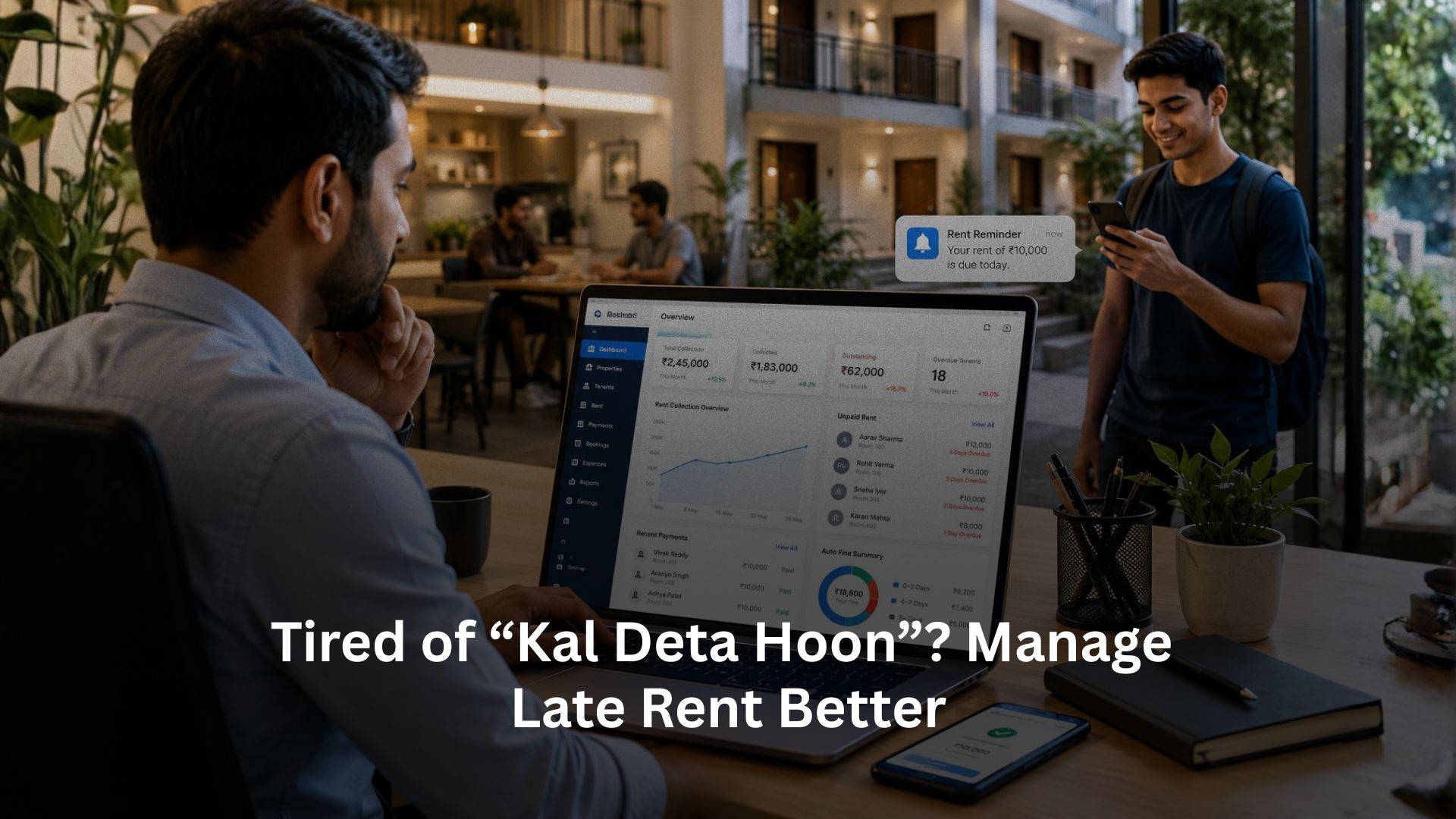
RentOk helps landlords, PG operators, and property managers streamline rent dues management by centralizing critical collection workflows within a single platform. Instead of juggling spreadsheets, notebooks, WhatsApp chats, and manual calculations, operators gain a clearer and more organized view of their collection process.
With RentOk, property managers can:
- Automate rent reminders so tenants receive timely notifications before payments become overdue, reducing the need for repeated manual follow-ups.
- Track unpaid rent through centralized dashboards that provide real-time visibility into pending dues, payment status, and collection performance.
- Configure automatic late fee calculations that apply predefined rules consistently across all residents, helping reduce disputes and improve transparency.
- Maintain organized payment records and tenant histories that make collection management more efficient and easier to monitor over time.
- Improve operational visibility by bringing rent collection, payment tracking, and tenant management into one connected ecosystem.
As occupancy grows, collection success becomes less dependent on constant follow-up and more dependent on strong systems. RentOk helps operators build those systems while reducing administrative effort and improving payment discipline across the property.
Conclusion
Every property owner will hear “Kal deta hoon” at some point.
The difference between struggling collections and predictable collections is not how often those conversations happen. It is how the business responds to them.
Late rent is rarely solved through stricter penalties alone. It is solved through clear expectations, consistent enforcement, transparent communication, and systems that make payment discipline easier to maintain.
When tenants understand the rules, reminders are automated, penalties are transparent, and outstanding balances remain visible, collections become significantly less stressful for everyone involved.
The strongest rental businesses do not spend their time chasing payments every month. They create processes that encourage tenants to pay on time in the first place.
See how RentOk can help you streamline rent dues management, automate collections, improve payment visibility, and build stronger payment discipline across every property you manage.
About the Author
Ishika Pannu
Ishika Pannu brings you the latest insights and easy-to-apply strategies in property management—helping you simplify renting and grow with RentOk.