Property Management
Why Most PG Owners Lose Revenue Without Realizing It

Written by
Ishika Pannu
Read Time
9 min read
Posted on
June 17, 2026
Overview
Overview
Why Most PG Owners Lose Revenue Without Realizing It
Most PG owners assume revenue loss is easy to identify. A room stays vacant, a tenant leaves unexpectedly, or rent goes unpaid for several months. These situations are obvious and immediately attract attention because the financial impact is visible.
The reality is often very different.
Many PGs and hostels lose revenue every single month despite maintaining healthy occupancy levels and collecting rent regularly. The losses are not caused by one major operational failure. Instead, they develop through dozens of small inefficiencies that quietly accumulate over time.
A room remains vacant for a week longer than necessary after a move-out. Security deposits are adjusted incorrectly because records are scattered across spreadsheets and WhatsApp chats. Electricity charges are not recovered accurately. Rent collection gets delayed repeatedly without proper follow-up. None of these issues appear alarming individually, but together they can significantly reduce annual profitability.
This is what makes revenue leakage particularly dangerous in the PG business. Owners often focus on occupancy while overlooking the systems that directly influence profitability.
The most successful operators understand that revenue growth is not only about filling beds. It is also about protecting the revenue that the property is already generating.
What Revenue Leaks Exist in PG Businesses?
When people hear the term “revenue leak,” they often think about unpaid rent. While rent defaults certainly affect cash flow, they represent only one part of a much larger problem.
In practice, revenue leakage can occur across almost every stage of property operations. Some leaks are financial, while others are operational issues that eventually create financial consequences.
A few of the most common examples include:
- Extended vacancy periods between tenants, where rooms remain unoccupied for days or weeks because move-outs, maintenance work, and onboarding processes are not coordinated efficiently.
- Delayed rent collection cycles, where payments eventually arrive but repeated delays affect cash flow and increase the amount of management effort required to recover dues.
- Untracked utility and miscellaneous charges, particularly electricity, maintenance, laundry, food, or service-related expenses that are either under-billed or forgotten entirely.
- Poor occupancy planning, which results in empty beds during high-demand periods simply because lead management and follow-up processes are inconsistent.
- Manual record-keeping errors, where incorrect calculations, duplicate entries, or missed updates create revenue gaps that often remain unnoticed for months.
Many operators are surprised when they calculate the annual impact of these issues. Losing ₹500 here and ₹1,000 there may not seem significant in isolation. However, when multiplied across dozens or hundreds of tenants over an entire year, these seemingly minor inefficiencies can translate into lakhs of lost revenue.
The challenge is that these losses rarely appear in a single report. They are spread across different operational areas, making them difficult to detect without proper visibility.

Why Do Owners Miss These Problems?
One of the biggest reasons revenue leaks continue for long periods is that most operators focus on visible performance indicators.
If occupancy is high and monthly collections appear stable, the business feels healthy. Management assumes that operations are running efficiently because there are no obvious signs of trouble.
Unfortunately, profitability and occupancy are not always the same thing.
Consider a property operating at 95% occupancy. On paper, this appears excellent. However, if rent collection delays are increasing, utility recoveries are inaccurate, and rooms take too long to refill after move-outs, the property may still be underperforming financially.
The problem becomes even more complicated as the business grows.
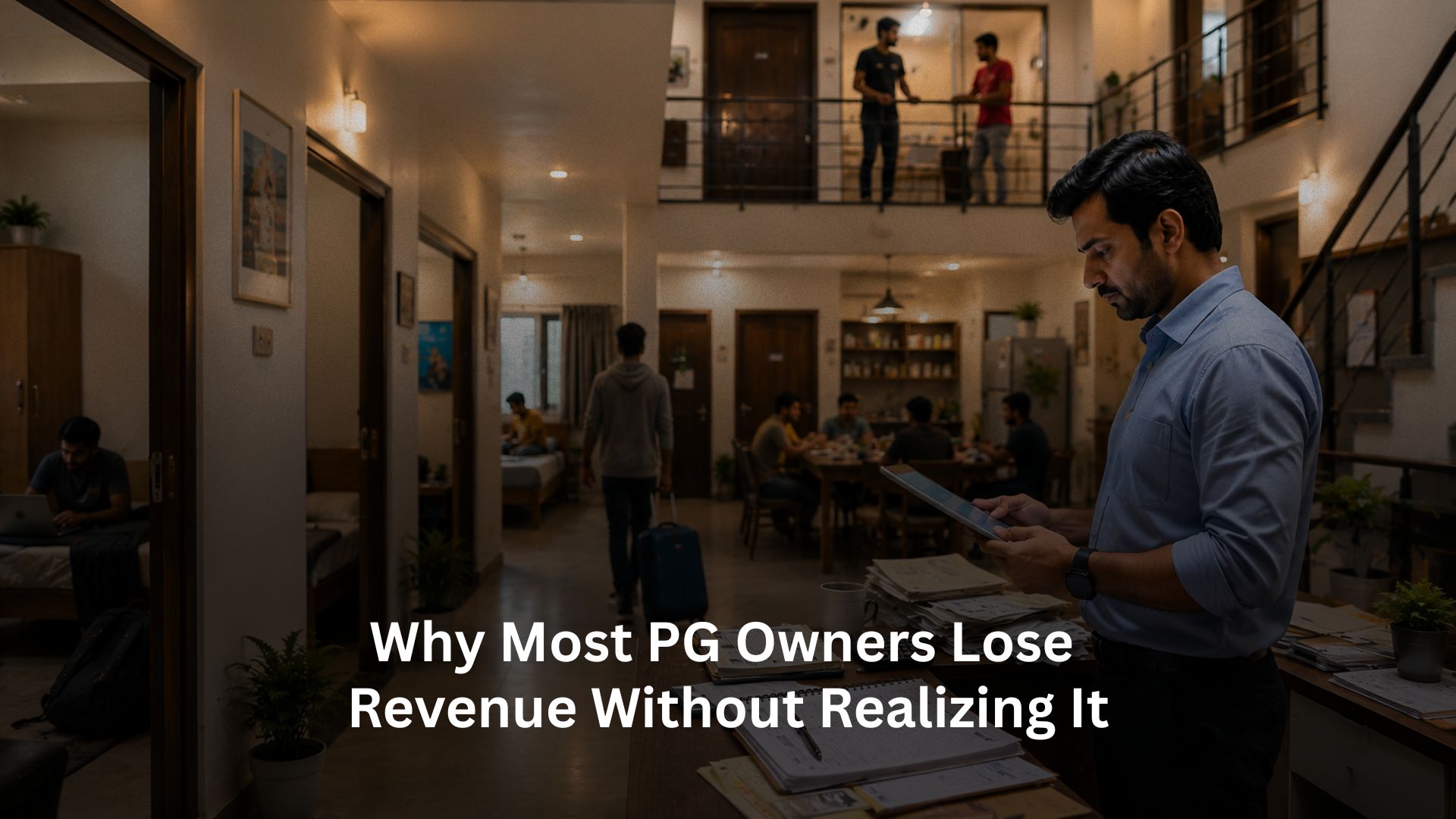
In smaller properties, owners often have direct visibility into daily operations. They personally know who has paid rent, which rooms are vacant, and what expenses have been incurred.
As occupancy increases, this visibility starts disappearing.
Operational information becomes scattered across:
- Multiple spreadsheets maintained by different team members.
- WhatsApp conversations containing payment confirmations and tenant updates.
- Handwritten registers used for occupancy tracking.
- Manual expense records maintained separately from revenue records.
- Verbal communication between staff members that is never formally documented.
Once information becomes fragmented, identifying revenue leakage becomes significantly harder.
Management may know that revenue feels lower than expected but struggle to identify the exact cause. By the time the issue becomes visible, the business may already have been losing money for several months.
This is why mature property operators invest heavily in visibility and reporting systems. They understand that revenue protection begins with operational transparency.
How Can Revenue Leaks Be Identified Early?
The strongest PG operators rarely wait for financial problems to become obvious.
Instead, they monitor operational indicators that often reveal revenue leakage long before it affects profitability in a significant way.
One of the most important warning signs is increasing occupancy turnover without corresponding revenue growth. If new tenants are moving in regularly but overall collections remain flat, it may indicate issues related to vacancies, discounts, or delayed payments.
Similarly, frequent tenant complaints about billing, deposits, or utility calculations often suggest deeper process-related problems. These issues are rarely isolated incidents. They usually point toward inconsistent systems that create both operational inefficiencies and financial losses.
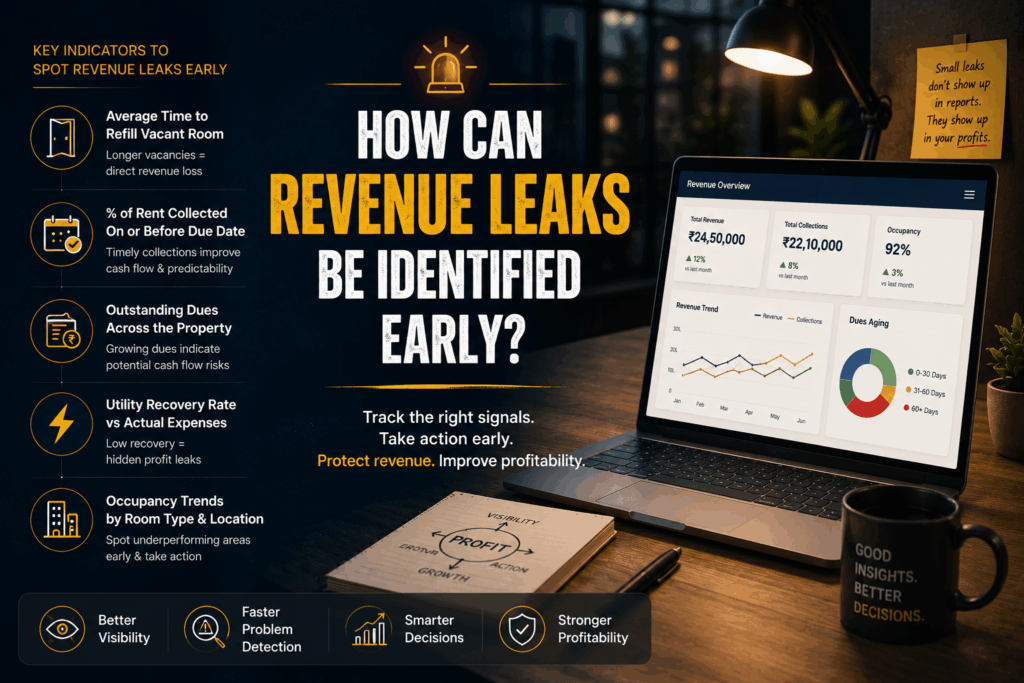
Owners should regularly review metrics such as:
- Average time taken to refill a vacant room after move-out.
- Percentage of rent collected on or before the due date.
- Outstanding dues across the property.
- Utility recovery rates compared to actual utility expenses.
- Occupancy trends across different room categories and property locations.
These metrics provide much clearer insight into business performance than occupancy figures alone.
More importantly, they help operators identify problems before those problems start affecting profitability at scale.
What Systems Help Prevent Revenue Loss?
Identifying revenue leaks is only half the battle. The bigger challenge is preventing them from becoming a recurring part of the business.
Many PG owners know where money is slipping away. They know collections are delayed, occupancy gaps exist, or expenses are rising. The problem is that these issues are often managed reactively. Teams notice them after revenue has already been lost rather than having systems that prevent the loss in the first place.
This is where operational structure becomes important. As occupancy grows, relying on memory, spreadsheets, and manual coordination becomes increasingly risky because small oversights start affecting larger portions of the business.
The most effective revenue-protection systems usually focus on four areas:
- Occupancy visibility that helps management track upcoming move-outs, vacant beds, and room availability in real time. This reduces the chances of rooms remaining empty simply because nobody had visibility into the vacancy.
- Collection management processes that ensure rent reminders, due tracking, and follow-ups happen consistently instead of depending entirely on staff members remembering payment dates.
- Expense monitoring systems that make it easier to identify rising maintenance costs, unusual utility expenses, or recurring operational spending that may be reducing profitability.
- Centralized tenant records where agreements, deposits, payment history, and occupancy information remain organized and accessible instead of being spread across multiple files and conversations.
None of these systems directly generate new revenue. What they do is protect the revenue that the property is already capable of earning, which often has a much bigger impact on profitability than most operators realize.
The Hidden Cost of Operating Without Visibility
One reason revenue leakage becomes difficult to control is that it rarely appears as a single problem.
Most losses develop gradually. A few delayed payments this month, a vacant bed next month, a missed utility recovery after that. Individually, these situations seem manageable. Collectively, they create a noticeable impact on annual revenue.
The challenge is that owners often do not have enough visibility to connect these issues together.
The consequences usually appear in several ways:
- Revenue forecasting becomes less reliable because management cannot accurately predict how much money is expected versus how much is actually being collected.
- Occupancy planning becomes reactive as teams discover vacancies after they occur instead of preparing for them in advance.
- Staff spend more time coordinating information across spreadsheets, WhatsApp chats, and registers instead of focusing on tenant experience and business growth.
- Financial reporting becomes less accurate because important operational information is spread across multiple disconnected systems.
When visibility is limited, management often feels busy but lacks clarity. Problems continue getting solved one by one without addressing the underlying reasons those problems keep appearing.
That is why many successful operators invest in operational visibility long before they invest in expansion. Better visibility often creates profitability improvements without adding a single new room to the property.
Why Data-Driven Operators Outperform the Market
The PG industry has traditionally relied on experience and intuition. While experience remains valuable, growing properties generate too much information to manage effectively through observation alone.
The strongest operators today combine experience with data. They use operational insights to identify trends, improve decision-making, and spot problems before they affect profitability.
Instead of relying on assumptions, they can answer questions such as:
- Which room categories consistently maintain the highest occupancy and contribute the most stable revenue throughout the year.
- How much revenue is currently tied up in pending dues and whether collection performance is improving or weakening over time.
- Which properties are generating stronger margins and which ones may require operational improvements.
- How quickly vacant rooms are being filled compared to previous months and whether occupancy turnover is becoming a concern.
This visibility changes the way decisions are made.
Pricing strategies become more informed. Occupancy planning becomes more proactive. Collection processes become more consistent. Most importantly, management gains the ability to identify small operational inefficiencies before they become expensive revenue leaks.
Over time, this creates a significant competitive advantage. Businesses that understand their numbers usually make better operational decisions than those relying purely on instinct.

How RentOk Helps PG Owners Protect Revenue
As occupancy grows, keeping track of collections, vacancies, expenses, deposits, and tenant records becomes increasingly difficult. Information often ends up scattered across spreadsheets, WhatsApp conversations, handwritten registers, and multiple disconnected tools.
This lack of visibility is one of the biggest reasons revenue leaks remain unnoticed.
RentOk helps property owners centralize key operational workflows in one platform, making it easier to track occupancy, monitor collections, manage dues, maintain tenant records, and gain better visibility into overall property performance.
With structured reporting and automated workflows, operators can identify potential revenue gaps earlier, reduce dependency on manual follow-ups, and make more informed decisions about occupancy and property management.
Instead of spending hours compiling information from different sources, teams can focus on improving operations, increasing occupancy efficiency, and protecting profitability across the business.
Conclusion
Most PG owners believe revenue loss comes from obvious problems such as vacant rooms or unpaid rent. In reality, some of the biggest revenue leaks develop quietly through delayed collections, poor visibility, inefficient processes, and missed operational opportunities.
The good news is that these losses are often preventable.
By building stronger systems around occupancy, collections, expenses, and reporting, operators can gain greater control over their business and protect revenue that would otherwise slip away unnoticed.
As competition in the rental market continues to grow, profitability will increasingly depend on operational visibility rather than occupancy alone.
Looking for a smarter way to track occupancy, manage collections, and improve property performance? Explore RentOk’s PG Management Software and discover how better operational visibility can help you maximize revenue and run a more efficient rental business.
About the Author
Ishika Pannu
Ishika Pannu brings you the latest insights and easy-to-apply strategies in property management—helping you simplify renting and grow with RentOk.