Property Management
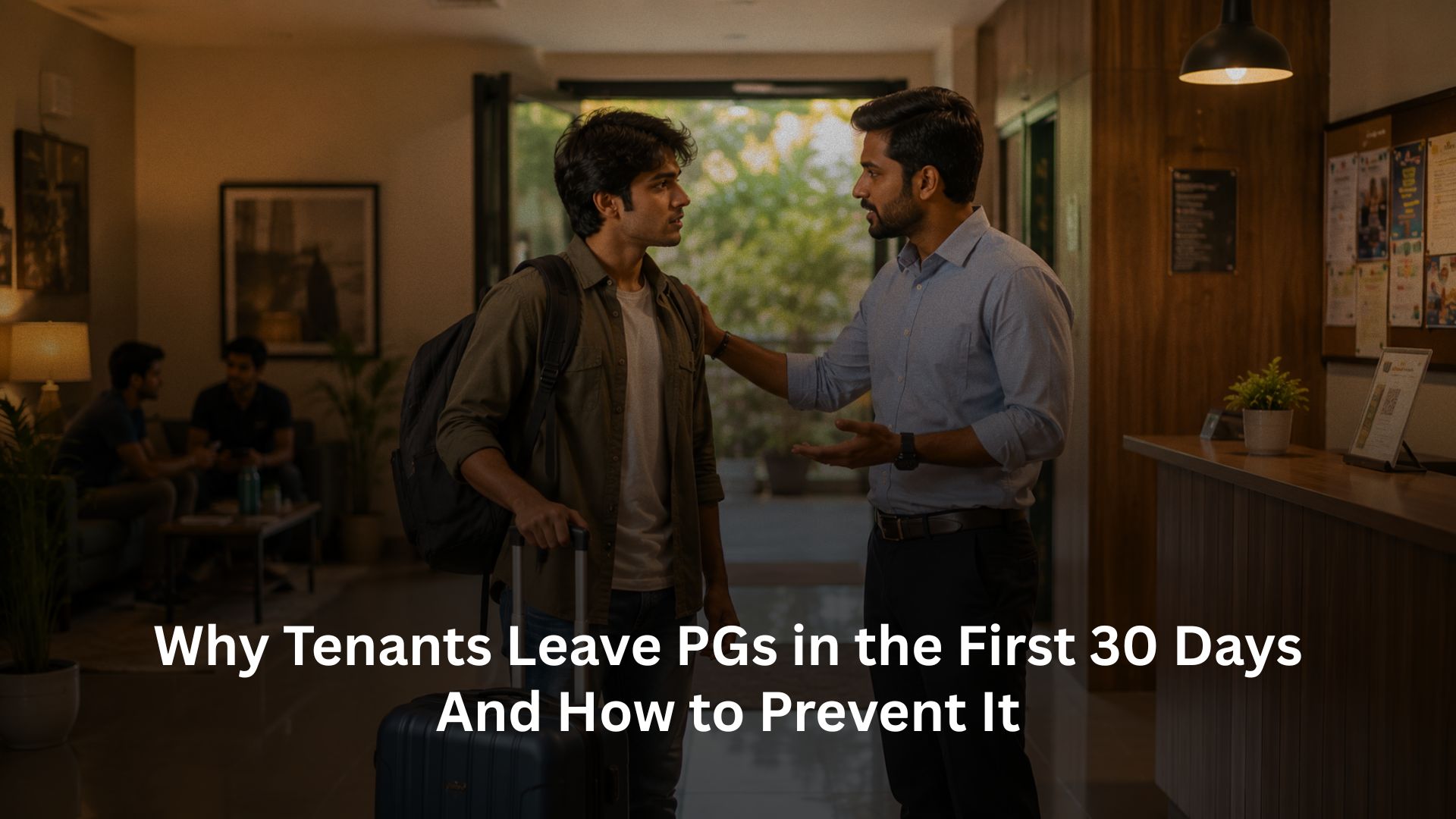
Why Tenants Leave PGs in the First 30 Days And How to Prevent It

Written by
Ishika Pannu
Read Time
12 min read
Posted on
June 19, 2026
Overview
Overview
Why Tenants Leave PGs in the First 30 Days And How to Prevent It
Filling a vacant bed is only half the job.
For many PG owners and co-living operators, the real challenge begins after a tenant moves in. Marketing campaigns, listing subscriptions, broker commissions, and countless property visits may successfully bring a resident through the door, but if that tenant leaves within the first month, the business is forced back into acquisition mode almost immediately.
This is one of the most overlooked occupancy challenges in the rental industry. Operators often focus heavily on attracting new tenants while assuming retention will happen naturally. In reality, the first 30 days play a critical role in determining whether a resident settles into the property or quietly starts looking for alternatives.
Early exits do more than create temporary vacancies. They increase acquisition costs, disrupt occupancy planning, create operational inefficiencies, and reduce overall profitability. More importantly, they often signal deeper issues within the tenant experience that may affect future residents as well.
The good news is that most early move-outs are preventable. The strongest PG operators understand that retention starts long before a tenant considers renewing their stay. It begins from the moment they enter the property.
Why the First 30 Days Matter More Than Most Operators Realize
When tenants move into a new property, they are constantly evaluating whether they made the right decision.
During this period, they are not just judging the room itself. They are forming opinions about management responsiveness, cleanliness standards, food quality, community culture, safety, maintenance efficiency, and overall living experience.
Many operators assume that if a tenant completes the move-in process, the difficult part is over. Operationally, that assumption can be expensive.
The first month often determines:
- Whether a tenant develops confidence in the management team or starts questioning their decision to move in.
- Whether minor inconveniences feel manageable or begin accumulating into larger frustrations that eventually trigger a move-out.
- Whether residents feel welcomed into the property’s ecosystem or continue comparing the experience with competing PGs nearby.
- Whether the tenant becomes a long-term resident, a future referral source, or another vacancy that needs to be filled again.
Properties that consistently achieve strong tenant retention understand that the onboarding phase is not an administrative process. It is a relationship-building process that directly affects occupancy stability.

The Hidden Cost of Early Tenant Churn
Most operators measure tenant departures by counting vacant beds. However, the financial impact goes much deeper than a temporary occupancy gap.
Every new tenant represents an investment before revenue is fully recovered. Room preparation, cleaning, marketing expenses, staff coordination, documentation, onboarding support, and utility setup all require time and money.
When tenants leave within the first month, those investments often fail to generate meaningful returns.
Early churn creates several operational challenges:
- Marketing costs increase because the same room must be promoted repeatedly within a short period, forcing operators to spend more money on lead generation and visibility.
- Staff productivity declines because teams spend more time handling move-ins and move-outs instead of focusing on resident satisfaction and operational improvements.
- Occupancy forecasting becomes less reliable, making it harder to plan cash flow, staffing requirements, and room availability effectively.
- Tenant confidence can be affected when frequent move-outs create the perception that residents are dissatisfied with the property experience.
This is why successful rental businesses view tenant retention as a profitability strategy rather than simply a customer service initiative.
Poor Onboarding Creates Problems Faster Than Most Owners Expect
One of the biggest reasons tenants leave early has nothing to do with pricing, amenities, or location.
It starts with confusion.
Many PGs invest significant effort in attracting tenants but very little effort in helping them settle in after arrival. Once payments are collected and paperwork is completed, the onboarding experience often becomes informal and inconsistent.
New residents frequently find themselves trying to figure out basic operational details on their own.
Questions begin appearing almost immediately:
- What are the meal timings and how are food-related concerns handled?
- What is the process for raising maintenance complaints?
- Who should be contacted during emergencies?
- How are visitor policies managed?
- What facilities are available and how should they be used?
When answers are unclear, frustration develops quickly.
A structured onboarding process helps eliminate uncertainty and creates confidence during the most sensitive stage of the tenant journey. Residents who understand how the property operates are significantly more likely to feel comfortable and remain engaged.
The strongest operators treat onboarding as an experience rather than a checklist.
First Impressions Are Often Built Around Maintenance and Cleanliness
Tenants can tolerate occasional inconveniences.
What they struggle to tolerate is disappointment immediately after moving in.
A room that looked excellent during the property visit but appears poorly prepared on move-in day creates an immediate gap between expectation and reality. Once that trust gap forms, every future issue tends to feel larger than it actually is.
Common examples include:
- Rooms that were promised to be fully cleaned but still contain visible maintenance issues or housekeeping gaps.
- Furniture, appliances, or Wi-Fi systems that are not functioning properly during the first few days of occupancy.
- Common areas that appear significantly different from what tenants observed during the initial property tour.
- Delays in resolving move-in related concerns that make residents feel their complaints are not being prioritized.
The issue is not always the problem itself.
The issue is timing.
When these experiences occur during the first few weeks, they influence how tenants evaluate the entire property. Strong operators understand that early maintenance responsiveness can significantly improve tenant retention because it demonstrates professionalism when residents are paying the closest attention.
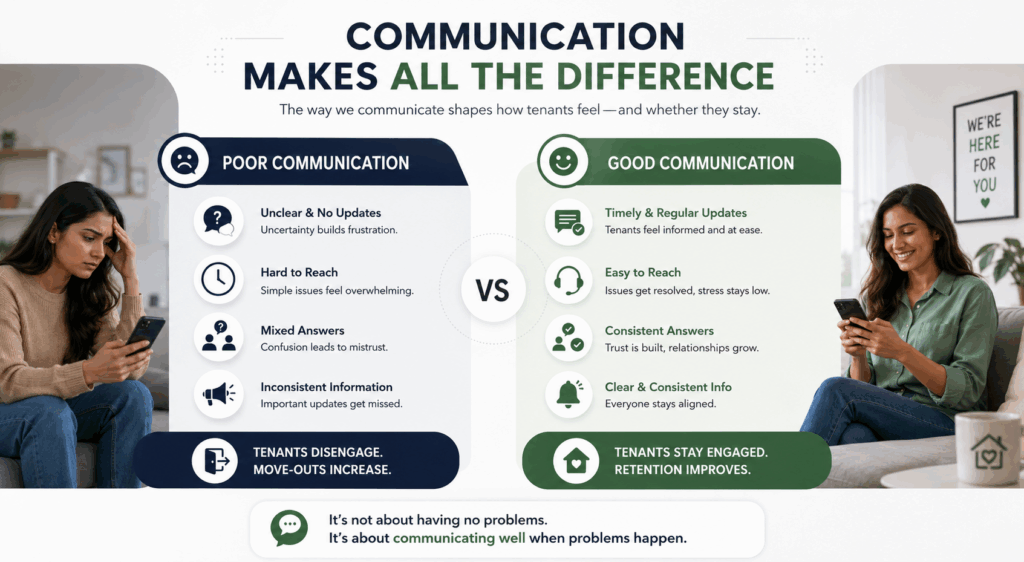
Why Communication Gaps Push Tenants Toward the Exit
Many early move-outs are not caused by unresolved problems.
They are caused by unresolved communication.
Tenants are generally willing to wait for solutions if they believe progress is being made. Frustration usually develops when updates disappear completely.
Consider a maintenance complaint that takes three days to resolve.
Most residents can accept the timeline if they receive regular updates explaining what is happening. However, if communication stops after the complaint is submitted, the same issue suddenly feels ignored.
This pattern appears repeatedly across PG operations.
Residents become frustrated when:
- Complaint statuses remain unclear and they are forced to repeatedly follow up for updates.
- Payment-related queries take too long to receive responses.
- Operational announcements are communicated inconsistently across different channels.
- Staff members provide different answers to the same questions, creating confusion and reducing trust.
Communication plays a critical role in tenant retention because it directly influences how residents perceive management quality.
A well-managed property is not necessarily the one with the fewest problems. It is often the one that communicates most effectively when problems occur.
Community and Social Comfort Matter More Than Amenities
When operators think about tenant retention, they often focus on tangible factors such as room quality, food service, Wi-Fi speed, or housekeeping standards. While these elements are certainly important, many early move-outs are influenced by something less visible: social comfort.
People do not just rent a room. They choose an environment where they will spend a significant part of their daily lives.
This becomes especially important in:
- Student housing, where residents are entering a completely new city and often rely on their living environment to build initial social connections.
- Co-living spaces, where community interaction is frequently part of the property’s value proposition and overall tenant experience.
- PGs for working professionals, where long working hours make a comfortable and predictable living environment particularly valuable.
A tenant may have no complaints about the room itself, yet still leave because they never felt comfortable within the property’s social ecosystem.
This is why successful operators pay attention to factors such as:
- How new residents are introduced to the property environment and whether they feel welcomed during the initial days.
- Whether common areas encourage positive interactions instead of becoming underutilized spaces that add little value.
- How management handles conflicts between residents before they escalate into larger dissatisfaction issues.
- Whether the property creates an environment where tenants feel comfortable recommending the accommodation to friends or colleagues.
Retention is rarely driven by a single factor. More often, it is the result of multiple positive experiences working together over time.
When Expectations and Reality Do Not Match
One of the fastest ways to lose tenant trust is creating expectations that the property cannot consistently deliver.
This problem often begins before move-in.
In highly competitive rental markets, operators sometimes feel pressure to highlight only the best aspects of the property during inquiries and visits. While this may improve conversions initially, it often creates challenges later if the actual experience feels noticeably different.
Expectation gaps commonly appear when:
- Amenities showcased during the sales process are not available as consistently as tenants were led to believe.
- Food quality varies significantly from what was described before occupancy.
- Operational policies such as visitor access, housekeeping schedules, or facility usage are explained only after move-in.
- Room conditions differ from the standards that were communicated during property visits.
The operational issue here is not necessarily service quality.
It is predictability.
Modern tenants value transparency. Most residents are willing to accept reasonable limitations if they understand them upfront. What creates frustration is discovering those limitations only after the move-in process is complete.
Properties that prioritize honest communication often experience stronger retention because trust starts forming before occupancy even begins.
Why Complaint Resolution Directly Impacts Retention
Many operators view complaint management as a maintenance function.
In reality, it is one of the strongest retention drivers inside any rental business.
Every complaint represents a moment where management has an opportunity to either strengthen or weaken tenant confidence. The way issues are handled often matters more than the issue itself.
For example, a maintenance request involving Wi-Fi, plumbing, or electrical problems may be inconvenient, but tenants generally understand that operational issues occasionally occur.
What they evaluate is:
- How quickly the complaint is acknowledged after being raised.
- Whether timelines are communicated clearly instead of leaving residents uncertain about next steps.
- How professionally staff members handle the interaction throughout the resolution process.
- Whether the issue remains visible until completion rather than disappearing into a communication gap.
Properties with strong retention rates typically have one thing in common: residents trust that problems will be addressed professionally.
That trust reduces frustration, improves satisfaction, and significantly lowers the likelihood of early move-outs.
The Properties With Strong Retention Focus on Consistency
One of the biggest misconceptions in the rental industry is that tenant retention depends primarily on offering more amenities.
In reality, consistency often matters far more.
Tenants generally do not expect perfection. What they expect is reliability.
They want confidence that:
- Housekeeping standards will remain consistent throughout their stay rather than fluctuating week to week.
- Food quality will be reasonably predictable instead of changing dramatically without explanation.
- Complaint handling processes will work similarly regardless of which staff member is on duty.
- Property rules and operational policies will be applied fairly across all residents.
This consistency creates stability.
When residents know what to expect, they become more comfortable building routines around the property. That sense of stability plays a major role in long-term tenant retention because uncertainty is often one of the strongest drivers of dissatisfaction.
Professional operators understand that retention is not built through occasional exceptional experiences. It is built through consistently positive everyday experiences.
Practical Ways to Reduce First-Month Tenant Churn
Improving retention does not always require major investments. In many cases, small operational improvements create significant long-term results.
Some of the most effective strategies include:
- Creating a structured onboarding process that clearly explains property operations, policies, facilities, and support channels during the first few days.
- Conducting proactive check-ins during the initial weeks to identify concerns before they become reasons for moving out.
- Maintaining room readiness standards so that move-in experiences match the expectations created during property visits.
- Establishing clear complaint-resolution workflows that provide visibility and updates throughout the process.
- Gathering feedback early rather than waiting until the tenant is already considering leaving.
- Building stronger communication systems that keep residents informed about operational updates, maintenance activities, and important announcements.
The goal is not simply to prevent complaints.
The goal is to create confidence.
When tenants feel supported, informed, and valued, they are far more likely to remain with the property long enough to become long-term residents.

How RentOk Helps Improve Tenant Retention
Managing tenant retention becomes increasingly difficult as occupancy grows because onboarding, communication, complaint management, payment tracking, and operational coordination often become fragmented across spreadsheets, WhatsApp chats, calls, and manual records.
RentOk helps PG owners and property managers centralize critical operational workflows within a single platform. From managing tenant information and tracking occupancy to handling complaints, monitoring payments, and improving communication visibility, the platform helps operators create a more structured resident experience from day one.
This operational visibility allows management teams to identify issues faster, improve response times, maintain better communication consistency, and create smoother onboarding experiences for new residents. As a result, tenants feel more supported during the critical first month, reducing the likelihood of early exits and helping operators build stronger long-term occupancy stability.
Conclusion
The first 30 days often determine whether a tenant becomes a long-term resident or another vacancy that needs to be filled again. While pricing, location, and amenities certainly influence occupancy decisions, retention is usually driven by the daily experiences residents have after they move in.
Clear onboarding, consistent communication, reliable maintenance support, transparent expectations, and professional complaint management all play a critical role in shaping those experiences. Properties that focus only on acquiring tenants often overlook these factors, while the strongest operators understand that retention begins the moment a resident walks through the door.
Reducing early tenant churn is not just about improving satisfaction. It is about creating a more stable, predictable, and profitable rental business.
Want to improve tenant retention, streamline tenant management, and create better resident experiences from day one? Book a demo with RentOk and discover how modern property management software can help you build stronger occupancy and long-term growth.
About the Author
Ishika Pannu
Ishika Pannu brings you the latest insights and easy-to-apply strategies in property management—helping you simplify renting and grow with RentOk.