Property Management
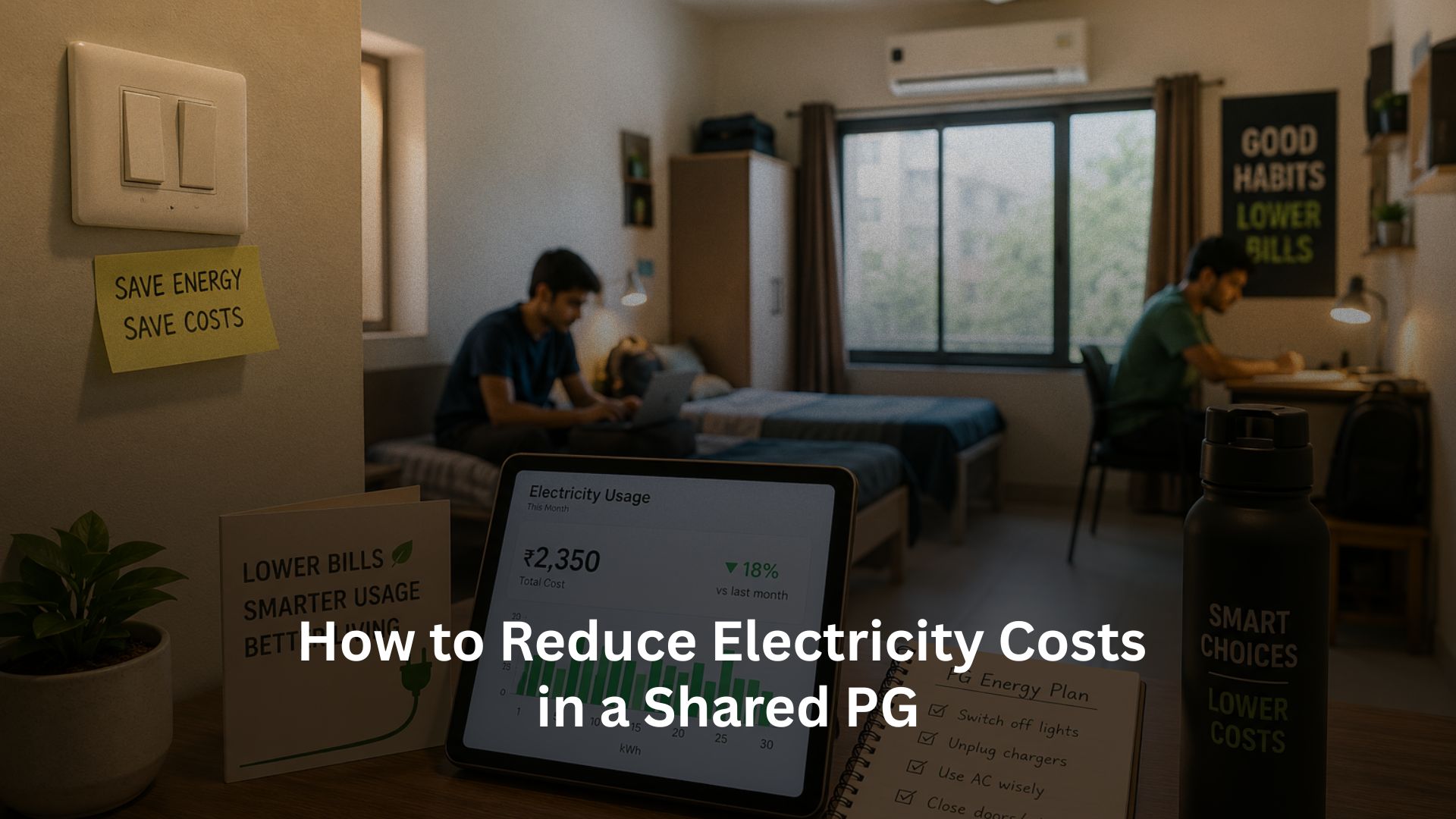
How to Reduce Electricity Costs in a Shared PG

Written by
Ishika Pannu
Read Time
12 min read
Posted on
July 6, 2026
Overview
Overview
How to Reduce Electricity Costs in a Shared PG
Electricity is one of the largest recurring operational expenses for any PG or co-living property. As occupancy increases, so does energy consumption. Air conditioners run for longer hours, kitchen appliances remain in constant use, water pumps operate multiple times a day, and common areas require continuous lighting. While these costs are expected, many property owners unknowingly pay far more than necessary because electricity management often remains reactive instead of strategic.
The challenge isn’t simply that electricity has become expensive. It’s that wastage often goes unnoticed until utility bills start affecting monthly profitability. A fan left running in an empty room, an old refrigerator consuming excess power, or a poorly maintained air conditioner can collectively increase operating costs by thousands of rupees every month.
For smaller PGs, these additional expenses may seem manageable. However, for operators managing multiple properties or hundreds of beds, even a 10–15% increase in electricity costs can significantly impact overall margins. This is why experienced operators no longer look at electricity bills only as an unavoidable expense. Instead, they treat energy management as an operational process that can be measured, optimized, and continuously improved.
Reducing electricity costs does not mean compromising tenant comfort or restricting appliance usage. It involves understanding where energy is being consumed, identifying avoidable wastage, and implementing systems that encourage efficient usage without creating friction for residents.
Why Electricity Costs Continue to Rise in Shared PGs
Many operators assume that rising electricity bills are simply the result of tariff increases or seasonal demand. While these factors certainly play a role, they are rarely the only reason behind higher monthly expenses. In reality, a significant portion of electricity costs comes from operational inefficiencies that develop gradually as occupancy grows.
Unlike independent apartments, shared accommodations have multiple occupants using common infrastructure throughout the day. Since responsibility is shared, individual consumption habits often go unnoticed, making it difficult to identify where electricity is actually being wasted.
Some of the most common operational factors include:
- Continuous appliance usage in common areas, where televisions, water coolers, Wi-Fi routers, lights, and kitchen equipment remain switched on even during periods of low occupancy because there is no defined monitoring process.
- Inefficient room-level energy consumption, where tenants may leave fans, air conditioners, geysers, or charging devices running while attending classes or work, assuming that someone else will switch them off later.
- Ageing electrical infrastructure, including outdated tube lights, inefficient refrigerators, old ceiling fans, or poorly maintained air conditioners that consume considerably more electricity than modern energy-efficient alternatives.
- Lack of consumption visibility, where operators receive only a consolidated electricity bill every month without understanding which building, floor, room, or appliance contributes most to the overall expense.
These issues often remain hidden because electricity is viewed as a monthly bill rather than an operational metric. Without detailed visibility, it becomes difficult to identify improvement opportunities, and operators continue absorbing unnecessary costs month after month.
The Hidden Cost of Not Monitoring Electricity Usage
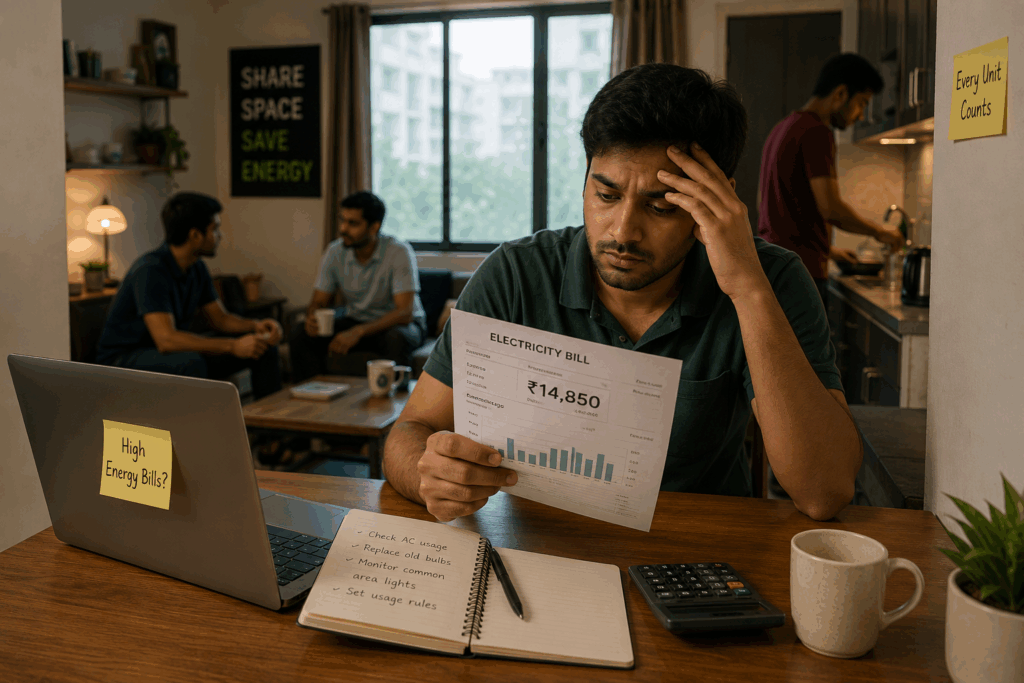
Most PG owners review electricity expenses only after receiving the monthly bill. By then, the excess consumption has already occurred, leaving little opportunity to identify what caused the increase or how it could have been prevented.
Modern property management is increasingly shifting from reactive monitoring to proactive tracking. Instead of waiting for the bill to arrive, successful operators monitor electricity consumption throughout the month, allowing them to identify unusual patterns before they become expensive problems.
Consider a simple example.
If an air conditioner develops a maintenance issue and begins consuming more power than usual, the difference may not be noticeable immediately. Over several weeks, however, the additional consumption could translate into a substantial increase in monthly operating costs. Without any monitoring system, this change often goes unnoticed until the utility bill arrives.
The same applies to water pumps running longer than necessary, corridor lighting remaining switched on throughout the day, or common kitchen appliances operating inefficiently because of poor maintenance.
The financial impact becomes much larger when these small inefficiencies occur simultaneously across multiple rooms and properties.
Practical Ways to Reduce Electricity Costs in a Shared PG
Lowering electricity expenses is rarely about implementing one major change. Instead, it comes from improving several operational practices that collectively reduce unnecessary consumption while maintaining a comfortable living environment for tenants.
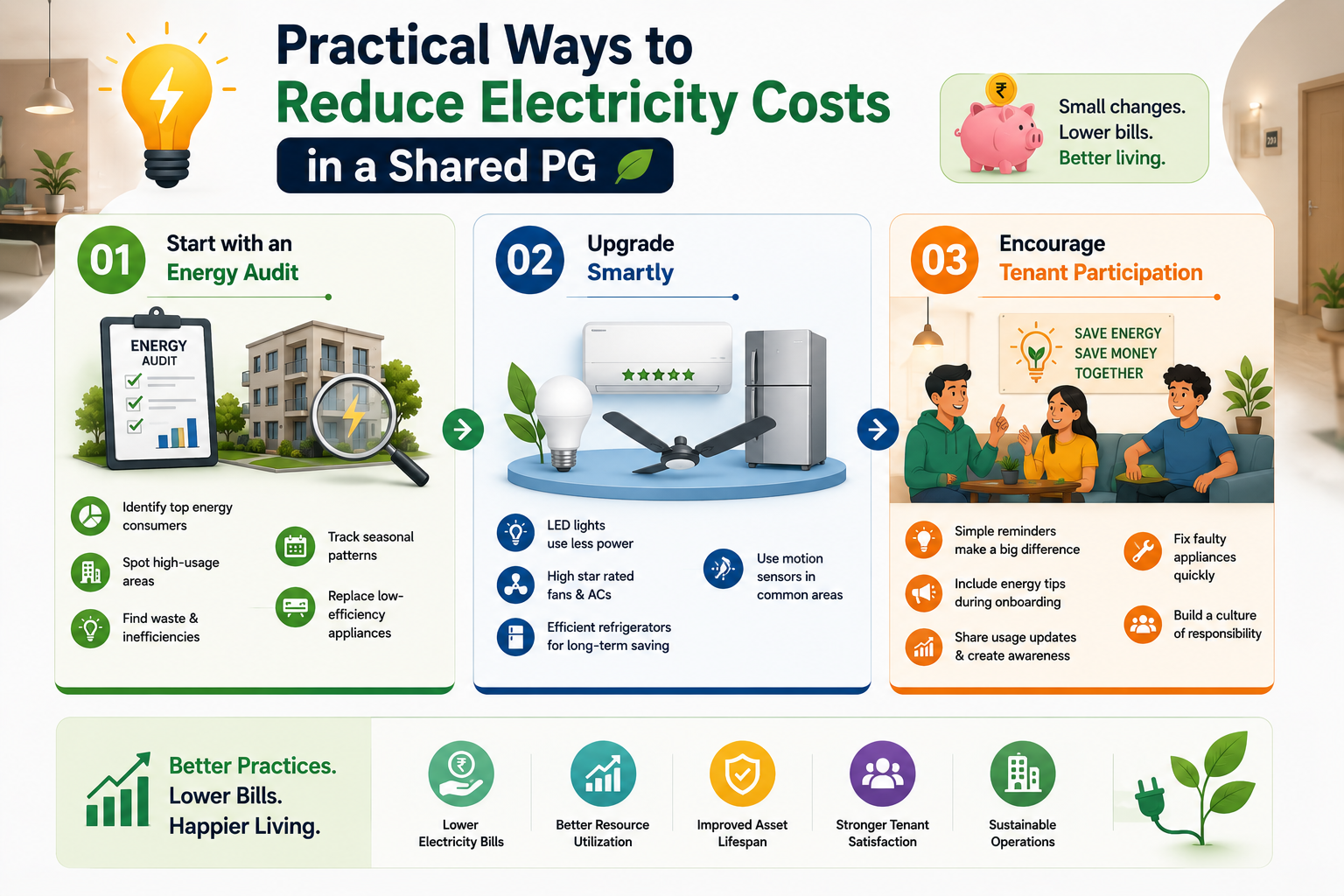
Start with an Energy Audit
Before investing in new equipment or introducing new policies, operators should first understand where electricity is actually being consumed. Many cost-saving initiatives fail because they focus on assumptions instead of actual usage patterns.
An internal energy audit helps answer important operational questions:
- Which appliances contribute the highest share of monthly consumption?
- Are certain floors or rooms consistently using more electricity than others?
- Which common areas remain powered despite limited usage?
- Are seasonal changes affecting consumption more than expected?
- Which appliances require replacement because of declining efficiency?
This exercise provides a clear baseline for future improvements and prevents unnecessary investments in areas that may not significantly reduce costs.
Upgrade High-Consumption Appliances Strategically
Replacing every electrical appliance at once is rarely practical. However, prioritizing equipment that consumes the most electricity can deliver noticeable savings over time.
Operators should evaluate appliances based not only on their age but also on their daily usage. Equipment that runs for several hours every day usually offers the highest return on replacement.
Examples include:
- LED lighting systems that consume significantly less electricity while providing better illumination throughout rooms and common areas.
- Energy-efficient ceiling fans and air conditioners with higher star ratings, particularly in properties where cooling equipment operates extensively during summer months.
- Refrigerators designed for commercial or high-occupancy usage, which maintain consistent cooling while reducing long-term energy consumption.
- Motion-sensor lighting in staircases, corridors, and washrooms where lights often remain switched on despite limited movement.
Rather than viewing these upgrades as expenses, experienced operators treat them as long-term operational investments that gradually reduce recurring utility costs.
Encourage Responsible Tenant Participation
Electricity management cannot rely entirely on infrastructure improvements. Tenant behaviour also plays a significant role, especially in shared accommodations where multiple residents use common resources throughout the day.
The objective should never be to impose restrictive rules. Instead, operators should create awareness around responsible energy usage while ensuring that tenants continue enjoying a comfortable living experience.
Simple initiatives can make a noticeable difference over time:
- Display clear reminders in common areas encouraging residents to switch off fans, lights, and air conditioners before leaving their rooms.
- Include energy-saving practices during tenant onboarding so residents understand the property’s expectations from the beginning rather than learning them through repeated reminders later.
- Share periodic updates on electricity consumption trends to encourage collective responsibility, especially in student housing where community participation often improves compliance naturally.
- Address maintenance complaints involving electrical appliances quickly, as faulty equipment frequently consumes more electricity while delivering poorer performance.
When tenants understand that efficient energy usage contributes to better facilities, stable operational costs, and improved property management, they are generally more willing to participate without feeling restricted.
Preventive Maintenance Is One of the Most Overlooked Cost-Saving Strategies
Many property owners focus on reducing electricity costs by changing tenant behaviour or replacing appliances. While both are effective, one of the biggest opportunities often lies in something much simpler, regular maintenance.
Electrical appliances gradually become less efficient over time. Dust accumulation, clogged filters, loose wiring, and neglected servicing force equipment to work harder to deliver the same performance. As a result, electricity consumption increases even though tenants don’t notice any significant difference in usage.
A well-maintained property doesn’t just reduce maintenance complaints; it also operates more efficiently from an energy perspective. Small servicing tasks performed consistently can prevent unnecessary power consumption throughout the year.
Some maintenance practices that deliver long-term savings include:
- Cleaning air conditioner filters before every peak summer season, as dirty filters restrict airflow, forcing the compressor to consume more electricity while delivering lower cooling efficiency.
- Inspecting water pumps and electrical motors regularly to ensure they are operating within their recommended load capacity instead of consuming additional power because of wear and tear.
- Replacing damaged switches, loose wiring, and ageing electrical fittings before they create voltage fluctuations that affect both energy efficiency and appliance lifespan.
- Scheduling periodic inspections of common-area appliances, including refrigerators, water coolers, washing machines, and kitchen equipment that operate continuously and contribute significantly to monthly electricity consumption.
Preventive maintenance often requires relatively small investments, but it helps operators avoid larger repair costs while keeping monthly utility expenses under control.
Why Smart Metering Is Changing the Way PGs Manage Electricity
One of the biggest challenges in shared accommodation is the lack of visibility. Most PG owners receive a single electricity bill that represents the entire property’s consumption. While this provides the total amount payable, it offers very little insight into where electricity is actually being used.
Without accurate consumption data, operators are often left making assumptions.
Is one floor consuming more electricity than the others? Are common areas responsible for the increase? Is a particular room using significantly more power than average? A consolidated utility bill cannot answer these questions.
This is where smart metering has become increasingly valuable for modern PGs and co-living spaces.
Instead of relying solely on monthly bills, smart metering provides detailed consumption insights that help operators make informed decisions. Rather than reacting to rising costs after they occur, property managers can identify unusual usage patterns much earlier and take corrective action before expenses escalate.
The benefits extend beyond billing accuracy. Smart metering enables operators to:
- Track electricity consumption with greater precision, making it easier to identify rooms or areas where usage is consistently higher than expected.
- Detect unusual consumption patterns early, allowing maintenance teams to investigate faulty appliances or operational issues before they significantly increase utility costs.
- Improve transparency with tenants, especially in properties where electricity charges are calculated separately or based on actual usage rather than fixed estimates.
- Make data-driven investment decisions, helping operators determine whether replacing an appliance or upgrading infrastructure will generate measurable cost savings over time.
As energy costs continue to rise, access to reliable consumption data is becoming just as important as implementing energy-saving practices themselves.
Common Mistakes That Increase Electricity Costs Unnecessarily
Even experienced operators sometimes overlook practices that quietly increase electricity expenses over time. These mistakes may appear minor individually, but together they can have a noticeable impact on operational profitability.
Some of the most common issues include:
- Treating electricity bills as accounting documents instead of operational reports. Reviewing the total amount payable without analysing consumption trends prevents operators from identifying recurring inefficiencies.
- Delaying appliance replacement until equipment completely fails. Older appliances often consume substantially more electricity for months or even years before they stop functioning altogether.
- Ignoring seasonal planning. Peak summer months naturally increase electricity usage, but proactive maintenance and equipment servicing before the season begins can reduce avoidable consumption.
- Using fixed electricity charges despite highly variable consumption. In some properties, this discourages responsible usage because tenants do not directly see the impact of excessive consumption.
- Relying entirely on manual monitoring. As occupancy grows, manually tracking electricity usage across multiple rooms and properties becomes increasingly difficult, making it easier for wastage to go unnoticed.
Avoiding these mistakes is often more cost-effective than introducing expensive infrastructure changes later.
Building an Energy-Conscious Property Culture
Technology certainly plays an important role in reducing electricity costs, but long-term success depends equally on creating a culture of responsible energy usage.
The most efficient PGs are not necessarily those with the newest infrastructure. They are the ones where management, staff, and tenants collectively understand that electricity is a shared operational resource.
Creating this culture doesn’t require strict enforcement or constant reminders. Instead, it involves establishing simple operational habits that become part of everyday property management.
For example, managers can review electricity trends during monthly operational meetings, maintenance teams can report inefficient equipment before it becomes a larger problem, and tenants can be encouraged to follow practical energy-saving practices without feeling restricted.
Over time, these small behavioural improvements complement technological investments and create sustainable reductions in electricity costs.

How RentOk Helps You Manage Electricity More Efficiently
Managing electricity costs becomes increasingly difficult as a property expands. Tracking consumption manually, resolving billing disputes, and identifying energy wastage across multiple rooms or buildings often requires significant time while still leaving operators with limited visibility.
RentOk’s Smart Metering feature helps property owners simplify electricity management by providing better visibility into consumption patterns and making billing more transparent. Instead of relying solely on consolidated electricity bills, operators can monitor usage more effectively, improve billing accuracy, and reduce disputes related to electricity charges.
When combined with RentOk’s broader property management platform, including expense tracking, tenant management, rent collection, and operational reporting, property owners gain a more complete understanding of where operational costs originate and how they can be controlled.
If you’re also looking to improve billing transparency, you may find our guide on electricity sub-metering for PGs useful. Similarly, understanding how to prevent electricity billing disputes can help create a smoother experience for both operators and tenants.
Conclusion
Reducing electricity costs in a shared PG isn’t about restricting tenants or constantly reminding them to switch off appliances. It’s about building smarter operational processes that make energy management more efficient without compromising the living experience.
From conducting regular energy audits and maintaining electrical equipment to adopting energy-efficient appliances and monitoring consumption patterns, every improvement contributes to lower operating costs and better profitability over time. As electricity prices continue to rise, property owners who proactively manage energy usage will be better equipped to maintain healthy margins while delivering a comfortable experience for their tenants.
Looking to simplify electricity management and optimize your property’s day-to-day operations? Book a demo with RentOk to see how our all-in-one property management platform helps you streamline electricity billing, automate operational workflows, improve cost visibility, and manage your PG business more efficiently, all from a single dashboard.
Frequently Asked Questions
Find answers to common questions about this topic
About the Author
Ishika Pannu
Ishika Pannu brings you the latest insights and easy-to-apply strategies in property management—helping you simplify renting and grow with RentOk.