Property Management
Handling Electricity Bill Disputes with Digital Sub-Meter Tracking

Written by
Ishika Pannu
Read Time
9 min read
Posted on
June 6, 2026
Overview
Overview
Handling Electricity Bill Disputes with Digital Sub-Meter Tracking
Electricity billing is one of the most common causes of disagreements between tenants and property managers. Unlike rent, which remains fixed every month, electricity charges fluctuate based on usage patterns, occupancy levels, seasonal changes, and appliance consumption. As a result, tenants often scrutinize electricity bills much more closely than any other charge they receive.
For PG owners and hostel operators, this creates a unique operational challenge. A bill may be completely accurate, yet still trigger questions because the tenant cannot clearly see how the final amount was calculated. The problem becomes even more noticeable in larger properties where dozens of rooms need to be billed every month and meter readings are often recorded manually.
Over time, these disputes start affecting much more than utility collections. Property managers spend valuable hours explaining bills, caretakers repeatedly revisit old records, and tenants begin questioning the transparency of the management process. In many cases, the issue is not the calculation itself. The issue is visibility.
This is why professional PG operators are increasingly moving towards digital utility tracking. Recording sub-meter readings on a phone, maintaining historical records, and automating calculations creates a far more transparent process for both management and residents. More importantly, it helps prevent disputes before they begin.
Why Electricity Leads to Fights More Often Than Other Charges
Most rental expenses are predictable. Tenants know the rent amount before moving in. Security deposits are discussed during onboarding. Even housekeeping or maintenance charges are usually fixed and easy to understand.
Electricity works differently because consumption changes constantly.
A tenant who spends most of the day outside may use significantly less power than someone working remotely from their room. During summer months, air conditioners can dramatically increase consumption. Similarly, appliances such as refrigerators, induction cooktops, and geysers can influence usage patterns in ways that tenants often underestimate.
This creates a gap between expectation and reality.
Some of the most common situations that lead to billing disputes include:
- Tenants comparing their current bill with previous months without accounting for seasonal changes in electricity usage or increased appliance consumption.
- Residents assuming their electricity costs should match those of friends or roommates, despite having completely different usage habits.
- Meter readings being recorded manually and becoming difficult to verify later when questions arise regarding historical consumption.
- Room changes, move-ins, and move-outs creating confusion around which tenant is responsible for a particular billing period.
The important thing to understand is that most disputes are not accusations of overcharging. They are requests for clarity. When residents can clearly understand how a bill was generated, they are far more likely to accept the outcome, even if the amount is higher than expected.

The Hidden Problems With Manual Meter Tracking
Many PGs still rely on a process that has remained largely unchanged for years. A caretaker walks through the property, notes down meter readings in a register, and later transfers the information into a spreadsheet or billing sheet.
At first, this seems perfectly manageable.
The challenge appears when occupancy increases.
A property with 15 rooms may only require a few minutes to record readings every month. A property with 100 rooms creates an entirely different operational workload. Now the management team is dealing with hundreds of readings, calculations, and billing records throughout the year.
Manual systems often create problems such as:
- Handwritten readings becoming difficult to interpret after several weeks, especially when different staff members record information differently.
- Historical data being scattered across notebooks, spreadsheets, and WhatsApp conversations, making dispute resolution unnecessarily time-consuming.
- Calculation errors occurring because readings need to be transferred between multiple systems before final bills are generated.
- Delays in record updates causing confusion regarding which reading belongs to which billing cycle.
Individually, these issues may seem minor. Collectively, they create a process that relies heavily on memory, manual effort, and staff consistency. The larger the property becomes, the harder it is to maintain accuracy through manual systems alone.
Recording Readings Digitally Creates Immediate Transparency
One of the biggest advantages of digital utility tracking is visibility.
When meter readings are recorded directly through a mobile device, information becomes centralized and searchable. Instead of depending on physical registers or multiple spreadsheets, operators gain access to a structured utility history for every room.
This changes how electricity management works.
Rather than searching for old records whenever a tenant raises a question, management can access relevant information almost instantly. The discussion shifts from proving that a bill is correct to explaining why consumption increased or decreased.
Digital recording also improves consistency across the property.
Some key benefits include:
- Every reading follows the same process, reducing variation between different staff members and improving overall data reliability.
- Utility records remain accessible even if caretakers or managers change, ensuring operational continuity.
- Historical consumption becomes easier to review, helping management identify trends rather than focusing only on current bills.
- Room-level utility data can be accessed quickly whenever questions arise, reducing the time required to resolve disputes.
The operational value of this visibility becomes more apparent as occupancy grows. What may feel like a small improvement at 20 tenants can become a significant advantage at 100 tenants.
Why Photo-Based Meter Recording Is Becoming Popular
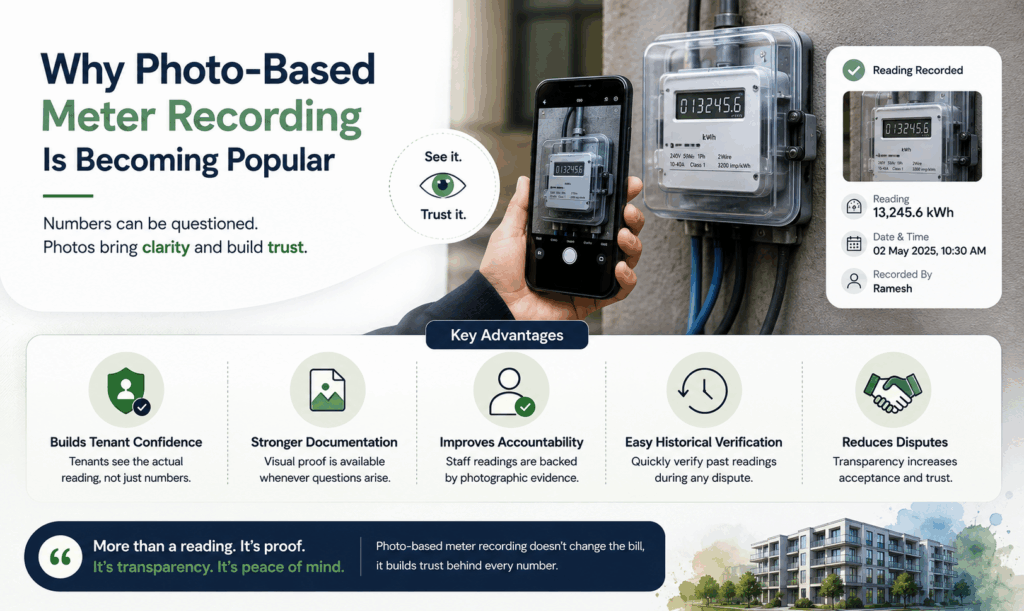
Numbers alone are not always enough to build trust.
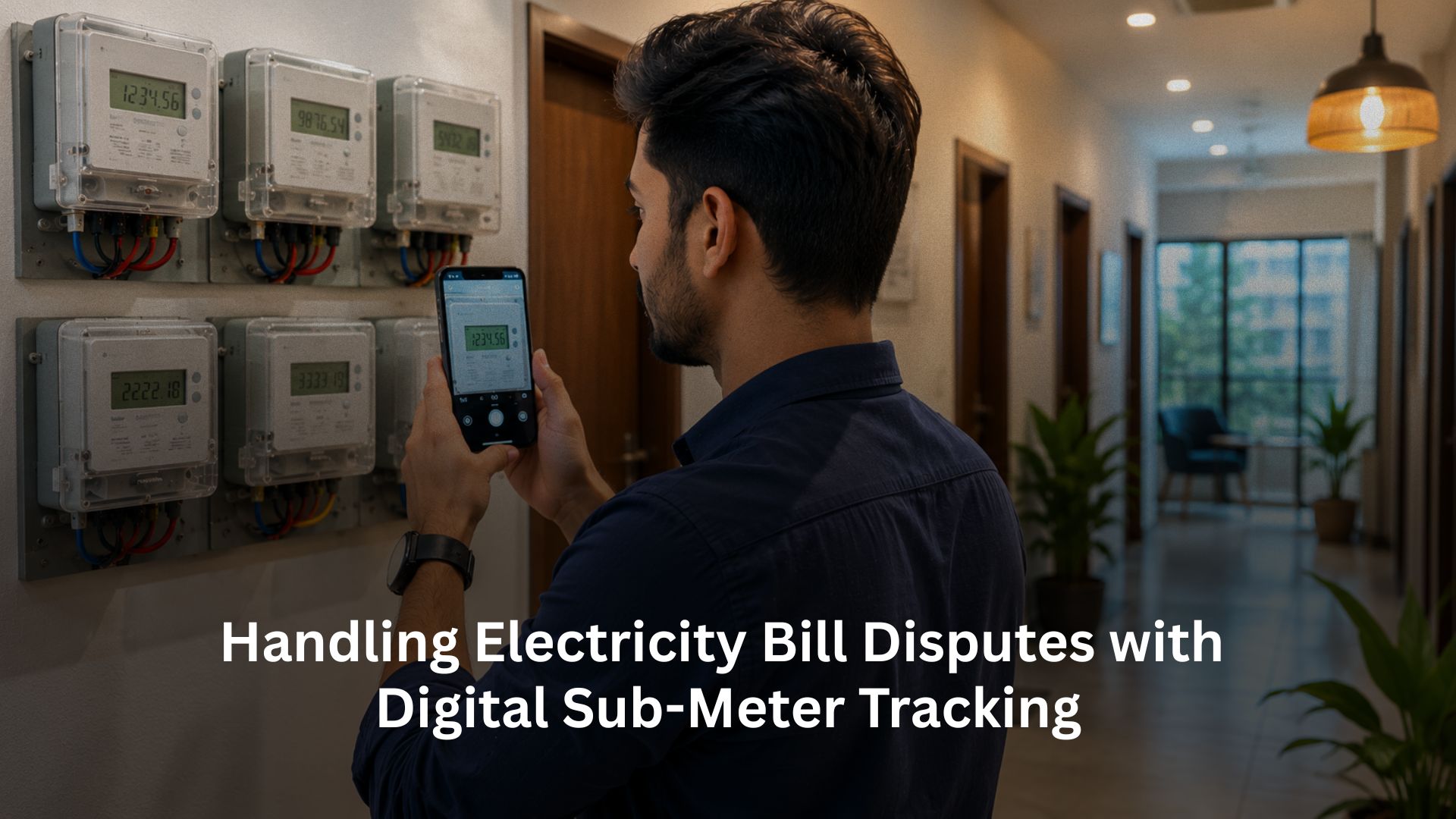
A tenant who receives a higher-than-expected bill may still question the reading, even if the calculation is accurate. This is where photo-based meter recording becomes particularly useful.
Instead of simply entering a reading into the system, staff can capture an image of the meter at the same time. The photograph acts as supporting evidence that validates the recorded value.
This simple step creates several advantages:
- Tenants gain greater confidence because they can see the actual reading rather than relying entirely on written records.
- Property managers have visual documentation available whenever billing questions arise.
- Staff accountability improves because readings are supported by photographic evidence.
- Historical verification becomes significantly easier during disputes involving older billing cycles.
Many operators discover that photo-based documentation reduces disputes not because it changes the bill, but because it increases transparency. People are generally more comfortable accepting a charge when they can see the source of the information behind it.
Auto-Calculating Units Reduces Human Error
Recording readings accurately is important, but calculation errors can still create problems later.
While the formula itself is simple, manually calculating electricity usage across dozens of rooms every month introduces unnecessary risk. Small mistakes can lead to incorrect bills, tenant complaints, and additional administrative work.
Common calculation-related issues include:
- Incorrect previous readings being referenced during the billing process.
- Spreadsheet formulas being accidentally modified or applied inconsistently.
- Data entry mistakes causing unit consumption figures to appear higher or lower than actual usage.
- Delays in bill generation because calculations need to be reviewed manually before being shared with tenants.
Digital utility tracking systems eliminate much of this risk by automating calculations.
Once a reading is entered, the system automatically compares it against the previous reading and calculates units consumed. This creates a standardized billing process that is consistent across every room.
The operational benefits are substantial:
- Bills can be generated faster because calculations no longer depend on manual review.
- Accuracy improves because the same calculation logic is applied consistently throughout the property.
- Staff spend less time handling repetitive administrative work.
- Management gains greater confidence in billing accuracy and dispute resolution.
For larger PGs, automation often saves several hours every month while simultaneously reducing billing-related complaints.
Historical Bill Records Are Often the Real Solution
When tenants question electricity bills, they are rarely interested only in the current month’s reading. Most of the time, they want context.
They want to understand:
- Why consumption increased.
- Whether usage has changed over time.
- How the current bill compares with previous months.
- Whether the increase is temporary or part of a longer trend.
Without historical records, these conversations become difficult.
Digital utility tracking creates a complete consumption history that can be reviewed whenever required.
This helps operators:
- Compare current consumption against previous billing cycles and identify genuine changes in usage patterns.
- Understand seasonal fluctuations that naturally affect electricity bills throughout the year.
- Detect unusual spikes that may indicate appliance issues, maintenance problems, or incorrect readings.
- Provide tenants with clear explanations backed by historical data rather than assumptions.
Historical visibility transforms billing discussions from emotional debates into fact-based conversations. That is one of the most powerful advantages of digital utility management.
Why Utility Tracking Becomes More Important as Occupancy Grows
The operational impact of electricity management increases significantly as a property expands.
At smaller occupancies, manual systems may still feel manageable. However, as tenant numbers increase, utility tracking becomes connected to multiple operational functions.
Operators need visibility into:
- Room-wise electricity consumption and utility dues.
- Move-in and move-out billing adjustments.
- Occupancy-related utility trends and consumption patterns.
- Financial reporting and monthly profitability analysis.
- Tenant payment history and utility collections.
Without structured tracking, these processes become increasingly difficult to manage efficiently.
This is why many professionally managed PGs now treat utility management as part of their operational infrastructure rather than simply a monthly administrative task. The objective is no longer just generating bills. The objective is creating a transparent, scalable process that continues working effectively as occupancy grows.
How RentOk Helps Simplify Electricity Management
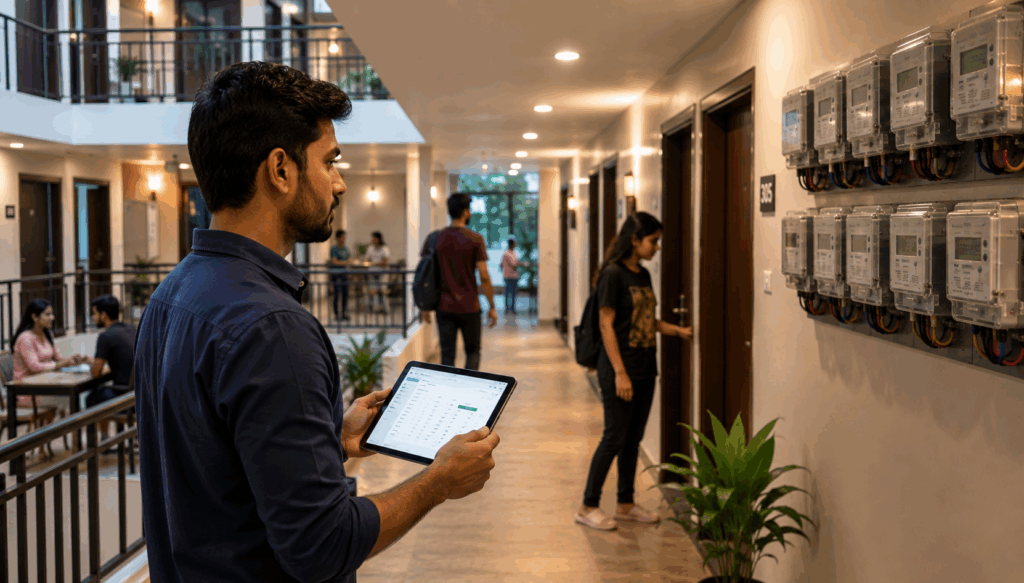
Managing electricity billing through registers, spreadsheets, and scattered records becomes increasingly difficult as occupancy grows. What starts as a simple monthly process often turns into a workflow involving meter tracking, billing calculations, payment verification, historical record management, and dispute resolution.
RentOk helps PG operators centralize utility management by bringing together sub-meter readings, tenant records, electricity billing, payment tracking, and historical consumption data within one connected platform.
This helps operators:
- Maintain organized utility records without relying on multiple disconnected systems.
- Access historical readings quickly whenever tenants have billing questions.
- Improve billing transparency through structured utility tracking.
- Reduce manual calculations and administrative effort associated with utility management.
- Gain better visibility into room-level electricity consumption across the property.
As rental operations grow, having utility management integrated with broader property operations creates a more efficient and scalable workflow.
Conclusion
Electricity disputes are rarely caused by electricity itself. More often, they occur because tenants lack visibility into how their bills were generated and property managers struggle to provide quick, verifiable explanations.
By recording sub-meter readings digitally, maintaining historical consumption records, and automating calculations, operators can create a much more transparent billing process. This not only reduces disputes but also improves operational efficiency, tenant trust, and overall utility management.
As PGs, hostels, and co-living spaces continue becoming more professionally managed, digital utility tracking is quickly moving from a convenience feature to an operational necessity.
If you’re looking to improve billing transparency, reduce utility-related disputes, and simplify electricity management across your property, explore RentOk and discover how structured utility tracking can help create a more organized and scalable rental operation.
About the Author
Ishika Pannu
Ishika Pannu brings you the latest insights and easy-to-apply strategies in property management—helping you simplify renting and grow with RentOk.