Property Management
The Real Cost of Manual Paperwork in Your PG Business


Written by
Ishika Pannu
Read Time
7 min read
Posted on
June 7, 2026
Overview
Overview
The Real Cost of Manual Paperwork in Your PG Business
Most PG owners believe that occupancy is the biggest factor affecting profitability. If rooms are full and rent is being collected on time, the business should be doing well. While occupancy certainly plays a major role, it is often not the reason profits remain stagnant despite strong demand.
The reality is that many PG businesses lose money through operational leakages that are difficult to notice. These leakages do not appear as a single large expense or a major financial mistake. Instead, they accumulate through dozens of small inefficiencies that become part of everyday operations. A missed utility charge, an unrecorded payment, a forgotten penalty, or hours spent manually updating records may not seem significant individually. Over time, however, these small issues create a measurable impact on profitability.
This is one of the reasons why two PGs with similar occupancy levels can produce very different financial outcomes. One operator has complete visibility into collections, expenses, and tenant records, while the other is constantly trying to piece together information from registers, spreadsheets, and WhatsApp chats.
The question is not whether manual paperwork creates problems. The real question is how much those problems are costing the business every month.
Calculation Errors in Tenant Dues Can Quietly Drain Revenue
Most PG operators are not just collecting rent. They are managing electricity charges, maintenance recoveries, meal plans, security deposits, damage deductions, and a variety of other tenant-related expenses. As occupancy grows, keeping track of these charges manually becomes increasingly difficult.
At smaller occupancies, owners often catch mistakes quickly because they are closely involved in daily operations. Once the property starts managing dozens or hundreds of tenants, however, even small errors can remain unnoticed for months. The challenge is not usually a lack of effort. The challenge is that manual systems depend on constant updates, cross-checking, and data entry.
Some of the most common billing-related leakages include:
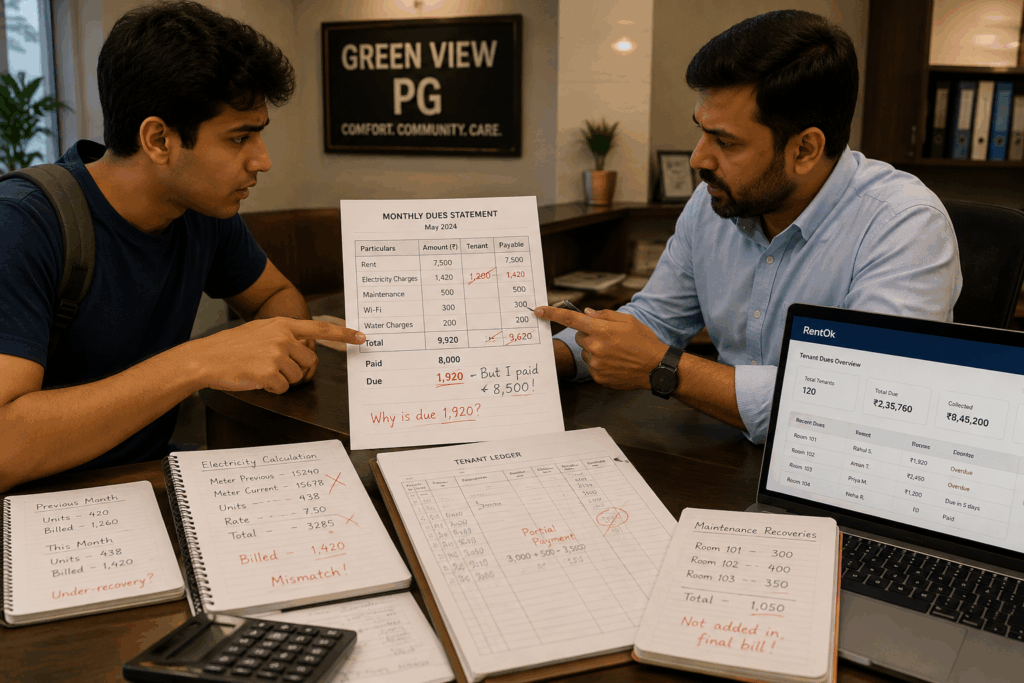
- Electricity charges being calculated using outdated meter readings, leading to under-recovery that may continue for several billing cycles before anyone notices the discrepancy.
- Partial rent payments being marked as fully settled because payment confirmations and tenant ledgers are updated separately, creating inaccurate due reports.
- Security deposit adjustments being missed during move-outs because agreements, settlement records, and payment details are stored across different files.
- Maintenance recoveries and damage-related deductions being discussed with tenants but never formally added to the final settlement amount.
While each of these mistakes may involve only a few hundred rupees, the cumulative impact can become substantial over the course of a year. More importantly, these losses often remain invisible because there is no centralized system showing where money is being missed.
Many operators assume that if collections look healthy, billing must also be accurate. In reality, revenue can leak slowly through small calculation errors that rarely attract immediate attention.
The Hidden Cost of Staff Time Is Bigger Than Most Owners Realize
When owners think about operational costs, they usually focus on visible expenses such as salaries, utilities, maintenance, and vendor payments. What often gets overlooked is the amount of productive time being consumed by administrative work.
Every manual process requires attention. Payments need to be verified. Occupancy records need updating. Utility bills need reconciliation. Reports need preparation. Complaints need tracking. Individually, these tasks appear manageable. Together, they create a significant workload that grows with occupancy.
In many properties, administrative work includes:
- Matching incoming payments against tenant records and ensuring balances are updated correctly across multiple spreadsheets or registers.
- Preparing occupancy and collection reports by gathering information from different sources instead of accessing it through a single dashboard.
- Following up with tenants regarding pending dues, documentation requirements, electricity bills, and move-out settlements.
- Reconciling maintenance expenses, utility charges, and miscellaneous recoveries that require repeated verification.
The financial impact is not limited to salary costs. There is also an opportunity cost attached to every hour spent on paperwork. Time spent updating records is time that cannot be used to improve occupancy, enhance tenant experience, strengthen marketing efforts, or optimize operations.
This is why many growing PGs eventually find themselves hiring additional staff just to manage administrative complexity. The issue is not necessarily a shortage of manpower. Often, it is a shortage of operational efficiency.
Missing Fine Collections Hurt More Than Just Revenue
Late fees are intended to encourage timely payments and maintain financial discipline across the property. However, in many PGs, penalty tracking remains largely manual. As a result, some tenants are charged correctly while others are missed entirely.
This inconsistency creates a much larger problem than the lost penalty amount itself.
When residents notice that enforcement varies from case to case, payment timelines become less important. Delays increase because there is uncertainty around consequences. Over time, collection behavior starts changing across the property.
Properties that struggle with penalty tracking often experience:
- Higher instances of delayed payments because tenants do not view due dates as strict deadlines.
- Increased administrative workload as staff spend more time following up on overdue balances.
- Reduced cash flow predictability because outstanding dues become harder to monitor accurately.
- Additional reconciliation work because penalties and adjustments must be calculated manually after delays occur.
The goal of a penalty system is not to maximize collections from late fees. The real objective is to create predictable payment behavior that improves overall financial stability.
Consistent processes are usually more effective than aggressive penalties. When tenants clearly understand expectations and those expectations are enforced uniformly, payment discipline improves naturally.
Why Digital Transparency Creates Better Business Decisions
One of the biggest misconceptions about property management software is that its primary purpose is automation. While automation certainly saves time, the greater advantage is visibility.
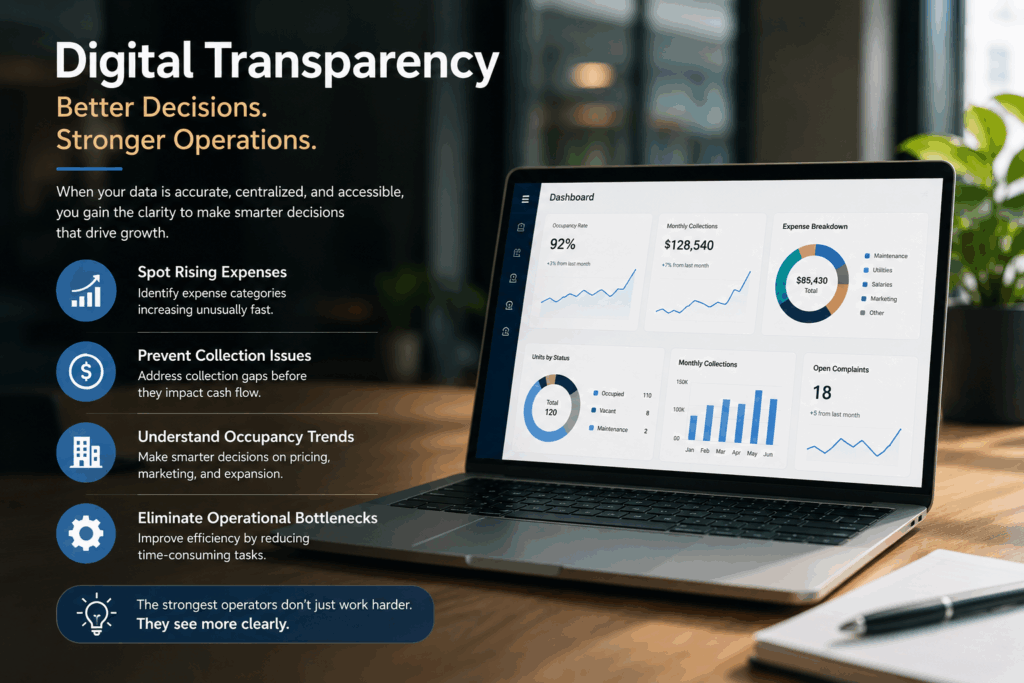
When collections, expenses, occupancy, utility charges, complaints, and tenant records are maintained within a centralized system, operators gain a much clearer understanding of how the business is performing. Instead of spending hours gathering information, they can focus on analyzing it.
Better visibility helps operators identify:
- Expense categories that are increasing unusually fast and require closer monitoring.
- Collection issues before they begin affecting monthly cash flow.
- Occupancy trends that influence pricing, marketing, and expansion decisions.
- Operational bottlenecks that consume excessive staff time and reduce efficiency.
The strongest operators are not necessarily the busiest operators. They are often the ones with the clearest understanding of what is happening inside their business.
When information is accurate, centralized, and easily accessible, decision-making becomes faster and more effective. That advantage becomes increasingly valuable as occupancy grows.
How RentOk Helps Eliminate Hidden Revenue Leakages
As PG operations expand, managing information through registers, spreadsheets, and disconnected communication channels becomes increasingly difficult. The challenge is not collecting information. The challenge is maintaining accuracy, consistency, and visibility across every operational workflow.
RentOk helps operators centralize rent collection, occupancy tracking, utility billing, expense management, complaint handling, and tenant records within one connected platform. Instead of switching between multiple systems, property owners gain access to a single source of truth for their operations.
With RentOk, operators can:
- Track rent collections, pending dues, and payment histories more accurately while reducing reconciliation errors.
- Monitor operational expenses and vendor payments with greater visibility, helping identify unusual spending patterns early.
- Manage occupancy, move-ins, move-outs, and tenant records through structured workflows that reduce administrative effort.
- Generate reports quickly and access business insights without spending hours compiling information manually.
The result is not just better organization. It is greater control over the financial and operational health of the business.
Conclusion
The biggest cost of manual paperwork is rarely the notebook, spreadsheet, or register itself. The real cost comes from the operational inefficiencies these systems create as a property grows. Small billing mistakes, missed recoveries, delayed collections, fragmented records, and excessive administrative effort may seem harmless individually, but together they can have a significant impact on profitability.
The most successful PG operators understand that growth is not only about increasing occupancy. It is about building systems that protect revenue, improve visibility, and make operations easier to manage at scale. If you’re looking to reduce hidden business leakages, improve operational efficiency, and gain better control over your property, explore RentOk and discover how a modern property management platform can help you build a more profitable and scalable rental business.
About the Author
Ishika Pannu
Ishika Pannu brings you the latest insights and easy-to-apply strategies in property management—helping you simplify renting and grow with RentOk.