Legal
Can a PG Admit Students Under 18? Rules, Parent Consent and Responsibility

Written by
Ishika Pannu
Read Time
11 min read
Posted on
November 20, 2026
Overview
Overview
Can a PG Admit Students Under 18? Rules, Parent Consent and Responsibility
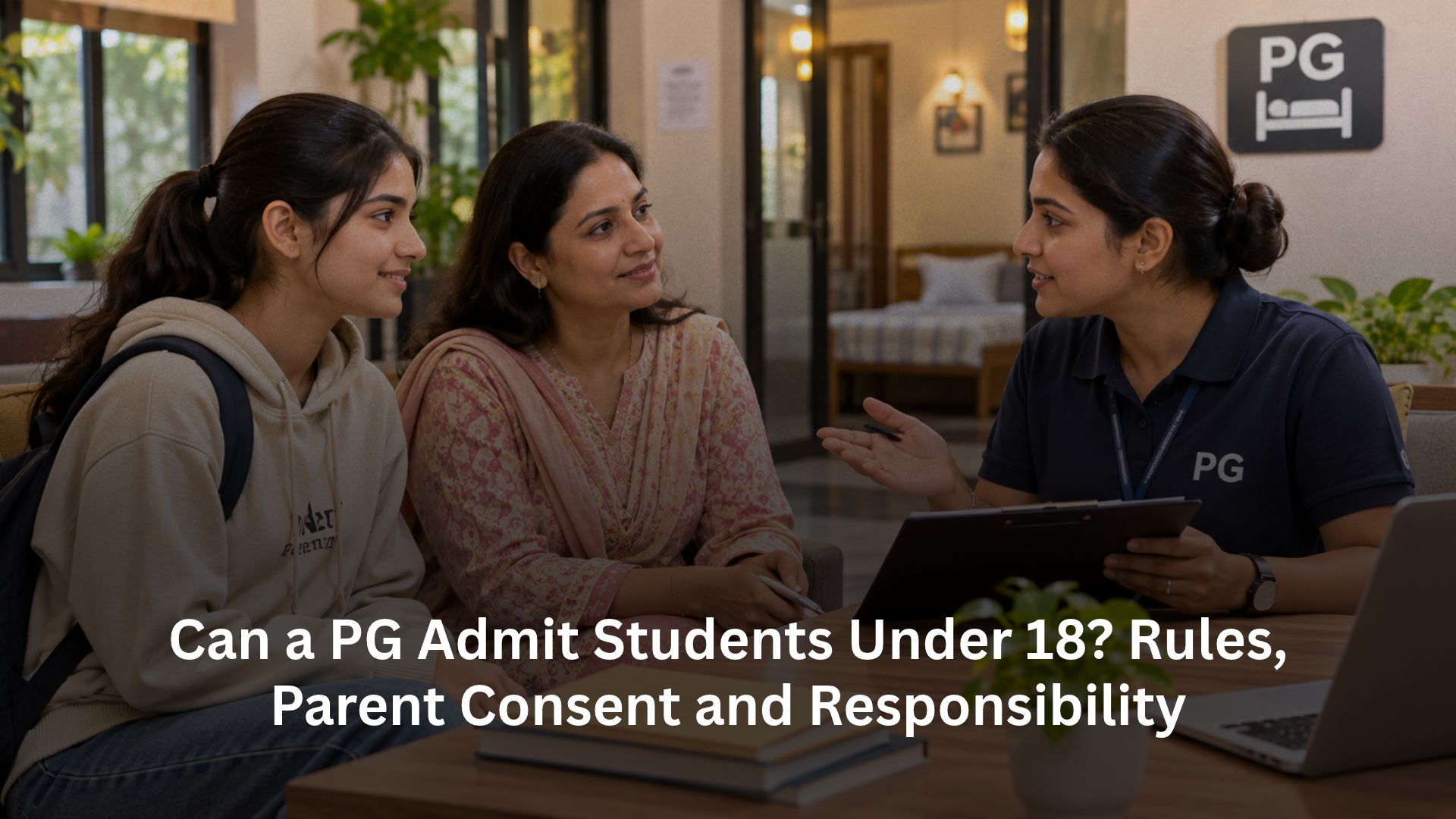
A student can finish school, secure college admission and need accommodation before turning 18. Finding a PG for minors then involves more than comparing rent and distance from campus. The family and operator need to establish whether the property admits younger residents, who accepts the financial obligations and what supervision the PG actually provides.
A PG may admit an under-18 student where applicable local rules and permissions allow it. Parent or legal-guardian involvement, written consent and an appropriately drafted adult contractual undertaking should form part of admission. Consent alone does not authorise an unsuitable property to accommodate children or remove safety duties. This guide concerns paying guest accommodation, including a PG for a 17-year-old, rather than postgraduate university programmes.
Can a minor sign a rent agreement?
Under section 3 of the Majority Act, 1875, a person domiciled in India ordinarily reaches majority at 18. Section 11 of the Indian Contract Act, 1872 makes contractual competence depend on majority, soundness of mind and the absence of legal disqualification.
The practical consequence is that an operator should not rely on a minor’s signature alone to enforce ordinary rent and payment promises. A student might acknowledge house rules, but that acknowledgement does not give them adult contractual capacity.
The document’s title does not solve the problem. Calling it a “PG licence,” “student declaration” or “rent agreement” cannot change the resident’s age. Nor does an electronic signature cure a lack of capacity. The arrangement needs an appropriate adult contracting structure.
Section 68 of the Contract Act separately addresses reimbursement from an incapable person’s property for qualifying necessaries. That limited provision is not permission to treat every PG charge or penalty as an enforceable personal debt against a child.
Before preparing the paperwork, also confirm the property’s admission conditions and approvals. RentOk’s guide to checking whether a PG has the required registrations explains why one certificate cannot establish every aspect of compliance.
Parent consent and financial responsibility need separate wording
A parent’s consent answers, “May my child stay here?” An adult contractual undertaking answers, “Which obligations do I personally accept?” These are related documents or clauses, not interchangeable promises. A parent signing only as a witness or emergency contact may not accept the payment obligations the operator assumes.
Identify the parent or legal guardian and state their role clearly. A local relative authorised to collect the student is not automatically a legal guardian. Where someone claims legal guardianship, check the supporting authority appropriate to that arrangement.
The adult should review:
- Charges and payment: Specify rent, meal charges, utilities, deposit, payment dates and the adult’s agreed responsibility. Avoid a vague promise to pay “anything demanded.”
- Departure terms: Record notice, any lock-in conditions, permitted deductions, the refund process and who receives the refund.
- Accommodation and supervision: Identify the property, room or bed, stay period, designated contact and the supervision the operator actually offers.
- Permissions and communication: Set out visitor, leave and collection arrangements, emergency contacts and how staff will communicate important incidents.
RentOk’s PG agreement format guide provides a useful clause checklist, but a generic adult-resident template needs appropriate adaptation.
Use a legally reviewed adult obligation rather than assuming that the word “guarantor” validates a minor’s otherwise unenforceable promise. Follow applicable stamping and registration requirements too. A signed consent letter is a sensible admission record; it is not a nationwide licence to admit minors or a waiver of the operator’s legal duties.
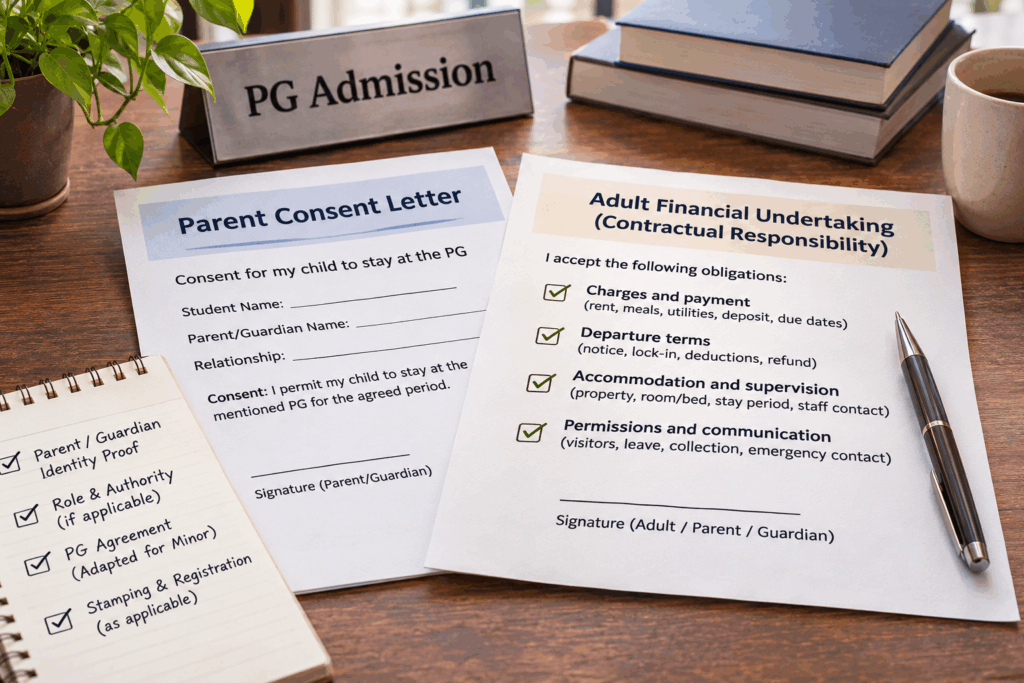
An under-18 admission file needs more than one ID
Use a checklist suited to the property and local requirements. There is no single document bundle that automatically authorises every Indian PG to admit minors. Collect what establishes age, identity, authority and the agreed arrangement, without demanding every personal document available.
| Record | What it helps establish |
|---|---|
| Accepted age evidence, such as a birth certificate or suitable school record | Whether the resident needs the under-18 process |
| Student identity and educational details | Who will occupy the accommodation and their institution, where relevant |
| Parent or guardian identity, address and authority | Who has consented and accepted the stated adult obligations |
| Consent and appropriately executed agreement | Stay terms, charges, permissions and responsibilities |
| Primary and backup contacts | Who staff should contact, and in what order |
| Relevant health information and emergency plan | Allergies, essential medication information and necessary response arrangements |
| Required local verification acknowledgement | What the relevant police or government process actually recorded |
Confirm the parent’s contact details directly before admission, rather than relying only on a number supplied in a forwarded message. Record who can collect the student and how staff will verify a change. If guardianship or collection authority is disputed, seek clarification before accepting conflicting instructions.
Explain why each record is necessary and control access to sensitive information. Check originals where appropriate and return them; a minor’s academic certificates should not become rent security.
RentOk’s student tenant-verification guide explains why current and permanent addresses, identity checks and local police procedures need separate attention. Record completion and acknowledgements rather than assuming that an Aadhaar copy completes police verification.
Safety duties continue after a parent signs
Parents should inspect the premises and ask who is responsible during the day, overnight and when the usual manager is absent. A marketing promise of “warden support” needs a clear explanation of availability and response. An unattended shared flat may not provide the supervision a particular child needs.
NCPCR’s guidelines for hostels of educational institutions for children address matters including staffing, supervision and safety. Check their scope, applicable state implementation and local directions with the competent authority. Do not present every guideline as an identical nationwide licensing rule for all commercial PGs.
For the premises, examine clear escape routes, electrical condition, drinking water, hygiene, access control and appropriate staff screening. RentOk’s PG fire-safety guide helps families ask practical questions beyond whether an extinguisher hangs on a wall.
Emergencies and safeguarding need an actual response plan
Record who calls the parent, who accompanies the student to hospital and the backup contact. Seek urgent medical help when needed rather than delaying emergency assistance for routine paperwork. Medical professionals determine the consent and emergency-care requirements; a generic admission signature does not authorise every future procedure. The NMC’s medical-ethics regulations address parent or guardian consent for a minor’s operation and a doctor’s duty in emergencies.
If the circumstances trigger reporting under section 19 of the POCSO Act, information must go to the Special Juvenile Police Unit or local police. An operator cannot replace that duty with a private settlement or parental request for silence. The statutory reporting provision applies independently of the PG agreement.

Which house rules are appropriate for younger residents?
Agree on rules before admission and explain them to both the student and the parent. Rules should address realistic situations, including a late laboratory session, a parent collecting the student or a delayed journey home. A curfew without a safe late-entry procedure can create its own risk.
Useful rules cover:
- Entry and absence: Define usual return times, how to request an exception, whom staff contact after an unexplained absence and how they respond to a welfare concern.
- Visitors and collection: Identify permitted visitors, meeting areas and authorised collection arrangements. Check identity rather than releasing a resident solely because someone claims to be a relative.
- Overnight leave: Record destination, dates, transport arrangements where relevant and the parent’s approval process; distinguish approval from a casual message to another resident.
- Everyday conduct: Explain appliance restrictions, quiet hours, shared-space responsibilities and complaint routes in language the student understands.
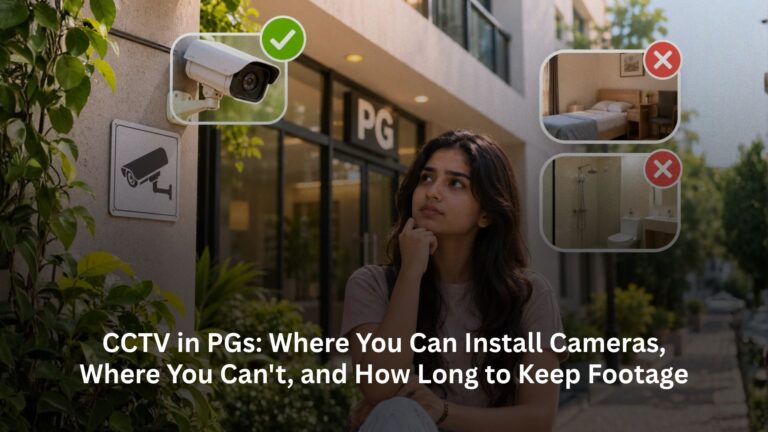
Rules should not become permission for humiliation, violence, unsafe confinement or intrusive surveillance. Younger residents still need privacy and dignity. RentOk’s guide to CCTV placement and resident privacy explains why private bedrooms and bathrooms are inappropriate monitoring spaces.
For a missing or endangered child, contact the appropriate authorities promptly rather than waiting for an internal disciplinary process. The Ministry of Women and Child Development describes Child Helpline 1098 and its integration with emergency services. Routine lateness and an actual safety emergency need different responses.
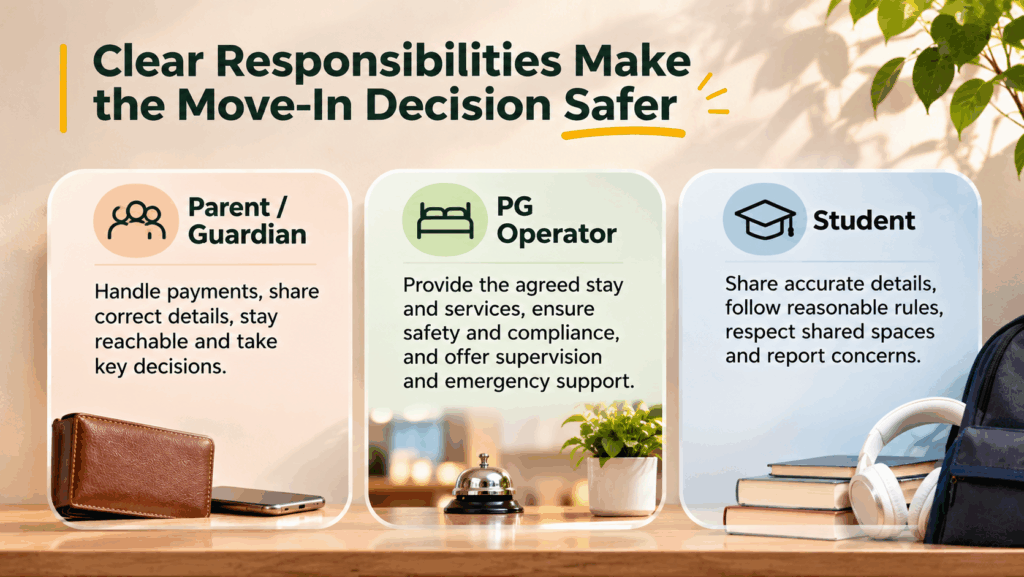
Clear responsibilities make the move-in decision safer
Parents retain their parental responsibilities; a commercial PG does not automatically become the child’s legal guardian. At the same time, “we are not guardians” cannot excuse an operator from agreed supervision, reasonable care or applicable legal obligations.
| Person | Responsibilities to make explicit |
|---|---|
| Parent or legal guardian | Agreed adult payment obligations, accurate information, reachable contacts, permissions and welfare decisions |
| PG operator | Promised accommodation and services, applicable compliance, safe management, agreed supervision and emergency response |
| Student | Accurate information, following reasonable rules, respecting shared spaces and reporting concerns |
Discuss valuables separately: storage arrangements, access, incident reporting and any agreed responsibility. A clause asking residents to secure their belongings does not establish blanket immunity from every loss or negligent act. The facts and applicable law still matter.
Before handing over the keys, confirm that the operator has reviewed the file, the adult has accepted the intended obligations and the student knows whom to approach. Give the family copies of the agreement, rules and emergency contacts. If the property cannot provide appropriate arrangements, choose accommodation equipped for younger residents.
Record the student’s eighteenth birthday as a review point. Reassess contacts, permissions and the agreement when they become an adult; do not assume that turning 18 automatically validates every earlier promise. Arrange appropriate fresh documentation rather than relying on an outdated minor-resident form.
How RentOk helps organise parent details and agreements
Under-18 onboarding needs an identifiable adult contact and a clear record of the agreement’s parties. RentOk’s multi-party agreement release describes a workflow for adding parent or guardian details alongside an under-18 resident.
- Mark the resident as under 18: During Add Tenant, select the under-18 option and enter the parent or guardian information. This makes the relationship explicit in the onboarding record.
- Include the parent in Agreement Parties: Continue to agreement review and the signing workflow. The Agreement Parties view shows the people involved and their signing status.
- Retrieve the completed agreement: Once the required signatures are complete, the final PDF is available from the tenant’s profile, helping staff refer to the same recorded terms.
The release also supports mixed-age rooms, where the under-18 occupant needs the additional parent details. The workflow does not itself determine legal capacity or guarantee enforceability. Draft the adult’s role correctly, verify authority and local admission requirements, and maintain a separate practical safety plan.
Conclusion
A PG can consider an under-18 student where the property’s applicable rules permit that admission and the arrangements suit the child’s needs. The important safeguards are an appropriate adult contract, informed written consent, reliable contact information and a clear understanding of the supervision and services the operator provides.
Parents should inspect the property and review the full terms; operators should assess whether they can deliver the required care rather than treating a consent letter as protection from liability. Add parent details to tenant profiles on RentOk to keep adult involvement and agreement records organised, while completing the local checks and safeguarding arrangements that a younger resident needs.
Frequently Asked Questions
Find answers to common questions about this topic
About the Author
Ishika Pannu
Ishika Pannu brings you the latest insights and easy-to-apply strategies in property management—helping you simplify renting and grow with RentOk.