
Legal
Tenant Left Without Paying and Locked the Room: What Can You Legally Do?

Written by
Ishika Pannu
Read Time
12 min read
Posted on
November 19, 2026
Overview
Overview
Tenant Left Without Paying and Locked the Room: What Can You Legally Do?
The rent is overdue, the tenant has stopped answering and their room remains locked. You may suspect they have left permanently, especially when other residents have not seen them for days. But if a tenant left without paying rent, the unpaid balance and the locked door raise different questions: what money do they owe, and who currently has the legal right to possession?
Do not break the lock simply because the tenant is unreachable. Start with contact attempts and evidence, then follow the notice and possession process that applies to the property. This India-focused guide explains the steps for landlords and PG operators, including police intimation, belongings and deposit adjustments. Information checked on 19 November 2026; the agreement, state law and nature of the accommodation can change the route.
A locked room is not proof of surrendered possession
An unanswered phone, unpaid rent and a padlocked door do not establish that the tenant has surrendered possession. They may be travelling, unwell or disputing the amount. Even a message saying “I have moved out” needs clarification if keys, belongings or access remain unresolved.
Ownership does not give a landlord an unrestricted right to use force against someone’s existing possession. Section 6 of the Specific Relief Act, 1963 provides a remedy against dispossession without consent outside the lawful process. Breaking the lock, changing access or clearing the room can create a separate dispute about unlawful dispossession.
Removing belongings can also lead to allegations involving theft, trespass or misappropriation. These offences require their own legal ingredients; they do not automatically follow every disputed entry. The Bharatiya Nyaya Sanhita’s property-offence provisions make intent and the circumstances relevant.
For a PG, also distinguish an inspection or emergency-access provision from a right to terminate occupancy and re-let the bed. RentOk’s guide to a PG owner’s right to enter a resident’s room explains why the purpose and basis of entry matter.
Contact the tenant and preserve a clear record
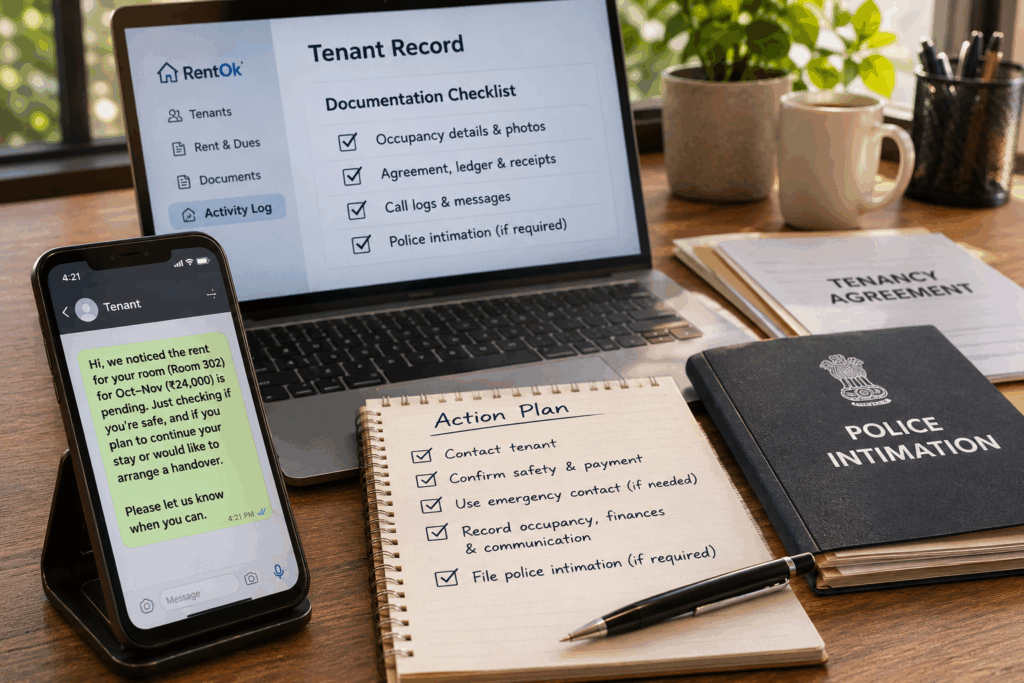
Call the tenant and send a factual written message through the contact channels you hold. State the room, the unpaid period and the amount you can support. Ask them to confirm their safety, respond about payment and clarify whether they intend to continue occupying or arrange a formal handover.
Use the emergency contact to reconnect, not to pressure someone into paying another adult’s debt. A parent or friend is not automatically a guarantor and cannot necessarily surrender the room or authorise disposal of belongings. Share only the information necessary for the contact attempt.
Keep a dated record of:
- The occupancy position: When staff last saw the tenant, what they actually observed and photographs of the locked door from a lawful vantage point.
- The financial position: Agreement, rent ledger, deposit receipt, utility bills, payment references and any agreed extension.
- Communication attempts: Call logs, messages, emails and responses, preserving original records rather than only cropped screenshots.
RentOk’s tenant-onboarding guide explains the value of collecting reliable contact and occupancy information before a problem arises.
Police intimation records facts, not a right to repossess
Where the tenant’s whereabouts are genuinely unknown or the situation warrants it, submit a factual written intimation to the jurisdictional police and retain any acknowledgement. Explain the locked room, contact attempts, known belongings and unpaid dues accurately; do not manufacture an accusation of fraud.
Police intimation does not replace a possession order. Nor does it require the police to recover a civil debt. If there are specific signs of immediate danger, seek emergency assistance promptly instead of treating the matter only as rent collection.
How much notice should you give?
There is no universal 15-day or 30-day notice that lets every Indian landlord open a room afterwards. Ask a local property lawyer to identify the applicable agreement, tenancy or licence framework, notice requirements and competent forum. A demand for money and a notice terminating occupancy may require different wording and legal grounds.
For certain leases, Section 106 of the Transfer of Property Act provides a default 15-day notice framework, subject to its conditions and contrary contractual or local provisions. That is not a nationwide abandonment rule. State rent laws can prescribe a different period and an opportunity to clear arrears.
A properly prepared notice should explain:
- The agreement and premises: Identify the parties, room or property and relevant contractual dates.
- The supported claim: List unpaid periods, amounts received and the balance, with legitimate utilities or other charges separately identified.
- The action required: Demand payment and seek the response, termination or handover that the applicable law permits, with the correct deadline.
- The next legal step: State the intended proceedings accurately, without threatening forcible entry or automatic seizure of goods.
RentOk’s guide to responding when a tenant stops paying rent discusses the distinction between a reminder, formal notice and possession proceedings.
Service and newspaper publication need separate attention
Use the service method your lawyer identifies as appropriate, and keep postal receipts, tracking, returned envelopes and other delivery records. Electronic copies can support communication, but do not assume a WhatsApp tick satisfies every statutory service requirement.
A newspaper advertisement does not independently terminate possession or authorise lock-breaking. Court-ordered substituted service is a separate procedure. Delhi High Court’s procedure note hosted by the National Judicial Academy illustrates publication following a court’s satisfaction about failed ordinary service. Follow the applicable court’s directions rather than buying an advertisement and treating silence as consent.
Opening the room needs a lawful basis
Before arranging a locksmith, establish why entry and any recovery of possession are legally authorised. The tenant’s confirmed, voluntary surrender may allow a documented handover without contested eviction proceedings. Where possession remains disputed or surrender is unclear, seek the appropriate order and follow its terms.
| Situation | Appropriate approach |
|---|---|
| Tenant confirms surrender and cooperates | Record clear terms, authority, key handover and arrangements for any remaining belongings. |
| Tenant is unreachable and possession remains unresolved | Seek advice on the appropriate possession proceedings and any necessary interim relief. |
| A possession order requires execution | Follow the authorised execution process, including any directions about locks, inventory and police assistance. |
Judicial guidance from Guna’s district judiciary explains the court-officer mechanism under Order XXI Rule 35(3) CPC for overcoming a locked entrance while executing a possession decree. The power belongs to the legal process; it is not permission for a landlord to act alone.
Witnesses support documentation after authority is established
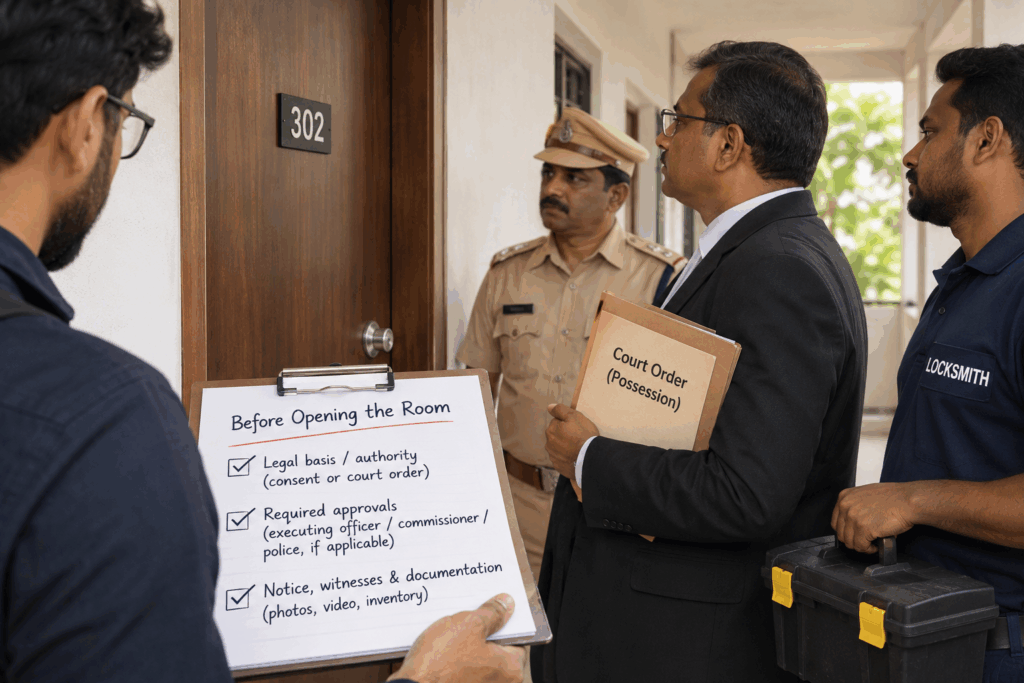
Ask your lawyer whether the case requires an executing officer, a commissioner for a specified task, police assistance or another authorised arrangement. A commissioner appointed to inspect does not automatically have authority to evict. The order determines the scope of the task.
During authorised access, follow directions about notice, witnesses, photographs, video, inventory, keys and custody. Record who entered, when, under what authority and what happened. Do not quietly clear the room or advertise it as available while the right to possession remains unresolved.
A genuine emergency, such as fire, a suspected medical crisis or a serious leak, needs an immediate safety response through the relevant services. Any necessary access should address that danger. It should not become a pretext for repossession or removal of goods over unpaid rent.
Belongings need an inventory and safe custody
Items left behind do not automatically become the landlord’s property. Once you have lawful access, follow the order, surrender terms or legal advice governing those goods. Do not sell a laptop, retain identity documents or place luggage outside to recover rent or pressure the tenant.
Prepare a careful inventory describing visible items and their condition. Photograph them appropriately, identify storage locations and keep a record of anyone who handles them. Respect privacy: avoid unnecessary searches of personal papers, devices or sealed containers, and seek directions where inspection is necessary.
For collection, contact the tenant through the documented channels and agree on a practical handover. Verify the identity and authority of any representative, record the items returned and obtain an acknowledgement. If the tenant remains unreachable, ask the court or your lawyer about further directions.
There is no universal 30-day disposal rule you can safely apply to every PG or tenancy. Storage costs, any claimed lien and eventual disposal need a legal basis; an owner’s message alone does not establish one. Keep custody of belongings separate from negotiating the debt, and preserve proof of reasonable care while the issue remains unresolved.
Can you recover unpaid rent from the deposit?
You may adjust genuine, legally permissible dues against the security deposit according to the agreement and applicable law. That does not mean automatically forfeiting the entire amount because the tenant stopped responding. Prepare an itemised settlement and support each deduction.
For illustration, assume the final settlement permits these adjustments:
| Settlement item | Illustrative amount |
|---|---|
| Supported unpaid rent | ₹24,000 |
| Unpaid utilities | ₹1,500 |
| Supported tenant-caused damage | ₹500 |
| Total permissible dues | ₹26,000 |
| Less security deposit held | ₹20,000 |
| Balance to recover separately | ₹6,000 |
The arithmetic does not establish the legal validity of a deduction. Ordinary wear, arbitrary repainting charges and unsupported penalties need different treatment. Notice-period or lock-in claims also require review; avoid charging twice for the same period or assuming every clause guarantees the full amount demanded.
RentOk’s security-deposit handling guide explains why condition records and clear settlement statements matter. If a balance remains after lawful adjustments, pursue that debt separately. RentOk’s guide to recovering rent after a tenant has vacated provides related documentation context, while the locked-room possession issue still needs its own resolution.
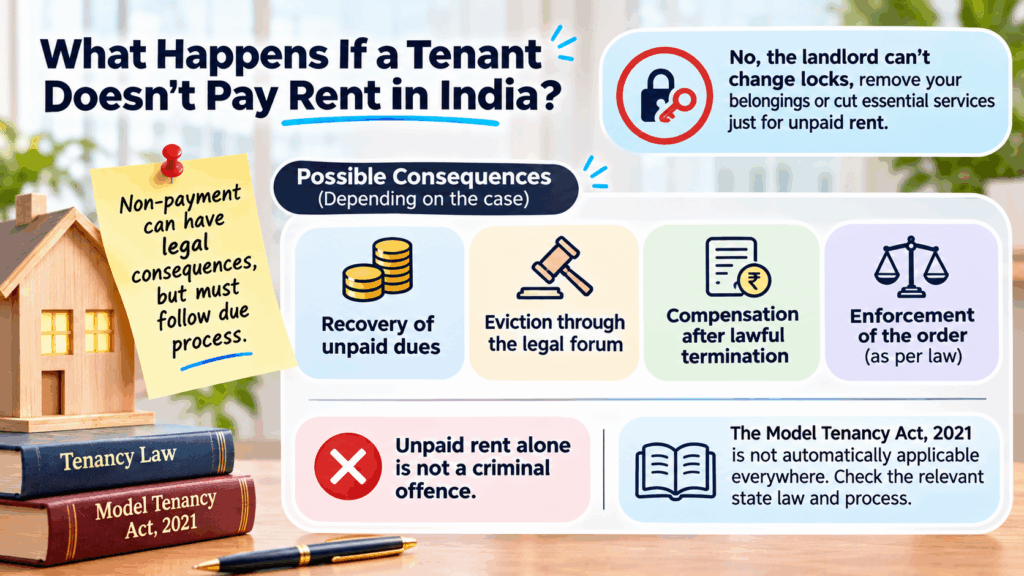
What are the consequences if a tenant doesn’t pay rent in India?
Non-payment can lead to recovery proceedings, permitted deposit adjustments and eviction through the applicable legal process. It does not give the landlord a general right to change locks, remove goods or disconnect essential services. RentOk’s article on water and electricity cutoffs over unpaid rent explains that separate issue.
The consequences depend on the case:
- Arrears and other established dues: The landlord can seek payment of sums that the contract and law support, subject to proof and any defence or adjustment.
- Possession proceedings: A Rent Controller, Rent Court or another statutory forum may have jurisdiction where the relevant state law applies. Otherwise, a competent civil court may be the appropriate route. PG licences and service arrangements need their own assessment.
- Compensation after lawful termination: A landlord may seek mesne profits or use-and-occupation compensation where possession is wrongful. The CPC addresses possession and mesne-profit claims; this is not an automatic penalty at any rate the owner chooses.
- Further enforcement: Obtaining an order and enforcing it are separate stages. Follow the applicable process for recovering money or delivering possession rather than treating either order as permission to seize goods personally.
Unpaid rent alone does not establish a criminal offence
In the Supreme Court’s Neetu Singh order, the Court quashed an FIR where the alleged non-payment did not establish the required cheating or misappropriation ingredients. That does not immunise separate fraud, threats or theft. Report specific evidence truthfully, but do not promise arrest merely because rent is unpaid.
The Model Tenancy Act, 2021 is not automatically the law for every Indian property. Ask your advocate to identify the operative state framework, forum, grounds and remedies before filing. A possession claim may accompany monetary relief where procedure permits; it does not guarantee a particular outcome or deadline.
How RentOk helps keep contact details and dues accessible
When a tenant stops responding, staff need reliable contact details, the actual agreement and a clear payment history. RentOk helps organise resident and rental records, reducing the need to reconstruct the situation from separate notebooks and messages before seeking advice.
- Keep contact information with the resident record: RentOk’s onboarding guidance includes emergency-contact information, while its tenant workflow supports phone numbers, alternate numbers and other important details. Record whose number it is and keep it current; an emergency contact is not automatically a guarantor.
- Review the outstanding balance: Tenant records include rent, security-deposit information, dues and opening balances. Reconcile these entries with payment evidence before issuing a demand or proposing a settlement.
- Find the agreement and stay details: Keep the relevant move-in dates, notice terms and executed agreement accessible. The supported agreement workflow makes the final PDF available from the resident profile, helping staff check the actual terms.
- Use reminders appropriately: The tenant workflow includes optional rent reminders. These can support routine follow-up, but they do not replace a legally required notice, establish service or authorise possession.
RentOk’s tenant-record workflow explains the documented fields and options. Confirm the setup your property uses. Software records support communication and evidence; they do not declare abandonment, authorise entry or resolve the tenant’s legal rights.
Conclusion
If a tenant left without paying rent and locked the room, protect your position by keeping the debt, possession and belongings issues distinct. Try to reconnect, preserve evidence, send the correct notice and obtain clear authority before opening or re-letting. A police acknowledgement and witnesses can document events, but they do not supply a missing right to possession.
Store emergency contacts on RentOk as part of a complete resident record, alongside agreements and payment details. Current information makes the first response more organised, while a local property lawyer can identify the lawful route for your premises and agreement.
Frequently Asked Questions
Find answers to common questions about this topic
About the Author
Ishika Pannu
Ishika Pannu brings you the latest insights and easy-to-apply strategies in property management—helping you simplify renting and grow with RentOk.